Is All on 4 Worth It
If you're reading this, you're probably at the point where patchwork dentistry isn't cutting it anymore. Maybe your teeth are breaking one by one, your denture moves when you talk, or chewing on one side has become your normal. At that stage, the question isn't just whether implants work. It's whether All-on-4 is worth it for your mouth, your budget, and the amount of upkeep you're willing to live with.
My opinion is simple. For the right patient, All-on-4 is one of the smartest full-arch treatments in modern dentistry. For the wrong patient, it's an expensive way to buy years of repairs, frustration, and regret. Looking up a dentist in Las Vegas, NV, searching dental implants near me, or trying to decide between a removable denture and fixed teeth, you need a straight answer, not a glossy sales pitch.
Facing Major Tooth Loss in Las Vegas
A lot of people in Las Vegas wait too long because life gets in the way. I see the hospitality worker who spends long shifts on the Strip, lives on coffee, clenches through stress, and keeps putting off treatment until every meal hurts. I also see the retiree near Sun City Summerlin or Desert Shores who has worn a lower denture for years and is tired of it lifting every time they laugh, cough, or order dinner with friends.
Why Las Vegas patients end up here
This city has a few patterns that matter. Dry mouth is common. Some people deal with it because of desert living, some because of medications, and some because they breathe through their mouth at night. Add smoking, old dental work, gum disease, or years of avoiding a new patient exam, and full-arch tooth loss sneaks up fast.
Once you're here, you usually have three paths:
- Do nothing for too long. That almost always makes eating, speaking, and bone loss worse.
- Choose a removable denture. It's the lowest-commitment option, but many patients hate the movement.
- Invest in a fixed implant solution. That usually means All-on-4, more implants, or a staged plan.
Chairside truth: Patients rarely ask me, "What has the highest survival rate?" They ask, "What am I going to live with every day?"
The decision isn't just clinical
Most online articles miss the point. They focus on survival statistics and skip the ownership experience. That's a mistake. You don't wear a study. You wear a prosthesis, clean around it, pay to maintain it, and deal with repairs if something chips or loosens.
If you're also looking for a cosmetic dentist near me, an emergency dentist, or help with tooth extraction before moving into implants, this decision has to be made as part of a complete treatment plan. Full-arch care isn't separate from the rest of your dental care. It ties into gum health, bite function, hygiene access, and what your long-term mouth will tolerate.
The question is this. Is a same-day fixed arch better for you, or would an overdenture or staged implant approach be the smarter move?
How All-on-4 Actually Works
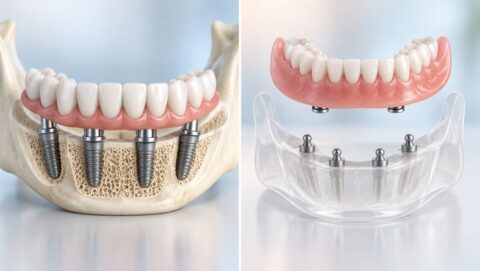
All-on-4 means a full upper or lower arch is supported by four dental implants. Two implants usually go straight in the front. Two go in the back at an angle. That back angulation matters because it helps the dentist use available bone more efficiently and often avoid more extensive grafting.
The mechanics in plain English
Instead of replacing every tooth with its own implant, this approach turns four implants into support posts for one full bridge. The bridge is screwed in, not snapped in like a removable denture. In most cases, you're leaving with fixed teeth the same day as surgery, even though the first set is typically a temporary restoration.
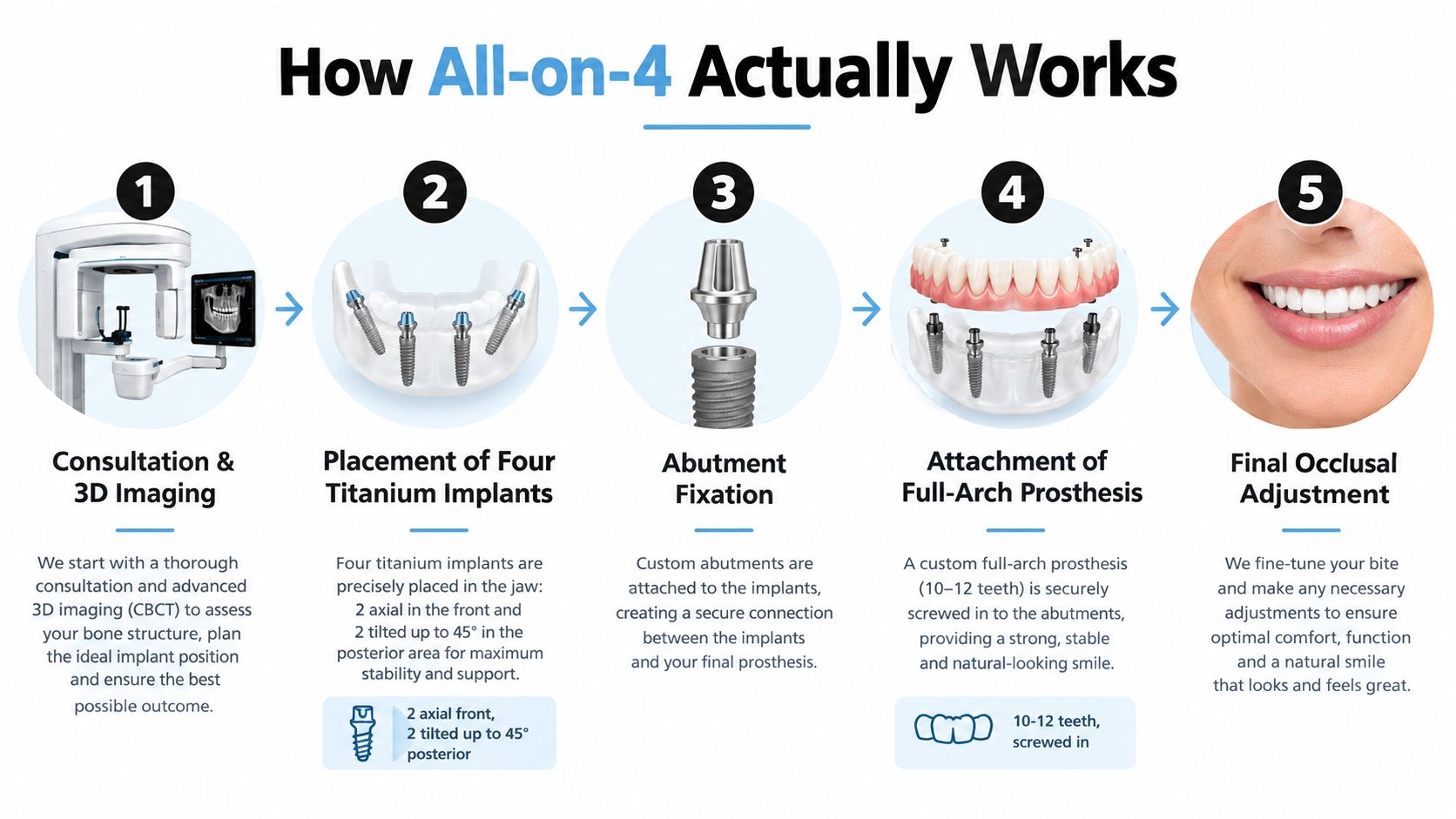
The prosthesis usually restores 10 to 12 teeth across the arch. That gives you appearance and function without placing an implant for every missing tooth. If you want a more technical walk-through, this page on the All-on-4 dental procedure lays out the treatment sequence.
What the workup should include
Before anyone tells you you're a candidate, you need imaging and a real exam. In practice, that usually means:
- CBCT imaging to map bone and anatomy.
- Medical review to look at healing risks, smoking, and disease control.
- Bite analysis so the final teeth don't get overloaded.
- Treatment planning for extractions, immediate placement, and the temporary bridge.
Consensus guidance identifies All-on-4 mainly for an atrophic maxilla or mandible, with or without hopeless teeth, in ASA I or II patients, and says it's especially suited to Cawood and Howell class IV, V, and VI bone loss according to this clinical consensus review.
A short overview helps some people visualize the flow better than words do.
What surgery day and healing usually look like
Most patients start with extractions if failing teeth are still present. Then the implants are placed, multi-unit abutments are attached, and a temporary acrylic bridge is fitted. You go home with fixed teeth, but that doesn't mean you're done.
Fixed on day one doesn't mean fully healed on day one.
Expect a soft-food phase for several months while the implants integrate. After healing, the temporary is replaced with a stronger final prosthesis, often zirconia or a reinforced design depending on the case and bite forces.
This is why All-on-4 appeals to so many people searching for dental implants near me in Las Vegas. It compresses treatment time and avoids some of the bigger grafting cases. But speed only helps if the case selection is right.
All-on-4 Versus Traditional Implants and Dentures
Here's the blunt version. All-on-4 sits in the middle. It's more stable and more fixed than a denture. It's usually less complex than rebuilding an arch with more implants and grafting. It's not automatically the best value for every patient.
All-on-4 vs. Alternatives at a Glance
| Option | Implants Per Arch | Typical Cost Per Arch (Las Vegas) | Longevity | Removable? | Best For |
|---|---|---|---|---|---|
| All-on-4 | 4 | Higher than overdentures, lower than many more-implant full-arch rebuilds | Long-term fixed full-arch option with strong durability when maintained | No | Patients who want fixed teeth and may want to avoid more invasive grafting |
| Traditional full-arch implant bridge | More than 4 | Usually higher than All-on-4 | Long-term fixed option | No | Patients with the bone, budget, and need for a more built-out implant foundation |
| Implant-supported overdenture | 2 to 4 | Lower than All-on-4 | Durable with regular maintenance | Yes | Patients who want more stability than a denture without the cost of fixed teeth |
| Conventional denture | 0 | Lowest upfront cost | Usually needs ongoing adjustments and replacement over time | Yes | Patients prioritizing the lowest initial cost or avoiding surgery |
What the evidence says about performance
All-on-4 has earned its place because the core mechanics are solid. A long-term retrospective study of mandibular full-arch rehabilitation reported a 98.8% cumulative prosthetic survival rate, with implant cumulative survival of 93.0% and success of 91.7% across 1,884 implants. The same study found that only 4 of 471 patients lost their prostheses because of implant failures, and another long-term mandibular report in the same evidence summary showed 99.2% prosthesis survival over follow-up to 10 years. Those data are summarized in this PubMed study record.
That matters because it tells you All-on-4 isn't some trendy shortcut. It can last.
Where the real differences show up
The harder choice is lifestyle, not just survival.
- All-on-4 gives you fixed teeth and usually avoids the nightly removal that bothers many denture patients.
- Overdentures are easier to clean because they come out, and some patients do better with that.
- Traditional dentures are cheaper up front, but they move more, preserve bone less effectively, and often frustrate patients who want stronger chewing and confidence in social settings.
- More-implant fixed bridges may make sense when bite force, arch shape, or anatomy call for something more substantial.
A comparative review found no statistically significant disadvantage for All-on-4 versus approaches using more implants, and comparative data also showed similar marginal bone loss and quality-of-life scores versus 4-implant overdentures. That same review noted a practical tradeoff: overdentures were easier to clean, while fixed prostheses were perceived as less painful. That's the useful frame from this systematic review summary.
Some patients hate taking teeth out at night. Others hate cleaning under a fixed bridge. That's not a minor preference. It should drive the plan.
My clinical take
If you're in Las Vegas, NV and you want a fixed smile, All-on-4 is often the sweet spot when the arch is failing, bone is limited in the back, and you don't want a bigger grafting project. If you care most about simple hygiene, lower repair stress, and a lower initial bill, an implant overdenture can be the smarter choice.
Real Costs of All-on-4 in Las Vegas
A common starting point is asking for a price. Fair enough. But phone-shopping this treatment is how patients get misled.
All-on-4 Cost Breakdown in Las Vegas
| Cost Component | Typical Range | Notes |
|---|---|---|
| Surgical and restorative base fee | Varies by case and office | Often advertised as a starting figure, not a complete treatment total |
| Extractions | Varies | May or may not be included |
| Sedation | Varies | Often billed separately |
| Temporary prosthesis | Varies | Essential in many same-day cases |
| Final prosthesis | Varies | Material choice affects total cost |
| Maintenance visits | Ongoing | Professional cleanings and periodic evaluation matter long term |
| Repairs and component replacement | Unpredictable | Screws, wear items, and prosthetic repairs are part of ownership |
The number that gets attention is not the full number
One patient-outcome analysis reported an average adjusted cost of $42,422 for All-on-4 treatment and found 95% of patients satisfied and 74% extremely satisfied, based on the source document here in this patient outcome analysis PDF. That's useful because it reminds people this treatment isn't cheap, even when satisfaction is high.
Locally, you'll see lots of "starting at" advertising. Treat that carefully. A low headline fee may leave out extractions, sedation, a temporary bridge, or parts of the final restoration. If you're comparing practices, compare complete treatment plans, not teaser pricing.
The longer-term math matters more than the ad
The cost question isn't just surgery day. It's ownership over years.
You should assume ongoing professional maintenance. You may also face repairs, replacement screws, worn prosthetic components, relines in some scenarios, or restorative remakes down the line. Some patients do very well for years with modest upkeep. Others burn through savings because they chose a fixed bridge when their hygiene habits and bite forces were poor.
If financing is the barrier, some patients look into third-party lenders or specialized bad credit dental financing options before committing. That's not a treatment recommendation. It's part of the practical budgeting conversation many full-arch patients have.
For a service-specific overview, this page on All-on-4 dentures cost can help you understand what may be included in a quote.
What I tell patients about money
Don't choose full-arch treatment based on the lowest sticker price. Choose based on which option you can maintain. A cheaper removable denture that you clean well and can afford to update may be a better value than fixed teeth you can't maintain properly.
If you're also overdue for cleaning and exams, dental x-rays, or need extractions before implant planning, build those into the budget from the start. That isn't "extra." That's part of doing the case correctly.
Who Makes a Good All-on-4 Candidate
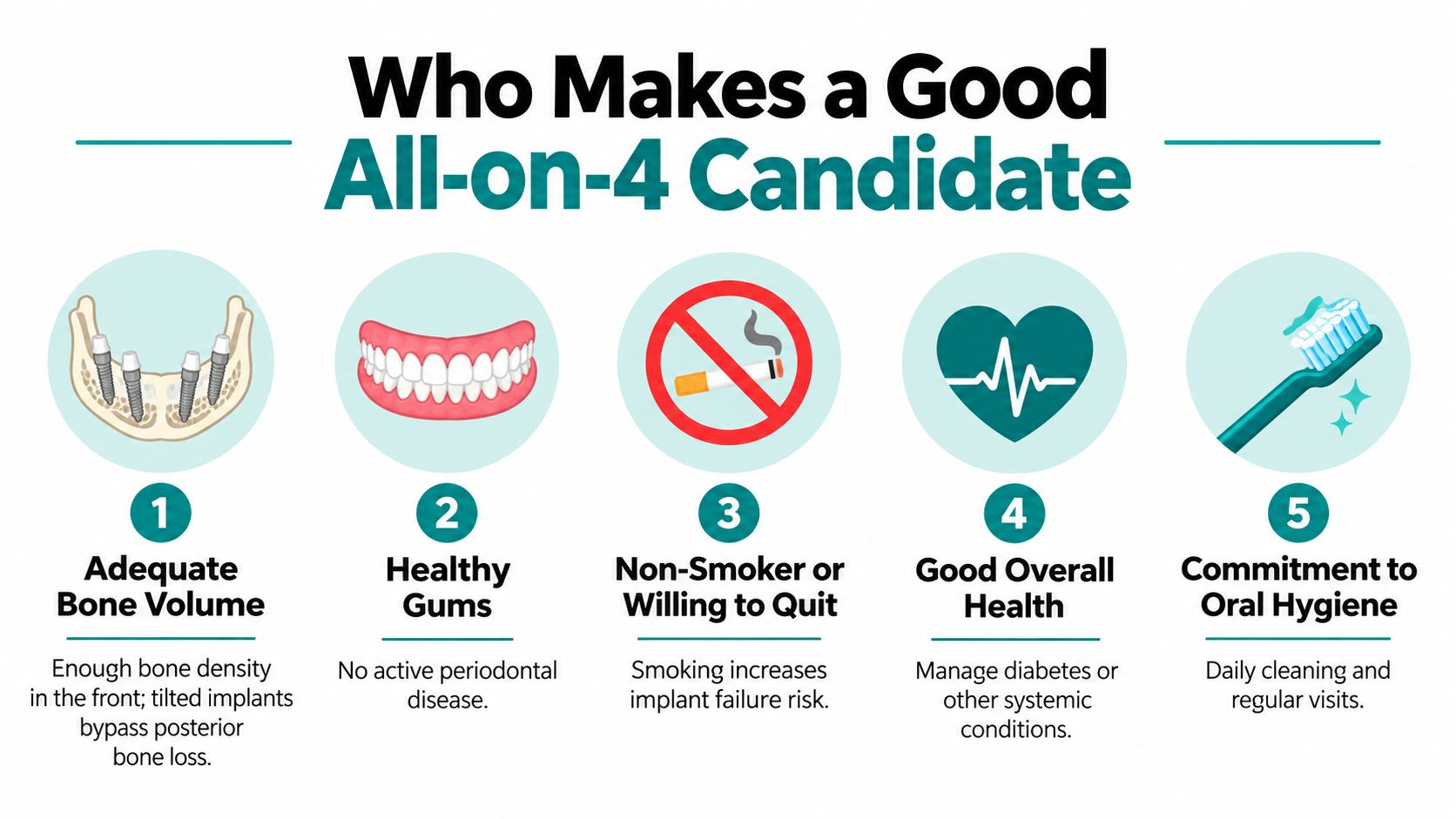
A good All-on-4 candidate isn't just someone who wants fixed teeth. It's someone whose bone, health, habits, and expectations line up with the treatment.
The people who usually benefit most
The best candidates are often patients with a failing full arch, advanced breakdown, or teeth that are no longer worth saving one by one. If the front bone is usable and the back of the jaw is the weak area, All-on-4 can be a very efficient design because the posterior implants are angled to work around that limitation.
A 2024 review summarized the literature as showing implant survival rates exceeding 97% and success rates above 95% in well-selected patients, while also noting that outcomes vary by anatomy and patient selection in this PubMed review. That last point matters more than the headline. Selection drives outcomes.
Strong candidate signs
- Full-arch failure: You're not dealing with one bad tooth. You're dealing with an arch that's collapsing.
- Adequate front-jaw bone: Enough bone remains in the anterior jaw to support the design.
- Medical stability: You're healthy enough for surgery and healing.
- Willingness to stop smoking or cut risk factors: If you won't change habits, don't buy a complex implant case.
- Commitment to hygiene: You need to clean under a fixed bridge well, every day.
Who should pause or choose something else
Some patients should not jump into All-on-4. If you have uncontrolled health issues, active gum infection, poor hygiene, or heavy smoking you don't plan to stop, fixed full-arch treatment can become a long-term headache.
My rule: If you can't commit to maintenance, don't choose the option with the highest maintenance consequences.
Younger patients need special thought too. If you still have several maintainable teeth, removing everything for a full-arch bridge can be overtreatment. In those cases, preserving teeth with restorative dentistry, selective implants, crowns, or bridges is often the better call.
A practice point that matters
If you're coming in for a new patient exam or complex restorative dentistry evaluation, one mention of the local option is appropriate. Aspiring Smiles Dental and Braces offers CBCT-based implant planning, extractions, implant-supported dentures, and full-arch options in Las Vegas, which is the kind of workup you want before anyone promises a fixed solution.
Risks and Long-Term Maintenance Reality
This is the part marketing usually softens. I won't. All-on-4 can be durable, but it is not maintenance-light.
The implants may survive while the ownership gets messy
Independent reviews report very strong short- to mid-term durability, with implant cumulative survival commonly in the 94% to 99% range and prosthesis survival around 99% to 100% at 1 to 5 years. One review found 99.8% survival beyond 24 months and a minimum of 97.6% at 36 months, while another found pooled survival of 99.20% at 1 year and 98.14% at 5 years or more according to this systematic review article.
That's the good news. The catch is that survival doesn't equal smooth ownership.
A review-style article on long-term outcomes argues that true success has to include prosthetic complications, tissue stability, esthetics, and patient experience. It reported biologic complication rates of 18.9% to 25.5% and mechanical complication rates of 7.3% to 36.7%, even when implant survival stayed high, as discussed in this clinical review on true success with All-on-4 implants.
What patients in Las Vegas need to watch
Dry mouth, plaque buildup, smoking, grinding, and missed maintenance appointments create problems fast. Food traps under the bridge. Tissue gets inflamed. Screws loosen. Acrylic can chip. If you ignore bleeding, odor, soreness, or a bridge that feels different when you bite, small issues become big ones.
A separate long-term retrospective study on full-arch implant prostheses reported prosthesis success rates around 60% to 71%, with fractures and chipping more common in ceramic prostheses and detachments more common in Toronto bridges according to this 10-year retrospective analysis.
What maintenance actually looks like
Expect regular professional maintenance and home care that is more involved than brushing natural teeth. Water flossers, proxy brushes, and periodic removal by the dental team for evaluation may all be part of the long-term plan depending on the prosthesis design.
This is not optional. If you want something easier to clean, a removable implant overdenture may serve you better than a fixed bridge.
Choosing the Right Full-Arch Option for You
Here's the cleanest way to answer is All-on-4 worth it. It depends on which patient you are.
Which Full-Arch Option Fits Your Situation?
| Patient Profile | Recommended Option | Why | Key Question to Ask |
|---|---|---|---|
| Failing dentition, adequate bone, budget flexibility, wants fixed teeth | All-on-4 | Strong full-arch option when you want fixed teeth and may avoid a more invasive grafting path | Can my front-jaw bone support a stable four-implant design? |
| Significant posterior bone loss, cost-sensitive, okay with removable teeth | Implant-supported overdenture | Lower commitment and easier hygiene access | Will a removable option give me enough stability for chewing and speaking? |
| Medically complex, poor healing risk, heavy smoker, active disease | Staged treatment or removable denture first | Reduces risk and avoids forcing implants into a bad setup | What needs to be treated before implants are even on the table? |
| Younger patient with only a few missing teeth | Single implants or short-span bridge | Preserves healthy teeth and avoids over-treatment | Why would I remove salvageable teeth for a full-arch fix? |
My direct recommendations
If your whole arch is failing and you already know the teeth aren't worth saving, All-on-4 is often worth it. It's especially attractive when you want fixed teeth, don't want removable dentures, and your anatomy supports the design.
If you're budget-sensitive and don't mind removing teeth at night, don't let anyone shame you out of an overdenture. For a lot of patients, it's the most practical choice.
If your health, smoking, or gum condition is working against healing, slow down. Get stable first. A removable denture or staged approach is smarter than forcing a fixed implant case that isn't ready.
The right full-arch treatment should fit your biology and your habits, not just your wish list.
One thing not to do
Don't commit based on a phone quote. Full-arch dentistry is imaging-driven. A CBCT scan can completely change the recommendation, especially when hidden bone loss, infection, bite problems, or sinus anatomy show up.
For a dentist near me in Lone Mountain, Painted Desert Estates, Mar-A-Lago, Monterrey, Sunhampton, or Sun City Summerlin, get evaluated in person. The right answer comes from the scan, the exam, and an honest discussion about maintenance, not from a generic package price.
If you're weighing dentures, extractions, or full-arch implant treatment, Aspiring Smiles Dental and Braces offers exams, dental x-rays, extractions, implant planning, and All-on-4 consultations in Las Vegas, NV. Dr. Patel and the team can help you compare fixed and removable options based on your bone, bite, and budget so you can make the right call before you spend a dollar on the wrong one.