Teeth in a Day in Las Vegas, NV: A Complete Guide
Living with missing teeth or loose dentures changes small moments first. You stop biting into certain foods. You smile with your lips closed in photos. You speak a little more carefully in meetings, at dinner, or while catching up with neighbors around Las Vegas.
For many people, that loss of confidence matters just as much as the loss of chewing power. If you've been searching for a dentist in Las Vegas, NV, dental implants near me, or a long-term answer after years of removable dentures, teeth in a day is often the treatment that brings everything into focus. It offers a way to replace a full arch of teeth in one surgical visit instead of dragging the process out over months without teeth.
At our office, patients often arrive from Desert Shores, Sunhampton, Sun City Summerlin, Lone Mountain, Monterrey, Mar-A-Lago, and Painted Desert Estates with the same question. Can this really be done in one day, and will it feel secure? The short answer is yes for the right candidate, but it only works when the planning is thorough, the technology is precise, and the expectations are honest.
Your New Smile Starts Here in Las Vegas
A lot of people wait longer than they should.
They manage around failing teeth, broken-down dental work, or dentures that move when they eat. They keep putting off treatment because they assume replacing a full arch will take too long, hurt too much, or leave them without teeth during the process. In a busy city like Las Vegas, that's a heavy thing to carry into work, family events, and everyday errands.
One common story goes like this. A patient has been avoiding steak, apples, crusty bread, and even smiling in bright light because the denture feels unstable or the remaining teeth are wearing down. Over time, the problem stops being “just dental.” It affects confidence, energy, and the willingness to be social.
Why local care matters
When someone looks for a dentist near me or a cosmetic dentist near me, they're often looking for more than convenience. They want a team that can explain options clearly, respond when something feels urgent, and support the full process from consultation to healing. That's especially important with full-arch implant treatment, because success depends on careful screening, planning, and follow-up.
Las Vegas patients also tend to value efficiency. Parents, professionals, retirees, and people juggling packed schedules don't want a vague process with endless appointments. They want to know what works, what doesn't, and whether same-day teeth are realistic for their situation.
Teeth in a day isn't about rushing treatment. It's about doing the planning first so surgery day can be efficient and predictable.
That patient-first communication matters online too. If you're curious how dental practices think about clear education and trust-building before a patient ever calls, Adwave's dental marketing insights offer a useful look at how practices can present information in a way that's easier for patients to understand.
Who usually asks about this treatment
Many who ask about teeth in a day fall into one of these groups:
- Patients with multiple failing teeth who are tired of patchwork dentistry and want a more stable long-term solution.
- Longtime denture wearers who want fixed teeth and don't want adhesives, slipping, or a removable appliance.
- People facing extractions who want to combine tooth extraction and replacement into one coordinated plan when appropriate.
- Adults seeking restorative dentistry that also improves appearance, speech, and day-to-day confidence.
If that sounds familiar, the next step isn't guessing from internet photos. It's finding out whether your bone, bite, and health history support immediate full-arch implants.
What Exactly is a Teeth in a Day Procedure
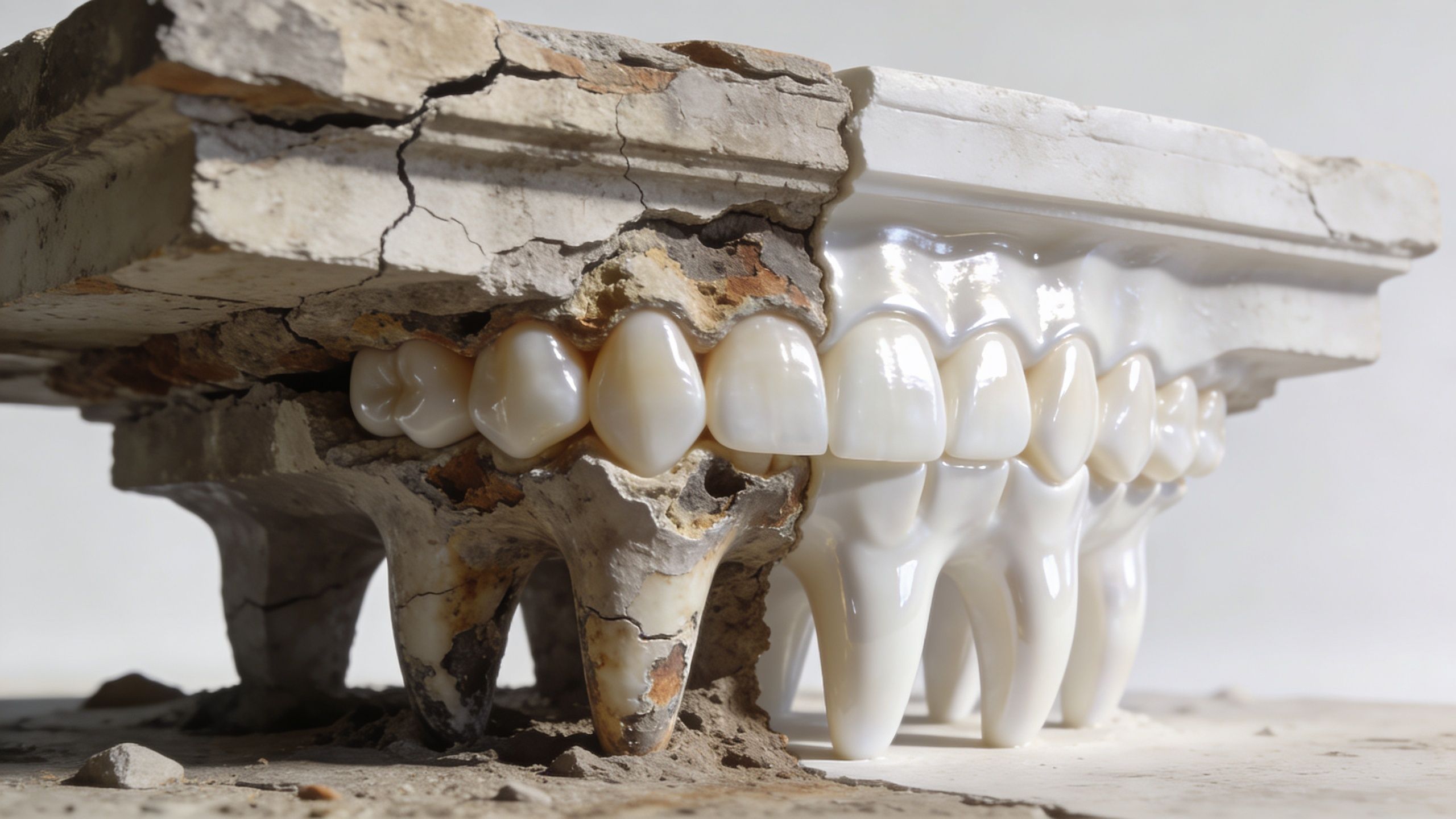
Think of teeth in a day as rebuilding the support system first, then attaching a working smile to it right away. It isn't a shortcut. It's a carefully planned form of full-arch implant dentistry designed to replace an entire upper arch, lower arch, or both in one surgical visit.
The foundation behind the name
The most common approach referred to as teeth in a day is All-on-4. According to the American Academy of Implant Dentistry overview of teeth in a day, this procedure was developed by Nobel Biocare and first clinically documented in 1998. It lets qualified patients receive a full arch restoration in a single surgical visit using four strategically angled implants, can minimize bone grafting in up to 95% of cases, and has reported success rates of approximately 95% to 98%.
That matters because traditional full-mouth implant treatment often involves more steps and more waiting. Teeth in a day changes the sequence. Instead of extracting teeth, waiting for healing, placing implants, waiting again, and only then attaching teeth, the treatment is organized so you leave surgery with a fixed temporary prosthesis.
How four implants can hold a full arch
This is the part that surprises most patients. You don't need one implant for every missing tooth in a full-arch case. The implants act like anchors. Once they're placed in the right locations, they support a full bridge across the arch.
The reason this works is biomechanics and planning. By using the available bone wisely, the implants create a strong base for immediate function.
Here is the simple version:
- Remaining unhealthy teeth are removed if needed.
- Four implants are placed in carefully selected positions.
- A temporary full-arch set of teeth is attached the same day.
- The implants heal and integrate with the jaw before the final set is made.
Practical rule: The speed of treatment only makes sense when the diagnosis is precise. Good candidates are chosen, not assumed.
Who tends to be a good candidate
Teeth in a day is often a strong option for:
- Patients missing many teeth or dealing with teeth that can't be predictably saved
- People frustrated with dentures who want more security when eating and speaking
- Adults wanting fewer treatment stages than a traditional full-arch implant process
- Patients with enough usable bone to support immediate implant stability
What doesn't work well is forcing this treatment on someone who isn't a fit. If the bone support, bite pattern, or health history doesn't support immediate loading, a different plan may be safer. That's not a failure. That's good implant judgment.
The biggest shift for patients is understanding that “in a day” refers to getting fixed teeth attached in one visit. It doesn't mean the body skips healing. The implants still need time to fuse with bone, and that healing phase is a major part of long-term success.
Your Teeth in a Day Journey at Aspiring Smiles
A lot of Las Vegas patients arrive at Aspiring Smiles after months, and sometimes years, of putting this off. Some are tired of a lower denture moving at dinner. Some are dealing with broken teeth before a work event on the Strip. Others are done patching the same problems over and over. The first visit starts there, with what your mouth has been through and what you want daily life to feel like after treatment.
From the start, the goal is clarity. We examine the teeth, gums, bite, jaw shape, and overall oral health, then match that with your priorities. For one patient, the main goal is eating comfortably again. For another, it is being able to smile in family photos without thinking about their teeth.
The planning visit
The planning appointment is usually the point where anxiety drops. Once you can see the scans, review the condition of the bone and remaining teeth, and hear a treatment plan in plain language, the process feels real instead of uncertain.
For full-arch cases, the treatment is built around precise implant positioning. Four titanium implants are commonly used for each arch, and the back implants are often angled to engage stronger areas of bone. The goal is immediate stability, which is what allows fixed temporary teeth to be attached the same day when conditions are right.
That technical planning matters for practical reasons. It helps us place the implants in positions that support the temporary bridge well, reduce surprises during surgery, and set up the final restoration for a more predictable fit and bite.
What the procedure day feels like
Procedure day is organized because the major decisions have already been made. You are not coming in for guesswork. You are coming in for a plan we have already reviewed with you.
A typical day includes:
- Arrival and final review so there are no surprises
- Anesthesia or sedation based on the treatment plan and your comfort needs
- Removal of failing teeth if they are still present
- Implant placement in the mapped positions
- Delivery of a temporary fixed bridge before you leave, if immediate loading is appropriate
For many patients, the biggest moment is not the implant placement itself. It is seeing a full smile again before going home.
Patients rarely talk about the mechanics afterward. They talk about the relief of leaving the office with fixed teeth instead of another temporary gap or removable solution.
The first days after surgery
The temporary teeth are made for function and appearance during healing. They are not your final set, and they do require care.
This part of the journey is where good results are protected. A softer diet, careful cleaning, and on-time follow-up visits matter because the implants still need time to bond with the jaw. I tell patients in Las Vegas the same thing every day. The surgery is one appointment. The result depends on how well we handle the healing period together.
What patients tend to value most
The process feels far more manageable once each step is clearly laid out.
- Before treatment, the hardest part is usually not knowing what to expect
- During planning, you can see the problem and the solution more clearly
- On procedure day, many patients feel relief knowing they will leave with teeth in place
- During healing, attention shifts toward protecting the long-term result
That patient journey matters. At Aspiring Smiles, the experience is built to be clear, personal, and carefully planned for Las Vegas patients who want fixed teeth without months of uncertainty.
The Life-Changing Benefits of Same-Day Dental Implants
The biggest benefit of teeth in a day isn't just speed. It's the return to normal life.
When someone has spent years covering their mouth when they laugh, choosing soft foods, or worrying that dentures might move while talking, fixed full-arch teeth change everyday behavior. People often feel more comfortable in photos, conversations, meals, and work settings because the teeth are attached and stable.
Confidence and function come back together
A lot of dental treatment improves health. Teeth in a day improves health and self-assurance at the same time. That combination matters.
Patients often value these changes most:
- A more secure smile without the movement that comes with removable dentures
- Better speech confidence because the teeth stay put
- More enjoyable meals with fewer day-to-day limitations
- No denture adhesive routine and no removing teeth at night
The bone health advantage
There is also an important medical benefit. According to this review of the pros and cons of teeth in a day implants, the procedure has a success rate of approximately 95%, and immediate implant placement helps counter the 40% to 60% bone loss that can occur in the first year after tooth removal.
That bone support matters for more than implant stability. It also helps preserve facial structure. After tooth loss, the jawbone no longer receives the same stimulation, and over time the lower face can start to look sunken. Implant-supported restorations help address that problem in a way dentures alone do not.
A strong full-arch implant result should look better, work better, and help protect the bone underneath it.
Why this treatment appeals to busy Las Vegas patients
People searching for an emergency dentist, tooth extraction, or restorative dentistry often need a plan that reduces disruption. Teeth in a day can do that when the case is appropriate. Instead of stretching treatment into many separate phases with long gaps between them, the patient gets a fixed temporary restoration right away and a clear path toward the final prosthesis.
That doesn't mean every case should be handled this way. The right treatment is the one your anatomy and health support. But when a patient qualifies, same-day full-arch implants can restore appearance, chewing confidence, and daily comfort much faster than many expect.
Comparing Your Tooth Replacement Options
A patient from Summerlin recently asked a practical question I hear often at Aspiring Smiles. "What am I really choosing between?" That is the right place to start.
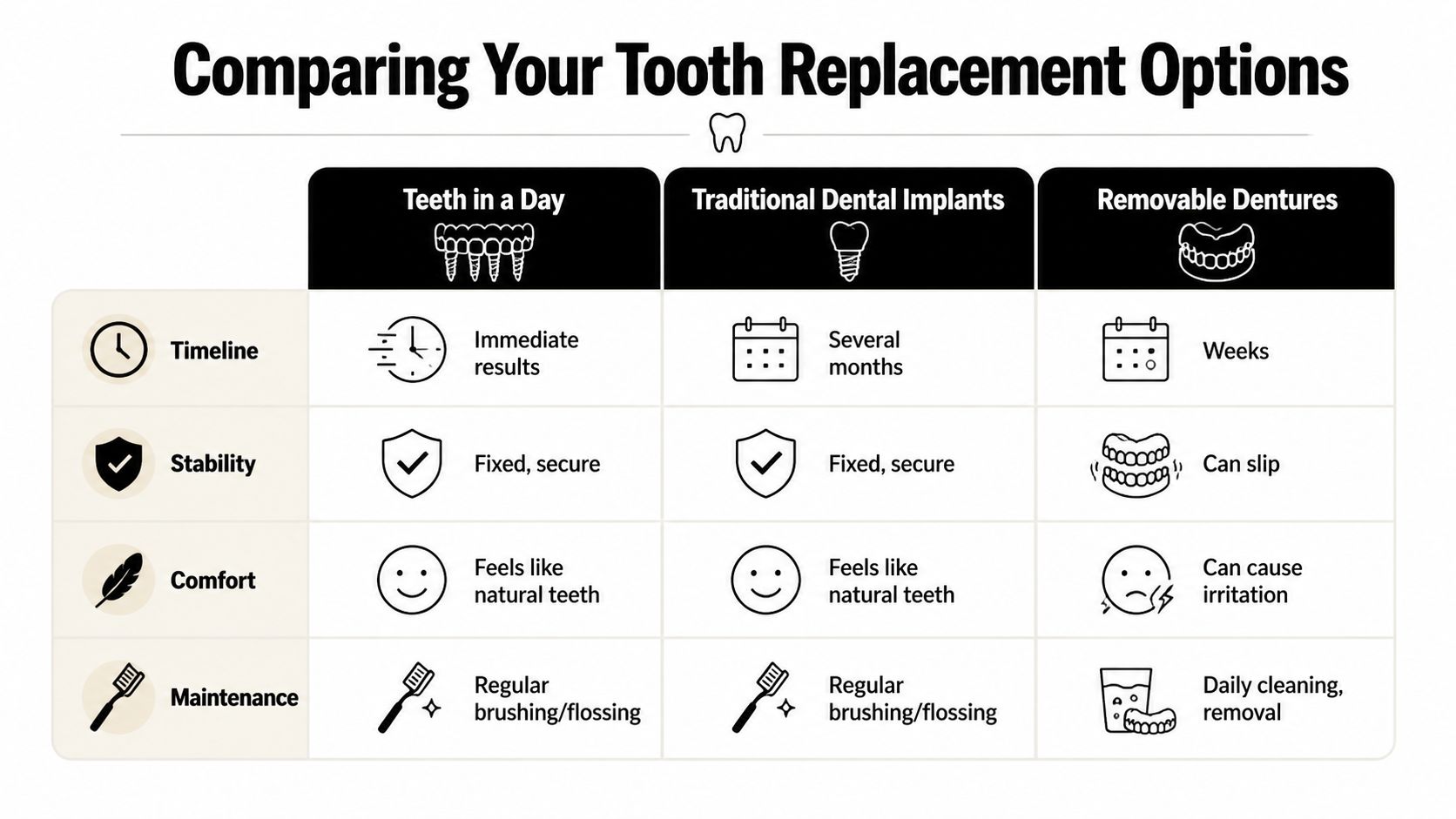
For full-arch tooth replacement, the decision usually comes down to three paths. A same-day fixed implant restoration, a traditional staged implant approach, or removable dentures. Each option solves a different problem, and each asks something different of the patient.
Full Arch Restoration Options Compared
| Feature | Teeth in a Day (All-on-4) | Traditional Implants (Full Arch) | Conventional Dentures |
|---|---|---|---|
| Timeline | Fixed temporary teeth attached in one surgical visit | Longer staged process with healing between phases | Usually quicker to make than implants, but not fixed |
| Stability | Fixed in place | Fixed in place | Removable and can shift |
| Number of surgeries | Fewer steps when the case qualifies for immediate loading | Often completed in more stages | No implant surgery |
| Bone support approach | Uses available bone strategically | May require a different sequence based on anatomy | Does not provide the same bone stimulation as implants |
| Daily feel | More like fixed teeth | More like fixed teeth | Bulkier, removable feel |
| Maintenance | Home care plus professional implant maintenance | Home care plus professional implant maintenance | Remove for cleaning and overnight storage |
| Best fit for | Patients who want fixed teeth right away and can follow healing instructions | Patients who need a slower or more cautious treatment sequence | Patients who want a removable option or do not want implant surgery |
The practical trade-offs
Same-day treatment appeals to many Las Vegas patients because they do not want to spend months without teeth. The trade-off is responsibility during healing. Temporary teeth look good and function well, but they are not meant for a steak dinner on night one. Patients need to protect the implants while the bone bonds to them.
Traditional full-arch implants can be the better choice when immediate loading would put too much stress on the case. I recommend that route when bone quality, bite forces, medical history, or anatomy make a slower sequence safer and more predictable.
Dentures remain a valid option. They avoid surgery and cost less at the start. The trade-off is day-to-day function. Many denture wearers tell me the hardest parts are movement during meals, sore spots, and the constant awareness that the teeth come out.
What usually matters most to patients
Technical terms matter less than daily life. These are the questions that usually decide it:
- Do you want teeth that stay in place, or are you comfortable with a removable prosthesis?
- Can you follow a soft-food plan and protect temporary teeth during healing?
- Is speed your top priority, or is a longer staged approach more appropriate for your health and anatomy?
- How much do comfort, chewing confidence, and long-term bone support matter to you?
Patients across Las Vegas, Henderson, and North Las Vegas often come in thinking every implant option is basically the same. It is not. A focused review of our All-on-4 dental implant treatment in Las Vegas helps clarify whether a fixed full-arch solution matches your goals, your timeline, and what your mouth can support safely.
Our Advanced Technology Ensures Predictable Results
The success of teeth in a day depends on precision before the surgery starts. This isn't a procedure that should rely on visual estimation alone. Every important decision, implant position, angulation, prosthetic design, and bite planning benefits from digital imaging and guided workflow.
What CBCT changes for the patient
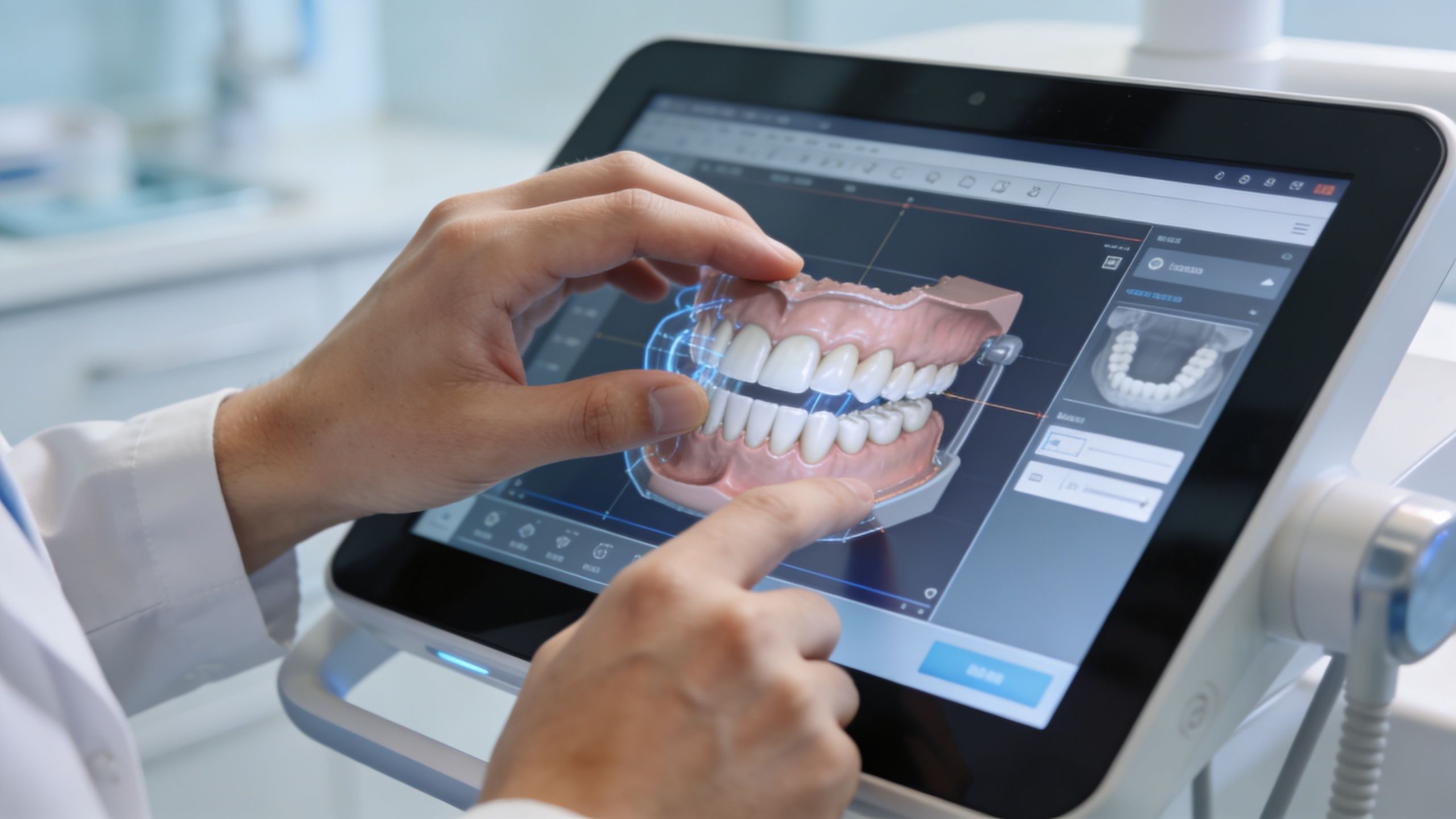
Cone beam computed tomography, usually called CBCT, creates a three-dimensional view of the jaws. That lets the dentist evaluate bone volume, anatomy, implant angulation, and restorative space before treatment begins.
According to this review of digital technology behind Teeth-in-a-Day workflows, modern CBCT-derived planning can achieve implant placement accuracy of 0.2 to 0.4 mm. The same source notes that advanced implant surfaces can promote 55% to 70% bone-implant contact within 2 weeks, which helps make immediate loading possible and supports a 95% survival rate at 3 years.
For patients, that level of precision means fewer surprises. The anatomy is studied in advance, the surgical path is clearer, and the temporary prosthesis can be planned around the actual bone rather than guesswork.
Why digital workflow matters
Digital planning isn't just about cool equipment. It improves the handoff between diagnosis, surgery, and the design of the temporary teeth.
That matters in several ways:
- Safer positioning because bone and nearby structures are mapped in three dimensions
- More predictable fit when the temporary bridge is designed from digital records
- A smoother surgical day because the team has already worked through the sequence
- Better communication because patients can see their situation on screen instead of trying to imagine it
Good technology doesn't replace clinical judgment. It gives that judgment better information.
Aspiring Smiles Dental and Braces uses modern imaging and restorative planning as part of full-arch implant evaluation. In practical terms, that helps connect diagnosis, surgical placement, and the final aesthetic outcome in one coordinated workflow.
Recovery and Long-Term Care for Your New Smile
The first thing to know after surgery is that feeling better quickly and healing completely are not the same thing. Many patients are surprised that the early recovery is manageable. The part that requires the most discipline is protecting the implants while they integrate with the bone.
The temporary teeth let you function right away, but they are not a license to chew anything you want. Biting into hard foods too early puts unnecessary stress on implants that are still healing.
What the first phase looks like
Patients should expect a soft-food period and a careful home-care routine. According to this post-op guidance on All-on-4 teeth in a day care, about 70% of patients transition from their immediate temporary teeth to a final permanent set at 4 to 6 months, proper hygiene matters because poor home care can raise the risk of peri-implantitis by 12%, and patients should avoid hard foods for 3 to 6 months while osseointegration develops.
That timeline is one of the most important expectations to understand. The teeth you leave with on surgery day are usually the working temporary phase. They look good and function well, but the final restoration is built after healing tells us the implants are stable and the tissues have settled.
What works and what doesn't
What helps most during recovery:
- Follow the food instructions exactly even if your mouth feels good early.
- Keep the mouth clean every day using the tools and rinsing routine recommended for your case.
- Show up for follow-up visits so healing, bite pressure, and prosthetic fit can be checked.
- Report sore spots or bite changes early rather than waiting and hoping they settle down.
What tends to create problems:
- Testing the new teeth with hard foods too soon
- Skipping hygiene around the implants
- Assuming temporary teeth are the final version
- Missing maintenance visits after treatment
The patients who do best long term usually aren't the ones who heal fastest. They're the ones who follow instructions closely.
Caring for implant-supported teeth long term
Once the final prosthesis is placed, the routine becomes more familiar. You still need regular professional cleanings and exams, just with implant-specific attention. Food and bacteria can collect around the prosthesis if the area isn't cleaned thoroughly, and that's why maintenance matters so much.
For a practical overview of home habits that protect implants, this guide on how to properly care for dental implants is a helpful starting point. In office, we also review cleaning tools, flossing strategies, and what to watch for so the restoration stays healthy and comfortable.
Frequently Asked Questions About Teeth in a Day
Is teeth in a day painful
Most patients are worried more about the idea of surgery than the actual recovery. With local anesthesia and, when appropriate, sedation, the procedure itself is typically much easier than expected. Some soreness, swelling, and adjustment are normal afterward, especially if extractions were part of the treatment.
Will my new teeth look natural
Yes, when the case is planned properly. The shape, color, and smile design matter just as much as implant placement. Good full-arch work shouldn't look bulky, overly white, or artificial. It should fit your face, lip support, and bite.
How long do the results last
Implant-supported full-arch restorations are built as long-term treatment, but longevity depends on the same factors that drive success in any implant case. Good hygiene, regular maintenance, bite protection when needed, and keeping follow-up appointments all matter. The implants and prosthesis need care, not neglect.
Am I a candidate if I have failing teeth or need tooth extraction
Possibly. Many teeth in a day patients still have damaged or failing teeth at the start. Whether those teeth can be removed and replaced in one coordinated visit depends on your bone, gum health, medical history, and treatment goals.
How is this different from seeing an emergency dentist
An emergency visit usually focuses on stopping pain, infection, or immediate damage. Teeth in a day is a planned reconstructive treatment. Some patients begin with an emergency dental problem and then move into full-arch treatment after the urgent issue is under control.
What about cost and payment options
Cost depends on the complexity of the case, whether one arch or both arches are being treated, and what preparatory work is needed. The most useful next step is a consultation and imaging appointment so the treatment can be diagnosed properly. From there, the office can review payment options, insurance details when applicable, and phased recommendations if more than one path is available.
If you're ready to replace missing or failing teeth with a fixed full-arch solution, schedule a consultation with Aspiring Smiles Dental and Braces. Patients across Las Vegas, including Desert Shores, Sunhampton, Sun City Summerlin, Monterrey, Lone Mountain, Mar-A-Lago, and Painted Desert Estates, can get clear answers about candidacy, treatment planning, and what to expect from teeth in a day.