Achieve Your Brightest Smile: Teeth Cleaning and Whitening
If you're reading this, there’s a good chance you’ve looked in the mirror lately and thought, “My teeth are healthy enough, but they don’t look as bright as I want.” Maybe you’ve got a wedding coming up, a job interview, family photos, or you’re just tired of coffee and tea stains making your smile look older than you feel.
That’s a very common place to start. Many new patients in Las Vegas tell me they’re unsure whether they need a cleaning, whitening, or both. They’ve seen whitening strips at the store, heard about Zoom treatment, or typed “cosmetic dentist near me” or “dentist in Las Vegas, NV” into Google and ended up with more questions than answers.
I’m Dr. Patel, and my goal is to make teeth cleaning and whitening easy to understand. A brighter smile should feel exciting, not confusing. It should also be planned the right way, especially if you already have crowns, fillings, veneers, implants, or other dental work.
A Brighter Smile for Las Vegas Residents
A patient from Sun City Summerlin recently came in with a concern I hear often. She said, “I brush every day, but my teeth still look dull. Do I just need a better whitening toothpaste?” That question gets to the heart of the confusion.
A clean smile and a white smile are related, but they aren't the same thing. Cleaning focuses on oral health. Whitening focuses on changing the color of natural teeth. When patients understand that difference, it becomes much easier to choose the right treatment and avoid wasting time on products that don’t fit the problem.

The interest in a brighter smile is not small. Teeth whitening is the most popular cosmetic dental procedure in the United States, and approximately 19% of American adults have undergone professional treatments. Adults under 45 are twice as likely to pursue whitening as those over 45, according to Grand View Research’s teeth whitening market report.
Why Las Vegas patients often feel stuck
In Las Vegas, I see people balancing appearance, health, time, and budget all at once. A parent in Desert Shores may want a routine cleaning and exams visit but also ask whether they can brighten their smile before an event. Someone in Lone Mountain may be comparing over-the-counter products with professional care. Another patient from Painted Desert Estates may be worried because they already have a front crown and don’t want mismatched teeth.
Those are smart concerns.
What matters most: The right plan depends on what’s causing the discoloration, whether your teeth and gums are healthy, and whether you have existing dental work that won’t change color with whitening.
What you should expect from a good dental conversation
A trustworthy dentist near me search shouldn’t lead you to pressure. It should lead you to clarity. If you’re exploring teeth cleaning and whitening, you deserve answers in plain language:
- What is a cleaning removing
- What whitening can and can’t do
- Whether your crown, veneer, or filling will match afterward
- How to reduce sensitivity
- Which option makes sense for your schedule
That’s the path to a smile that looks better and feels healthy, not just temporarily brighter.
The Foundation of Oral Health Professional Teeth Cleaning
A professional teeth cleaning is a health service first. Yes, your teeth often look fresher afterward. But the main purpose is to remove buildup that brushing and flossing at home can’t fully handle.
That buildup includes plaque, tartar, and surface stains. Plaque is the soft film that forms on teeth. Tartar, also called calculus, is hardened plaque. Once tartar forms, you can’t brush it off on your own. A hygienist or dentist has to remove it with professional instruments.
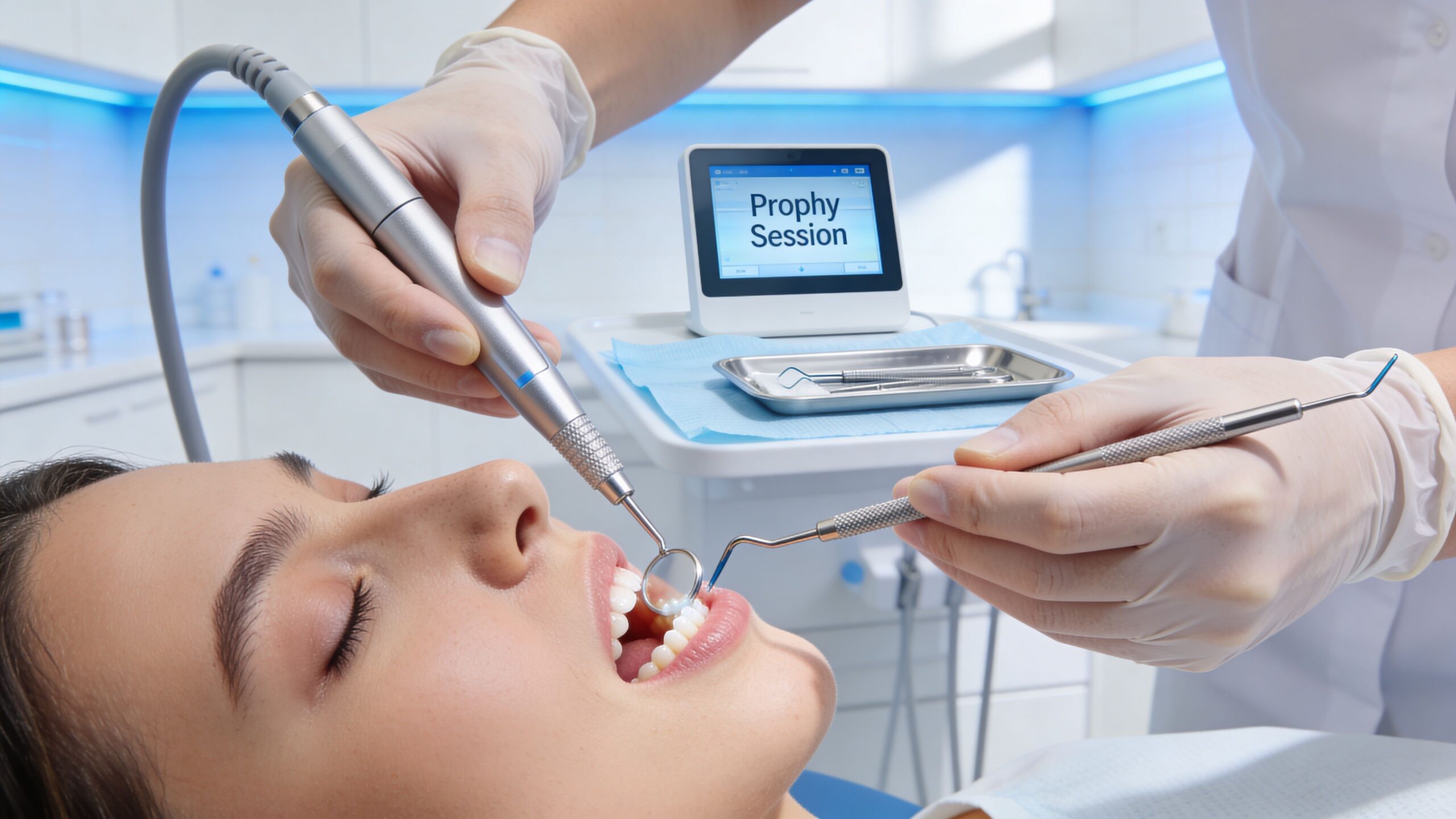
What a cleaning removes that toothpaste can’t
Whitening toothpastes can help with some extrinsic stains, which means stains on the outer surface of the tooth. They do that mainly through abrasives. Those abrasives must stay within safety limits, so there’s a cap on how aggressive they can be.
Professional cleanings go much further. According to the PMC review on whitening dentifrices and cleaning tools, whitening toothpastes are limited by Relative Dentin Abrasivity, while ultrasonic scalers used in dental offices operate at 20 to 40 kHz and can remove up to 95% of stubborn subgingival calculus. That’s something toothpaste cannot achieve.
Why this matters for your health
When tartar sits along the gumline, it creates a rough surface where bacteria can collect more easily. That can lead to gum irritation, bleeding, bad breath, and eventually more serious periodontal problems. A cleaning helps reset the mouth.
It also gives us a clearer view of your teeth. If there’s a cavity starting, a cracked filling, or gum inflammation, we want to spot it early. That’s one reason routine cleanings are often paired with cleaning and exams, dental x-rays, and new patient exams.
A polished smile may look cosmetic, but the reason for the appointment is preventive care.
Cleaning versus whitening in simple terms
Patients often ask for “whitening” when they really mean “my teeth look stained.” The source of the stain matters.
Here’s the easiest way to separate the two:
| Treatment | Main purpose | What it helps with |
|---|---|---|
| Professional cleaning | Oral health | Plaque, tartar, some surface stain |
| Teeth whitening | Cosmetic color improvement | Lightening the shade of natural teeth |
A cleaning can make teeth look brighter because it removes debris and external stain. But it doesn't bleach the tooth structure. Whitening does.
What a cleaning visit usually feels like
Most patients are relieved by how straightforward this is. During a typical visit, your provider checks your gums and teeth, removes plaque and tartar, polishes the teeth, and reviews any findings. If you’ve been searching for professional dental cleaning in Las Vegas, that’s the kind of appointment you should expect.
Some patients with heavy buildup need more than a routine prophylaxis. Others may need restorative dentistry afterward if hidden problems show up. That isn’t a setback. It’s useful information. A healthier mouth gives you better cosmetic options later, whether that means whitening, veneers, crowns, or even long-term planning for dental implants near me searches you may be doing now.
Choosing Your Whitening Path In-Office vs At-Home
Once the teeth are clean and the mouth is healthy, whitening becomes a much more predictable conversation. Many patients then ask the practical question: should I whiten in the office or at home?
Both approaches can work well. The difference usually comes down to speed, convenience, and how much supervision you want during the process.
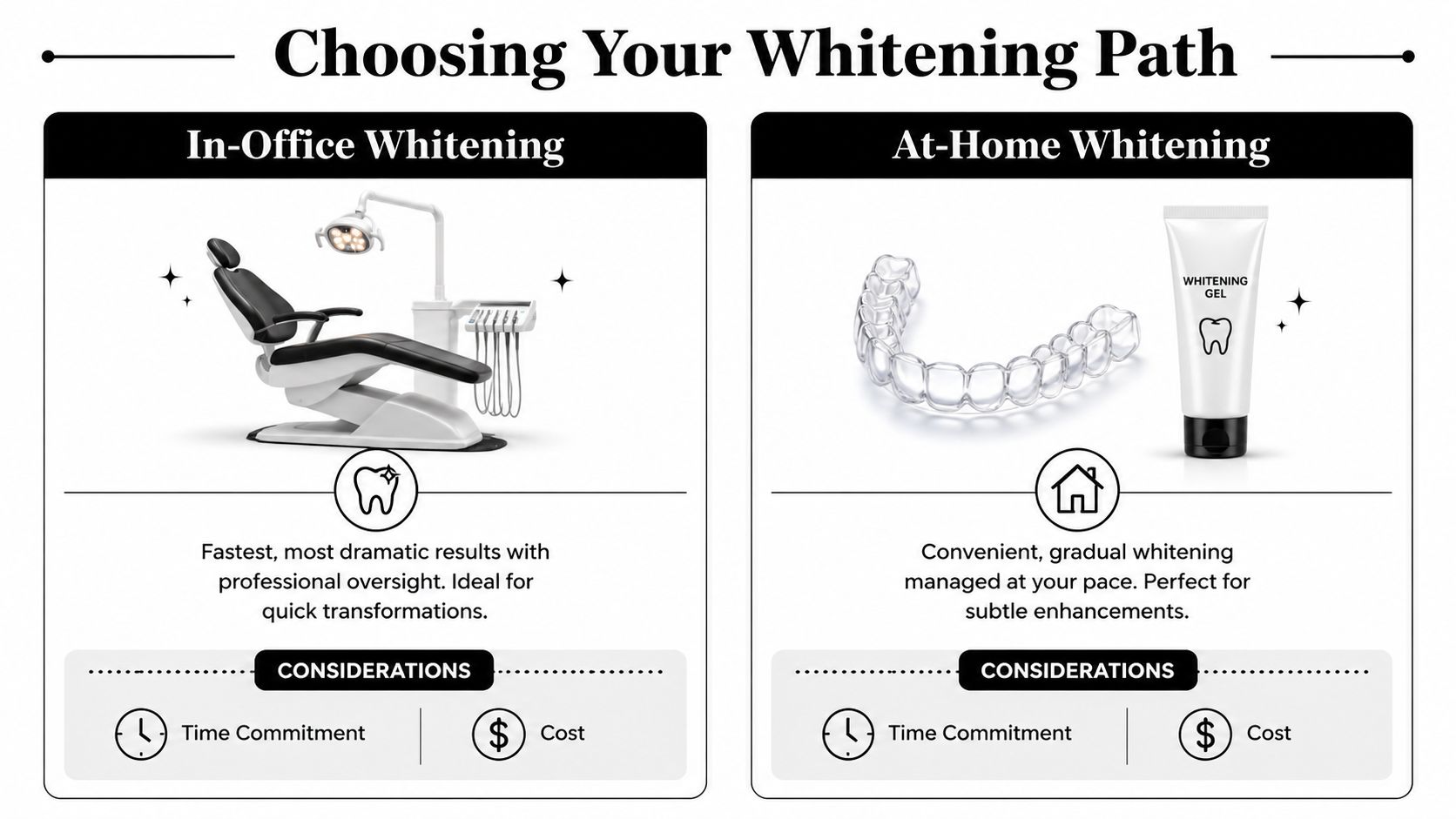
What in-office whitening is like
In-office whitening is the faster option. A high-concentration whitening gel is applied under professional supervision, and some systems use a special light as part of the process. Patients usually choose this route when they want visible change in a single visit.
That can be helpful if you have an event coming up, want less guesswork, or prefer to have the whole process handled for you in one appointment. It’s also useful for patients who know they won’t be consistent with trays at home.
A short video can help if you want to visualize the process before booking.
What take-home whitening is like
Take-home whitening is more gradual. You wear custom or dentist-provided trays with whitening gel on a schedule recommended by your provider. Many patients like this because it fits around work, family life, and travel.
This option often appeals to people who want control. You can whiten at your pace, monitor sensitivity, and build the change over time. If you're comparing options, at-home teeth whitening from a dental office is different from a generic store kit because the plan is guided and the materials are intended for supervised use.
For patients who like to understand ingredients before treatment, this resource on understanding the science behind carbamide peroxide gives a useful plain-language overview of how a common whitening agent works.
Which one whitens better
Clinical studies show both in-office and at-home professional whitening are highly effective. According to this review of whitening effectiveness and sensitivity, in-office treatment with high-concentration hydrogen peroxide can produce a noticeable color shift immediately, while dentist-supervised at-home kits with lower-concentration carbamide peroxide achieve comparable long-term results.
That means the best choice isn’t always “the strongest” or “the fastest.” It’s the one that fits your life and your dental situation.
A side-by-side way to think about it
- Choose in-office whitening if you want quicker results, have a deadline, or want the dentist to control the whole process while you sit back.
- Choose at-home whitening if you prefer a slower change, want flexibility, or like making gradual adjustments.
- Choose a consultation first if you have old fillings, front crowns, sensitivity, deep discoloration, or aren’t sure why your teeth look darker.
Some patients do best with speed. Others do best with control. The right answer isn't the same for everyone.
Questions that usually decide it
Here’s what I ask patients in Las Vegas when they’re choosing:
| Question | If your answer is yes | Likely fit |
|---|---|---|
| Do you want faster visible change? | You have an event or short timeline | In-office |
| Do you prefer whitening on your own schedule? | You want convenience at home | Take-home |
| Are you worried about using too much product? | You want close monitoring | In-office |
| Do you want to spread the process out? | You’re comfortable with routine use | Take-home |
This is also where cosmetic dentistry overlaps with general care. A patient might come in thinking they only want whitening, then realize they’d benefit from replacing an old filling, smoothing a chipped edge, or talking about veneers instead. A good cosmetic dentist near me conversation should leave room for those possibilities.
The Right Order Why Cleaning Always Comes First
If you remember only one thing from this article, remember this: cleaning comes before whitening.
Trying to whiten teeth that still have plaque, tartar, and surface buildup is a little like painting over a dusty wall. The color won’t go on as evenly, and the result may disappoint you even if the whitening product itself is good.
Why the order matters
Whitening gel works by contacting the natural tooth surface. If buildup is sitting on that surface, the gel may not reach the enamel as evenly as it should. That can mean patchy results, less noticeable change, or a smile that still looks dull because stain and calculus were never removed first.
A professional cleaning also helps separate two different problems. Sometimes a patient thinks they need whitening, but once the teeth are cleaned and polished, they’re happy with the result and don’t need bleaching at all. Other times, the cleaning reveals the true underlying shade, and then whitening can be planned more accurately.
What patients often misunderstand
A lot of store products blur the line between cleaning and whitening. The packaging makes it sound like one tube can do everything. In real life, those are different jobs.
Cleaning removes buildup.
Whitening changes the color of natural tooth structure.
When you do them in the right order, the whitening step has a better surface to work on. That usually means a more even result and a more realistic starting point for shade selection.
Practical rule: If you haven’t had a recent professional cleaning, don’t guess your whitening outcome based on what you see in the mirror today.
Why dentists insist on this step
This isn’t about making treatment longer. It’s about making it smarter. If your gums are inflamed, if tartar is covering parts of the teeth, or if hidden dental issues are present, whitening first can create frustration.
For patients looking for a dentist in Las Vegas, NV, this is one of the simplest signs of thoughtful care. A dentist who starts with health is usually trying to protect your comfort and your result, not slow you down.
Are You a Candidate For Teeth Whitening
Not every type of discoloration responds the same way. Some smiles whiten very nicely. Others need a different cosmetic plan. Consequently, an exam matters more than a sales pitch.
The best candidates usually have healthy teeth and gums and discoloration in natural teeth that responds to bleaching. Patients with yellow-toned staining often do well. Patients with uneven color from old dental work need a more careful discussion.

The overlooked issue with crowns and fillings
This is the concern many adults in Las Vegas don’t hear enough about before they whiten. Professional whitening agents do not change the color of restorations like crowns, veneers, or fillings. That means your natural teeth may lighten while those restorations stay the same shade.
That matters because many adults already have dental work. According to this discussion of whitening and restorations, up to 70% of adults over 40 have at least one restoration. If you whiten without planning ahead, you can end up with a color mismatch, especially in visible areas.
Mixed smiles need a different plan
A “mixed smile” is a smile that includes both natural teeth and restored teeth. Common examples include:
- A front crown: Your natural teeth whiten, but the crown doesn’t.
- White fillings near the smile line: The filling may suddenly look darker or flatter in color next to brightened enamel.
- Porcelain veneers: Veneers won’t bleach, so the surrounding natural teeth need to be evaluated carefully.
- Implants and implant crowns: These restorations also won’t respond to whitening gel.
If you’ve searched for dental implants near me, restorative dentistry, or cosmetic dentist near me, this issue is especially relevant. Whitening can still be part of the plan. It just has to be coordinated.
Whitening is often ideal for natural teeth, but restorations may need shade matching, replacement, bonding, or veneer planning if the goal is a uniform smile.
When whitening may not be the only answer
Sometimes the color problem isn’t simple surface staining or routine darkening over time. You may have one tooth that changed color after trauma. You may have discoloration that’s deeper within the tooth. You may also have old restorative work that already varies in shade from tooth to tooth.
In those cases, whitening may help part of the smile but not all of it. That’s when we start talking about alternatives such as bonding, veneers, crowns, or other cosmetic dentistry options. The goal isn’t just “whiter.” It’s balanced.
What about sensitivity
Sensitivity is one of the biggest reasons people delay treatment. That fear is understandable. Some patients do notice temporary sensitivity during whitening.
What helps is planning. We look at gum health, existing recession, areas of wear, exposed roots, and your history with sensitive teeth. Then we choose the gentlest path that still gives you a worthwhile result. Sometimes that means lower-concentration products, shorter wear times, spaced-out applications, or a different cosmetic approach altogether.
A quick self-check before you book
You may be a strong candidate for teeth whitening if:
- Your teeth are healthy: No untreated decay, major gum irritation, or urgent pain
- Most of the visible teeth are natural: Not mostly crowns or veneers in the smile zone
- Your goal is realistic: You want a brighter version of your smile, not an artificial paper-white look
- You’re open to an exam first: Especially if you already have fillings, crowns, or implants
If you have active pain, swelling, a broken tooth, or sudden discoloration in one tooth, address that first. Sometimes what looks like a cosmetic problem is in fact a restorative or emergency dentist issue.
Your Whitening Journey at Aspiring Smiles in Las Vegas
Most patients feel better once they know what the process looks like. It’s usually much more comfortable and organized than they expected.
When you schedule, the first step is a consultation and exam. If you’re new to the office, that may include a full review of your dental history, a discussion of your goals, and dental x-rays if needed. If you came in searching for dentist near me because you want brighter teeth, this is the point where we make sure the smile is healthy enough to whiten.
What happens at the first visit
At Aspiring Smiles Dental and Braces, the visit may start with a new patient exam and a close look at the current shade of your teeth, any existing restorations, and the condition of your gums. If there’s plaque, tartar, or surface staining, a cleaning is handled first because that sets up the cosmetic step more predictably.
If you have a crown, veneer, implant crown, or visible fillings, that gets factored into the plan right away. This matters for many adults in neighborhoods like Desert Shores, Lone Mountain, Mar-A-Lago, Monterrey, and Sunhampton, because prior dental work is common and often forgotten until the shade mismatch question comes up.
What comfort planning looks like
Sensitivity is manageable for many patients when whitening is dentist-supervised. According to this overview of professional whitening for sensitive patients, pre-treatment cleanings can reduce sensitivity by up to 40%, and professional-grade gels like Zoom show 92% efficacy on cleaned teeth while often including desensitizing agents such as Potassium Nitrate.
That’s why a good whitening appointment isn’t rushed. The product, timing, and your current tooth condition all matter.
How treatment day usually feels
If you choose in-office whitening, the appointment is focused and controlled. Your lips and gums are protected, the whitening material is placed carefully, and your progress is monitored throughout. If you choose take-home trays, you’ll get instructions on how much gel to use, how long to wear the trays, and what to do if a tooth feels sensitive.
Patients often tell me the most reassuring part is knowing what’s normal. Mild temporary sensitivity can happen. Uneven spots early in the process can happen. Questions about a front filling or older crown are normal too.
A smooth whitening experience usually comes from planning, not from guessing.
Aftercare that helps your results last
After whitening, your teeth can be more prone to picking up color from dark foods and beverages for a short period. That doesn’t mean you have to live on plain rice and water. It just means being thoughtful for a bit and following the instructions you were given.
Good habits after treatment usually include:
- Keep up with regular cleanings: Surface stains build back over time
- Brush and floss consistently: Whitening doesn’t replace daily care
- Use your trays only as directed: More gel isn’t better
- Ask before touch-ups: Especially if you have crowns, fillings, or implants
Our office is located at 3211 N Tenaya Wy Suite 122, Las Vegas, NV 89129, which makes visits convenient for many families in Sun City Summerlin and Painted Desert Estates as well. Whether you’re coming in for whitening, cleaning and exams, restorative dentistry, or even asking about tooth extraction or emergency dentist services, the experience should feel straightforward and respectful.
Common Questions About Teeth Cleaning and Whitening
How much do teeth cleaning and whitening cost in Las Vegas
The honest answer is that cost depends on what you need. A routine cleaning is different from periodontal treatment. In-office whitening is different from take-home whitening. If you need a filling replaced first or want to discuss veneers because of old front dental work, that changes the plan too.
The most useful way to get an accurate answer is with an exam and conversation. That lets your dentist tell you whether your goal can be reached with cleaning alone, whitening, or a combination with restorative care.
How long do whitening results last
There isn’t one exact timeline for everyone. Results depend on your starting shade, the type of whitening used, and your habits afterward. Coffee, tea, red wine, tobacco, and inconsistent cleanings can shorten how long your smile looks bright.
Maintenance matters. Regular hygiene visits and small touch-up plans, when appropriate, usually work better than waiting until all the color returns and starting over from scratch.
Is professional whitening safe
When supervised by a dentist and used as directed, professional whitening is a well-established treatment. Safety depends on proper diagnosis, the right product, and making sure there isn’t untreated decay, gum disease, or a restoration issue being overlooked.
That’s one reason store-bought products can be frustrating. They don’t tell you whether a dark tooth is a warning sign, whether your existing crown will match, or whether sensitivity is coming from whitening or from an exposed area that needs care.
Can I whiten right after a cleaning
Often, yes. In many cases, that’s the ideal sequence because the teeth are freshly cleaned and ready for a more even cosmetic result. But “right after” only works if the mouth is healthy and your provider confirms it’s appropriate.
If the cleaning reveals gum irritation, cavities, a leaking filling, or another issue, the safer move is to address that first. Good cosmetic dentistry doesn’t skip diagnosis.
Will whitening toothpaste do enough
For some people, whitening toothpaste helps maintain a cleaner-looking smile by removing some surface stain. But if you want a noticeable change in the actual color of your natural teeth, toothpaste usually won’t do what professional whitening can do.
It’s also important not to overdo abrasive products. A toothpaste can support maintenance, but it shouldn't become your whole whitening plan.
What should I do at home after whitening
Keep your home care simple and consistent. Brush gently, floss daily, and follow the instructions for any trays or maintenance products. If you want to be extra thoughtful about hygiene tools between visits, this guide on how to sanitize your toothbrush is a practical read.
Call your dentist if something feels off. Ongoing pain, one tooth reacting differently than the others, or concerns about an old filling should be checked rather than ignored.
Can whitening fix every kind of discoloration
No. Whitening is effective for many natural teeth, but not every stain responds the same way. Some situations need bonding, veneers, crowns, or restorative treatment instead. That’s especially true when the issue involves trauma, one dark tooth, or visible restorations that won’t change color.
A good consultation saves you from spending money on the wrong solution.
If you’re looking for a clear plan for teeth cleaning and whitening in Las Vegas, schedule a visit with Aspiring Smiles Dental and Braces. Dr. Patel and the team can evaluate your teeth, check any existing crowns or fillings, and help you choose a safe, realistic path to a healthier, brighter smile.