Dentist for Teeth Veneers in Las Vegas: A Patient’s Guide
You catch your reflection before work or before heading out for dinner in Las Vegas, and the same tooth grabs your attention again. It might be a small chip, a stain that never quite lifted with whitening, or a front tooth that makes your smile look uneven in photos even though it feels healthy.
That is often the moment someone starts looking for a dentist for teeth veneers. The goal is usually simple. You want your smile to look natural, balanced, and more like the version of yourself you had in mind all along.
Across Las Vegas, from Summerlin-area neighborhoods to nearby residential communities, more patients are asking about veneers as a practical cosmetic option for visible front teeth. That matters because it shows veneers are not just for celebrities or extreme smile makeovers. For many people, they are a careful, planned choice made after weighing appearance, tooth structure, cost, and long-term upkeep.
At Aspiring Smiles, that decision is treated the way it should be treated. Like any lasting home improvement, the right result depends on whether the foundation is sound, whether the materials fit the job, and whether the plan matches what you want your smile to do every day.
When considering whether veneers are the right next step, the first question is not how white or perfect your teeth could look. The first question is whether veneers make sense for your teeth, your bite, and your goals.
Begin Your Smile Transformation in Las Vegas
A lot of veneer consultations start the same way. A patient says, “My teeth bother me, but I don't want my smile to look fake.”
That concern is reasonable. Veneers sit on the front surfaces of teeth that people notice first, so every detail matters. Color, shape, size, and symmetry all have to work together with your face, lips, and bite.

What patients are usually hoping to fix
Those who inquire about veneers aren't typically dealing with pain. They're dealing with frustration that shows up every day.
Common concerns include:
- Chips on front teeth that make the smile look rough or uneven
- Stains that whitening hasn't improved enough
- Small gaps that draw attention in photos
- Teeth that look worn, short, or misshapen
- Slightly crooked front teeth when the bite itself feels otherwise comfortable
In a city like Las Vegas, where social events, work interactions, and photos are constant, those concerns can feel bigger than they sound.
Why the right guidance matters
Veneers can create a beautiful result, but they're not a one-size-fits-all purchase. They're a treatment choice. A careful cosmetic dentist looks at your enamel, gum health, bite pattern, and goals before saying yes.
A strong veneer plan starts with the question, “What's the least invasive way to get you the smile you want?”
That's why patients often do better when they choose a local office that can look at the full picture. If you're also due for cleaning and exams, dental x-rays, new patient exams, restorative dentistry, or even Invisalign evaluation, those details should shape the veneer plan.
For Las Vegas families in Desert Shores and Sun City Summerlin, the best cosmetic result is usually the one that also protects long-term oral health.
Understanding Dental Veneers and Candidacy
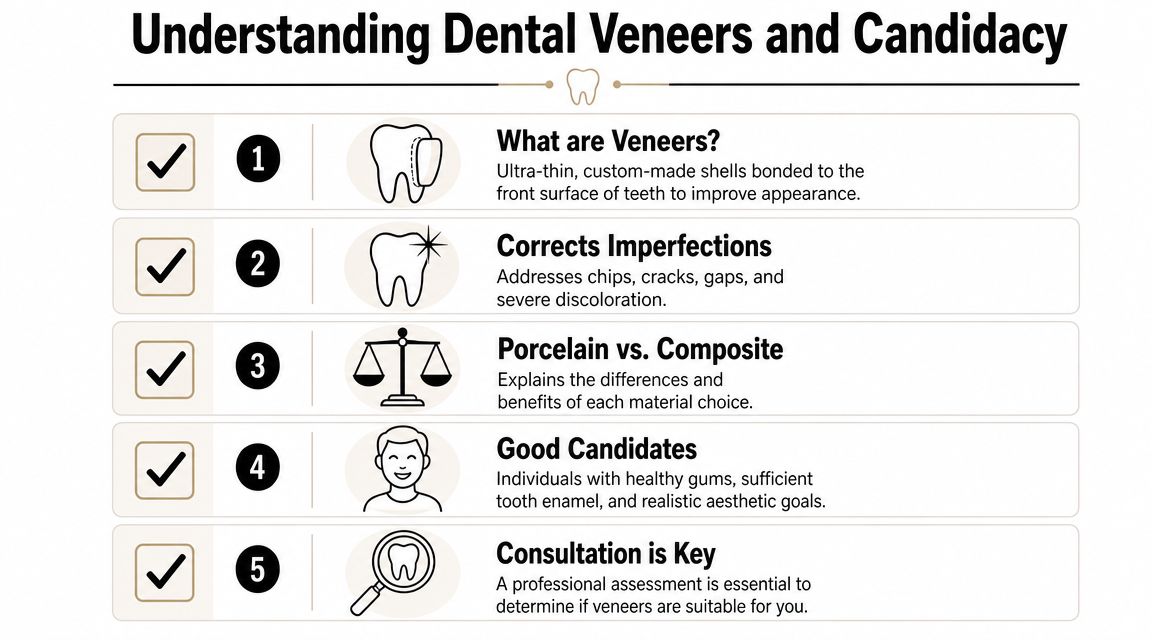
A veneer is easiest to understand if you think of it as a custom cover for the front of a tooth. It doesn't wrap around the whole tooth like a crown. It changes the visible front surface so the tooth looks brighter, smoother, straighter, or more even.
That sounds simple, but candidacy is where many people get confused.
What veneers can correct
Veneers are a cosmetic treatment. Cleveland Clinic notes that they're intended to conceal aesthetic imperfections and cover only the front surfaces of teeth, as explained in this overview of dental veneers from Cleveland Clinic.
That makes them a practical option for issues like:
- Noticeable discoloration when the shade difference is on the front of the tooth
- Minor chips or surface cracks that affect appearance
- Small spaces between front teeth
- Slight irregularity in shape or length
- Mild visual misalignment when the problem is mainly cosmetic
When veneers may not be the first answer
A good consultation is of utmost importance. Some smiles look like veneer cases at first glance, but a more conservative option may make more sense.
Examples:
- A small chip on one tooth might be better treated with bonding.
- A patient who mainly wants whiter teeth may benefit from teeth whitening first.
- A person bothered by crookedness may get a healthier result from Invisalign if the issue is positional, not just visual.
- A tooth with major structural damage may need a crown instead of a veneer.
Because veneers often require permanent enamel reduction, they should be recommended thoughtfully, not casually.
Practical rule: If the problem can be solved predictably with a reversible or lower-intervention option, it's worth discussing that first.
What makes someone a good candidate
A dentist for teeth veneers usually looks for three things before moving forward:
- Healthy gums and teeth so cosmetic work isn't placed over untreated disease
- Enough enamel to support bonding
- Realistic expectations about what veneers can and can't change
Patients from Lone Mountain or Painted Desert Estates often come in expecting a quick answer, but the best answer is often a careful one. Sometimes the verdict is yes. Sometimes it's “not yet.” Sometimes it's “there's a better option.”
That isn't a setback. It's how good cosmetic dentistry protects your smile instead of chasing a shortcut.
Veneers Compared to Crowns and Dental Bonding
Patients often ask the right question right away. “Do I need veneers, or would bonding or crowns make more sense?”
That's the kind of question you want your dentist to welcome.
The main difference in plain language
Bonding usually works best for small cosmetic fixes. Crowns usually work best when a tooth needs more protection and support. Veneers fit in the middle. They're designed for teeth that are generally healthy but need a stronger cosmetic upgrade on the front surface.
Here's a simple side-by-side view.
| Factor | Teeth Veneers | Dental Bonding | Dental Crowns |
|---|---|---|---|
| Primary purpose | Improve the front appearance of visible teeth | Repair small chips, gaps, or shape issues | Restore teeth with more significant damage or weakness |
| Tooth coverage | Front surface only | Small added material on selected area | Covers the entire tooth |
| Tooth preparation | Usually requires some enamel reduction | Often minimal preparation | Usually requires more reshaping than veneers |
| Best use case | Smile design, color change, shape correction, mild spacing issues | Very minor cosmetic touch-ups | Teeth needing structural reinforcement plus cosmetic improvement |
| Appearance | Often chosen for highly refined cosmetic results | Can look very good for small repairs | Can look excellent, especially when strength is the priority |
| Repairability | Depends on the case and material | Often easier to touch up | Usually replaced rather than patched |
| Cost approach | Premium cosmetic treatment | More conservative entry point | Varies by restorative need and material |
How to decide without overthinking it
If your tooth is healthy and you dislike how the front looks, veneers may be the better fit. If the flaw is very small, bonding may preserve more natural tooth structure. If the tooth is cracked, heavily filled, or weakened, a crown may be safer.
For a deeper service comparison, this page on the difference between veneers and crowns is useful when you're weighing cosmetic and restorative options together.
A simple patient example
If someone in Las Vegas comes in with one tiny chip on a side front tooth, bonding might be enough. If another patient wants to brighten, reshape, and balance several upper front teeth at once, veneers are usually the more complete cosmetic solution.
The right treatment isn't the one that changes the most. It's the one that solves the actual problem with the right level of treatment.
That same mindset applies across cosmetic dentistry, restorative dentistry, and even services like dental implants near me or tooth extraction. Good planning starts with diagnosis, not sales.
The Veneer Placement Process Step by Step
You have decided you want a better smile, but the next question is usually more practical. What happens from the first visit to the day you see the final result?
For many Las Vegas patients, the process feels much easier once it is broken into clear steps. Veneers are custom work. The appointments follow a predictable path, and each step has a specific purpose.
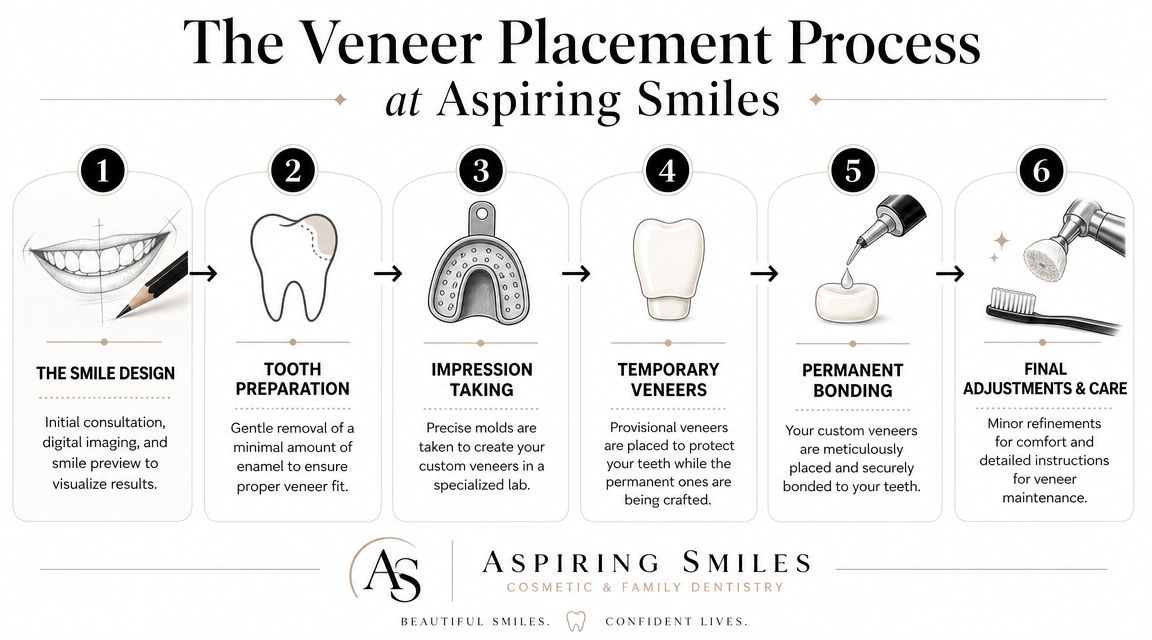
Your consultation and smile design
The first visit is about fit, not pressure.
Your dentist starts by learning what bothers you about your smile and what you want to change. One patient wants teeth that look less uneven in photos. Another wants to close small spaces, soften sharp edges, or create a brighter look that still feels natural.
Then comes the part that protects your long-term result. Your dentist checks the teeth, gums, bite, and any habits such as clenching or grinding. If veneers are a good match, the smile design can move forward. If another treatment would serve you better, that should be explained clearly before any tooth preparation begins.
This planning stage works like drafting a blueprint before a home remodel. The goal is not just pretty veneers. The goal is veneers that fit your face, your bite, and the way you use your teeth every day.
A short visual can help you picture the treatment path before you commit.
Preparation and temporary veneers
If you choose to proceed, the next appointment usually prepares the teeth for the veneers. In many cases, that means removing a very small amount of enamel so the final veneers sit naturally instead of looking or feeling bulky.
After that, your dentist takes impressions or digital scans and confirms details such as shape, length, and shade. This is the handoff point between the treatment plan and the custom lab work.
Temporary veneers are often placed while the final ones are being made. They are not the finish line, but they give you a preview of the size and general look. That can be helpful if you are adjusting to changes in the front teeth or deciding whether a small shape change would improve the result.
Patients often ask whether this stage is painful. In most cases, it is manageable and far less dramatic than people expect. The teeth may feel a little different for a short period, especially with cold foods or when biting into something firm.
Final bonding and the smile reveal
At the delivery visit, each veneer is tried in and checked carefully before it is bonded. Fit matters. Color matters. Bite matters too, because a veneer that looks good but hits wrong can chip or feel awkward.
Small refinements are common at this stage. A fraction of a millimeter can change how a front tooth catches the light or how symmetrical your smile appears. That level of detail is one reason patients often choose an experienced cosmetic dentist instead of treating veneers like a simple cosmetic purchase.
For patients in Sunhampton, Monterrey, and nearby Las Vegas neighborhoods, this is usually the moment the plan becomes real. The new smile should look polished, healthy, and believable in everyday life. You should be able to talk, laugh, and smile without feeling like your teeth look overdone.
At Aspiring Smiles, the process is meant to support a decision you can feel good about for years, not just on reveal day.
Longevity and Caring for Your New Smile
Veneers are durable, but they aren't permanent in the sense of “never needs attention again.” That's one of the most important things to understand before treatment.
The long-term picture is encouraging when veneers are planned well and cared for properly.
What the clinical data tells us
A peer-reviewed review in the National Library of Medicine reported a 91% survival rate for porcelain veneers at 20 years, while composite veneers in reviewed studies showed 80% to 89% survival after 5 years. That same review supports the general clinical view that porcelain tends to outperform composite in durability, as described in this review of ceramic and composite veneer outcomes.
For patients, the practical takeaway is simpler than the statistics. Porcelain usually lasts longer and holds up better cosmetically, while composite can be a useful option in selected cases.
Daily habits that protect veneers
If you want your veneers to stay attractive and stable, routine matters.
Good habits include:
- Brush and floss consistently to protect the tooth and gumline around the veneers
- Keep regular cleanings and exams so small issues are found early
- Wear a nightguard if you grind or clench
- Avoid using teeth as tools to open packages or bite non-food objects
- Be careful with very hard foods if you tend to bite directly with the front teeth
Veneers don't fail because a patient smiled too much. They usually fail because of bite stress, neglect, trauma, or changing conditions around the tooth.
When replacement becomes part of the plan
Even great veneers may eventually need replacement because of edge wear, fracture, margin discoloration, bite changes, or gum changes over time.
That matters even more for younger adults. If you get veneers early in life, you should go into treatment knowing you're choosing a restoration that may need future maintenance or replacement. A good dentist should explain that upfront so the decision feels informed, not rushed.
How to Choose the Right Cosmetic Dentist in Las Vegas
If you've searched cosmetic dentist near me or dentist in Las Vegas, NV, you've probably seen plenty of pages that show pretty smiles. What matters more is how the dentist thinks.
For veneers, technical skill and judgment matter just as much as artistic taste.
What to look for in a veneer consultation
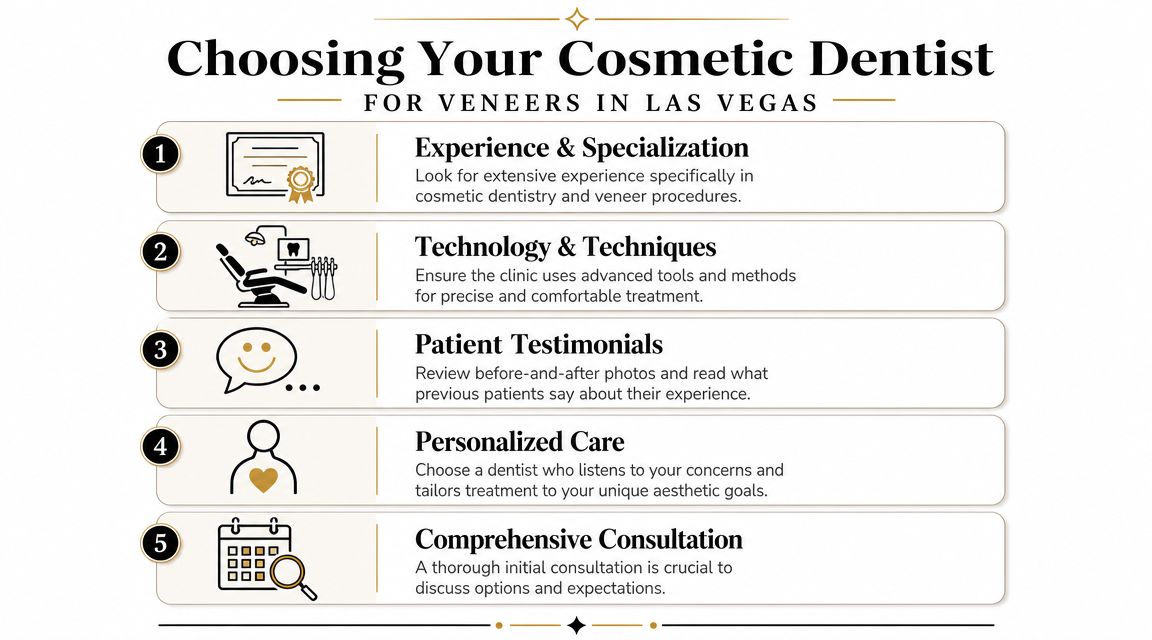
A thoughtful cosmetic dentist should be able to do more than say, “Yes, we can place veneers.”
Look for these signs:
- A complete exam first because untreated decay, gum disease, or bite instability can affect results
- Clear explanation of alternatives such as whitening, bonding, Invisalign, or crowns
- Attention to long-term maintenance so you know what future care may involve
- Comfort with both cosmetic and restorative planning in case your smile needs a combination approach
- A process that feels collaborative instead of rushed
One often-missed issue is the replacement conversation. Veneers require some permanent tooth reduction, and they aren't lifetime devices. That's why long-term counseling matters, especially for younger adults, as discussed in this overview of porcelain veneer maintenance and replacement considerations.
Why systems matter behind the scenes
Patients usually notice the smile design and chairside experience. They don't always see the operational side that supports consistent care. A practice that handles treatment planning, scheduling, financial communication, and follow-up well often creates a smoother patient experience.
For readers interested in that business side of dentistry, resources that explain how offices accelerate dental practice cash flow can be helpful because financial systems often affect how clearly treatment estimates and payment processes are handled.
Applying that checklist locally
If you're evaluating a cosmetic dentist near you in Las Vegas, ask direct questions. What happens if veneers aren't the best option for me? How do you evaluate bite forces? What would maintenance look like over the years? What other services do you provide if I need broader care, like emergency dentist visits, dental implants near me, or restorative treatment?
Aspiring Smiles Dental and Braces provides cosmetic, restorative, preventive, and emergency services in one Las Vegas setting, which can be useful when veneer planning overlaps with the rest of your oral health.
The right dentist for teeth veneers should make you feel informed, not pressured.
For patients in Mar-A-Lago and nearby areas, that usually means choosing a practice that treats veneers as part of a larger health plan, not just a cosmetic transaction.
Schedule Your Veneers Consultation at Aspiring Smiles
If you're tired of noticing the same flaws every time you smile, the next step is simple. Get a professional opinion based on your teeth, your goals, and your long-term oral health.
At a veneer consultation, you should expect a real conversation. Your dentist should look at the condition of your enamel and gums, discuss what bothers you most, explain whether veneers are appropriate, and review other options if they'd preserve more tooth structure or fit your goals better.
What your first visit can help you answer
A consultation can clarify:
- Whether you're a true veneer candidate
- How many teeth would need treatment for a balanced look
- Whether bonding, whitening, crowns, or Invisalign should be considered first
- What kind of maintenance to expect over time
- How treatment costs and payment options will be explained
For many Las Vegas patients, that visit also becomes the starting point for broader dental care. If you need a new patient exam, routine preventive care, cosmetic dentistry, restorative dentistry, or treatment for an urgent concern, it helps to work with one office that can connect those pieces.
The office is located at 3211 N Tenaya Wy Suite 122, Las Vegas, NV 89129, which is convenient for families and working adults across Desert Shores, Sun City Summerlin, Lone Mountain, Painted Desert Estates, and nearby neighborhoods.
If you're ready to talk with a trusted local team about veneers, smile design, or related dental care, contact Aspiring Smiles Dental and Braces to request your consultation and take the next step toward a healthy, confident smile.