How to Stop Grinding Teeth at Night: A Las Vegas Guide
You wake up with a sore jaw, a dull headache near your temples, or teeth that suddenly feel sensitive when you drink something cold. Sometimes a partner hears grinding first. Sometimes your dentist spots the wear before you do. Either way, nighttime clenching and grinding can create real damage.
If you have been searching for a dentist near me or a dentist in Las Vegas, NV because your jaw feels tight in the morning or your teeth seem to be changing, this is worth addressing sooner rather than later. Teeth grinding at night is common, treatable, and often more connected to your overall sleep health than people realize.
Waking Up to Jaw Pain in Las Vegas You Are Not Alone
A lot of patients describe the same pattern. They assume they slept in an awkward position. Then it happens again. Morning jaw fatigue turns into headaches, tooth sensitivity, or a chipped edge on a front tooth. Weeks later, they are looking for dental care in Las Vegas because something no longer feels normal.
That pattern often points to sleep bruxism, which is nighttime grinding or clenching. It is not rare. Sleep bruxism affects 8 to 10% of adults globally, and clenching pressure during sleep can reach up to 250 pounds, which helps explain why 80% of grinders experience significant tooth wear and damage without intervention (ftbenddental.com).
Why patients often miss it
Patients are often asleep when it happens. They do not connect worn enamel, sore jaw muscles, or flattened teeth with what is happening overnight.
Others think a little grinding is harmless. It is not always harmless. Ongoing pressure can strain teeth, chewing muscles, and the jaw joints.
Key takeaway: If you wake up with jaw pain, temple headaches, or unexplained tooth sensitivity, grinding may be part of the problem.
Why local care matters
In Las Vegas, busy schedules, long workdays, and uneven sleep habits can make symptoms easy to ignore. Patients from Desert Shores, Sunhampton, Sun City Summerlin, Monterrey, Lone Mountain, Mar-A-Lago, and Painted Desert Estates often want the same thing. Clear answers, practical treatment, and a plan that fits real life.
A good exam matters because grinding is not just about protecting enamel. Sometimes it is tied to stress. Sometimes to bite imbalance. Sometimes it is a clue that sleep is being disrupted.
If you want to know how to stop grinding teeth at night, the first step is not guessing. It is identifying what is driving it in your case, then choosing treatment that protects your teeth and addresses the cause.
Recognizing the Signs and Uncovering the Causes of Teeth Grinding
Some signs are obvious. Others are subtle enough that patients dismiss them for months. Teeth grinding can affect the teeth, muscles, and jaw joints all at once.
Signs your teeth may be grinding at night
Watch for a pattern, not just one symptom.
- Morning jaw soreness that eases as the day goes on
- Temple headaches or facial tension after sleep
- Tooth sensitivity when eating or drinking hot or cold foods
- Flattened chewing surfaces or teeth that look shorter than before
- Chipped or cracked edges without a clear injury
- Clicking or tightness in the jaw when opening wide
- Neck and cheek muscle fatigue after waking
Sometimes the signs appear during a routine cleaning and exam. A dentist may notice wear facets, enamel changes, tiny fractures, or muscle tenderness before a patient realizes the pattern.
Common causes are not all the same
Bruxism is not one single-condition problem. Different patients grind for different reasons.
Here are the main categories dentists look at:
| Cause | What it can look like |
|---|---|
| Stress and tension | Daytime clenching, jaw tightness, restless sleep |
| Sleep disruption | Frequent waking, snoring, poor sleep quality |
| Bite issues | Uneven contact, pressure on certain teeth, muscle strain |
| Lifestyle triggers | Evening caffeine, alcohol, smoking, stimulating routines |
A person under stress may clench during the day and carry that tension into sleep. Another may have interrupted breathing during the night. Someone else may have a bite pattern that overloads certain teeth and muscles.
Daytime habits can feed nighttime symptoms
Many patients do not realize how often they hold their teeth together during the day. Working at a computer, driving, exercising, or concentrating can lead to a clenched jaw.
A relaxed jaw should leave a little space between the upper and lower teeth. If your teeth are touching all day, your jaw muscles never really get a break.
Practical check: Rest your tongue gently on the roof of your mouth and let your teeth stay apart when you are not chewing or swallowing.
When it is time to get checked
You do not need severe pain to justify an appointment. If your teeth feel different, your jaw feels overworked, or someone has heard you grind at night, a dental evaluation is reasonable.
This is especially important if you are also searching for help with:
- Cleaning and exams
- Dental x-rays
- New patient exams
- Emergency dentist visits for cracked teeth
- Cosmetic dentistry after visible wear
- Restorative dentistry for broken or weakened teeth
Grinding can start as a comfort problem and become a tooth damage problem. Catching it earlier usually means simpler treatment.
Immediate Steps You Can Take at Home for Relief
You cannot force yourself to stop grinding while asleep, but you can reduce strain on the jaw and lower some common triggers. Home care is not a replacement for diagnosis, but it can help calm symptoms while you arrange an appointment.
Start with muscle relief before bed
The jaw responds well to simple, low-force relaxation.
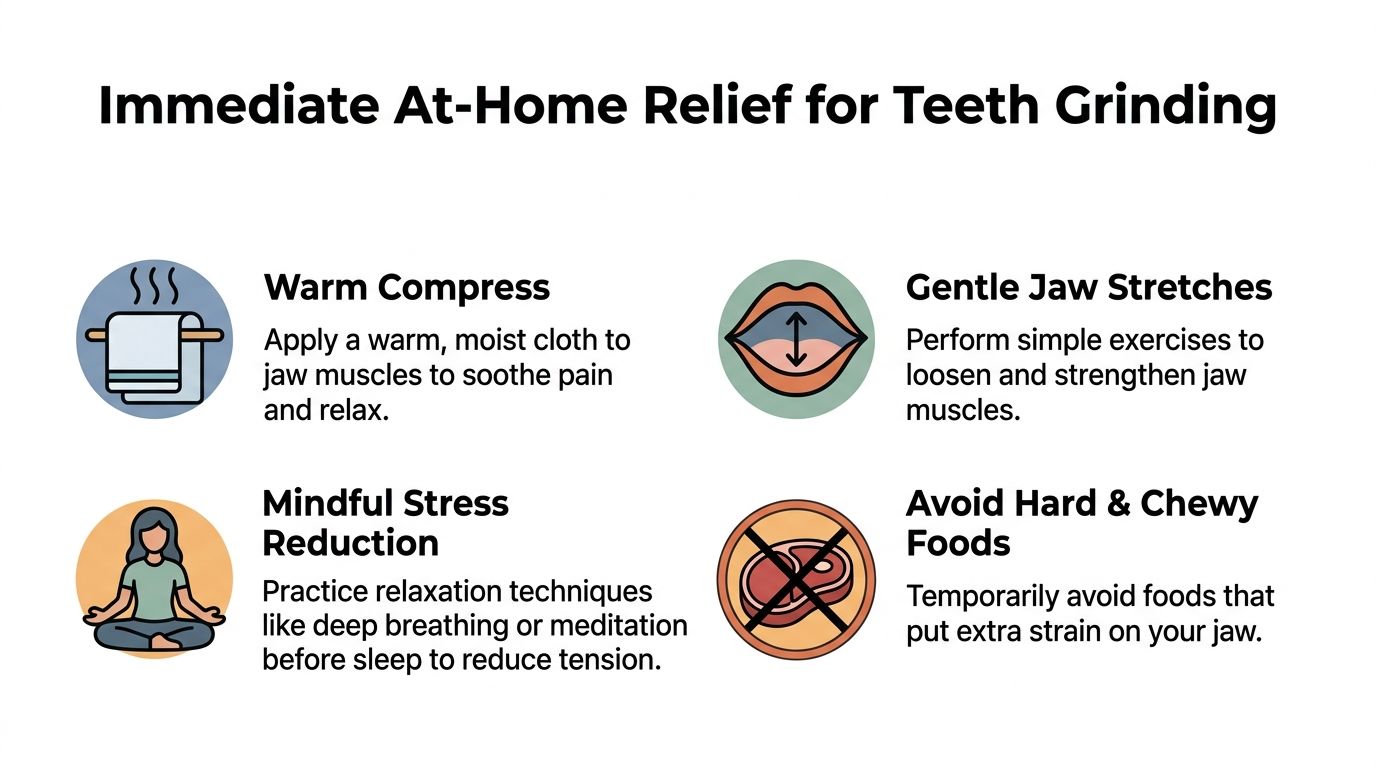
A good evening routine can include:
- Warm compress held against the jaw muscles for a few minutes
- Gentle opening and closing without forcing a stretch
- Light massage over the cheeks and temples
- A softer dinner if chewing feels tiring
The goal is not to work the jaw harder. It is to give the muscles permission to settle down.
Reduce habits that keep the jaw activated
Some everyday behaviors make symptoms worse without people realizing it.
- Skip gum for now because repeated chewing can keep the muscles overactive
- Avoid chewing ice, pens, or fingernails because the jaw reads all of that as more work
- Pause hard or chewy foods if your jaw already feels irritated
- Notice clenching during focus such as emails, driving, or workouts
For many patients, daytime tension and nighttime grinding feed each other. Interrupting that cycle matters.
Calm the nervous system at night
Stress does not cause every case of bruxism, but it does contribute for many people. Evening wind-down habits can help reduce the intensity of nighttime clenching.
Some useful options include:
Slow breathing before bed
A few quiet minutes of nasal breathing can lower physical tension.Screen limits late at night
If you tend to stay alert after scrolling or working, give your body more time to shift into sleep mode.Warm bath or shower
Heat can help reduce overall muscle tightness.Consistent sleep timing
Irregular sleep often goes along with more restless nights.
Helpful rule: If your day is full, your bedtime routine should be simple, not perfect. Even one or two calming habits can help.
Be selective with food and drink in the evening
Lifestyle choices later in the day can affect sleep quality and muscle activity. Cutting back on stimulants and irritants in the evening is a practical move if you are trying to figure out how to stop grinding teeth at night.
A few examples:
- Caffeine late in the day can make sleep lighter or more fragmented
- Alcohol at night may seem relaxing at first but can worsen sleep quality
- Smoking can aggravate both oral health and sleep-related issues
You do not need an extreme reset overnight. Start by changing one evening habit and see whether mornings feel different over the next week or two.
Know what home care cannot fix
If teeth are chipping, sensitivity is increasing, or jaw pain is becoming frequent, home care alone is not enough. It can ease symptoms, but it cannot reverse tooth wear or diagnose why the grinding is happening.
That is where professional dental care becomes important. A dentist can check bite patterns, wear damage, jaw function, and whether your symptoms point to a deeper sleep issue.
The Hidden Link Between Nighttime Grinding and Sleep Apnea
A lot of online advice treats grinding like a simple stress habit. Sometimes it is. Sometimes it is not.
For some patients, nighttime grinding is tied to obstructive sleep apnea, which means breathing repeatedly becomes restricted during sleep. That changes the conversation completely, because the grinding may be a sign that your body is reacting to disrupted breathing.
Why this connection matters
Recent studies show that up to 40% of patients with obstructive sleep apnea also exhibit sleep bruxism, and in some cases a standard night guard can inadvertently worsen sleep-disordered breathing (209nycdental.com).
That means a generic answer is not always the right answer. A night guard may still be useful for many patients, but it should be selected in the context of your airway, bite, and sleep symptoms.
Clues that point beyond grinding alone
Grinding deserves a closer look if it shows up alongside:
- Loud snoring
- Dry mouth on waking
- Morning fatigue
- Frequent waking at night
- Daytime sleepiness
- Headaches that feel tied to poor-quality sleep
Some patients come in focused on worn teeth and leave realizing the larger issue may be sleep quality.
Important point: If grinding is part of an airway problem, tooth protection alone may not fully solve the problem.
Why screening comes before guessing
This is one reason a careful dental exam matters. Dentists can look for tooth wear and jaw strain, but also for signs that suggest your sleep may need closer evaluation.
If you have wondered whether your symptoms line up with sleep-disordered breathing, this page on sleep apnea signs and evaluation is a useful next step.
Patients often ask about internet remedies when they suspect airway issues. Some people also read about mouth taping for sleep apnea. It helps to review those ideas carefully, because not every strategy is appropriate for every patient, especially when breathing during sleep is part of the concern.
The safest approach is to treat nighttime grinding as a possible signal, not just a symptom to cover up. If sleep apnea is contributing, a more complete plan can protect your teeth and support better sleep at the same time.
How Professional Dental Care in Las Vegas Can Stop Grinding Damage
When patients want a real answer for how to stop grinding teeth at night, professional treatment usually comes down to two goals. First, protect the teeth and jaw from more damage. Second, identify whether the cause is primarily muscle tension, bite imbalance, airway-related sleep disruption, or a combination.
Custom night guards are the starting point for many patients
A custom-fitted night guard, also called an occlusal splint, is often the first treatment dentists recommend for sleep bruxism. It creates a protective barrier between the teeth and helps distribute force more evenly.
Custom-fitted night guards are the first-line intervention for sleep bruxism, with studies showing a 77 to 90% reduction in grinding episodes, and dentist-made guards outperform over-the-counter versions by 2 to 3 times in alignment efficacy (stadium-dental.com).
That difference matters. Store-bought guards may seem convenient, but poor fit can make them bulky, unstable, or uncomfortable. A custom guard is made to fit your bite, which improves protection and makes nightly use more realistic.
For patients comparing options, this page on custom night guards in Las Vegas explains how dentist-made appliances are designed and adjusted.
What a custom appliance can and cannot do
A night guard is excellent for protection. It helps reduce tooth-on-tooth wear, lowers the risk of chips and cracks, and may ease pressure on the jaw joints.
It is not a cure for every cause of grinding.
If the underlying issue is stress, sleep apnea, or a bite problem, the appliance works best as one part of a broader plan. That is why a professional exam matters more than grabbing the first appliance you see online.
Here is a quick comparison:
| Option | Main advantage | Main concern |
|---|---|---|
| OTC boil-and-bite guard | Easy to buy | Fit may be poor |
| Custom night guard | Designed for your bite | Requires dental visit |
| No protection | No adjustment period | Ongoing wear and fracture risk |
Bite correction can reduce uneven pressure
Some patients do not grind because they are anxious. They grind because the bite does not come together in a stable way. If certain teeth hit too early or too hard, the jaw muscles may compensate.
In those cases, your dentist may recommend:
- Bite evaluation to identify uneven contact
- Selective reshaping in limited situations if small adjustments are appropriate
- Orthodontic treatment, such as Invisalign, when alignment is contributing to the problem
- Restorative care if worn or damaged teeth have changed the bite over time. These situations often involve an overlap of general, cosmetic, and restorative dentistry.
A short video can help if you want a visual overview of grinding and treatment options.
Severe muscle tension may need additional treatment
When masseter muscles are overactive and symptoms are persistent, some patients may benefit from additional therapies. Dentists may discuss approaches that reduce muscle force when a guard alone is not enough.
The right option depends on your exam, symptom pattern, and whether your jaw pain is mostly muscular, joint-related, or both. The key is matching treatment to the actual problem instead of assuming every grinder needs the same appliance.
Clinical reality: What works best is often not the most advertised option. It is the treatment that fits your bite, your symptoms, and your sleep pattern.
If damage is already done, restoration may be part of treatment
Many patients do not seek care until a tooth chips, sensitivity becomes hard to ignore, or their smile starts to look worn down. At that point, protecting the teeth is still step one, but rebuilding them may also be necessary.
Depending on the damage, treatment can include:
- Bonding for small chips
- Crowns for teeth weakened by heavy wear or fractures
- Veneers when front teeth have visible shortening or edge damage
- Invisalign if grinding has contributed to spacing or bite changes
- Dental implants if a tooth cannot be saved
- All-on-4 in extreme full-arch situations involving major damage and tooth loss
Aspiring Smiles Dental and Braces provides custom night guards along with restorative and cosmetic treatment such as Invisalign, crowns, veneers, teeth whitening, and implant care for patients who need both protection and repair.
When urgent care is the right move
Grinding is not always a routine issue. Sometimes it becomes an emergency dentist problem.
Call promptly if you have:
- A cracked tooth with pain
- Sudden swelling
- A broken crown
- Sharp pain when biting
- A tooth that feels loose after heavy clenching
In those cases, treatment is not just about comfort. It is about preserving the tooth before the damage spreads.
Your Consultation at Aspiring Smiles Dental and Braces
A first visit for grinding should feel straightforward. Patients are usually tired of searching symptoms online and want someone to look carefully, explain clearly, and recommend what makes sense.
What happens when you come in
Your appointment starts with a conversation. Dr. Patel will want to know what mornings feel like, whether you have headaches, whether someone has heard you grind, and whether your teeth have become more sensitive or fragile.
From there, the exam focuses on signs that matter:
- Wear on the biting surfaces
- Small fractures or chips
- Muscle tenderness
- Jaw joint movement
- Bite alignment
- Areas that may need imaging or closer evaluation
If needed, digital dental x-rays can help show the condition of teeth and supporting structures. For many new patients, this visit also works well as a new patient exam and routine dental checkup, especially if it has been a while since their last visit.
The visit is about pattern recognition
Grinding is rarely diagnosed from one symptom alone. A dentist puts several clues together. A flattened molar, jaw tenderness, sensitivity, cracked enamel, and sleep complaints create a more useful picture than any one issue by itself.
That matters because treatment decisions change based on that pattern. One patient may need a night guard first. Another may need bite correction. Another may need referral for sleep evaluation before settling on an appliance.
If your teeth already show wear
This is a common question in the chair. Patients ask whether the damage can be fixed or if they have missed the window.
The answer depends on how much structure has been lost, but there are usually options. For patients with long-term damage from chronic grinding, modern restorative dentistry can be life-changing. After protecting the bite with a custom guard, treatments like crowns or veneers can fix severe wear, while options like All-on-4 dental implants can fully restore a smile in extreme cases (rejuv-health.com).
A local practice should feel easy to work with
Patients from Sun City Summerlin, Painted Desert Estates, Desert Shores, Lone Mountain, Monterrey, Sunhampton, and Mar-A-Lago often want convenience as much as they want answers. They need care that fits work, family schedules, and the practicalities of daily life in Las Vegas.
That is why a good consultation should leave you with:
- A clear diagnosis or working explanation
- A practical treatment plan
- A sense of urgency if a tooth is at risk
- Next steps for both protection and long-term care
What patients usually want most: relief now, prevention going forward, and a plan they can follow.
If you are also thinking about your smile more broadly, grinding care can connect naturally with other services. Some patients need only a protective appliance. Others combine treatment with cosmetic dentistry near me searches for veneers or whitening after worn teeth are repaired. Some move into restorative dentistry, crowns, or even dental implants near me if a damaged tooth cannot be saved.
The right plan is personal. It should reflect your symptoms, your goals, and what your teeth need today.
Frequently Asked Questions About Teeth Grinding
Can children grind their teeth too
Yes. Children can grind at night, and parents sometimes hear it before a child notices any symptoms. If your child complains of jaw soreness, headaches, or tooth sensitivity, a dental exam is a smart next step.
Will a night guard feel uncomfortable
A custom night guard usually feels far more natural than an over-the-counter version because it is made for your bite. Most patients need a short adjustment period, but a properly fitted appliance should not feel loose or bulky.
Can grinding crack a tooth
Yes. Repeated pressure can chip enamel, worsen existing weak spots, and lead to fractures. If a tooth suddenly hurts when biting, call for an exam.
Is stress the only cause
No. Stress is common, but grinding can also be connected to bite issues, sleep disruption, and sleep apnea. That is why treatment should start with diagnosis, not assumptions.
Are there good self-care resources to read before my visit
Yes. If you want to review additional home-based ideas, this guide on strategies to stop teeth grinding at night gives a helpful overview. It is still best to have persistent symptoms evaluated professionally.
Does dental insurance cover treatment
Coverage varies by plan and by the type of treatment involved. A night guard, restorative treatment, or emergency repair may each be handled differently. The simplest approach is to have your benefits reviewed during scheduling or at your visit.
If you are waking up with jaw pain, noticing worn teeth, or dealing with a chipped tooth that may be related to grinding, schedule an appointment with Aspiring Smiles Dental and Braces. Patients across Las Vegas, NV, including Desert Shores, Sunhampton, Sun City Summerlin, Monterrey, Lone Mountain, Mar-A-Lago, and Painted Desert Estates, can get a thorough exam, clear guidance, and a treatment plan built around protection, comfort, and long-term oral health.