
Invisalign vs Braces for Adults: A Practical Guide
If you're a working adult in Las Vegas weighing Invisalign against braces, you probably aren't asking which treatment looks more modern. You're asking which option will fit your meetings, meals, travel, dental history, budget, and patience. You may also be searching for a dentist near me in Las Vegas, NV who can explain the trade-offs without pushing one treatment on everyone.
The practical answer is simple: Invisalign is often the better fit for mild-to-moderate cases when appearance and removability matter. Braces are usually the safer choice for complex tooth movements, extraction cases, and patients who don't want to manage daily wear time. The right decision depends on your bite, not on popularity.
Why Adults Are Choosing Between Invisalign and Braces
A professional in her late thirties comes into a Las Vegas consultation with two plans in mind. She wants straighter teeth before an important change at work, but she also has client meetings, frequent coffee breaks, and an old filling that needs attention. Invisalign sounds easier to hide. Braces sound more dependable. Her real question isn't “Which is better?”
It's “Which treatment is better for my bite, my routine, and my willingness to follow through?”
That question matters because adults often bring more variables to orthodontic treatment than younger patients. Gum recession, crowns, bridges, implants, worn teeth, previous orthodontic treatment, and bite discomfort can all affect the plan. An adult who has already invested in restorative dentistry should have those restorations assessed before any tooth movement begins.
Appearance is only one part of the decision
Invisalign has an obvious appeal for adults who work with customers, lead meetings, appear on camera, or just don't want brackets in photographs. You can remove the aligners for eating and special occasions, although they need to go back in promptly. Braces remain visible, even when you choose ceramic brackets instead of metal.
That convenience doesn't make Invisalign automatically superior. Clear aligners are removable, so the outcome depends on your daily habits. Fixed braces stay on your teeth and continue applying force without asking you to remember a tray after lunch.
The useful question isn't which appliance is more attractive. It's which appliance gives your dentist enough control to move your teeth safely and predictably.
Adults should think beyond the finish date
The appliance is only one stage of treatment. Your dentist also needs to plan for cleaning and exams, dental X-rays, gum health, refinements when needed, and retention after active movement ends. Teeth can shift after either Invisalign or braces, so the retention plan deserves the same attention as the initial appliance.
A 2025 review of seven randomized controlled trials included 402 patients, divided evenly between clear aligners and fixed appliances, with a mean participant age of 24.8 years. It found better aligner results in specific domains, but no significant difference in overall treatment quality or duration for non-extraction cases, supporting a case-by-case decision for many adults (the randomized evidence review).
How Invisalign and Braces Actually Work
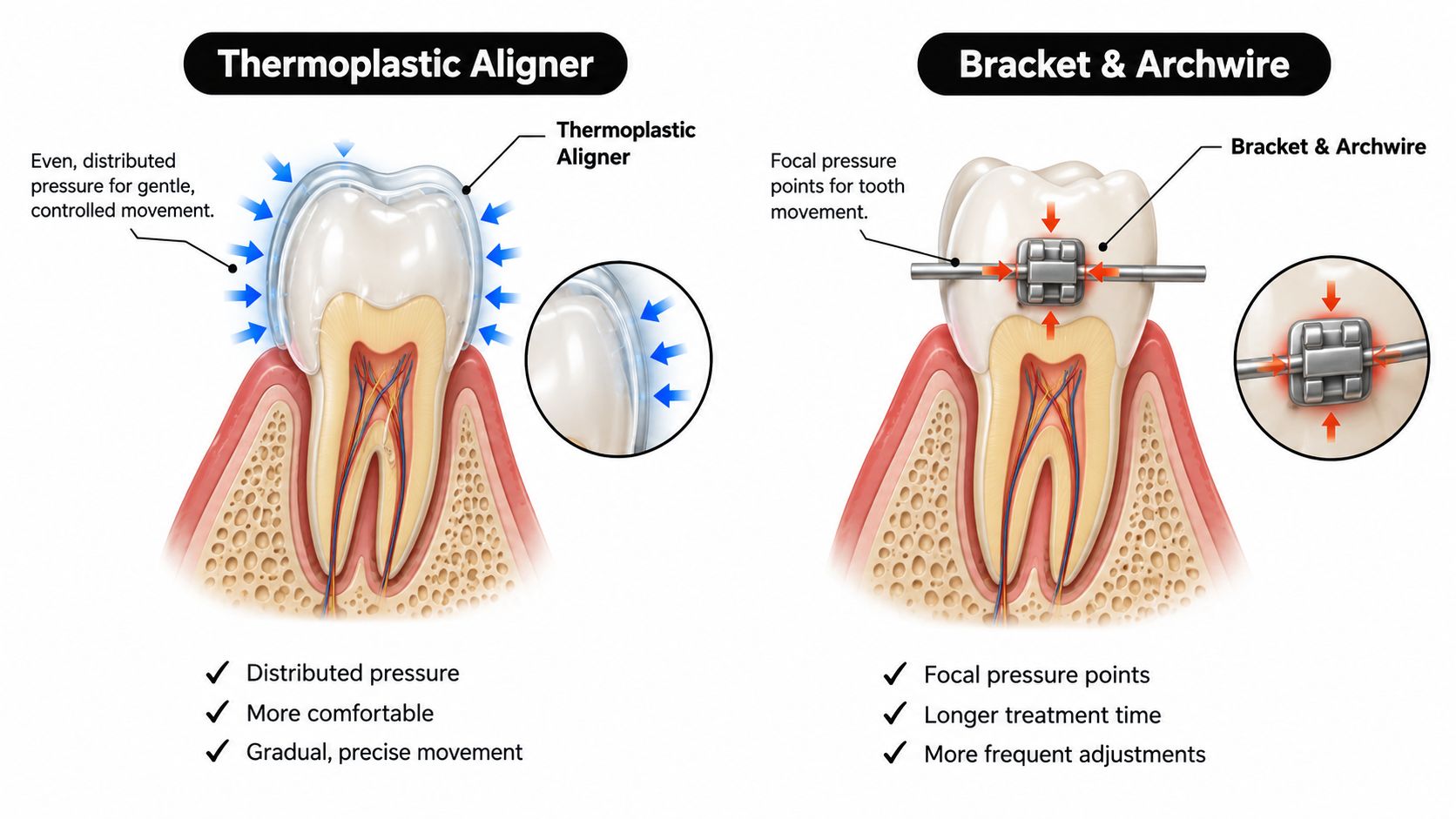
Both treatments move teeth by applying controlled force over time. The difference is how that force reaches each tooth and how much responsibility sits with the patient.
Invisalign uses a sequence of custom-made thermoplastic trays. Each aligner is shaped for a particular stage of movement. Adults typically wear each tray 20 to 22 hours per day and change aligners every one to two weeks, following the doctor's instructions (Invisalign's guidance for complex cases). The aligners are planned from digital scans and a staged treatment design, then adjusted when the clinical response calls for it.
You remove the trays to eat, drink anything other than water, brush, and floss. The removable design makes normal eating possible, as Invisalign's patient guidance explains, but it also creates a daily compliance task (Invisalign's explanation of food and aligner use).
Traditional braces use brackets bonded to the teeth and connected by archwires. Your dentist or orthodontist adjusts the wires during scheduled visits so the brackets guide teeth toward planned positions. Braces remain fixed, so you don't need to remember to put them back after a meal. You do need to clean carefully around the brackets and follow instructions about foods that can damage the appliance.
Neither system moves teeth by magic. The supporting tissues around the roots gradually adapt to controlled pressure. Clear aligners deliver that pressure through a removable tray, while braces use bonded brackets and wires that provide direct tooth-by-tooth control.
A digital scan can show the intended sequence, but it doesn't replace an examination. Your dentist still needs to assess your bite, gums, roots, existing restorations, and the health of each tooth before recommending treatment. For a plain-language overview, review how Invisalign works for adults.
Side by Side on Effectiveness, Time, Comfort, and Aesthetics
A useful Invisalign versus braces comparison has to look past the smile in a photograph. Effectiveness, treatment duration, comfort, appearance, and maintenance all matter, but they don't carry equal weight for every adult.
Effectiveness depends on the movement
For routine non-extraction cases, randomized evidence suggests clear aligners can perform comparably to braces in overall treatment quality and duration. A separate 2024 study of 100 adult orthodontic patients reported a 75% PAR reduction with clear aligners and an 80% reduction with braces over the study period. It also reported average treatment times of 14.5 months for aligners and 16.2 months for braces (the comparative adult study).
The evidence becomes less favorable for aligners in harder cases. A 2020 review of 11 comparative studies involving 887 mostly adult patients found worse occlusal outcomes with aligners, including an ABO Objective Grading System score 9.9 points worse and a higher risk of an unacceptable result, with a reported relative risk of 1.6 (the adult comparative meta-analysis).
That doesn't make Invisalign a poor treatment. It means your dentist should match the system to the movement required.
Time isn't guaranteed to favor aligners
Some adult cases finish sooner with aligners, especially when the movements are limited and wear is consistent. Other cases take longer because trays need refinement or the teeth don't track as planned. Independent research has reported average treatment times of about 1.7 years for Invisalign compared with 1.3 years for braces in one finished-case study, while another reported mean times of 18 months for Invisalign and 24 months for conventional braces (the independent treatment-time review).
The honest promise is not “Invisalign is always faster.” The honest promise is a treatment plan based on your records.
Comfort and appearance favor different priorities
Aligners are smooth and don't have brackets or wires rubbing against the cheeks. You may still feel pressure when changing trays, and speech can feel different at first. Braces can irritate the cheeks and lips, and a loose bracket or wire may require a prompt visit.
Aligners are the more discreet option and can be removed for a photograph or presentation. Ceramic braces are less conspicuous than metal braces, but they're still fixed to the teeth.
| Dimension | Invisalign | Traditional Braces |
|---|---|---|
| Force delivery | Staged force through removable trays | Continuous guidance through brackets and archwires |
| Appearance | Clear and removable | Visible, with ceramic options available |
| Eating | Remove before eating, normal food choices are possible | Food choices may need adjustment to protect brackets and wires |
| Daily responsibility | High, because wear time affects progress | Lower for appliance wear, higher for cleaning |
| Complex movements | May be less predictable for some difficult movements | Often offers stronger control for complex corrections |
| Hygiene | Remove trays to brush and floss normally | Clean carefully around brackets and wires |
| Retention | Required after treatment | Required after treatment |
Which Cases Each Option Handles Best
Case selection should come before appliance preference. A clear tray may be an excellent choice for one adult and the wrong tool for another adult with a similar-looking smile.
Aligners suit controlled, routine corrections
Invisalign is often a sensible recommendation for mild crowding, spacing, minor relapse, and selected moderate bite problems. It can also suit an adult who places a high value on a discreet appearance and can reliably wear the trays as directed.
The randomized review cited earlier found that aligners and braces can produce comparable overall outcomes in many non-extraction cases. That supports aligners for appropriate routine cases, not for every orthodontic problem.
Braces remain attractive when the clinician needs direct control over rotations, torque, vertical movement, or the relationship between upper and lower teeth. A review of clear aligner evidence notes that fixed appliances can offer better control in extraction cases and for certain movements, including torque, rotation, and occlusal contacts. The same review discusses treatment-time advantages for Invisalign in some situations alongside concerns about relapse and case selection (the review of Invisalign effectiveness and stability).
| Malocclusion type | Invisalign suitability | Traditional braces suitability | Clinical notes |
|---|---|---|---|
| Mild crowding or spacing | Often a strong fit | Also effective | Appearance and removability may favor aligners |
| Minor relapse after earlier orthodontics | Often suitable | Suitable | The dentist must assess the current bite and retention history |
| Moderate bite correction | May work in selected cases | Often predictable | Wear-time consistency matters with aligners |
| Significant rotations or difficult tooth positioning | May be limited | Usually more predictable | Fixed control can help with demanding movements |
| Extraction treatment | Requires careful evaluation | Often preferred | The clinician should explain mechanics and risks clearly |
| Existing bridges, implants, or large restorations | Individual assessment required | Individual assessment required | Treatment planning must account for teeth that won't move normally |
| Gum recession or reduced tooth support | Requires periodontal evaluation | Requires periodontal evaluation | Appliance choice doesn't replace gum-health management |
Certain findings deserve an in-person examination before you choose. Short clinical crowns, gum recession, large restorations, previous jaw-joint symptoms, and a history of gum disease can change the plan. So can impacted teeth, severe bite discrepancies, or any situation where tooth movement may affect an implant or bridge.
What Adults Really Pay for Each Option
Cost comparisons become misleading when they show only the initial appliance fee. An adult treatment plan can also involve records, scans, visits, refinements, retainers, replacement trays, and treatment for cavities or gum problems discovered during the examination.
The verified clinical sources provided for this guide don't establish a reliable Las Vegas price range, so you shouldn't treat a national estimate as a quote for your case. Ask for a written plan that states what the fee includes. Some offices bundle scans, refinements, retention, and follow-up care. Others list some of those items separately.
Ask what happens if the plan changes
With Invisalign, ask how the practice handles a lost tray, a tray that no longer fits, and additional refinement aligners. With braces, ask whether broken brackets, replacement wires, and extra visits carry separate charges. The cheapest starting figure may not be the lowest total cost if important stages sit outside the package.
Insurance benefits also vary by policy. An adult dental plan may exclude orthodontics, impose an age restriction, or apply a lifetime orthodontic maximum. Your dental office can help verify benefits, but the insurer's written estimate should control your expectations.
Use a written comparison that includes:
- Included records: Confirm whether examination, X-rays, scans, and treatment planning are covered.
- Refinement policy: Ask whether additional aligners are included if teeth don't track as planned.
- Retention coverage: Find out whether the first retainers and future replacements are part of the fee.
- Payment schedule: Compare the deposit, monthly payments, and any financing terms.
- Related dental care: Complete needed fillings, cleanings, gum treatment, tooth extraction, or restorative dentistry before orthodontic movement when advised.
A payment plan can make either option easier to manage, but it shouldn't be used to justify a treatment that doesn't fit your clinical needs. If you're also searching for dental implants near me, a cosmetic dentist near me, or a tooth extraction provider, coordinate those services with the orthodontic plan rather than treating them as unrelated purchases.

Compliance, Lifestyle, and Retention After Treatment
Your workday can determine whether Invisalign is a smart choice. Removable trays make meals, brushing, and important meetings easier, but every removal creates another chance to lose treatment time. If coffee breaks, travel, presentations, or family routines keep the trays out for long stretches, treatment can slow and refinements may become necessary.
A 2025 study found no significant difference in compliance between aligner and fixed-appliance patients during the first 12 months (the 2025 compliance study). Do not assume removable trays are easier to follow. Choose Invisalign only if you can put the trays back after eating or drinking and keep that routine on busy days.
Braces eliminate the daily wear-time decision, which makes them the safer compliance choice for some adults. They still require disciplined brushing, flossing around brackets, and quick attention when a wire or bracket breaks. If you travel for work, ask your orthodontic office how repairs are handled when you are away and what symptoms require an urgent visit.
Retention is part of the treatment
Your teeth can shift after either appliance. Retainers hold them in position while the supporting tissues adjust. Adult guidance commonly recommends fuller-time retainer use at first, followed by nighttime wear for many patients (adult retainer guidance).
Aligner treatment generally depends on 20 to 22 hours of daily wear, and long-term retention may require extended or indefinite nighttime use (the 2025 compliance study). The practical recommendation is straightforward: select the appliance whose daily routine you can maintain, then treat retainers as part of ongoing dental care.
For Invisalign, store trays safely, clean them before reinserting, and do not leave them out for an afternoon. For braces, protect brackets and remove plaque around them carefully. Both options require consistent retention, not a short final phase. Review retainer care after Invisalign before choosing clear aligners, especially if you want a realistic picture of the routine after treatment.
Choosing the Right Option and Taking the Next Step
Three adult profiles make the decision easier.
The appearance-first patient has mild crowding or spacing, healthy gums, no major restorative complications, and a reliable routine. Invisalign is usually the first option to discuss because the patient values discretion and can manage removal, cleaning, and wear time.
The complex-correction patient needs extraction treatment, major rotations, difficult bite correction, or movement involving teeth with challenging positions. Braces deserve serious priority because fixed appliances may provide more predictable control.
The flexible moderate-case patient could succeed with either option. This person should choose based on the treatment plan, not the brand. If the dentist can achieve the same clinical goals with either appliance, lifestyle and appearance can reasonably decide the final choice.
Three questions should guide your consultation:
- How complex is my malocclusion? Ask which tooth movements are required and whether the plan involves extraction, elastics, attachments, or refinements.
- Can I follow the daily routine? Be honest about meals, coffee, travel, presentations, and whether you'll consistently put aligners back in.
- Will I maintain retention? If you don't want a long-term retainer routine, orthodontic treatment may not deliver a stable result.
An in-person examination is essential if you may need extractions, have a history of gum disease, have bridges or implants, or may be a candidate for jaw surgery. Bring a list of medications, prior dental records if available, and your concerns about comfort, visibility, and scheduling.
At a Las Vegas consultation, ask for two written plans when both are clinically reasonable. Compare the proposed movements, estimated duration, number of aligners or adjustment visits, refinement policy, emergency care, and retainer coverage. Don't compare only the first price shown on a brochure.

A local practice also has to make the decision easy to find and easy to schedule. For dental offices reviewing how patient acquisition supports consultation growth, PPC for dentists that works offers a useful discussion of paid search strategy without replacing the clinical consultation.
If you're in Las Vegas, Desert Shores, Sunhampton, Sun City Summerlin, Monterrey, Lone Mountain, Mar-A-Lago, or Painted Desert Estates, schedule an orthodontic consultation before choosing between Invisalign and braces. Ask the dentist to examine your bite, gums, restorations, and X-rays, then explain which option offers the most predictable result for your specific goals.
Aspiring Smiles Dental and Braces offers Invisalign consultations, traditional braces, complete dental exams, dental X-rays, restorative care, and emergency dental services for Las Vegas adults. Visit Aspiring Smiles Dental and Braces to request an appointment and receive a treatment plan based on your bite, lifestyle, and long-term retention needs.