Implant Maintenance Guide for Las Vegas Patients
If your implant feels fine, do you still need a maintenance visit? A lot of people treat a titanium post like a filling that is finished forever. The post does not decay. The gum and bone around it still can, and trouble often stays quiet until a cleaning is skipped.
That is the gap in the usual advice. A calendar reminder every six months is not a plan. Implant maintenance is set from your risk, and a missed recall is a missed early warning, not just a missed polish. If you are looking for a dentist near me or a dentist in Las Vegas, NV, the useful question is how often your gums need a look, not how often a brochure says to come in.
Families in Lone Mountain, Desert Shores, and Mar-A-Lago often notice bleeding before they notice pain. At Aspiring Smiles Dental and Braces we build that follow-up into regular cleaning and exams, the same way we watch natural teeth.
How Often Implants Need Professional Maintenance
How often should you book an implant check? For many patients, the interval is every 3 to 6 months, but your risk profile determines the schedule. A 2025 consensus statement recommends recall visits every 3 to 6 months, with timing adjusted for inflammation, plaque and calculus, tissue health, probing depths, restoration design, and other risk factors. After treatment for peri-implantitis, it describes an initial visit at three months, followed by visits every 3 to 4 months during the first year. Later intervals may be 3, 6, or 12 months, depending on risk.
Scottish guidance recommends at least one implant-maintenance visit a year. Smoking, poorly controlled diabetes, a history of periodontitis, or a restoration that is difficult to clean can mean shorter gaps. The schedule should reflect how your gums and implant are doing, rather than rely on a fixed calendar for everyone.
How risk changes the calendar
| Patient situation | Suggested visit interval | Why the interval changes |
|---|---|---|
| Healthy implant, stable gums, good home care | Every 3 to 6 months | Confirm the interval after each exam |
| No major risk factors | At least once a year, often every 6 months | Annual recall is the minimum in the cited guidance |
| Smoker | Every 3 to 4 months | Smoking raises the risk of peri-implantitis |
| Diabetes that is not well controlled | Every 3 to 4 months | Higher risk; coordinate blood sugar control with your physician |
| History of gum disease (periodontitis) | Every 3 to 4 months, with longer gaps only if tissues remain stable | Past periodontitis is a risk factor |
| After peri-implantitis treatment | At 3 months, then every 3 to 4 months during the first year | Later intervals may be 3, 6, or 12 months, depending on risk |
These are starting points, not a promise that every patient needs the same interval. If your gums remain stable and home care is consistent, your dentist can reassess whether visits can be spaced farther apart. A history of gum disease, smoking, or poorly controlled diabetes may call for closer follow-up. After peri-implantitis treatment, keep the early appointments; later spacing depends on how the tissues respond.
Practical rule: If your gums bleed, swell, or look more inflamed than before, call your dentist to ask whether you should come in sooner. Do not wait for the next scheduled date.
Why showing up matters more than the perfect interval
A 2025 systematic review found that attending supportive periodontal or peri-implant care was consistently associated with shallower probing depths, less bleeding, and lower tooth or implant loss. Only seven studies were comparable enough to review, and no meta-analysis was possible. Many implant patients do not keep up with recommended supportive visits, which can leave changes unnoticed between appointments.
Inflammation may begin without pain. Regular visits help identify changes over time, while they are easier to address. For an explanation of the purpose of ongoing care, see the maintenance guidance from Periodontal Associates of Delaware.
What Happens During Each Maintenance Visit
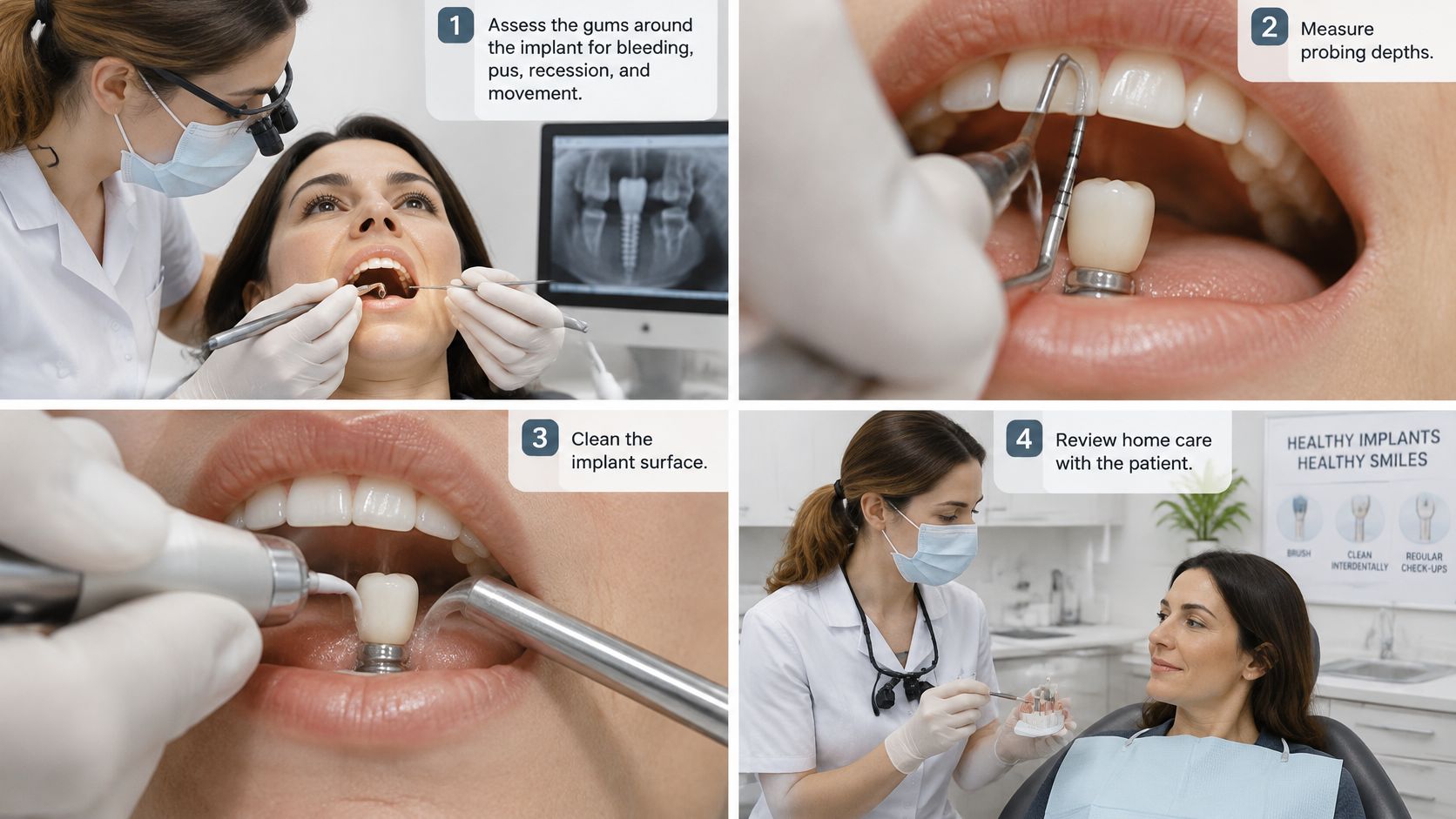
Say you come in from Sun City Summerlin with an implant crown that feels normal. The appointment is still a full check, not a quick polish. A repeatable four-step supportive peri-implant care visit is laid out in guidance in the British Dental Journal. Patients are enrolled in supportive care once the implant is loaded, and the recall is adjusted to risk rather than locked to one date for everyone.
The four steps, in order
- Assess the tissues. We examine plaque, bleeding on probing, probing depths, pus, gum recession, movement, and problems with the crown or denture. Those numbers get compared with your baseline record, not with a guess from last year.
- Reinforce home care. The hygienist watches how you brush and clean between teeth, points out spots you cannot see, and discusses smoking, blood sugar, past gum disease, and contours that block a brush.
- Remove biofilm. Plaque and tartar above and just below the gumline come off with instruments selected so they do not scratch the implant or the restoration.
- Treat or refer. If a site is infected, we do not book another cleaning without action. The dentist treats it or refers you when specialist care is the safer next step.
Dental x-rays are taken when the exam calls for them, so crestal bone can be compared with earlier films. They are not automatic at every visit.
A short clip shows how gentle probing and cleaning look from the chair:
Treating the visit as a cleaning-only service is a common miss. If tissue changes, plaque traps, or a crown you cannot reach go unwatched, inflammation can move on without you feeling it. Air polishing can lift biofilm during prevention. It is not a cure for established peri-implantitis. That disease needs treatment, not another pass with the same powder.
You leave with a written recall date, plus aftercare instructions and care guidelines for the weeks until you are back. That written date is how the risk-based spacing happens.
How to Clean Your Implant Every Day
Home care is where most plaque either gets cleared or sits at the neck of the implant. Use the method that fits your restoration, and fix the slip that usually causes trouble.
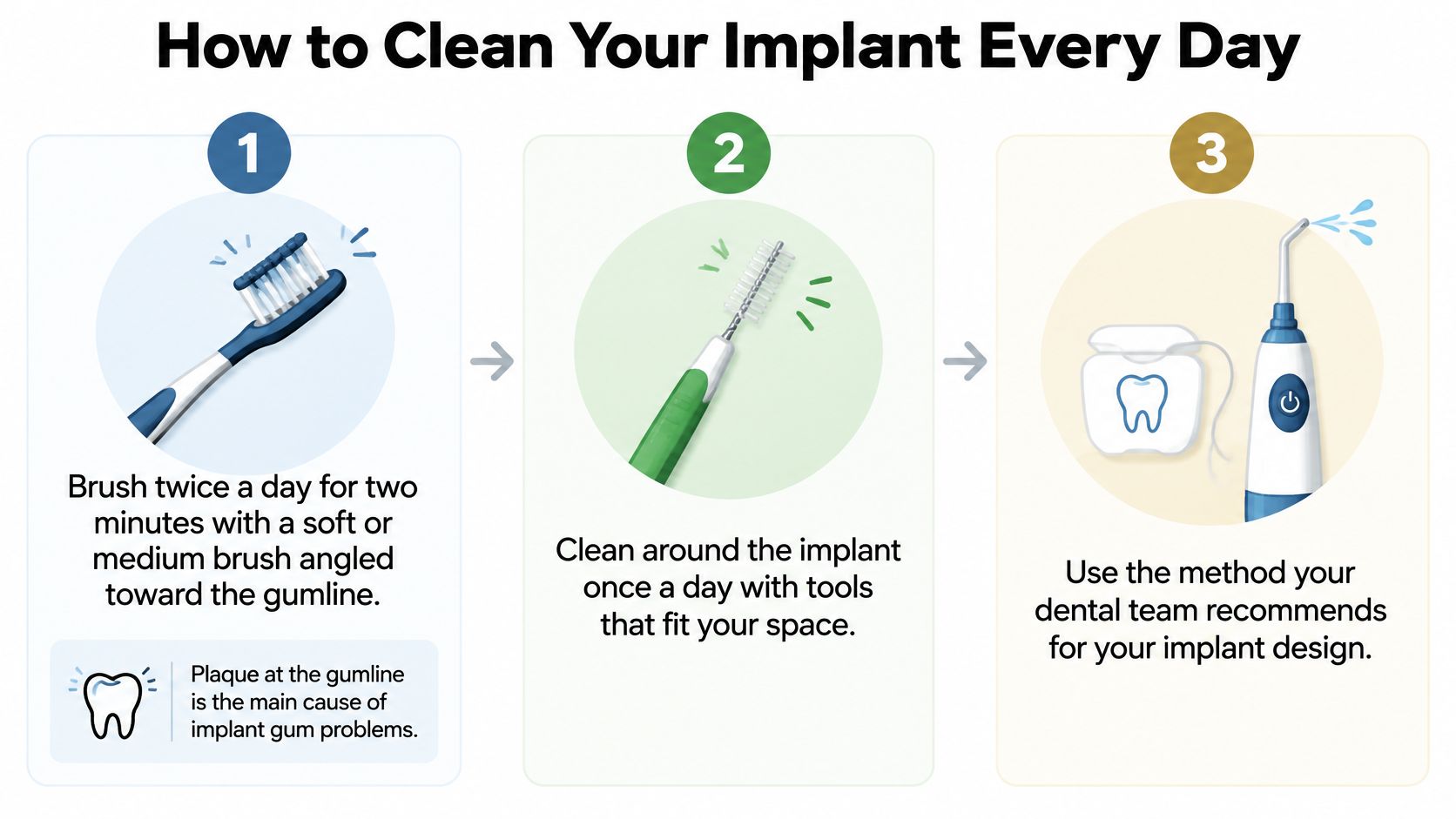
- Brush twice a day for two minutes with a soft or medium brush angled toward the gumline. Plaque at the gumline is the main driver of implant gum problems. Brushing harder does not clean better. It irritates the tissue and can push the gum back.
- Clean around the implant once a day with an interdental brush sized to the gap. It should slide in without forcing. That brush reaches the ring of plaque floss often misses. Skipping it is the mistake we see most.
- Use non-scratch floss or a floss threader along the implant and the neighboring teeth. Slide it. Do not snap it. Hard floss and metal picks can mark implant surfaces and porcelain.
- Add a water flosser on a low setting only if we have approved it for your restoration. Aim the tip along the gumline, not straight into the pocket. High pressure can be uncomfortable and is not more thorough.
- Rinse with water or an alcohol-free rinse. Use a prescribed rinse only when we recommend one. A harsh mouthwash is not a substitute for the brush.
- Check the gums in a mirror once a week. Note redness, bleeding, or tenderness so you can mention it at the next visit instead of hoping it fades.
What healthy looks like
After the first few days of careful cleaning, healthy tissue is firm and pink. It does not bleed, and it is not tender when you press it gently. A little bleeding on day one often means the area was already inflamed, not that the brush is wrong.
Ask the hygienist to watch you brush at the next visit. Thirty seconds of coaching on your own implant beats a generic floss demo.
Special Care for Crowns, All-on-4 and Implant Dentures
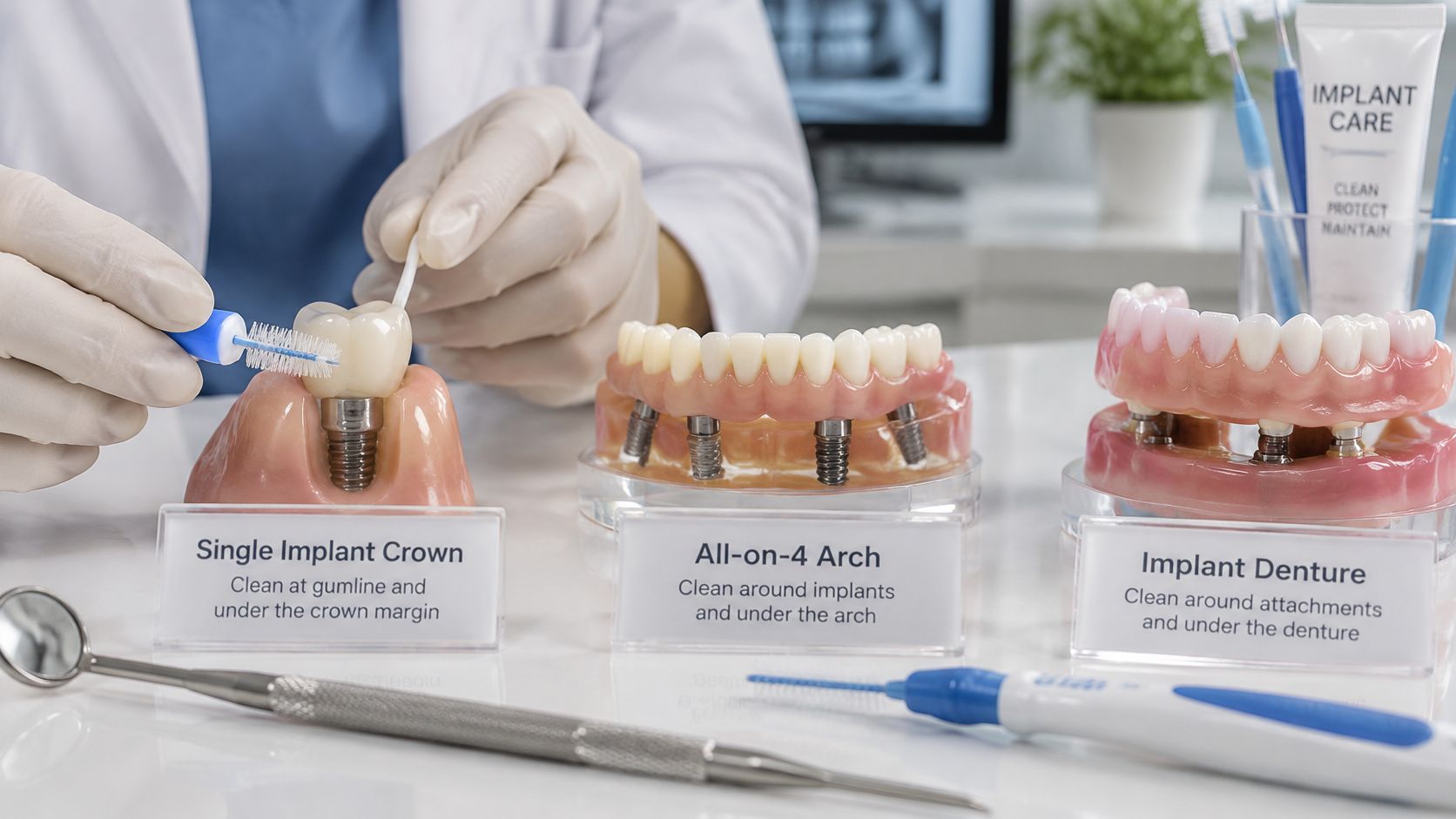
Each restoration traps plaque in a different place. The tool has to reach that place, or daily brushing only cleans what you can already see.
| Restoration | Where plaque hides | Tools to use |
|---|---|---|
| Single implant crown | Gumline and the gap between crown and gum | Soft brush, interdental brush, non-scratch floss |
| Implant bridge | Under the false tooth and between the units | Floss threader, bridge floss, interdental brush |
| All-on-4 fixed bridge | Under the bridge and around each implant post | Water flosser, interdental brush, soft brush |
| Implant-supported denture | Attachments, clips or bar, and the gumline | Denture brush, water flosser, non-abrasive denture cleaner |
Where people get stuck
A single implant crown needs attention at the gumline and in the small gap under the crown edge. An interdental brush plus non-scratch floss covers both. If the crown is bulky, tell us. Shape and access can be adjusted.
An implant bridge hides plaque under the false tooth and between the units. A floss threader or bridge floss is what gets under there. Regular floss from the biting surface never reaches it.
A fixed All-on-4 bridge rests on four implants. The spaces under the bridge and around each post need an interdental brush and, for many people, a water flosser on a low setting. If you cannot see the underside in a mirror, you are probably missing it.
An implant-supported denture is different from a traditional denture because the process involves a surgical procedure, so the daily routine is different too. Clean the attachments, clips or bar, the gumline, and the denture itself every day. Take it out overnight. Rinse it over a basin of water so a drop does not crack it. Clips wear and should be checked at visits, not replaced only after the denture rocks. More detail on the tissue side is in our guide to caring for the gums under implant-supported dentures.
If a bridge or denture stays hard to clean, we may reshape a contour or change the tool. Bring the restoration to the visit and ask the hygienist to demonstrate on it, not on a model.
Warning Signs That Need a Prompt Dental Visit
Comfort is a poor alarm. A 2025 cross-sectional study of 115 patients with 417 implants, seen during regular maintenance visits and published in Clinical Implant Dentistry and Related Research, found peri-implant mucositis in 67.8% of patients and peri-implantitis in 9.6%. Many of those implants still felt fine. That is why monitoring is part of care even when nothing hurts.
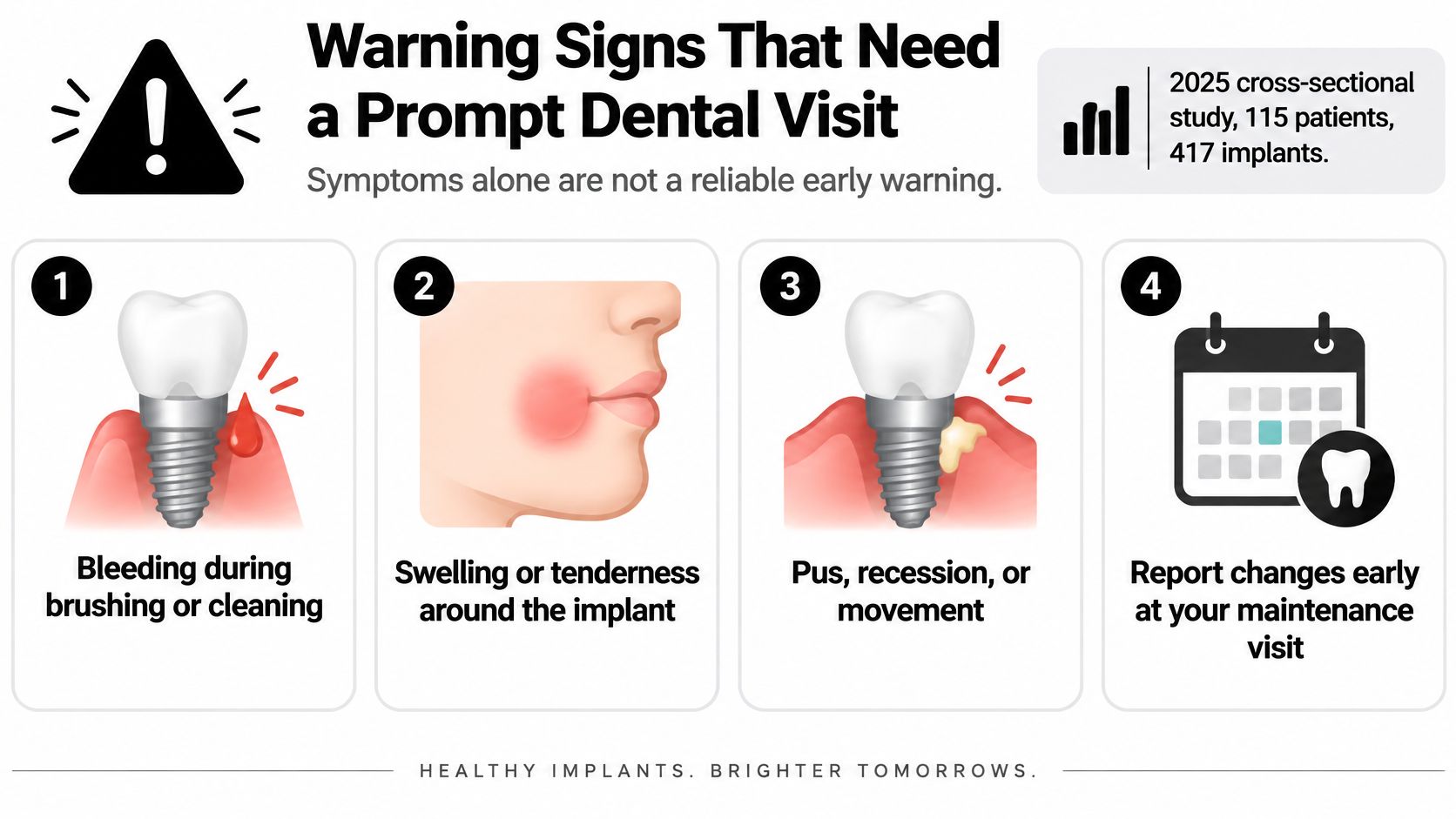
| Symptom | What it may mean | When to act |
|---|---|---|
| Bleeding when brushing or flossing near the implant | Early gum inflammation, often from plaque | Book a visit within a few weeks |
| Gum swelling, redness or tenderness | Inflammation spreading around the implant | Call for an exam within a few days |
| Pus or a bad taste near the implant | Possible infection (peri-implantitis) | Call the same day |
| Implant or crown feels loose or moves | Bone or component problem | Call the same day |
| Pain when biting on that side | Restoration or bite problem | Call the same day |
| Deep pocket or receding gum line | Loss of supporting tissue | Schedule an exam; X-rays if needed |
| Swelling spreading to face or neck, fever, trouble swallowing | Possible serious infection | Seek emergency care now |
Bleeding with brushing is often the first sign you can see, and a visit within a few weeks is enough if nothing else is changing. Swelling, redness, or tenderness should get a call within days. Pus, a bad taste, a loose crown, an implant that moves, or pain on biting all need a same-day call so the site can be checked before the weekend. A deep pocket or a receding gum line needs an exam and sometimes x-rays, even if it does not hurt.
Swelling that spreads to the face or neck, fever, or trouble swallowing or breathing is not a scheduled cleaning. That is emergency dentist care right away. For a shorter home checklist of changes that should not wait, see five signs you need to see an implant dentist.
Symptoms lag behind the tissue. If something looks different from your last visit, report it. Do not wait for pain to prove it.
Book Your Next Implant Maintenance Visit in Las Vegas
How can you make implant maintenance easier to keep? Choose an appointment time that works with your routine, then follow the interval your dentist sets based on your implant, gum health, and history. Aspiring Smiles Dental and Braces is located at 3211 N Tenaya Wy Suite 122, Las Vegas, NV 89129, and is led by Dr. Patel.
The practice offers dental implants and creates treatment plans around each patient's individual needs. At your maintenance visit, the dentist can assess your gums and restoration and confirm when to return. If you are checking the office details online, maintain consistent NAP across listings helps you match the practice name, address, and phone number.
What makes a visit easy to keep
- Online requests: Request an appointment online at a time that suits you.
- Hours: Extended weekday and Saturday hours offer scheduling options around work and school.
- Payment: The practice accepts insurance, offers flexible payment options, and has a membership program.
- New patient visit: Bring your implant placement date, current medications, notes about smoking or diabetes, and any dental records or X-rays you have.
A few details shared when booking can help the team understand what you need. If you want teeth whitening or other cosmetic dentistry on the natural teeth beside a crown, say so when you book.
Request an appointment online or call the office to schedule. The dentist can review your implant history and recommend a follow-up interval suited to your needs.
Aspiring Smiles Dental and Braces provides implant maintenance and follow-up for crowns, All-on-4 bridges, and implant-supported dentures. Dr. Patel and the team assess gum health, bite, and access for home care. Visit Aspiring Smiles Dental and Braces to request an appointment or a new patient consultation.