
All on 4 Teeth Explained: Cost, Candidacy and Recovery
For those needing a dentist near me because their denture slips when eating or missing most teeth in an arch and wanting fixed teeth again, All on 4 Teeth is worth understanding properly before booking. For patients looking for dental implants near me in Las Vegas, NV, the key isn't just whether four implants can hold a bridge. It's whether your bone, health, speech, cleaning routine, and budget fit a fixed bridge you'll maintain for years. This guide separates implant survival from the ongoing work of living with All on 4 Teeth, so you can compare plans with clear questions.
All on 4 Teeth at a Glance
Say you've worn a loose lower denture for years. You avoid crusty bread at dinner, cut meat into tiny pieces, and worry the denture will lift when you laugh. That daily frustration is what brings many adults to ask about All on 4 Teeth.
In plain terms, All on 4 Teeth means a full arch of replacement teeth, typically 12 teeth per arch, held by four dental implants. Two implants sit straight toward the front. The back two are angled to use the bone that's available and to spread support across the arch.
Think of four anchors holding a bridge deck. You don't need an implant under every tooth because the fixed bridge connects all four anchors together, and chewing force is shared across the whole structure.
How It's Different From a Removable Denture
A conventional denture rests on your gums and comes out at night. An All on 4 bridge attaches to the implants and stays fixed, so only your dentist removes it when needed for maintenance. That fixed connection is why chewing and speaking often feel more stable.
The approach grew from work described in Nobel Biocare's history of the All-on-4 treatment concept, which notes the concept was formally documented in a 2003 peer-reviewed retrospective clinical study by Paulo Maló and colleagues. It's now a widely used option for full-arch replacement, not an experimental shortcut.
Temporary fixed teeth can often be attached on the day of surgery when implant stability allows. Your final teeth usually follow after several months of healing, once the bone has bonded with the implants and your gums have settled.
Adults missing most or all teeth in one or both jaws who have enough bone are the typical candidates. At Aspiring Smiles Dental and Braces, a dentist in Las Vegas, NV led by Dr. Patel, every plan is reviewed in person, because a scan and exam tell us far more than a generic online quote ever can.
Who Qualifies for All on 4 Teeth
Age alone rarely decides this. What matters is what's happening in your jaw, your gums, and your medical history right now.
Before recommending All on 4 Teeth, your dentist checks bone volume and density on dental X-rays and 3D scans, gum health, medications, smoking, teeth grinding, and whether you can keep a fixed bridge clean. A new patient exam with proper imaging is the starting point, not an optional extra.
Upper and lower jaws don't behave identically. In a longitudinal study of 561 Japanese patients with 2,364 implants followed for as long as 17 years, cumulative survival at the patient level was 94.4% for maxillary treatment and 96.7% for mandibular treatment. That gap doesn't rule out upper-jaw treatment. It explains why upper-jaw planning gets extra attention to bone quality and early stability.
| Situation | Usually a Good Fit | Needs Closer Evaluation |
|---|---|---|
| Missing most teeth in the lower jaw | Yes, when bone volume is sufficient | Significant bone loss that needs planning |
| Missing most teeth in the upper jaw | Often, with careful imaging and planning | Lower long-term survival in some studies, so extra review |
| Current smoker | Possible after a risk review | Smoking lowers implant success, quitting plans are often advised |
| Diabetes | Yes, when blood sugar is well controlled | Uncontrolled blood sugar needs medical clearance first |
| Heavy nighttime teeth grinding | Possible with a night guard | Needs planning to protect the bridge and implants |
| Active gum disease | Suitable after treatment | Infection must be controlled before surgery |
When "Not Yet" Isn't "No"
Diabetes, smoking, and gum disease can often be managed before surgery. Gum infection gets treated first. Blood sugar control gets discussed with your physician. A realistic quit plan for smoking improves your odds and your healing.
Practical rule: Bring facts, not guesses. A clear medication and health list lets your dentist spot risks early, when they're easiest to manage.
Bring this checklist to your consultation:
- Current medications: List prescriptions, over-the-counter drugs, and supplements with doses.
- Past dental X-rays: Bring recent images if you have them, or ask for them to be sent.
- Medical conditions: Note diabetes, heart conditions, osteoporosis treatment, and immune issues.
- Implant or denture history: Tell us about past extractions, failed implants, or dentures that never fit well.
Ask how your jaw-specific risks change the proposed plan for dental implants near me. That answer should be specific to your scan, not generic reassurance.
How the All on 4 Procedure Works Step by Step
Knowing the order of the day removes most of the fear. Here's how All on 4 Teeth treatment usually runs, and why each step matters.
The overview below shows the main stages from planning to final teeth.
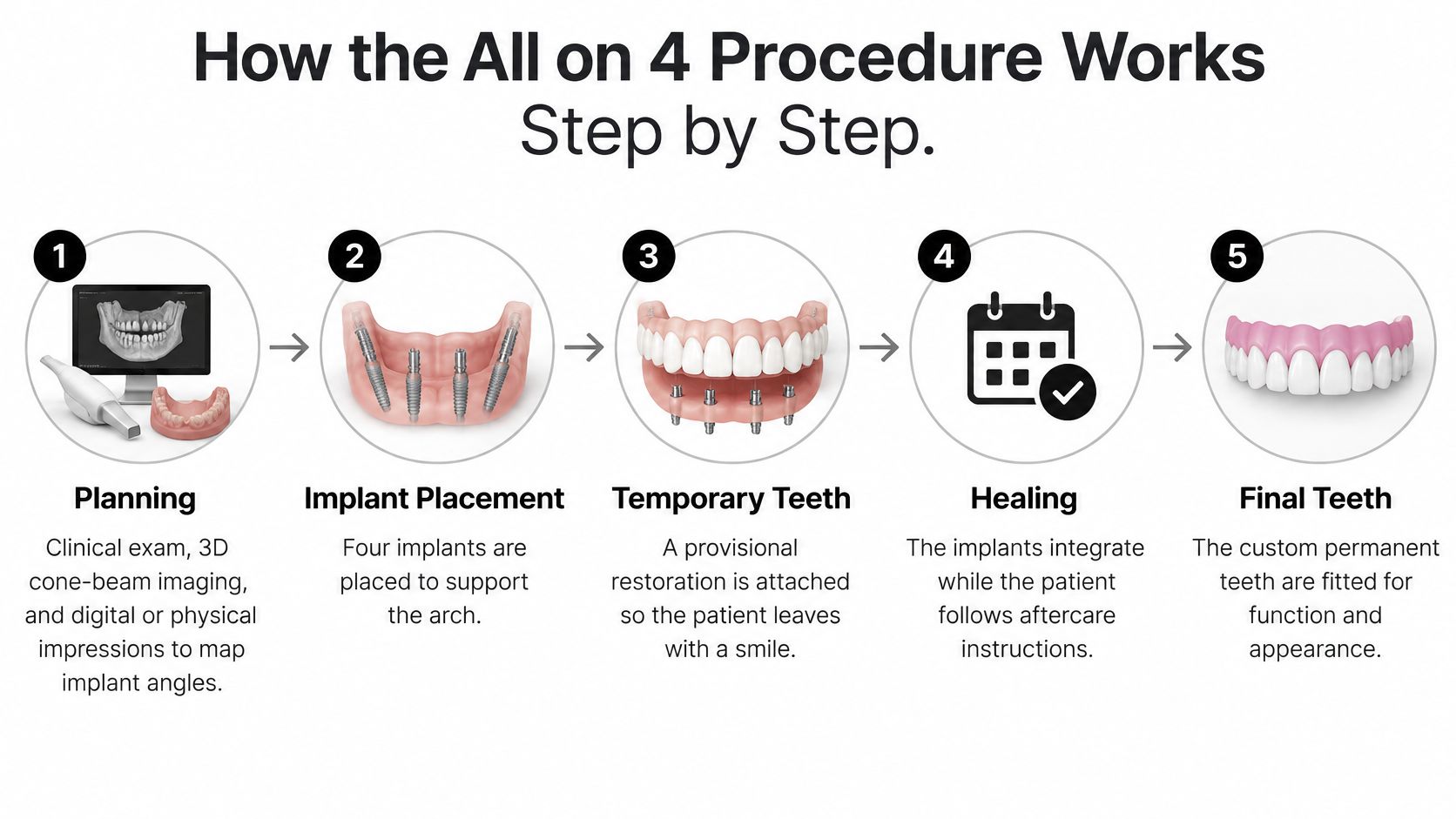
The Six Steps
Planning. You get a clinical exam, 3D cone-beam imaging, and digital or physical impressions. We use them to map implant angles around nerves in the lower jaw and sinuses in the upper jaw, so placement isn't guesswork.
Extraction. Any remaining failing teeth in the arch are removed, sometimes in the same visit as implant placement. Keeping it to one surgical visit can mean one healing period instead of two, which is why tooth extraction timing is planned in advance.
Implant placement. Four implants are placed under local anesthesia, with sedation options for anxious patients. The back two are usually angled to use available bone and reduce the need for extensive grafting in selected cases.
Stability check. The team confirms each implant is firm enough for immediate loading. This step decides what happens next, because not every patient qualifies for fixed temporary teeth on the day.
Temporary bridge. If stability allows, a fixed provisional arch is attached so you leave with teeth. If it doesn't, a removable temporary protects the implants while they heal, which is the safer trade-off.
Instructions and first check. You leave with written aftercare, medication instructions, and a follow-up date. Written steps matter because it's hard to remember details after sedation.
Why Immediate Teeth Aren't Automatic
Immediate loading needs adequate bone quality, rigid cross-arch splinting, and sufficient primary implant stability all at once. The European Consensus Conference guidelines on immediate loading reported average survival of approximately 96.3% for mandibular fixed bridges supported by at least four implants longer than 9 mm when additional anatomical and occlusal conditions were satisfied. In plain language, lower-jaw fixed bridges on firmly connected implants are well established, but the dentist still has to verify implant size, grip in the bone, bite control, and passive fit before loading.
If stability is inadequate, delayed loading isn't failure. It's how you protect the implants during the weeks when bone is bonding.
This short video gives a visual sense of how the bridge and implants fit together.
Before surgery, ask three questions. Which sedation will you use and who monitors it? Will my temporary teeth be fixed or removable, and what decides that? What happens if one implant doesn't reach the stability needed on the day?
Recovery Timeline From Surgery to Final Teeth
Recovery follows a predictable pattern, much like a broken bone that needs time to knit. You may feel better quickly, but the bone under the gum is still doing slow, important work.
| Phase | What Happens | What to Do |
|---|---|---|
| Day 0 to 2 | Swelling, mild bleeding and soreness | Eat soft foods, use cold packs, take medication as prescribed |
| Week 1 to 2 | Swelling eases, stitches are usually removed | Rinse gently as instructed and avoid smoking |
| Weeks 3 to 12 | Gums heal around the implants | Keep the provisional teeth clean, avoid hard and sticky foods |
| Months 3 to 6 | Bone bonds with the implants | Attend healing checks and prepare for the final bridge |
| After final teeth | The bridge settles into a daily routine | Clean under the bridge daily and keep recall visits |
What's Normal in the First Days
Swelling often peaks around day two, then eases. Mild bleeding, bruising, and soreness are expected and usually managed with prescribed medication and cold packs on the cheek.
Start with soft, cool foods like yogurt, scrambled eggs, mashed potatoes, and lukewarm soup. Move toward firmer textures gradually as your dentist advises, not just because soreness improves.
Rinse gently as instructed and brush the provisional teeth with a soft brush. Once you're cleared, clean under the bridge with a floss threader or water flosser, because food and plaque collect where the bridge meets the gum.
Smoking and alcohol slow healing and raise the risk of implant problems. Skip both during early healing. That's not moral advice, it's blood flow and tissue repair.
Warning Signs That Need a Same-Day Call
Call an emergency dentist the same day if you notice:
- Fever or worsening swelling: Especially after things had started improving.
- Bleeding that won't stop: Bleeding that continues despite firm pressure with gauze.
- Pain getting worse: Pain that intensifies after the first few days instead of easing.
- A loose provisional: Any movement, clicking, or change in how your bite feels.
- Numbness that doesn't improve: Lingering numbness in the lip, chin, or tongue.
Keep the office number and follow-up schedule somewhere visible at home. Attend every healing check so the team can confirm the bone is bonding before your final teeth are made. Comfort alone can't tell you that.
How Long All on 4 Teeth Last in Real Studies
A printout showing 95% implant survival often prompts the question: does that mean the teeth are permanent? Studies answer for groups, not for one jaw. That distinction matters because a fixed bridge can stay attached while still demanding repairs, cleaning work, and speech adjustment.
Survival means the implant remains in place and functions. Success is stricter. It includes comfort, chewing, gum health, and how often the prosthesis needs repair. A surviving implant under a repeatedly chipping bridge is not the result most patients picture.
| Study or review | Group studied | Reported result |
|---|---|---|
| 2017 systematic review | Lowest 10-year success rate, 245 patients | 94.8% |
| 2023 review of longitudinal data | Maxilla, implant level, 5 to 13 years | 94.7% |
| 2023 review of longitudinal data | Mandible, implant level, 10 to 18 years | 93.0% |
Reading Those Numbers Plainly
As summarized in a 2023 review in the International Journal of Implant Dentistry, a 2017 systematic review reported the lowest identified 10-year success rate as 94.8% among 245 patients. The same summary reported implant-level survival of 94.7% in the maxilla over 5 to 13 years and 93.0% in the mandible over 10 to 18 years.
That range is narrow. It supports immediate loading as a realistic option when bone volume, bite force, and cleaning access are favorable. It does not make the final bridge maintenance-free. The part that changes your five-year and ten-year cost is often the prosthesis: repairs, replacement teeth, cleaning under the bridge, and the hygiene visits that keep the implant margin healthy. Speech and chewing comfort belong in that calculation too.
Ask for a written estimate that separates the surgery from the bridge. Have the office list the provisional, the final prosthesis, repair visits, replacement of worn teeth, and hygiene appointments across five years. Compare plans on total cost and maintenance schedule, not on the headline survival rate alone.
Your own risk factors matter more than a group average. Bring smoking, grinding, diabetes control, and your realistic daily cleaning routine to the consultation. Ask how each one changes your outlook, and ask what repair history the practice expects for the bridge material you choose.
Cost Factors and Ongoing Care Over Time
There's no single fair price for All on 4 Teeth, because no two jaws need the same work. A quote given before an exam and scan is marketing, not planning.
What Changes the Estimate
- Extractions: Removing remaining teeth adds surgical time and healing management.
- Bone grafting: Thin bone may need grafting, which adds a procedure and recovery time.
- 3D planning scans: Detailed imaging adds to the diagnostic fee but reduces surprises during surgery.
- Sedation: Local anesthetic only costs less than deeper sedation or IV sedation.
- Bridge material: Acrylic, zirconia, and other options differ in appearance, durability, and how likely they are to need repair.
Your written plan after the exam should itemize each part so you can compare plans fairly. Ask whether dental insurance covers any portion, such as extractions or part of the prosthesis.
Survival Doesn't Mean Maintenance-Free
This is the point many advertisements skip. The NCBI Bookshelf summary of All-on-4 evidence notes a systematic review reporting approximately 99.0% combined implant survival at 36 months, while prosthetic complications remained relevant, including prosthesis detachment and acrylic-prosthesis fracture. Strong implant numbers and a bridge that needs repair can both be true at once.
Plan for daily cleaning under the prosthesis, professional recall visits with cleaning and exams, screw tightening if a screw loosens, repair of chipped acrylic or porcelain, relines as gum contours change, and eventual replacement of the bridge after years of wear. A patient who needs a chip repaired in year four hasn't failed treatment. That's prosthetic maintenance, which is more common than implant failure and usually far less serious.
Cleaning is the daily cost you control. Use a water flosser and threader floss under the bridge, and treat flossing as part of daily oral care rather than an occasional extra. Our own guide on how to floss around All-on-4 dental implants walks through the under-bridge technique step by step.
I would ask for one specific document before committing. Request an estimate that lists first-year costs and expected maintenance costs separately, including recall visits, likely repairs, night guard replacement, and bridge replacement timing. If a practice won't separate those numbers, you can't judge lifetime cost.
All on 4 Teeth Compared With Other Options
The right question isn't which option wins in general. It's which design fits your anatomy, speech, hygiene ability, and willingness to accept future maintenance.
| Option | Implants | Removable | Best Fit |
|---|---|---|---|
| All on 4 | Four per arch | No, fixed | Fixed teeth with fewer implants when bone and health support it |
| All on 6 | Six per arch | No, fixed | Patients who want extra support or higher speech satisfaction |
| Implant-supported removable denture | Two to four per arch | Yes | Patients who want easier cleaning access |
| Traditional dental implants | One per missing tooth | No | Few missing teeth with strong bone |
| Complete denture | None | Yes | Patients who want no surgery and accept less stable chewing |
What Patients Actually Report
Recent patient-reported evidence summarized in a Clinical Implant Dentistry and Related Research study comparing All-on-4 and All-on-6 found high satisfaction with both, with no significant differences in overall satisfaction, chewing comfort, aesthetics, cleanability, or stability. One nuance stood out. Patients followed for three to five years reported lower phonetic satisfaction with All-on-4 than with All-on-6, so speech deserves an honest discussion if you speak publicly or sing.
Removable implant-supported dentures snap onto two to four implants and come out for cleaning, which many patients find easier to manage with limited dexterity. Our comparison of All-on-4 versus snap-on dentures covers that trade-off in more detail. Complete dentures need no implants or surgery, but they can move while chewing and often need relines as the jaw changes.
A useful test: Rank chewing, speech, cleaning access, stability, surgical commitment, and future maintenance from one to six. Your ranking usually points to the right design faster than a sales pitch does.
Here's my verdict by situation. Choose All on 4 Teeth for fixed teeth with fewer implants when your bone and health support it. Consider All on 6 when extra support or speech is a priority and bone allows it. Consider a removable implant option when cleaning access matters most, and a complete denture when surgery isn't right for you.
Bring your ranked list to the consultation. A cosmetic dentist near me search may focus on appearance, but restorative dentistry decisions should weigh function and upkeep just as heavily.
Schedule Your All on 4 Consultation in Las Vegas
Two patients can accept the same headline price and end up with very different ten-year costs. The gap comes down to the questions they ask before signing.
Ask two things first. What does the first twelve months include, and what does upkeep cost in years two through five? A fixed prosthesis that survives is only half the story. Repairs, hygiene access, and replacements are the other half, and they belong in the same conversation as the surgical fee.
Booking is low pressure. Request an appointment online or call the office at 3211 N Tenaya Wy Suite 122, Las Vegas, NV 89129, and the team will find a time that works, including extended weekday and Saturday hours.
Your first visit is a conversation as much as an exam. Dr. Patel and the team review your medical history, look at your bone and bite, and discuss your goals, comfort level, and daily life before recommending anything. Bring your ranked priorities and a realistic budget range. Aspiring Smiles Dental and Braces has a 4.9 rating from 762 Google reviews, and new patients are welcome.
Ask specifically whether the quoted fee covers the provisional phase, the final prosthesis, and any repairs in the first year. A new bridge feels finished the day it is seated, but every hygiene visit and every chipped acrylic afterward carries a cost.
Aspiring Smiles Dental and Braces offers all-on-4 dentures alongside dental implants, cosmetic dentistry, teeth whitening, and general dental care. Financing plans, cash, and credit card payment options are available, and the practice treats patients of all ages.
Request a consultation to find out whether All on 4 Teeth fits your jaw, your budget, and your daily life at Aspiring Smiles Dental and Braces.