
How Often to Change Invisalign Trays: Las Vegas Guide
Invisalign trays are commonly changed every 7 to 14 days, but the exact timing depends on your daily wear time and how well the aligners track the planned tooth movement. A weekly change can be appropriate for some patients, while others need 10 or 14 days in each tray.
You may be asking this after a busy week in Las Vegas, when meals, work, school, travel, or a forgotten aligner case reduced your wear time. The next tray may be sitting on the counter, and you're left wondering whether to switch on schedule or stay with the current one. The safest answer depends less on the calendar alone and more on whether you've worn the tray consistently and whether it still fits the way your treatment plan expects.
Understanding Your Invisalign Tray Change Schedule
A patient in Desert Shores, Sun City Summerlin, or Lone Mountain may receive a different Invisalign schedule from someone with a similar-looking smile. That's because the plan considers the movements required, the way each tooth responds, and how reliably the aligners are worn. The general range is 7 to 14 days per tray, but your prescribed schedule should always take priority over a general online rule.
Historically, a foundational Invisalign protocol has involved wearing aligners for 20 to 22 hours per day and changing to a new set every 7 days, according to peer-reviewed orthodontic literature describing manufacturer protocols (peer-reviewed research on Invisalign replacement schedules). That schedule can work well when the movements are straightforward, the tray is seating fully, and daily wear is strong.

Start with your prescribed dates
Before changing a tray, check the schedule provided by your Invisalign dentist. Don't advance just because the aligner feels looser, and don't assume that a tight tray is automatically a sign that treatment is failing. Fit, wear consistency, visible gaps, and the planned movement all matter.
A randomized study assigned patients to 7-day, 10-day, and 14-day replacement schedules and found no clinically significant difference in outcomes between the groups in that study. The finding suggests that several intervals can be reasonable when compliance is strong and treatment goals are suitable, not that every patient can choose a schedule independently (randomized study of Invisalign tray-change intervals).
The modern approach is more individualized than a universal weekly rule. A 2023 randomized controlled trial directly compared 10-day and 14-day changes and reported similar tooth-movement efficacy and pain perception in both groups (2023 randomized trial of 10-day and 14-day aligner changes). Patients researching broader orthodontic treatment options can also review this guide to orthodontic treatment options for 2026, then discuss which approach fits their smile and lifestyle with a local provider.
Why Wear Time Matters More Than the Calendar
An aligner can only guide your teeth while it's in your mouth. Invisalign's patient guidance recommends wearing aligners for 20 to 22 hours per day, removing them for eating, drinking, brushing, and flossing (Invisalign wear and care guidance). If you regularly remove the trays for long periods, changing them quickly won't necessarily make treatment progress faster.
Many schedules break down. A compliance-focused review found that only 36% of aligner patients adhered to prescribed daily wear time. In a microsensor-based randomized trial, measured overall mean wear time was 15.2 ± 4.1 hours per day, compared with recommended full-time use (review of clear-aligner compliance and wear time). Those findings help explain why the nominal tray interval can be less important than the number of hours you wear each aligner.
Measure your routine honestly
Think about a typical day rather than your best day. If you remove the trays for breakfast, extended lunches, coffee, snacks, dinner, and evening activities, the total can be much longer than expected. Write down when the aligners come out for a few days, including time spent out for cleaning, and share the pattern with your dentist.
A tray change every 7 days may be reasonable when you're consistently close to the prescribed wear target and the aligner tracks well. A longer interval may be more appropriate when missed wear gives the teeth less time under controlled force. A peer-reviewed review describes clear aligner schedules as commonly involving a new set every week or two, while emphasizing that aligners must be worn almost all day for treatment to succeed (peer-reviewed review of clear aligner therapy).
Practical rule: Don't use a faster change date to compensate for inconsistent wear. First restore consistent wear, then ask your dentist whether the current tray should be extended.
The difference between 7, 10, and 14 days isn't just a choice between slow and fast treatment. Each interval gives the teeth and supporting tissues time to respond to the planned force. Your provider may also adjust timing during treatment if a tooth isn't following the digital plan, even if the original schedule appeared suitable.
Common Tray Change Intervals Explained
The schedule should follow two factors: how reliably the trays are worn and how well each stage is producing the planned movement. A 7-day change can suit a patient with strong compliance and excellent tracking. Ten or 14 days may be the better clinical choice when a tooth needs more time to respond or daily wear has been inconsistent.
| Interval | Typical Daily Wear | Best Fit | Clinical Consideration |
|---|---|---|---|
| 7 days | Consistent use for the prescribed full-time schedule | Straightforward movements with close tray fit | The aligner must seat fully before the next change. A randomized replacement-schedule study found no clinically significant outcome difference among 7-day, 10-day, and 14-day schedules in its participants, but that finding does not make weekly changes appropriate for every patient. |
| 10 days | Consistent wear, with the exact target set by the provider | Moderate movements or stages that need additional adaptation time | The 2023 randomized trial cited earlier found similar efficacy and pain perception with 10-day and 14-day changes (2023 direct comparison of aligner schedules). |
| 14 days | Wear patterns may need closer review | Movements that need more time to track or stabilize | A longer interval does not by itself indicate treatment failure. The dentist should confirm that the current tray has completed its movement before the next tray is used. |
These intervals are discussion points, not self-prescribed instructions. A clinical survey of orthodontic aligner protocols found that 58.12% of orthodontic providers recommended weekly changes, while 26.25% recommended a 2-week protocol. The same paper reported that weekly changes were considered acceptable, although refinements were often still needed to bring predicted and achieved outcomes closer together.
A patient who regularly removes trays for meals, drinks, cleaning, or extended activities may need a longer interval than the calendar suggests. Changing sooner does not recover wear time that was missed. Restore consistent use, then ask the dentist whether to keep the current tray in place longer or follow the original schedule.
Upper and lower teeth may not respond identically
A recent randomized clinical trial examined Invisalign patients wearing trays for 22 hours per day and changing them every 14 days. The protocol produced adequate upper-jaw alignment in very mild crowding, while lower-jaw correction was significantly less efficient under the same conditions (randomized trial of wear protocols and jaw-specific correction). Arch, movement direction, attachments, bite changes, and tray fit can all affect the choice.
The useful question is not only how often Invisalign trays should be changed. It is whether the current tray is completing the movement it was designed to produce.
When to Delay a Tray Change or Move Earlier
A calendar date matters, but it shouldn't override a clear tracking problem. If there's a visible gap between the plastic and a tooth, an attachment isn't engaging, or the tray rocks instead of seating evenly, contact the office before moving forward. Advancing early can ask the next aligner to perform a movement the current aligner hasn't completed.
Check the tray before advancing
Use a mirror and look at the front and chewing surfaces of the teeth. The plastic should sit closely against the teeth and attachments rather than lifting away in one area. Compare both sides of the smile, because an uneven fit can show that one tooth or segment is lagging behind.
Hold the current tray longer and ask for professional guidance if you notice:
- Visible gaps: Space between the tooth and plastic may indicate poor tracking.
- Incomplete seating: The aligner won't click fully into position over an attachment or tooth.
- Uneven pressure: One area feels unusually tight while another area appears loose.
- Persistent discomfort: Mild adjustment soreness can occur, but sharp, worsening pain or gum injury needs attention.
Independent orthodontic guidance notes that providers may extend wear when visible gaps appear or teeth aren't tracking. A 2026 clinical handout also states that remaining in trays longer is generally safer than changing too quickly when fit is uncertain (clinical guidance on delaying or advancing aligner changes).
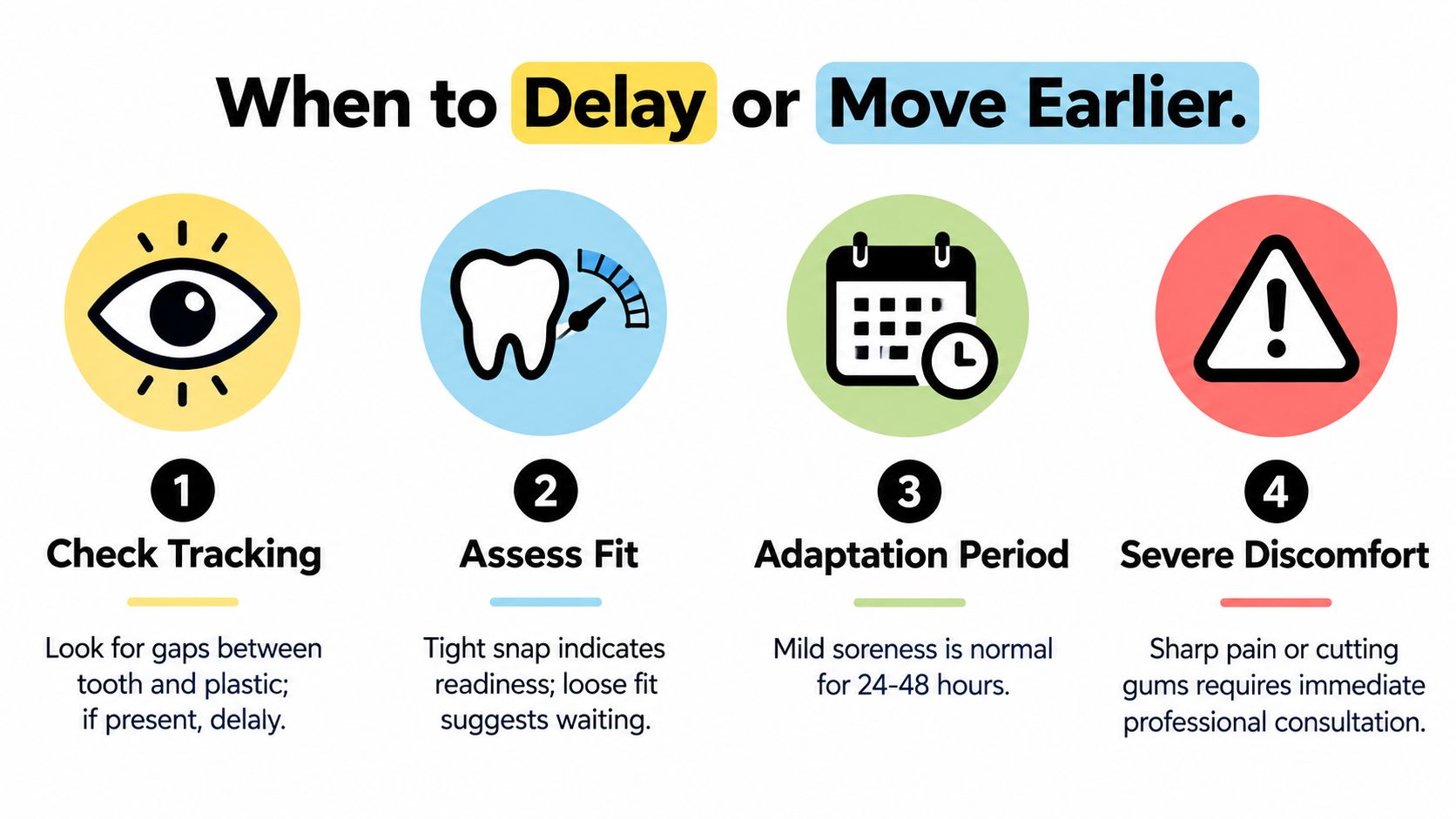
A slightly loose tray at the end of its prescribed interval doesn't automatically mean you should switch early. The planned date, complete seating, and movement response must agree. If you've missed substantial wear time, ask whether to continue the current tray rather than trying to catch up by moving ahead.
For a visual overview of tray timing and fit concerns, you can watch the following patient-focused video:
Severe pain, sharp edges, swelling, or a tray that can't be inserted should prompt a call to the Las Vegas office. Don't force the aligner into place or discard the previous tray until your provider tells you what to do.
Daily Care Habits That Keep Your Schedule on Track
Your daily routine determines whether the prescribed tray interval has a fair chance to work. Busy schedules in Painted Desert Estates, Monterrey, Sunhampton, or Mar-A-Lago can make small periods without aligners add up, so keep your case with you and treat reinsertion as part of every meal or drink break.
Use these habits to protect both your wear time and the trays:
- Remove trays only for food, non-water drinks, brushing, and flossing. Rinse your mouth before putting them back in, especially after meals.
- Clean the aligners as directed. Use cool water and an appropriate soft cleaning method. Avoid hot water, which can distort the plastic.
- Store the trays in their case. A napkin, pocket, or restaurant table makes accidental loss more likely.
- Seat the aligners carefully. Use clean fingers and any seating aid your dentist has recommended. Don't bite forcefully to push a tray into place.
- Keep the previous set. If a tray is lost or damaged, the earlier set may be useful while the office determines the next step.
For more detailed instructions, follow this guide on how to clean Invisalign aligners. Good cleaning also supports routine dental care, because trapped food and plaque can affect the teeth while the aligners are covering them.
If you forget a reinsertion or have an unusually interrupted day, don't automatically change the next tray early. Return to consistent wear and contact your provider if the interruption was substantial or if the current aligner no longer fits normally.
Working with Your Las Vegas Invisalign Dentist
Invisalign monitoring should include more than handing you a sequence of trays. During visits, Dr. Patel can evaluate fit, attachment engagement, bite changes, and whether the planned movement is progressing as expected. If tracking is off, the schedule may be extended or adjusted, and refinements may be considered rather than forcing the next stage.
Aspiring Smiles Dental and Braces provides Invisalign consultations and monitoring alongside general, cosmetic, restorative, and emergency dental care in Las Vegas, NV. Patients can also discuss whether they're a good candidate for Invisalign, dental cleaning and exams, dental x-rays, teeth whitening, crowns, veneers, tooth extraction, dental implants, or other care during an appointment.
Whether you're searching for a dentist near me, a dentist in Las Vegas, NV, or Invisalign care near Desert Shores, Sun City Summerlin, or Lone Mountain, bring your current tray schedule and questions to your consultation. A personalized review is the practical way to decide whether you're ready to change, should remain in the current aligner, or need help with comfort and tracking.
Schedule an Invisalign consultation with Aspiring Smiles Dental and Braces to review your tray fit, daily wear routine, and next change date. The Las Vegas team can provide personalized monitoring, refinements, and dental care so your aligner treatment stays connected to your long-term oral health.