
How to Get Emergency Dental Care in Las Vegas
A sharp, throbbing molar starts pulsing at 9 p.m. after a long shift on the Strip. Your regular dentist is closed, your cheek feels tender, and searching “dentist near me” only creates more uncertainty. You need to know whether to wait, call an after-hours dentist in Las Vegas, or go straight to an emergency room.
The safest approach is calm and practical. Stop, assess the symptoms, control what you can at home, and choose the right care pathway. This guide explains how to get emergency dental care in Las Vegas, NV, including first aid, ER warning signs, after-hours access, cost considerations, and follow-up with a local dental team.
When Late-Night Tooth Pain Strikes in Las Vegas
At 9 p.m., that lower molar may feel like the only thing in the city. You might be far from your usual office, worried about the cost, and tempted to search for pain medication before deciding what to do. Start by checking whether the problem is getting worse quickly, whether swelling affects your face or neck, and whether you can breathe, swallow, and open your mouth normally.
Fast action matters when tissue is swelling, a permanent tooth is loose, or bleeding won't stop. A knocked-out adult tooth needs immediate handling because the cells around its root begin losing viability when the tooth dries. An infection may also need prompt dental treatment rather than repeated attempts to suppress pain at home.
Make the first decision calmly
Use this order:
- Assess danger. Breathing trouble, swallowing difficulty, uncontrolled bleeding, or major facial trauma requires emergency medical attention.
- Control symptoms safely. Keep a displaced tooth moist, apply pressure to bleeding tissue, and use a cold compress for swelling.
- Contact a dental office. Most general dentists maintain an after-hours message pathway, and an emergency dentist in Las Vegas can often arrange an urgent visit the same morning.
- Prepare for the appointment. Note when the pain began, what caused it, medications you have taken, and whether you have fever or swelling.
Las Vegas has 24-hour pharmacies where you may find temporary pain-relief supplies, but medication only buys time. It won't remove decay, drain an abscess, repair a fracture, or replace a missing tooth.
Practical rule: If the symptom is severe, worsening, or connected to trauma, call a dental office before deciding to wait until morning.
That same local relationship helps with more than emergencies. After the immediate problem is stable, you may need cleaning and exams, dental x-rays, restorative dentistry, a tooth extraction, or a longer-term plan involving dental implants near me.
How to Tell If It Counts as a Real Dental Emergency
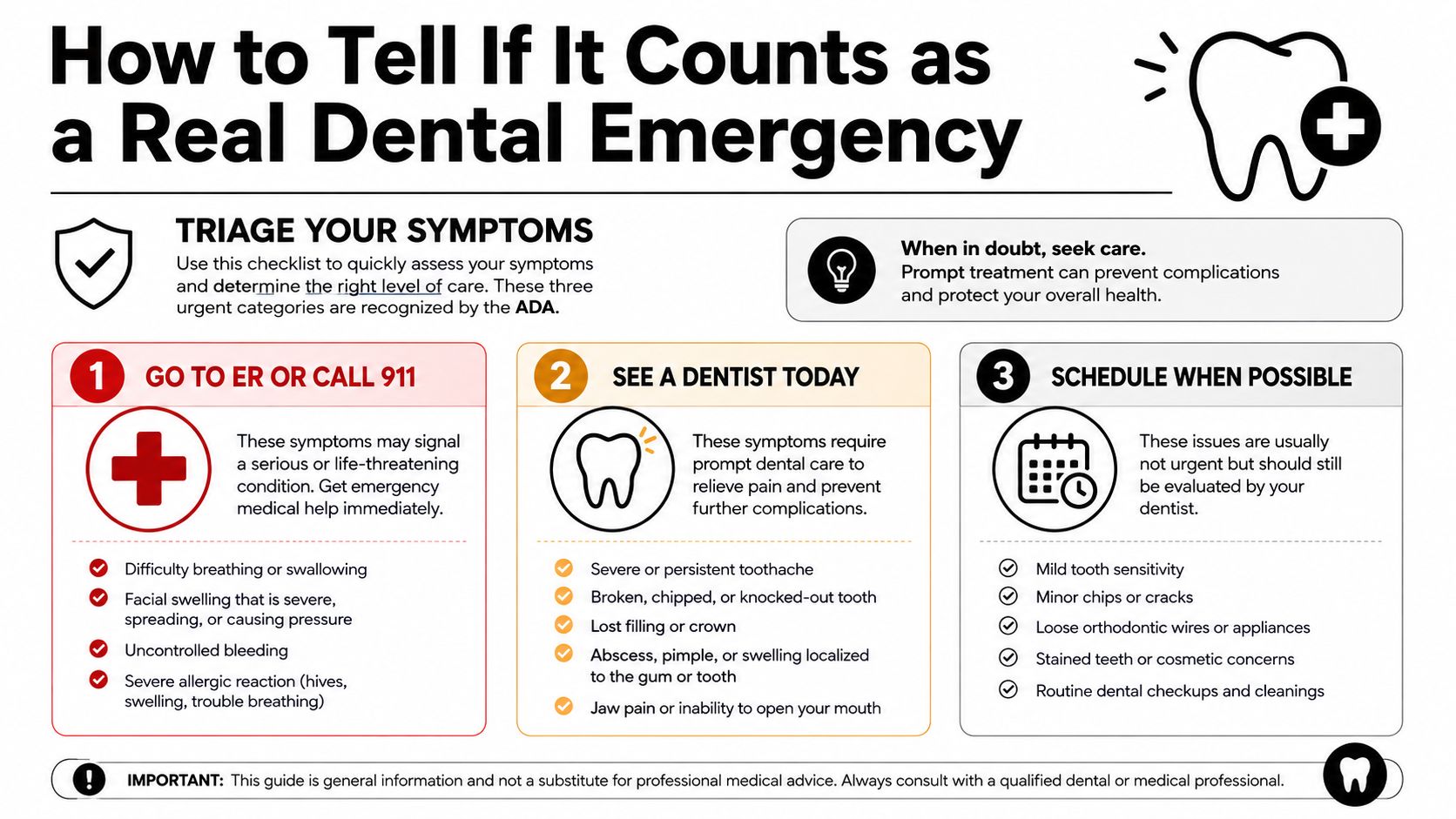
The American Dental Association describes urgent dental care as treatment for conditions that need immediate attention to relieve severe pain or reduce infection risk. Examples include severe pulpal pain, pericoronitis, dry socket, localized abscesses, painful fractures, and dental trauma involving avulsion or luxation, as outlined in the American Dental Association emergency guidelines.
Triage your symptoms
Go to the ER or call 911 when the mouth problem may threaten your airway or reflect serious trauma:
- Breathing or swallowing difficulty: Swelling can spread beyond the tooth and affect the throat.
- Facial swelling near the eye or neck: This needs urgent medical assessment, especially if it is expanding.
- Uncontrolled oral bleeding: Persistent bleeding after firm pressure isn't a routine dental complaint.
- Suspected jaw fracture: An accident involving facial impact may require hospital imaging and medical stabilization.
Call an emergency dentist within hours for severe dental problems that need hands-on treatment:
- Severe throbbing pain that over-the-counter medication can't control.
- A knocked-out or visibly displaced adult tooth.
- An abscess with facial swelling and fever.
- A cracked or broken tooth with possible nerve exposure.
Schedule the next available appointment when the issue is uncomfortable but stable:
- A lost filling or crown without pain.
- Mild sensitivity.
- A small chip with no nerve exposure.
- Food lodged between teeth that can be removed gently with floss.
Ask yourself three questions: Can I breathe and swallow normally? Is bleeding controlled? Is swelling spreading or accompanied by fever? A “no” to the first two questions means emergency medical care. A “yes” to the last question means you shouldn't rely on home care.
What to Do in the First Minutes at Home
First aid should preserve tissue, reduce irritation, and prevent the problem from becoming harder to treat. It isn't a substitute for an examination, especially when a tooth has been knocked out, an abscess has formed, or a fracture exposes the inner tooth.
Condition-specific first-aid steps
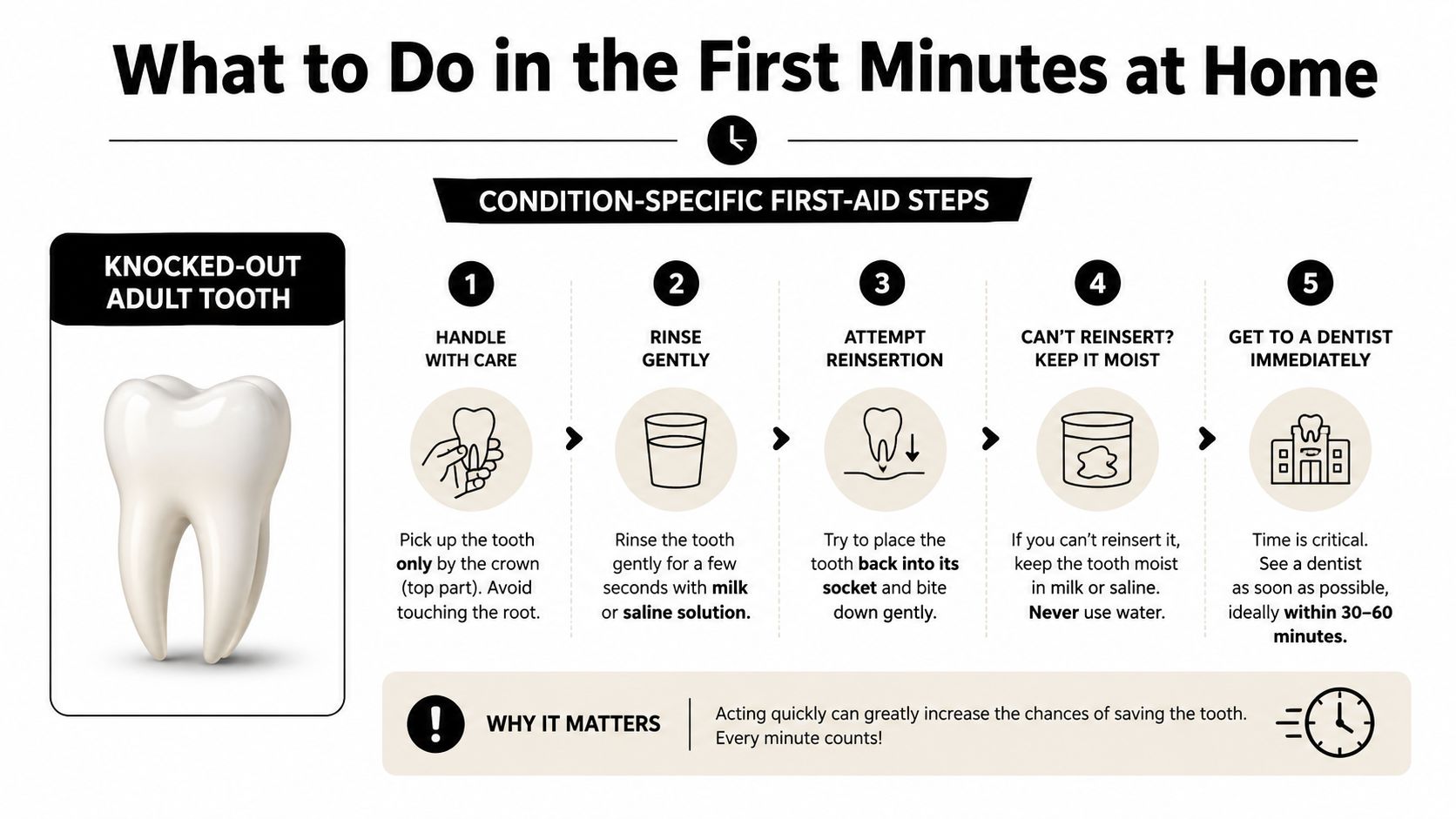
Knocked-out permanent tooth: Pick it up by the crown, the part normally visible in the mouth. Don't touch or scrub the root. If it's dirty, gently rinse it with milk or saline, then try to reinsert it into the socket. Guidance recommends replantation within 60 minutes when possible, and emergency references describe the strongest chance of saving the tooth when it returns to the socket within 30 minutes to one hour, according to this dental trauma guideline.
If you can't reinsert it, keep it moist in milk, saline, saliva, or another isotonic solution. Don't wrap it in a napkin or let it dry. The International Association of Dental Traumatology guidance emphasizes immediate action because dehydration begins within minutes.
Abscess or swelling: Rinse gently with warm salt water and place a cold compress against the cheek. Use the compress in short intervals, and avoid pressing directly on the swollen area. Don't puncture or squeeze the abscess.
Broken crown or lost filling: Avoid chewing on that side. A temporary dental-cement product from a pharmacy may cover a sharp edge, but don't force material deep into a cavity. A small amount of clove oil on a cotton pellet may temporarily ease nerve irritation, but keep it away from the gums if it causes burning.
Soft-tissue bleeding: Place clean gauze over the area and hold firm, uninterrupted pressure for 10 to 15 minutes. If bleeding continues, go to the ER rather than repeatedly lifting the gauze to check it.
Don't delay professional care because a home remedy reduced the pain. Pain can fade while the underlying infection, fracture, or tissue injury remains.
Reaching an Emergency Dentist in Las Vegas
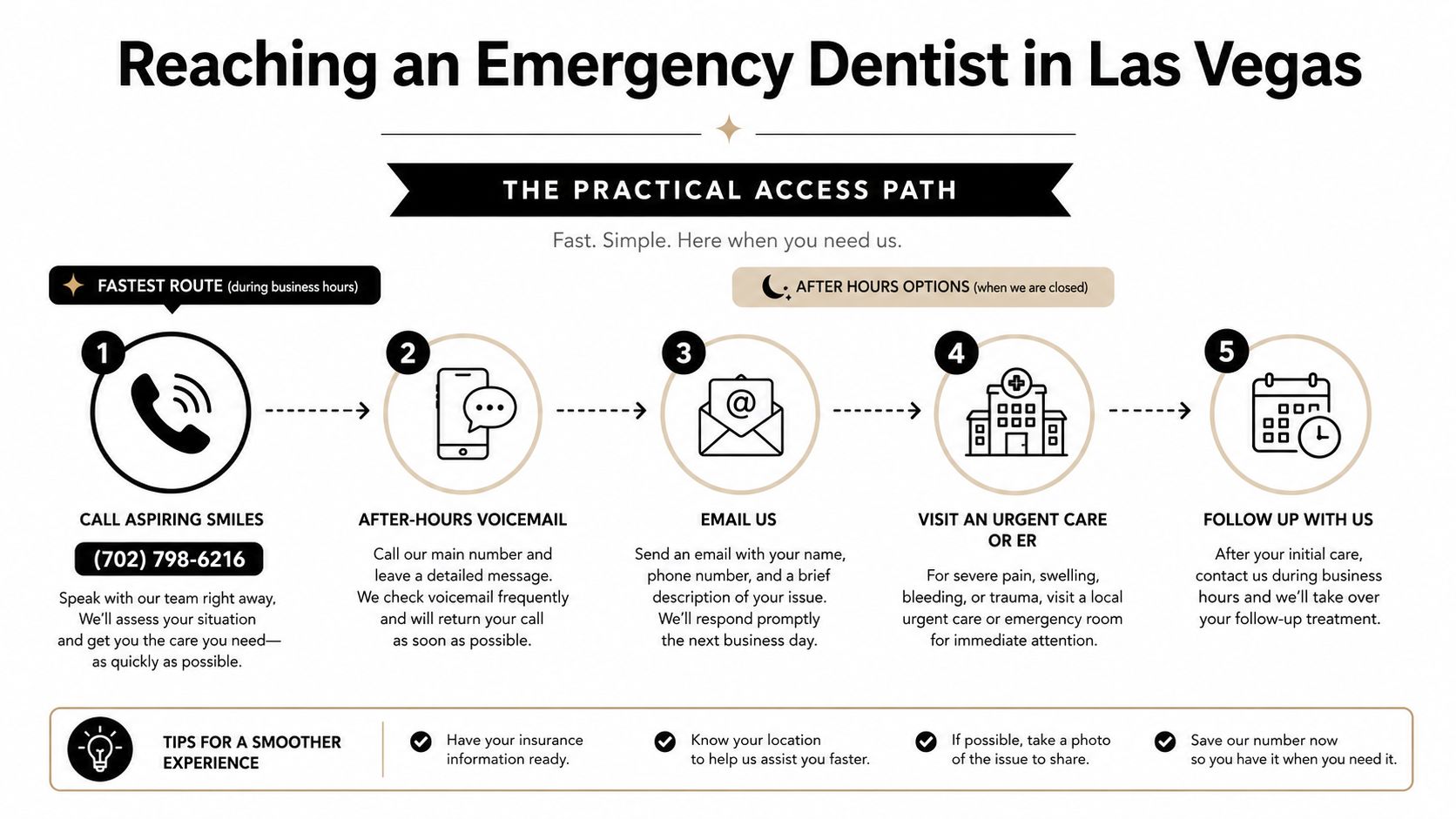
The fastest route during business hours is to call Aspiring Smiles at (702) 798-6216 and explain what happened. State whether the tooth is knocked out, broken, swollen, bleeding, or causing severe pain. The team can triage the complaint, determine whether you need immediate medical attention, and look for the earliest urgent appointment.
The practical access path
If the office is closed, use the after-hours line and leave a clear message. You can also use the online request form for the Tenaya Way office to describe your symptoms, upload a photo if appropriate, and request the earliest opening. Include your phone number and say whether swelling, fever, bleeding, or trauma is involved.
Use a simple rule:
- Call the dentist first for severe tooth pain, a broken tooth, a lost restoration with pain, or a displaced tooth.
- Go straight to the ER or 24-hour urgent care for heavy bleeding that won't stop, swelling that interferes with breathing, jaw trauma after an accident, or high fever paired with facial swelling.
- Don't drive yourself if medication, dizziness, trauma, or severe swelling makes driving unsafe.
Traffic on the 95 and 215 can change the time it takes to reach the Tenaya office, so leave room for delays. Tell the front desk where the pain is, how long it has lasted, whether you have taken medication, and whether you can open your mouth normally. That information helps the team prepare the operatory before you arrive.
For a direct local care pathway, see the emergency dentist near me information from Aspiring Smiles.
An on-call dentist can return messages quickly, but don't wait for a callback if you have airway symptoms, uncontrolled bleeding, or serious facial trauma. Those problems belong in emergency medical care first.
What Happens at Your Emergency Visit
You walk through the Tenaya Way door tired, uncomfortable, and unsure whether the tooth can be saved. The front-desk team starts with the basics, confirms your contact information, and asks what changed. You don't need a perfect explanation. Tell them what hurts, when it started, and whether an injury caused it.

The first examination
The dentist reviews your medical and dental history, including allergies, current medications, pregnancy status when relevant, and conditions that may affect treatment. The clinical exam focuses on the painful tooth or injured area, nearby teeth, gums, bite, mobility, swelling, and soft-tissue damage.
Digital dental x-rays may be taken during the visit to look for decay, fractures, root involvement, or an abscess. Trauma guidance also recommends recording tooth mobility or displacement, numbness, occlusion, missing fragments, and tetanus status when skin or mucosa has been breached, as described in this emergency dental review.
Stabilization comes before reconstruction
The immediate goal is to reduce pain, control infection, protect the tooth when possible, and make the situation safe. Depending on the findings, the dentist may use local anesthetic, place a temporary repair, drain a suitable swelling, prescribe antibiotics when clinically appropriate, or recommend analgesics.
An emergency visit often isn't the appointment where every final detail is completed. Instead, you leave with a specific plan for definitive care, which may include a crown, root canal, extraction, or replacement with dental implants. A dental office can also coordinate follow-up if the tooth needs a specialist.
Anxiety deserves practical attention. Patients may ask for a pause, a blanket, music, or an explanation before each step. Those small choices can make treatment feel manageable, particularly when you arrive after hours of pain.
Paying for Emergency Dental Care Without Stress
The ER may be appropriate for airway problems, uncontrolled bleeding, or major trauma, but it usually isn't the most direct setting for a tooth problem. Hospital teams can stabilize a medical threat, provide medication when appropriate, and direct you to dental follow-up. They generally won't complete a root canal, crown, extraction, or definitive abscess treatment.
A dental office is usually the more efficient financial pathway when the problem is dental and medically stable. Historical data from the Healthcare Cost and Utilization Project found that dental-related ED visits in 2014 carried an average charge of $992, with nearly $2.4 billion in total charges that year. The same source reports an American Dental Association estimate that nonhospitalized ED care for dental pain averaged $749, about three times the cost of a dental office visit.
Compare the care, not just the first bill
| Setting | Typical Cost Range | What You Actually Get | Insurance Handling |
|---|---|---|---|
| ER | Varies by medical evaluation and treatment | Medical stabilization, medication when appropriate, and dental referral | Medical benefits may apply differently from dental benefits |
| Urgent care | Varies by evaluation and treatment | Basic assessment, possible medication, and referral | Coverage depends on the plan and the clinic |
| Emergency dentist | Varies by exam, x-rays, and treatment | Dental diagnosis, pain control, temporary or definitive dental treatment, and follow-up planning | The office can review dental benefits and submit eligible claims |
Ask about payment before treatment
For insured patients, ask how the emergency exam and x-rays will be billed, whether the visit applies to the annual dental maximum, and how later services such as a root canal or crown are itemized. Aspiring Smiles accepts many PPO plans, including Delta Dental, MetLife, Aetna, and Cigna, but your exact benefits still need verification.
Uninsured patients can ask about membership savings plans, staged treatment across visits, and third-party financing such as CareCredit. A staged plan may address the urgent problem first and schedule reconstruction later, provided the dentist confirms that delaying part of the treatment is clinically safe.
Review the practice's emergency dental care without insurance options before assuming that the ER is your only choice. Calling a dental office first often clarifies both the treatment and the payment pathway.
Book Your Emergency Appointment Today
You now control three important decisions. You can recognize the signs that require the ER, perform safe first aid while arranging care, and contact the right dental provider instead of trying to manage severe symptoms alone.
Call the Aspiring Smiles Tenaya Way office during business hours for same-day triage. If the office is closed or you're contacting the team outside peak hours, use the website request form and describe the problem plainly. If pain can't wait and the office is accepting patients, walking in during business hours may be the most practical step, but call first when possible so the team can prepare.
Bring a list of medications and allergies, your insurance information if you have it, and any tooth fragment or knocked-out tooth stored correctly. Tell the team if you're an existing patient of record or a new patient. The office can coordinate with your current records and forward information to a specialist when your treatment requires one.
Plan the care after relief
Pain control is only the beginning. Complete any prescribed antibiotic course exactly as directed, return for a bite check when requested, and schedule the definitive restoration after the emergency has been stabilized. That may mean seating a crown, completing a root canal, removing a tooth that can't be restored, or discussing replacement options such as dental implants.
Aspiring Smiles also provides routine cleaning and exams, cosmetic dentistry, teeth whitening, restorative services, and family dental care. Patients searching for a cosmetic dentist near me, dental implants near me, or a long-term dentist in Las Vegas, NV can continue care with one team after the urgent problem is resolved.
Don't spend the night guessing whether your toothache can wait. Call (702) 798-6216, submit an online request, or seek emergency medical care immediately if breathing, swallowing, serious trauma, or uncontrolled bleeding is involved.
Aspiring Smiles Dental and Braces offers urgent dental evaluations, emergency stabilization, restorative care, tooth extraction, and follow-up treatment for patients in Las Vegas, NV, including Desert Shores, Sunhampton, Sun City Summerlin, Monterrey, Lone Mountain, Mar-A-Lago, and Painted Desert Estates. Visit Aspiring Smiles Dental and Braces to request an appointment and take the next step toward relief and dependable ongoing care.