
Does Cigna Cover Dental Implants? Las Vegas Guide
Cigna does not universally cover dental implants, coverage varies by plan, and many plans exclude implants entirely, but certain parts of treatment, like the crown or abutment, may still be partially covered. Verify your exact plan before you assume the answer is yes or no.
If you're in Las Vegas staring at an implant estimate and a Cigna card, you're not alone. People walk into our office every week with the same question, and the honest answer is that the insurance card by itself doesn't tell you enough. What matters is the plan design, the medical necessity language, and the specific line items your dentist bills.
At Aspiring Smiles Dental and Braces in Las Vegas, we treat this as a benefits verification problem first and a treatment decision second. That saves patients from nasty surprises and helps them move forward with a clear budget, not wishful thinking. For a useful look at how modern dental offices handle patient communication, dental clinic chatbot examples show why fast, clear answers matter when someone is comparing treatment options.
Does Cigna Cover Dental Implants in Las Vegas
A Las Vegas patient can have a Cigna plan, need a tooth replaced, and still get a denial on the implant itself. That's because Cigna's own policy says implant coverage varies across plans, and many dental plans exclude implants altogether. When benefits do apply, the approval usually hinges on narrow medical-necessity rules, not a general promise of implant coverage.
The practical answer for patients
The question is not just whether Cigna covers implants. It's which parts of the treatment might be covered under your exact plan. In some cases, the restorative pieces around the implant sequence can be paid differently than the surgical implant body itself, which is why patients get confused when they see words like major restorative services in their summary.
Practical rule: Never schedule implant surgery in Las Vegas until someone has checked the plan details and the billing lines, not just the headline benefit.
That's especially important in a city where patients often want a straight answer fast. A good insurance check should look at whether the plan allows coverage for the implant, whether the treatment needs prior approval, and whether any related service, like a crown, is handled separately.
Cigna's materials also make one thing clear, preventive care can be covered broadly on some plans even when implants are not. That contrast is what trips people up. A plan can be generous for cleanings, exams, and routine care while still being tight on restorative implant treatment.
For Las Vegas patients in Summerlin, Desert Shores, Sunhampton, Lone Mountain, and nearby neighborhoods, the smartest move is simple. Bring the Cigna card, ask for a benefit breakdown, and get the office to verify what's payable before you commit to surgery.
Cigna Dental Plan Types and Implant Coverage
Cigna doesn't treat every plan the same way, and that's where most implant confusion starts. A DHMO, a DPPO, and an employer-sponsored dental plan can all be branded Cigna, yet they can behave very differently at the claim level. One plan may be generous with preventive care and limited on implants, while another may allow partial payment for some restorative services and still exclude the surgical implant body.
Why the plan type matters
Cigna's DHMO clinical guidelines classify implant treatment under the D6000–D6199 CDT code range (Cigna DHMO guidelines). That tells you implants are treated as a specialized category, not a routine benefit like a cleaning. It also means the office has to code the treatment correctly, because the way the plan reads those codes can shape whether anything gets paid at all.
The other issue is plan structure. Employer-sponsored benefits can differ from one company to the next, so two Las Vegas patients with Cigna cards may have very different outcomes. Annual maximums, deductibles, waiting periods, and plan exclusions can all cut reimbursement down even when a service is technically eligible.

What to look for in your summary of benefits
If you're reviewing your own plan, focus on the words tied to major restorative, prosthetic, or implant-related benefits. Then check whether the plan names the implant body, abutment, or crown separately. That detail matters more than the brand name on the card.
A useful comparison is how Cigna plan language can cover one restorative service while leaving another out. If your plan is only helping with crowns or bridges, that does not automatically mean the implant itself is included. I've seen patients assume “major services” means full implant coverage, and that assumption gets expensive fast.
For a separate example of how benefit language can change what patients pay, our office often points people to this guide on cosmetic dentistry coverage because the same logic applies. The label on the benefit matters less than the exact wording underneath it.
When Cigna Considers Dental Implants Medically Necessary
A patient can have a missing tooth and still get a denial from Cigna. That happens because Cigna's policy uses a narrow medical-necessity standard for implants, and it only fits certain situations, including congenital defects, accidental injury after coverage starts, oral cancer, and head and neck cancer reconstruction (Cigna implant medical necessity policy). Routine tooth loss from decay, periodontal disease, or cosmetic reasons falls outside that standard.
What usually qualifies, and what usually doesn't
An accident that happens after the policy begins can change the claim. So can reconstruction after cancer treatment. In those situations, the record can fit the policy language in a way that ordinary dental loss does not.
Most implant requests in Las Vegas do not come from trauma or oncology. They come from everyday dental problems, which means the insurer often treats the implant as outside medical necessity even when the patient feels the need immediately and strongly. That gap between need and coverage is where many surprises start.
Cigna also ties approval to timing in the cases it does cover. In the patient materials, replacement can be limited to within 12 months after accidental loss of natural teeth or within 24 months after tooth loss due to oral cancer (Cigna implant guide). Timing, diagnosis, and records all affect the answer.
Cigna is looking for a documented reason that matches the policy, not just a missing tooth.
When trauma or cancer is involved, the dental chart and the medical record may both support the claim. When the cause is long-term decay or gum disease, approval usually stays out of reach. Patients should prepare for that early instead of waiting for a denial to explain it.
The best question is simple. Do the facts fit the policy language? If they do, the office can build the claim and request review. If they do not, it is smarter to plan around the denial and choose the treatment path with the actual cost in mind.
For a visual overview of how implant coverage is usually discussed in patient education, this short video can help clarify the decision points.
A quick way to think about approval risk
- Higher likelihood of review: accident-related tooth loss after coverage begins.
- Higher likelihood of review: cancer reconstruction cases with supporting records.
- Lower likelihood of approval: routine decay, gum disease, or cosmetic replacement.
- Lower likelihood of approval: cases where the missing tooth is just a long-standing dental problem.
If your office is keeping patients updated while benefits are checked, sms marketing can help with reminders and status messages. For the patient, the practical step is the same every time. Get the office to verify the policy language before treatment starts.
What Cigna May Cover Around the Implant Itself
Patients usually get stuck on the wrong question here. Cigna may pay for the restoration around an implant, such as crowns, bridges, dentures, or prostheses over implants, while still excluding the surgical placement of the implant body, surgical templates, abutments, or removal of an implant (Cigna dental HMO fees overview). That means a plan can show a major-service benefit and still leave the core implant work unpaid.
The line-item reality
A single-tooth implant can start around $3,000 and rise based on grafting, abutment, crown, and site complexity (Cigna implant guide). That is why partial coverage still matters. If the crown is covered and the implant body is not, the remaining balance can still be large.
Ask for each item separately. Is the fixture covered? Is the abutment covered? Is the crown covered? Is bone grafting covered? Each answer changes the final out-of-pocket cost, and guessing on the whole treatment is how patients end up surprised at checkout.
| Treatment Line Item | Common Plan Treatment | Patient Impact |
|---|---|---|
| Implant body | Often excluded or tightly limited | Largest uninsured portion in many plans |
| Abutment | May be covered separately or denied | Can change the final bill noticeably |
| Crown on implant | May be covered under major restorative benefits | Helps offset the visible part of treatment |
| Bridge or denture alternative | More likely to be covered on some plans | Can lower cost if implant coverage is limited |
| Surgical template or removal | Often excluded | Can surprise patients if not checked in advance |
That table matters because Cigna often processes implant care by piece, not as one flat benefit. If you only ask, “does Cigna cover dental implants,” you can miss the line item that gets paid. If you ask about each component, you get an answer you can use.
Best practice: Request a predetermination before surgery and ask the office to confirm whether the implant fixture, abutment, and crown are billed separately or treated as one bundle.
That is the cleanest way to protect your budget. It keeps the office and the insurer working from the same breakdown, so you do not assume one payment structure and discover another after the claim is submitted.
How to Verify Your Cigna Benefits Before Treatment
The cleanest way to handle this is to verify the plan before anyone books surgery. Start in the Cigna member portal, then read the dental summary, not just the marketing overview. Look for the exact language on major services, implant coverage, annual maximums, waiting periods, and replacement limits.
The documents that matter
Bring the Cigna card, photo ID, and any recent dental records to your consultation at the Tenaya Way office. That usually means X-rays, periodontal charting if gum disease is part of the history, and clinical notes that explain why the tooth needs replacement. If the case may qualify under medical necessity, a letter supporting that reason can strengthen the request.
Aspiring Smiles submits predeterminations for patients who want a written benefits breakdown before moving ahead. That's the right way to do it because it turns a vague estimate into a documented response from the insurer.
Ask for the estimate in writing. Verbal guesses don't protect your budget.
What to do if the estimate comes back low
If the predetermination shows a denial or a small payment, don't stop there. Ask whether the claim can be supported with more documentation, then ask whether treatment can be phased across two benefit years if that helps with annual maximums. That is often the more practical move than trying to force the entire case into one calendar year.
A useful checklist for Las Vegas patients:
- Confirm the plan type. DHMO and employer plans can behave very differently.
- Check whether implants are listed. Don't assume a major-service label means implant coverage.
- Ask for separate line-item answers. Fixture, abutment, crown, and grafting may all be treated differently.
- Request predetermination. That gives you a paper trail before treatment begins.
The point is to know the financial picture before the surgery date is set. Once you have that, the next step is choosing the right treatment path, not guessing.
Implant-Supported Dentures and All-on-4 as Practical Alternatives
If a plan is stingy on single implants, that doesn't mean the smile-replacement discussion ends. Implant-supported dentures and All-on-4 can solve the same missing-teeth problem with a different billing structure, and that sometimes lines up better with coverage. The treatment is still restorative, but the plan may look at it more favorably than a standalone implant request.
Why these options come up so often
All-on-4 uses four implants to support a full arch of teeth, so it's not just four separate tooth replacements. That can matter when the goal is full-mouth function instead of one isolated tooth. Implant-supported dentures also give patients more stability than removable dentures, which is why they're often part of serious treatment planning for patients who want a fixed solution.
For a deeper look at this option, patients can review our All-on-4 dental implants page. It's the right comparison when someone is weighing a single implant against a broader restoration.
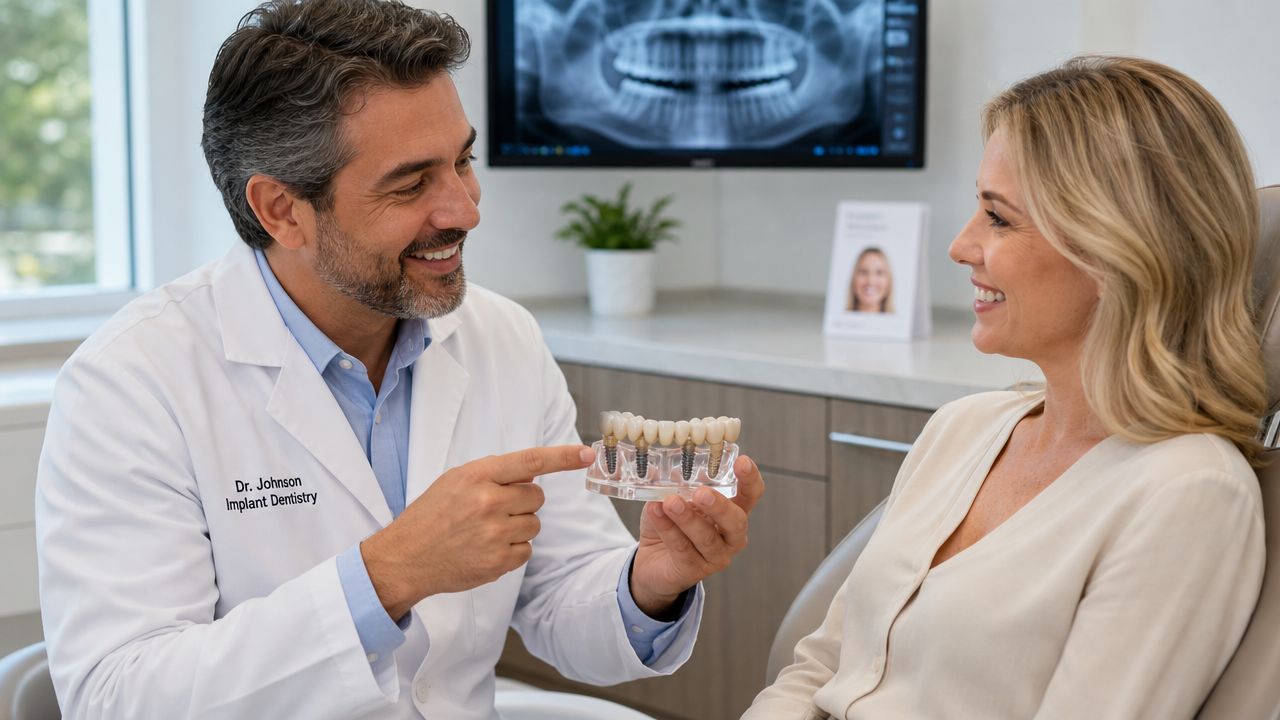
A consultation usually starts with a visual explanation of how the options differ.
A practical way to compare them
- Single implant: best when one tooth is missing and the plan covers enough of the sequence.
- Implant-supported denture: useful when several teeth are missing and stability matters.
- All-on-4: strong option for full-arch restoration when the patient wants a fixed result.
Aspiring Smiles Dental and Braces also coordinates related cosmetic and restorative services, including crowns, veneers, and Zoom whitening, when a full smile plan needs more than tooth replacement alone. That matters because the right treatment isn't always the one with the simplest insurance code. It's the one that restores function, comfort, and appearance in a way the patient can finish.
The smartest patients don't ask for the most expensive option first. They ask which option fits the plan, the mouth, and the budget together.
What to Expect at Aspiring Smiles Dental and Braces in Las Vegas
The first visit is straightforward. You'll get a clinical exam, dental X-rays, and a periodontal evaluation, then the team will review your medical history and talk through your goals and budget. That matters because implant planning is not one-size-fits-all, especially when Cigna coverage needs to be checked against the treatment plan.
Dr. Patel and the team take time to explain what they're seeing and why it matters. Patients don't get pushed into a fast yes. They get a clear explanation of what's missing, what can be restored, and what insurance may or may not cover.
The office at 3211 N Tenaya Wy Suite 122, Las Vegas, NV 89129 serves people from Summerlin, Desert Shores, Sunhampton, and Lone Mountain, along with nearby neighborhoods like Sun City Summerlin, Monterrey, Mar-A-Lago, and Painted Desert Estates. That local focus is important because follow-up visits, benefit checks, and treatment coordination are much easier when your dental home is close by.
Good implant planning starts with the exam, not the estimate.
Patients also appreciate that the practice offers flexible payment options, insurance acceptance, a membership program, and Saturday availability. Those details matter when a plan has limits and the treatment needs to be staged. The office can also help connect preventive care, emergency visits, Invisalign, and family dentistry into one long-term plan instead of treating each visit like a separate problem.
If you're nervous about the cost, bring the paperwork anyway. Most of the stress drops once someone reviews the plan and explains what the next step is.
Schedule Your Implant Consultation in Las Vegas Today
Cigna implant coverage is not a simple yes or no, and that's exactly why a local verification matters. Some patients will get partial coverage, some will get coverage for related restorative work, and many will find that the implant body itself is excluded. The right move is to verify the plan first, then build the treatment around the benefits you have.
At Aspiring Smiles Dental and Braces, the team helps Las Vegas patients sort out Cigna questions before treatment starts. That includes patients from Desert Shores, Sun City Summerlin, Lone Mountain, Monterrey, Mar-A-Lago, and Painted Desert Estates, along with anyone needing a dentist near me who can explain implant coverage in plain English.
Bring your Cigna card, your photo ID, and any recent dental records to your consultation. The office will review your benefits, explain the likely line-item coverage, and help you decide whether a single implant, implant-supported denture, or All-on-4 makes the most sense for your mouth and your budget. If you've been putting off care because the insurance question feels unclear, now's the time to get a real answer.
If you're ready to stop guessing about coverage, schedule a visit with Aspiring Smiles Dental and Braces in Las Vegas. The team can verify your Cigna benefits, walk you through implant options, and help you choose a treatment plan that fits your smile and your budget.