Emergency Dental Care Without Insurance Las Vegas
A dental emergency rarely happens at a convenient time. It starts with a sharp toothache during dinner, a broken tooth after biting down on something hard, or a child waking up in the middle of the night with swelling and pain. When you don't have insurance, the stress gets heavier fast. You're not only trying to stop the pain. You're also trying to figure out where to go, what can wait, and how to pay for treatment.
For Las Vegas families, that decision often feels urgent and personal. If you're in Desert Shores, Sunhampton, Sun City Summerlin, Monterrey, Lone Mountain, Mar-A-Lago, or Painted Desert Estates, you want clear answers close to home. Emergency dental care without insurance is possible, but the right next step matters. Some choices lower your cost and get the problem treated. Others only delay it.
Your Trusted Emergency Dentist in Las Vegas NV
A common Las Vegas emergency looks like this. Someone has been ignoring a tooth that felt “off” for a few weeks. Then the pain turns constant. Cold water hurts. Chewing hurts. Sleep gets interrupted. By morning, the side of the face feels tender, and the first thought is often, “I need a dentist near me right now, but I don't have insurance.”
That's exactly the moment when people need calm, practical direction. Dental pain creates a kind of tunnel vision. People start weighing bad options. They wait and hope it settles down. They search for an urgent care clinic that may not be equipped to treat the actual tooth. They head to the ER and leave with temporary relief but no real dental fix.
The larger pattern is real. The CDC reports that tooth disorders accounted for an annual average of 1,944,000 emergency department visits in 2020 to 2022, equal to 59.4 visits per 10,000 people and about 1.4% of all ED visits. The same CDC report found that 12.2% of those visits involved uninsured patients, showing how often people without coverage end up in hospital-based care for dental problems instead of a dental office with definitive treatment (CDC data brief on emergency department visits for tooth disorders).
What local patients usually need first
Those searching for an emergency dentist in Las Vegas don't need a lecture. They need to know three things:
- Can this be treated today
- Is it dangerous if I wait
- How do I manage this without insurance
Those are the right questions.
Dental emergencies feel chaotic, but the first goal is simple. Control the situation, protect the tooth if possible, and get to the right place for treatment.
A practical local path forward
In Las Vegas, the most helpful approach is to think in layers. Start with safe first-aid. Decide whether this belongs in a dental office, urgent care, or the ER. Then ask about self-pay, membership options, financing, and same-day scheduling.
That approach helps people move from panic to action. It's especially important in areas like Sun City Summerlin and Painted Desert Estates, where patients often want care nearby and don't want to spend hours bouncing between offices that can't solve the problem.
If you're dealing with severe pain, swelling, trauma, or a broken tooth, the next step is knowing what you can safely do before you leave home.
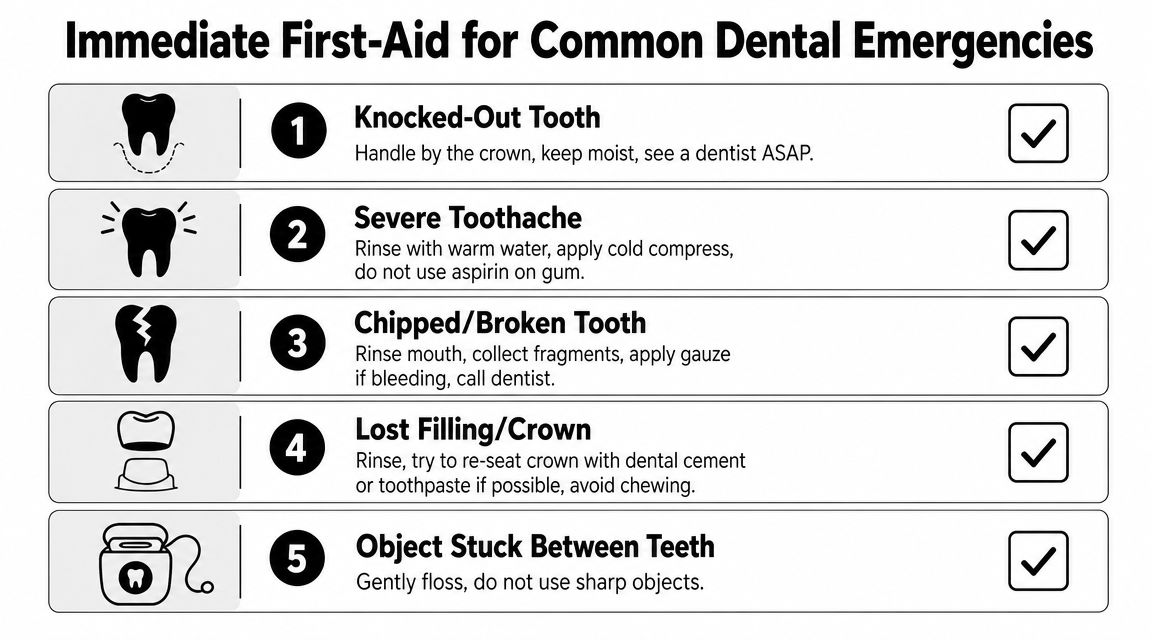
Immediate First-Aid for Common Dental Emergencies
At 10 p.m., a cracked tooth or sudden swelling can make everything feel urgent at once. The first job is simple. Protect the area, reduce pain, and avoid making the problem worse until you can get treatment.
Severe toothache or pressure pain
Rinse gently with warm salt water. If your cheek feels swollen, hold a cold compress on the outside for short intervals. Keep food away from that side, and stick with soft foods if you need to eat.
Do not place aspirin on the gum. It can burn the tissue and will not treat the cause.
Pain that throbs, wakes you up, or comes with swelling usually means the problem needs prompt dental care. In my office, those symptoms often turn out to be a cracked tooth, deep decay, or an infection. Home care may settle things for a few hours, but it does not remove the source.
Knocked-out permanent tooth
Time matters here.
Pick the tooth up by the crown, which is the part you normally see in the mouth. Do not touch the root. If the tooth is dirty, rinse it gently with water for a few seconds. Do not scrub it or wrap it in tissue.
If you can place it back in the socket, do that carefully and bite down on clean gauze. If you cannot, keep it moist in milk or saliva and head straight to a dentist. A dry tooth is much harder to save.
Chipped or broken tooth
Start by rinsing with warm water. If there is bleeding, use clean gauze and light pressure. Save any broken pieces you find.
Then protect the tooth from more damage. Avoid chewing on that side. Stay away from very cold drinks, very hot foods, and anything hard or crunchy. If a sharp edge is cutting your tongue or cheek, cover it with dental wax if you have some.
A small chip may wait a short time. A break that causes sensitivity, visible cracks, or strong pain should be seen the same day.
Lost filling, crown, or something stuck between teeth
These problems often look minor, but they can turn into a much bigger bill if the tooth stays exposed.
- Lost filling: Keep the area clean and avoid chewing there. If the tooth is sensitive to air or temperature, avoid cold drinks and sweets.
- Loose or lost crown: Save the crown if you have it. Rinse it gently and bring it with you. Do not chew sticky foods or use that side.
- Object between teeth: Floss carefully. Do not use pins, knives, tweezers, or other sharp objects that can cut the gum or damage the tooth.
Signs of an abscess or spreading infection
Swelling in the gum, facial swelling, a bad taste in the mouth, pain when you bite, or trouble opening comfortably can all point to an infection. Warm salt water rinses can help keep the area clean. A cold compress can reduce some swelling on the outside of the face.
Watch for red flags. Fever, fast-growing swelling, trouble swallowing, or trouble breathing need immediate medical attention.
For Las Vegas patients without insurance, this is where practical planning matters. If the problem is dental, a dental office can usually treat the cause faster and at a lower cost than a hospital visit. If you call Aspiring Smiles Dental and Braces, ask whether a same-day exam, self-pay pricing, or the in-house membership plan can help you get started right away instead of delaying care and risking a more expensive emergency later.
Where to Go in Las Vegas An ER Urgent Care or a Dentist
When pain spikes, many patients make the same calculation. They want the fastest place open. The better question is which setting can treat the dental problem.
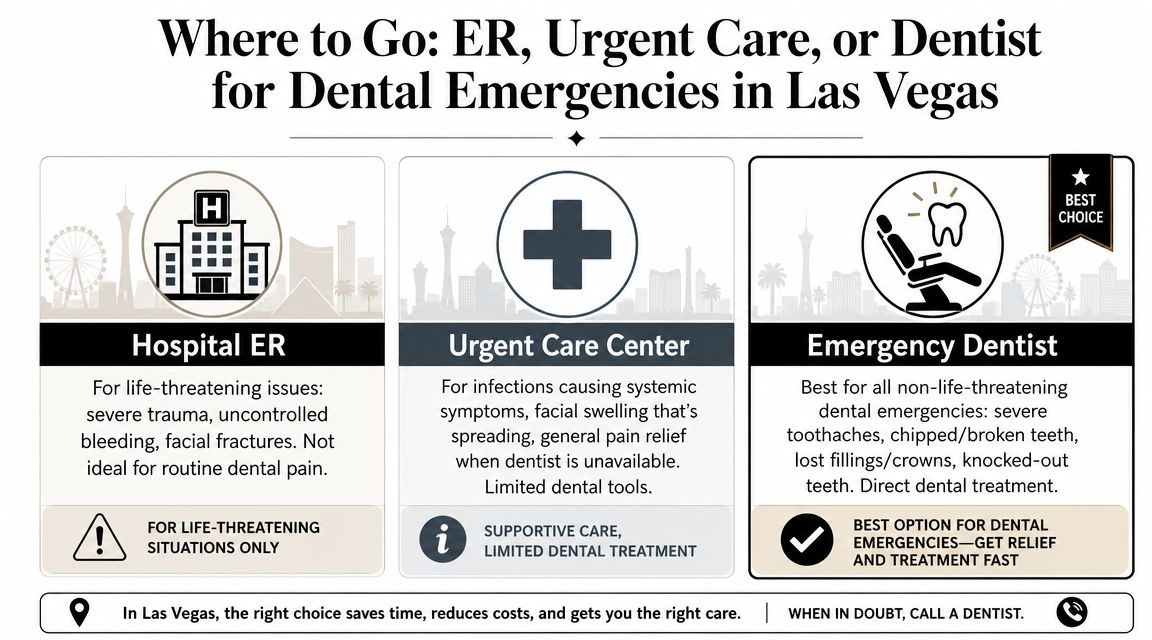
The American Dental Association states that emergency department visits for dental health care cost three times as much as a visit to the dentist, and that the U.S. sees about 2 million hospital ED visits each year for dental pain. That's one reason the ADA created its Emergency Department Referral Program to connect patients to complete dental care instead of repeat hospital visits (ADA information on emergency department dental referrals).
A quick comparison
| Care setting | Best used for | What it can usually do | Main limitation |
|---|---|---|---|
| Emergency dentist | Toothache, broken tooth, lost crown, abscess, tooth extraction needs, dental x-rays, trauma to teeth | Diagnose the cause and provide direct dental treatment | Not the place for life-threatening medical trauma |
| Urgent care | General pain help, infection concerns when a dentist isn't available, medical evaluation for systemic symptoms | May assess symptoms and provide medical support | Usually has limited dental tools and can't perform most dental procedures |
| Hospital ER | Severe trauma, uncontrolled bleeding, facial fractures, serious swelling affecting breathing or swallowing | Stabilizes urgent medical problems | Usually doesn't provide definitive dental treatment |
When a dental office is the right first call
For most non-life-threatening dental emergencies, a dentist in Las Vegas, NV is the right place to start. If you need a tooth extraction, treatment for a cracked tooth, help with a lost filling, or an exam with dental x-rays, a dental office can identify the actual source and treat it directly.
That matters because dental pain often has a mechanical cause. A deep cavity, a fractured cusp, an abscessed tooth, or a failing restoration won't improve just because pain is reduced for a short time.
When urgent care makes sense
Urgent care can be helpful when the problem seems partly medical and a dentist isn't immediately available. If you have fever, feel generally ill, or the swelling is moving beyond the gumline into the face, urgent care may be a useful stop.
Still, urgent care usually isn't the endpoint. It may help bridge the situation, but many patients still need a dentist to remove the source of infection or repair the tooth.
If the problem is in the tooth, the lasting solution usually comes from dental treatment, not temporary symptom control.
Go to the ER if these red flags show up
Use the ER for true emergency warning signs, including:
- Trouble breathing or swallowing: Facial or oral swelling can become dangerous.
- Uncontrolled bleeding: Especially after trauma.
- Suspected jaw fracture or major facial injury: Falls, sports injuries, and car accidents can cause damage beyond the teeth.
- Severe spreading infection with significant swelling: This needs immediate medical attention.
For Las Vegas residents in Lone Mountain or Desert Shores, this triage choice can save time, money, and unnecessary stress. The fastest door isn't always the most effective one.
Affordable Dental Care and Payment Options Without Insurance
A common Las Vegas emergency goes like this: a tooth starts throbbing at night, you do not have insurance, and the first question is not "What treatment do I need?" It is "How much is this going to cost me tomorrow?"
That question matters. I see patients delay care for a day or two because they are afraid of the bill, then end up needing more treatment than they would have needed at the start. In an emergency, the goal is to get the problem diagnosed quickly, stop it from getting worse, and choose the most affordable next step based on what the tooth needs.
Lower-cost care options in Las Vegas
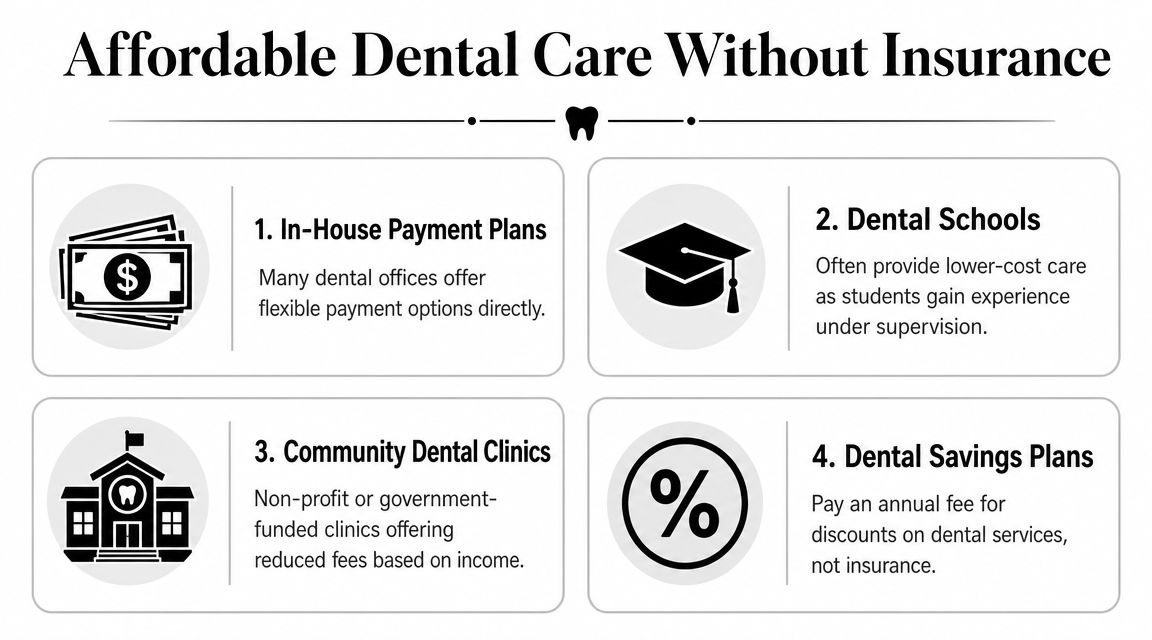
For uninsured patients in Las Vegas, there are usually four realistic paths. Each has a place. The right choice depends on how fast you need help, how much flexibility you have, and whether you need one visit or a longer treatment plan.
- Dental school clinics: UNLV School of Dental Medicine can be a useful lower-cost option for patients who can work with a slower schedule.
- Community health centers: These may reduce the upfront burden, though openings and eligibility can vary.
- Third-party financing: This can spread costs out over time if you qualify.
- In-house membership plans: These often help uninsured patients get seen quickly and lower treatment fees at the same office.
Here is the practical trade-off:
| Option | Works well for | Trade-off |
|---|---|---|
| Dental school clinic | Lower-cost care when the problem is stable and timing is flexible | May not be the best fit for same-day emergencies |
| Community clinic | Reduced-fee care for eligible patients | Appointment availability can be limited |
| Third-party financing | Breaking a larger bill into payments | Approval, interest, and terms vary |
| Membership plan | Uninsured patients who want immediate care and clearer self-pay fees | Savings depend on the office and plan details |
A quick explainer can help if you're comparing savings options and payment structures.
Why membership plans help in real emergencies
For many emergency patients, membership plans solve the biggest immediate problem: uncertainty. Insurance is not the only way to make care affordable, and in urgent situations, insurance-style delays are often the last thing a patient needs.
A useful membership plan usually gives uninsured patients three things:
- Fast access to an exam and x-rays
- Included or discounted preventive care for future visits
- Reduced fees on treatment such as fillings, crowns, or tooth extraction
That structure can make a real difference for Las Vegas residents who need care now, especially in areas like Lone Mountain, Centennial Hills, and Desert Shores where patients often want one local office they can return to instead of piecing care together from multiple places.
One local example is the practice's payment plans and membership options for patients with or without insurance. For someone facing a broken tooth or sudden swelling without insurance, that kind of option gives you a concrete next step instead of another dead end.
What helps financially, and what usually costs more later
Patients usually do best when they make a few direct calls and ask specific questions. Ask whether the office offers self-pay pricing, same-day emergency visits, financing, and an in-house plan for uninsured patients. Ask what is included in the emergency visit and what would be separate if treatment is needed the same day.
What tends to cost more in the end is waiting while the pain worsens, assuming every office requires full payment with no options, or choosing a stopgap solution that does not address the tooth itself.
The lowest bill is not always the cheapest choice if it delays the treatment you need. In dental emergencies, affordable care usually means getting seen quickly, understanding the options clearly, and choosing the path that solves the problem before it turns into a larger one.
Your Emergency Appointment at Our Las Vegas Office
By the time patients arrive for an emergency visit, they've already had a rough day. They're tired, worried about cost, and often bracing for bad news. A good emergency appointment should lower that stress, not add to it.

What happens first
The first step is usually straightforward. You check in, review the immediate concern, and the team focuses on getting enough information to identify the cause of the pain. That often includes a targeted exam and digital dental x-rays.
Tooth pain can be misleading. A patient may point to one tooth, but the actual source may be a cracked tooth nearby, a failing filling, or an infection under the gumline.
How treatment decisions are made
Once the problem is identified, Dr. Patel discusses the options in plain language. If the tooth can be saved with restorative dentistry, that's part of the conversation. If the tooth is too damaged or the infection is too advanced, a tooth extraction may be the most sensible next step. If a missing tooth later needs replacement, options such as dental implants can be reviewed after the emergency is under control.
The key point is that emergency visits aren't only about pain relief. They're about getting a clear diagnosis and a realistic plan.
Some people come in expecting only a temporary patch. What they usually find most helpful is finally understanding what's causing the pain and what it will take to stop it.
Preparing before you arrive
If you're coming from Sunhampton or Mar-A-Lago and want to make the visit smoother, bring any medication list you have, note when the pain started, and mention swelling, fever, trauma, or broken restorations. This guide on how to prepare for seeing an emergency dentist can help you organize the essentials before you leave home.
The larger reason this matters is simple. Many patients cycle through short-term relief without resolving the source. As noted earlier, the CDC found nearly 2 million annual emergency department visits for tooth disorders, and uninsured adults made up a meaningful share of those visits. A dental office is often the place where that cycle finally stops.
Questions to Ask Your Emergency Dentist
When you're in pain, it's easy to forget what you wanted to ask. A short list of questions helps you leave with more than temporary relief. It helps you leave with a plan.
What's actually causing my pain
This is the first question to ask because symptoms can overlap. A cavity, cracked tooth, gum infection, failed crown, or abscess can all feel similar at home. You want the dentist to tell you the source, not just the symptom.
What are my treatment options today
Ask what can be done immediately and what may need a follow-up visit. In emergency dental care without insurance, patients often need to weigh short-term stabilization against definitive treatment. That might mean deciding between a temporary step and a fuller repair, depending on the condition of the tooth.
What will the total cost look like and are payment options available
This question is practical, not awkward. Ask for a clear breakdown. If you need self-pay care, ask whether the office offers financing, phased treatment, or a savings plan. That conversation is part of good care.
If this tooth can't be saved, what comes next
A necessary extraction solves pain, but it also opens the door to the next decision. Ask what happens after the tooth is removed, how healing works, and whether restorative options such as bridges or dental implants near me are appropriate later.
Ask this before you leave: “What should make me call right away tonight or tomorrow?” That gives you clear red flags instead of uncertainty.
How do I keep this from happening again
An emergency visit should also point toward prevention. Ask whether you're due for cleaning and exams, whether you grind your teeth, whether an older filling is failing, or whether the rest of your smile needs attention. In many cases, the next smart step after urgent treatment is routine care, not waiting for another crisis.
If you're dealing with dental pain, swelling, a broken tooth, or another urgent problem, Aspiring Smiles Dental and Braces serves Las Vegas, NV with emergency evaluations, digital x-rays, restorative treatment, tooth extraction, and guidance on payment options for patients with or without insurance. If you're in Desert Shores, Sun City Summerlin, Lone Mountain, Painted Desert Estates, or nearby neighborhoods, contact the office to request an appointment and get clear next steps as soon as possible.