Dental Extraction Near Me: A Las Vegas Patient Guide
When you're searching for dental extraction near me, you're usually not doing it casually. You're in pain, a tooth feels loose or broken, your face may be swollen, or you've been told that waiting longer could make things worse. For a lot of people in Las Vegas, the stress isn't just about the tooth. It's also about fear of pain, worry about cost, and not knowing what will happen once you're in the chair.
That anxiety is understandable. A tooth extraction sounds intimidating until you understand what modern dental care aims to do. The goal isn't to create more discomfort. The goal is to remove the source of pain, protect the surrounding teeth and gums, and help you heal with as little disruption to daily life as possible.
Finding a Gentle Dentist for Tooth Extraction in Las Vegas
Tooth removal is more common than many patients realize. In the United States, adults ages 20 to 64 have an average of 25.5 remaining teeth, which means about 6.5 teeth lost from a full adult set, according to National Institute of Dental and Craniofacial Research data on adult tooth loss. That doesn't mean every lost tooth came from a recent emergency, but it does show that tooth loss is a real part of dental health, not something rare or shameful.
What a nervous patient usually needs most
Patients often come in expecting the extraction itself to be the hardest part. Usually, the hardest part is the buildup before treatment. The waiting, the uncertainty, and the stories people hear from friends can make the situation feel worse than it is.
A gentle approach starts with three things:
- Clear diagnosis: You need to know why the tooth has to come out and whether there are other options.
- Comfort planning: Numbing, pacing, and communication matter just as much as the technical procedure.
- Realistic recovery guidance: Good dentistry doesn't stop when the tooth is removed.
If you're trying to find a dentist near me in Las Vegas, those are better signs of quality than flashy promises. A calm explanation, careful exam, and a treatment plan that fits your life usually tell you more than marketing language ever will.
Practical rule: If a dentist can't explain why a tooth is being removed in plain language, ask more questions before agreeing to treatment.
Why local care matters
An extraction is one of those services where convenience matters. If pain worsens overnight, if you need a follow-up, or if you're juggling work, school, or kids' schedules, a nearby office in Las Vegas is easier to return to than one across town. That's especially true when you're looking for an emergency dentist and don't want to delay care.
The best local dental content should also help patients understand what trustworthy communication looks like online. Practices that focus on patient education tend to do better at attracting high-value dental patients because they answer the questions people are already asking when they're scared, uncomfortable, and ready to book.
A good extraction appointment should leave you feeling relieved, not rushed. That's the standard worth looking for.
Common Reasons for a Tooth Extraction
Not every painful tooth needs to be removed. Dentists try to save teeth when they can with fillings, crowns, root canal treatment, or periodontal care. An extraction becomes the right choice when keeping the tooth would leave you in pain, allow infection to continue, or compromise nearby teeth.
Severe decay and infection
Some teeth are too damaged to rebuild safely. If decay has destroyed too much structure, a filling won't hold, and a crown may not have enough sound tooth to anchor to. In that situation, removing the tooth often protects the rest of your mouth from ongoing infection and repeated pain.
Patients often notice:
- Persistent toothache: Pain that doesn't settle or keeps returning
- Swelling or tenderness: Especially around the gumline
- Pain with chewing: A sign the tooth may be structurally compromised
- Bad taste or drainage: Sometimes associated with infection
When a tooth is no longer predictable, extraction can be the most honest and safest recommendation.
Gum disease and tooth mobility
Advanced gum disease doesn't just affect the gums. It weakens the bone and ligament support that hold teeth in place. A tooth may start to feel loose, shift position, or hurt under pressure even if the visible crown doesn't look badly damaged.
In these cases, keeping the tooth isn't always helpful. A loose tooth can interfere with eating, irritate the gums, and make plaque control harder. Removing it may be part of a larger restorative plan that improves function and comfort.
A tooth doesn't have to be broken in half to be beyond saving. Sometimes the support around the tooth fails first.
Impacted or damaged teeth
Wisdom teeth are the most familiar example. When a tooth doesn't erupt properly, it can stay trapped under the gum, come in at an angle, or only partly emerge. That can create pressure, repeated gum irritation, and problems for the tooth next to it.
A tooth may also need removal after trauma. A crack below the gumline or a fracture that extends into the root can leave too little healthy structure for restoration. In those cases, extraction stops the cycle of pain and prevents repeated failed repairs.
Orthodontic space and long-term planning
Some extractions aren't emergencies at all. They are planned carefully to improve the result of orthodontic treatment or to prepare for restorative work.
That may include:
- Crowding relief: Making room so teeth can move into healthier positions
- Invisalign or braces planning: Creating the space needed for alignment
- Restorative sequencing: Removing a non-restorable tooth before discussing bridges or dental implants near me
- Full-mouth treatment planning: Balancing function, smile appearance, and long-term stability
Integrated dental care holds significant value. A tooth extraction shouldn't be viewed in isolation. It can connect to restorative dentistry, cosmetic dentistry, and orthodontic planning in a way that gives you a healthier final result instead of a quick fix.
Simple Versus Surgical Tooth Extractions
A parent in Las Vegas might bring in a teenager with a painful wisdom tooth, while another patient needs one cracked molar removed before starting Invisalign. Both need an extraction. The procedure is not the same, and it should not be. The right approach depends on how the tooth sits in the mouth, what the roots look like on X-rays, and how to remove it while protecting the surrounding bone and gum tissue.
What a simple extraction means
A simple extraction works best when the tooth is fully visible above the gumline and can be removed without opening the tissue. After the area is thoroughly numb, the tooth is loosened with controlled pressure and lifted out carefully.
For many adults and older teens, this is the more straightforward option. Recovery is often easier because there is less tissue manipulation. That matters if you are juggling work on the Strip, school schedules, or a child’s sports practice and want the least disruptive recovery possible.
Simple does not mean rushed. It means the tooth gives us safe access.
When a surgical extraction is the better option
A surgical extraction is chosen when the tooth cannot be removed safely with a standard approach. That may happen when a tooth is impacted, broken at the gumline, or covered partly by gum or bone. In those cases, creating better access protects the surrounding area and gives the dentist more control.
As explained in this explanation of surgical tooth extraction, the dentist may remove a small amount of bone or divide the tooth into sections to reduce the force needed for removal. Patients often hear the word "surgical" and assume the situation is more dangerous. In practice, it usually means the procedure is being handled more carefully because the anatomy calls for it.
That distinction matters for children, teens, and adults alike. A buried wisdom tooth in a college student, a fractured premolar in a busy parent, and a damaged tooth under an older crown can all require a surgical approach for the same reason. Better access leads to a safer, more controlled removal.
Comparing simple and surgical dental extractions
| Feature | Simple Extraction | Surgical Extraction |
|---|---|---|
| Tooth position | Fully erupted and visible | Broken, impacted, or difficult to reach |
| Gum incision | Usually not needed | Often used for access |
| Bone removal | Usually not needed | Sometimes needed |
| Tooth sectioning | Rare | More common if roots or position make removal harder |
| Typical use | Visible teeth that can be gripped safely | Wisdom teeth, broken teeth, teeth trapped under gum or bone |
| Procedure feel | Shorter and more direct | More staged, with access and removal done carefully |
| Recovery | Often simpler | May involve more swelling and closer aftercare |
Which one is easier on healing
Patients often ask which option is easier to recover from. The answer depends on the tooth, not the label.
A badly broken molar with curved roots may heal more comfortably after a careful surgical extraction than after repeated pulling on a tooth that does not want to move. Choosing the method that reduces trauma is usually the best path. In Las Vegas, where dry air can already make the mouth feel irritated, protecting the tissue during removal can make the first few recovery days more manageable.
How dentists decide
The decision comes from the exam and dental X-rays. We look closely at:
- How much healthy tooth is above the gumline
- Whether the roots are curved, long, or spread apart
- If the tooth is impacted or only partly erupted
- How close the roots are to nearby structures
- Whether the visible part of the tooth is strong enough to grip
- How the extraction fits into future care, such as implants, braces, or Invisalign
For wisdom teeth, planning is especially important because position and timing affect both the procedure and recovery. If back-of-the-mouth pain, swelling, or partial eruption is part of the problem, this guide on wisdom teeth extraction signs and how to prepare explains why many of those cases call for a surgical extraction.
The gentlest extraction is the one that removes the tooth with control and preserves as much healthy bone and gum tissue as possible.
Your Dental Extraction Procedure at Aspiring Smiles
It is common to arrive worried about pain, time off work, or how your child or teen will handle the visit. Once patients see the steps and know what to expect, the appointment usually feels much more manageable.
It starts with the exam, not the extraction
The first priority is confirming that removal is the right treatment. At the visit, the dentist reviews your symptoms, examines the tooth, and takes dental X-rays when needed. That is also when we discuss whether the tooth can still be saved, what the extraction will involve, and how the timing fits the rest of your care.
For Las Vegas families, that planning often matters more than people expect. A parent may be trying to schedule around school, sports, or a vacation. An adult may want to know whether an extraction will affect upcoming cosmetic work, an implant plan, or Invisalign treatment. Those details should be sorted out before the procedure, not after.
A careful new patient exam also prevents the wrong tooth from getting blamed. Dental pain can refer in confusing ways. A cracked molar can feel like sinus pressure, and a wisdom tooth can create soreness that seems to come from the jaw joint.
Comfort comes before movement
Once the plan is clear, the area is numbed thoroughly and tested before the tooth is moved. Patients usually feel pressure, vibration, and pushing. They should not feel sharp pain. If they do, we stop and correct it before continuing.
In our experience, patients often say, "That was faster than I expected."
Simple extractions are often brief. More complex teeth take longer because a controlled approach protects the bone and gums better than forcing the tooth out quickly. That trade-off matters if you may want an implant later or if orthodontic alignment is part of the long-term plan.
What happens in the chair
The tooth is loosened gradually with instruments designed to separate the supporting fibers and create enough space for safe removal. If the crown is badly broken or the roots are difficult to remove in one piece, the technique changes. In those cases, a more careful step-by-step approach usually makes the procedure gentler on the surrounding tissue.
Patients usually notice:
- Pressure and movement: Normal during removal
- Numbness in the area: Expected before the tooth is taken out
- Short pauses: The dentist checks mobility, comfort, and tissue response
- Clear communication: You should know what is happening and what comes next
That communication matters. Nervous patients do better when they are not left guessing, and children and teens usually stay calmer when each step is explained in plain language.
Here's a helpful visual overview of what many patients want to understand before treatment:
Before you leave the office
After the tooth is removed, the site is cleaned and checked, then gauze is placed so you can apply pressure and form a stable blood clot. You leave with instructions that match the procedure you had, your age, your health history, and your routine.
That matters in Las Vegas. Dry air, smoking, long work shifts, travel, and the temptation to get back to normal too fast can all make the first day harder. Good aftercare planning helps a busy adult recover with fewer setbacks, and it helps parents know how to monitor a child or teen once the numbness wears off.
The goal is simple. Remove the tooth safely, keep you comfortable, and set up a smooth recovery from the moment you walk out of the office.
Post-Extraction Aftercare and Recovery in Las Vegas
Most extraction recoveries go smoothly when patients protect the blood clot, keep the area clean, and avoid habits that disrupt healing. Trouble usually starts when the site is disturbed too early by suction, smoking, aggressive rinsing, crunchy food, or heavy activity.
The first day matters most
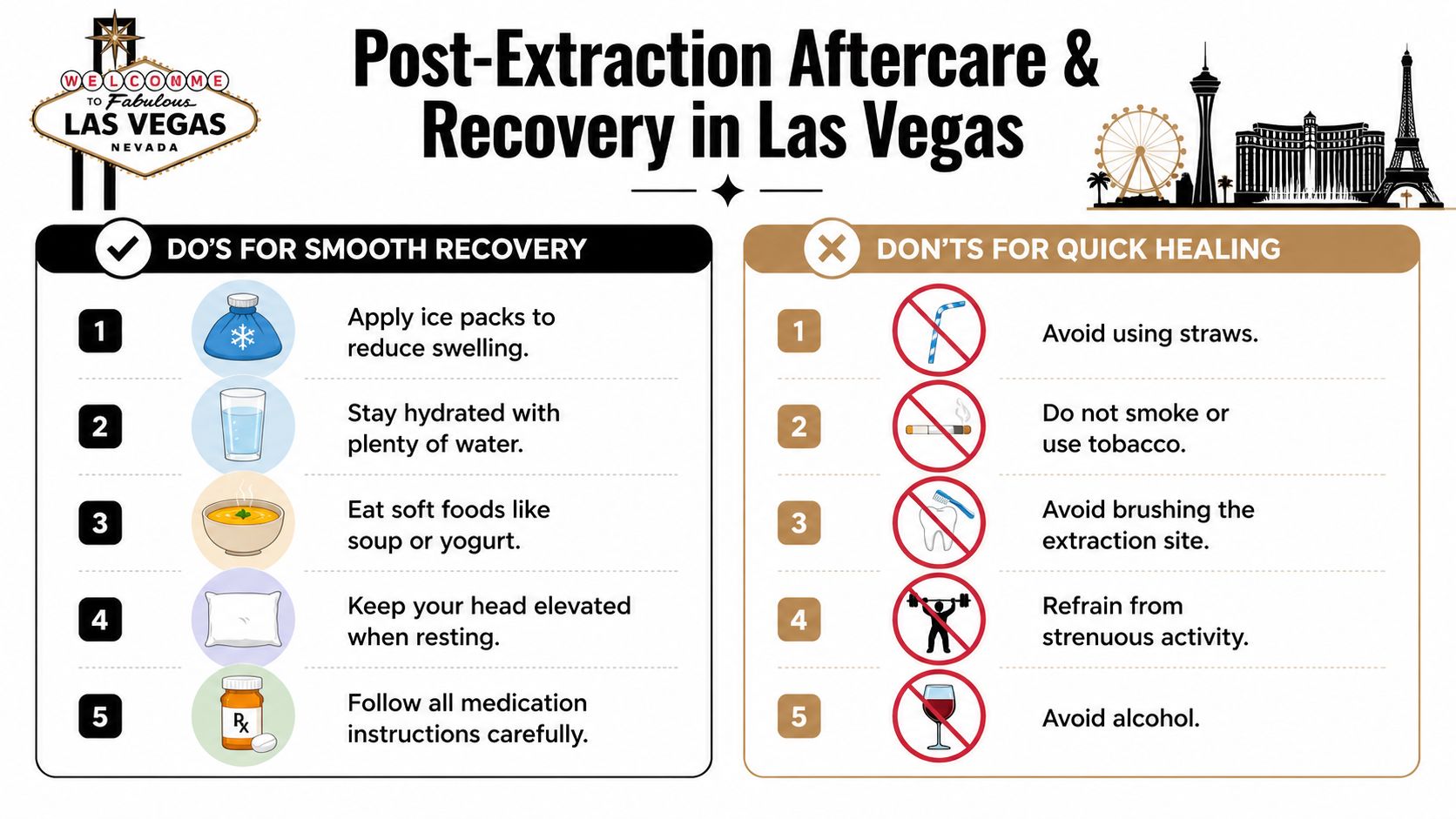
For the first several hours, your job is simple. Bite on the gauze as instructed, rest, and don't keep checking the site with your tongue or fingers. The clot that forms in the socket protects the bone and nerve underneath. If that clot is lost too soon, healing gets more painful.
Focus on these basics:
- Keep pressure on the gauze: Follow the instructions given before changing it
- Use ice on the outside of the face: Helpful when swelling starts
- Drink water carefully: Sip, don't use a straw
- Choose soft foods: Yogurt, soup, mashed foods, and similar options are easier on the area
- Rest with your head raised: That can make the first evening more comfortable
What to avoid while healing
A lot of post-op advice sounds repetitive until you know why it matters. Suction can pull at the clot. Smoke and tobacco can irritate the site and interfere with healing. Hard foods can scrape or pack into the socket.
For the early recovery window, avoid:
- Straws: The suction can disturb the healing socket
- Smoking or tobacco: A common reason healing becomes more difficult
- Alcohol: Especially if you're taking medication
- Brushing directly over the extraction site: Keep the area undisturbed
- Strenuous workouts or sports right away: Increased activity can aggravate bleeding and swelling
Protect the clot first. Almost every aftercare rule comes back to that one principle.
Special guidance for Las Vegas families with teens
Parents often have a harder job after the appointment than during it. Younger patients may say they understand instructions, then forget them as soon as they get home. That matters even more when the patient has braces, is preparing for Invisalign, or wants to get back to sports fast.
A family-specific concern in Las Vegas is teen compliance after extractions. According to this community resource discussing post-extraction care, proper aftercare is especially important for active teens with braces or Invisalign, and compliance issues can affect 25 to 30% of teen extractions. The practical takeaway is simple. Parents should supervise those first recovery days rather than assume instructions will be followed perfectly.
If orthodontic treatment is part of the plan
Timing matters. If an extraction is being done before Invisalign or as part of a broader orthodontic plan, healing has to be protected so treatment doesn't get delayed unnecessarily.
Helpful habits include:
- Keep aligners and appliances discussions specific: Follow the dentist or orthodontic team's instructions on when to resume wear
- Pack school-friendly soft foods: Teens do better when the right food is already available
- Pause sports when advised: A healing site and contact activity don't mix well
- Watch for worsening pain or unusual odor: Those signs deserve a call to the office
Good aftercare isn't complicated. It just requires consistency for a few days. That's what turns an extraction from a stressful event into a clean, efficient step toward comfort.
Understanding Extraction Costs and Insurance Options
Cost is one of the first things patients think about, even when pain is the immediate problem. That's reasonable. You need to know what affects the fee, what insurance may help with, and what options exist if you don't have coverage.
What changes the cost
The final cost of a tooth extraction isn't one flat number because the clinical work isn't always the same. A fully visible tooth that can be removed with a simple extraction is usually less involved than a broken or impacted tooth that needs a surgical approach. X-rays, the complexity of the roots, and whether follow-up restorative care is being discussed can also affect the overall plan.
That doesn't mean the process should feel vague. A well-run office explains what you're paying for before treatment begins and tells you whether the fee reflects a simple extraction, a surgical extraction, or related diagnostic steps.
Insurance and payment questions to ask
Before scheduling, ask direct questions:
- Is my exam covered: Especially if you're coming in as a new patient with pain
- Is the extraction categorized as simple or surgical: This often matters for benefits
- Are dental X-rays included or billed separately: Important for planning
- If I need replacement options later, are those separate estimates: Helpful if you're considering implants or restorative care
- Do you offer payment options or a membership program: Useful for uninsured patients
These questions aren't confrontational. They help you make a clear decision.
What works best for patients
What works is financial transparency. Patients handle treatment better when they understand the diagnosis and the payment path at the same time. What doesn't work is delaying a necessary extraction for too long because the estimate feels confusing or incomplete. Pain rarely becomes cheaper to manage by waiting.
For families in Las Vegas, it helps to choose a dental office that accepts insurance, explains benefits in plain language, and can discuss phased treatment when the extraction is only one part of a larger plan. That may include replacing the tooth later, coordinating with cosmetic dentistry, or preparing for dental implants near me after healing.
A good office doesn't pressure you. It helps you understand your choices so you can move forward with confidence.
Choose Aspiring Smiles for Your Dental Care in Las Vegas
When patients look for a dentist in Las Vegas, NV, they usually want more than someone who can technically remove a tooth. They want a practice that answers the phone, explains things clearly, sees families, and makes the process feel organized from the first call through recovery.
That matters in a city where people are balancing work, school, traffic, and family schedules across neighborhoods like Desert Shores, Sunhampton, Sun City Summerlin, Monterrey, Lone Mountain, Mar-A-Lago, and Painted Desert Estates. Convenience isn't a luxury in that situation. It's part of good care.
Why patients stay with one local office
A practice that handles extractions well should also be able to help you with what comes next. That might be a routine cleaning and exam, cosmetic dentistry, Invisalign, crowns, or planning for restorative treatment after healing. Continuity matters because your mouth doesn't treat these as separate categories, even if websites do.
Local patients also value practical access:
- Extended hours: Helpful when a tooth problem can't wait for a perfect weekday slot
- Saturday availability: Useful for families and working adults
- Online appointment requests: Easier than repeated phone tag
- Complete care in one place: Less running around for exams, X-rays, and follow-up planning
Communication builds trust
People often say they want a gentle dentist, but what they're really describing is a combination of skill and communication. They want to know somebody will listen when they're nervous, explain what the X-ray shows, and tell them what recovery should feel like.
Digital communication is part of that now. For patients who prefer quick questions before calling, tools like live chat for healthcare show why fast, clear responses can make healthcare access feel less stressful. In dentistry, that same principle applies. Patients feel calmer when they can get straightforward answers quickly.
The best dental office experience usually feels simple from the patient's side. That's because the team has done the hard work of making it organized, consistent, and clear.
A local choice with practical value
If you need a tooth extraction, an emergency dentist, a new general dentist, or guidance on what comes after a failing tooth, local experience matters. So does a team that sees children, teens, adults, and patients planning cosmetic or orthodontic treatment.
Aspiring Smiles Dental and Braces serves Las Vegas families with a wide range of care in a modern setting, including preventive, restorative, cosmetic, and emergency services. The office is located at 3211 N Tenaya Wy Suite 122, Las Vegas, NV 89129, making it a practical choice for patients across nearby neighborhoods who want ongoing care, not one isolated visit.
If you're dealing with tooth pain, swelling, a broken tooth, or you've been told an extraction may be necessary, schedule a visit with Aspiring Smiles Dental and Braces. The team can evaluate the tooth, explain your options clearly, and help you move from pain and uncertainty to a treatment plan that feels manageable.