Cosmetic Crowns Teeth in Las Vegas | Aspiring Smiles
If you're looking at one tooth every time you smile, you're not alone. In Las Vegas, many patients start searching for a cosmetic dentist near me after a front tooth chips, darkens, or no longer matches the rest of their smile. Others notice an older filling breaking down, a tooth after a root canal looking dull, or a shape problem that makes photos feel uncomfortable.
A cosmetic crown can solve more than one problem at once. It can rebuild a damaged tooth, improve color and shape, and help you chew comfortably again. The key is making the right decision before any tooth is prepared. For some people, a crown is clearly the right treatment. For others, a veneer, whitening, bonding, or even a dental implant may be a better fit.
Patients in Las Vegas neighborhoods like Desert Shores, Sunhampton, Sun City Summerlin, Monterrey, Lone Mountain, Mar-A-Lago, and Painted Desert Estates often ask the same practical questions. Will it look natural? Will too much tooth need to be removed? How long will it still look good years from now? Those are the questions that matter most, and they deserve direct answers.
Your Cosmetic Dentist for Crowns in Las Vegas NV
A common situation goes like this. A patient has a wedding, work event, graduation, or family photos coming up. One front tooth has a crack line, heavy discoloration, or an old filling that keeps showing. The person isn't always in pain, but they are tired of smiling with their lips closed.
At that moment, patients typically do not want a sales pitch. They want a clear answer about what works, what doesn't, and whether a crown is the right way to fix the problem.

For Las Vegas patients, crowns aren't some unusual or experimental treatment. They are a standard part of modern restorative and cosmetic dentistry. One U.S.-focused estimate says about 15 million adults have at least one dental crown, and another source notes approximately 1 million crowns are made annually in the United States. The same source also states that the global dental crowns market was valued at USD 3.56 billion in 2026 and is projected to grow, reflecting how widely crowns are used to address decay, trauma, and cosmetic concerns in everyday practice (U.S. crown usage and market growth overview).
That matters because people often assume a crown means their tooth is beyond saving. Usually, it means the opposite. It means the tooth can often still be protected and used, but it needs more coverage than a filling or bonding can provide.
When patients usually start considering a crown
Some concerns are mainly cosmetic. Others start as structural issues and become cosmetic over time.
- Visible damage: A tooth is chipped, cracked, worn down, or uneven.
- Stubborn discoloration: The tooth is much darker than the neighboring teeth, especially after prior treatment.
- Large old dental work: A filling keeps breaking, staining, or leaving too little healthy tooth visible.
- Function and appearance together: The tooth doesn't just look off. It also feels weak when biting.
A good cosmetic crown doesn't just make a tooth whiter. It makes the tooth look believable in your smile.
When looking for help with crowns and cosmetic dentistry in Las Vegas, the right starting point is a careful exam, not a quick cosmetic promise. A crown should be recommended because it solves the actual problem, not because it's the easiest thing to sell.
What Are Cosmetic Dental Crowns
A cosmetic dental crown covers the entire visible portion of a tooth to improve how it looks and how it functions. In practice, I recommend a crown when a tooth needs full coverage because appearance alone is not the whole issue. The tooth may also be weakened, heavily filled, worn down, or darkened in a way that simpler cosmetic treatment will not solve well.
This is often the point where patients compare crowns to veneers. That comparison matters. A veneer usually covers the front surface of a tooth and is best when the tooth is mostly healthy and the goal is to improve shape, color, or minor unevenness with less reduction. A crown wraps around the tooth and is the better choice when the tooth also needs reinforcement.
What a crown can fix
A cosmetic crown is usually considered when the problem involves both esthetics and structure.
- A tooth with a large filling or cavity: There may not be enough healthy enamel left for bonding or another filling to last well.
- A cracked, chipped, or fractured tooth: Full coverage can help protect a tooth that is taking too much stress.
- Deep discoloration: Some teeth stay dark because the staining is internal, often after trauma or prior treatment.
- A worn or misshapen tooth: A crown can rebuild length, contour, and symmetry in a more controlled way.
- A tooth after root canal treatment: Many of these teeth need added coverage because they are more likely to break under pressure.
A crown is a bigger commitment than bonding or a veneer because the tooth has to be shaped on all sides. That trade-off can be the right one. If a tooth is already compromised, choosing the more conservative-looking option does not always lead to the better long-term result.
Patients also need to know that cosmetic crowns are not a one-time beauty purchase. The shade and contour can be made to blend very naturally, but the surrounding teeth can still change over time. Natural enamel may darken, whitening done later will not lighten the crown itself, and gum position can shift with age or inflammation. Those are real maintenance issues, especially for front teeth.
For a quick visual overview of how crowns work and why they're used, this short video helps:
Why the word cosmetic matters
A cosmetic crown is designed with more than coverage in mind. On a back tooth, the main priority may be strength and bite support. On a front tooth, the crown also has to match the neighboring teeth in color, translucency, shape, texture, and light reflection.
Patients usually notice shape and surface texture before they notice shade.
That is why the planning stage matters so much. The goal is a crown that looks believable in everyday light, in photos, and at conversational distance. If you want to understand how material choice affects that result, it helps to review the different types of dental crowns and where each one tends to work best.
Choosing the Right Crown Material for Your Smile
Material choice affects how a crown looks, how it handles bite pressure, and how it may age over time. There isn't one material that's right for every tooth. The right answer depends on where the tooth is located, how much force it takes, and how visible it is when you smile.
All-ceramic and porcelain options
For front teeth, all-ceramic or porcelain-style crowns are often chosen when appearance is the top priority. These materials can create a softer, more natural look in visible areas because they can be designed with lifelike contours and light reflection.
They're often a strong fit when the main goal is to improve a front tooth that is dark, misshapen, uneven, or structurally compromised but still important to the smile line. The limitation is simple. A beautiful material still needs the right design. If the crown is too opaque, too bulky, or too flat, it can still look artificial.
Zirconia for strength-focused cases
Zirconia is often selected when a tooth has to tolerate heavier chewing forces. That's especially relevant for many back teeth. In some front-to-back cases, zirconia may also be considered if the bite is demanding or if durability is a major concern.
Patients sometimes assume stronger always means better. It doesn't. A crown has to fit the tooth's role. A front tooth isn't judged the same way a molar is judged.
Practical rule: The best crown material is the one that matches the tooth's job, not the one with the strongest marketing.
Where PFM crowns still make sense
Porcelain-fused-to-metal, often called PFM, combines a metal core for strength with a porcelain outer layer for appearance. That combination is why PFM crowns remain versatile in both front and back areas. They can be a reasonable option when a restoration needs solid support but still has to blend with neighboring teeth.
The trade-off matters in cosmetic cases. The porcelain can chip over time, and if the gum line recedes later, a gray metal margin may become visible. That is the main cosmetic drawback patients should understand before choosing this type of crown (PFM crown strengths and cosmetic trade-offs).
A broader discussion of different dental crown types can help patients understand why two people in the same Las Vegas office may receive different recommendations for teeth that seem similar at first glance.
The Crown Treatment Process at Aspiring Smiles
Many patients feel better once they know what happens during crown treatment. The process is straightforward, and each step has a purpose. If you're coming from Lone Mountain, Desert Shores, or nearby parts of Las Vegas looking for a dentist near me, this is what the visit sequence usually looks like.
The first visit and the planning stage
The appointment starts with a conversation, an exam, and dental x-rays when needed. A key decision is then made. The question isn't only whether the tooth can be covered with a crown. The question is whether it should be.
A careful exam checks the amount of remaining tooth structure, any cracks, existing fillings, bite forces, gum health, and whether the tooth is vital or has had prior root canal treatment. If a patient is also considering teeth whitening, veneers, or other cosmetic dentistry options, that should be discussed before the final shade and design are chosen.
Preparing the tooth
If a crown is the right choice, the tooth is shaped so the final restoration can fit properly. That reshaping creates room for the material and allows the crown to sit securely without looking oversized.
Patients often worry this step will be painful. In most cases, the area is numbed well, and the experience feels much easier than expected. Comfort matters, and modern dentistry is built around that.
- Why preparation is necessary: A crown needs space so it doesn't look bulky or throw off the bite.
- Why precision matters: If too little is done, the crown can feel thick or unnatural. If too much is removed unnecessarily, the tooth loses healthy structure.
- Why planning comes first: The amount of reduction should match the treatment goal and the material chosen.
Wearing a temporary crown
After the tooth is prepared, a temporary crown is usually placed while the final one is being made. This protects the tooth, helps maintain appearance, and gives you a chance to function comfortably in the meantime.
Temporary crowns are useful, but they are not the finish line. Patients should treat them gently, especially around sticky or very hard foods. If the temporary feels high, loose, or rough, it should be checked rather than ignored.
If a temporary crown feels awkward, don't assume the final one will feel the same. Temporary materials and final materials behave differently.
Delivering the final crown
At the delivery visit, the temporary is removed and the custom crown is tried in. The dentist evaluates fit, contacts between teeth, gum response, shade, contour, and bite. If those details are right, the crown is bonded or cemented into place.
This is also the point where good cosmetic work shows itself. A crown should not feel like a bright cap placed on one tooth. It should work with the smile, the bite, and the surrounding teeth.
For many patients, this same evaluation visit is when other needs become clear too. Some people move on to cleaning and exams, whitening, or restorative dentistry on nearby teeth. Others may need an emergency dentist because the crown issue began with a broken tooth or sudden pain. Good treatment planning looks at the whole mouth, not just one tooth in isolation.
Cosmetic Crowns vs Veneers and Implant Crowns
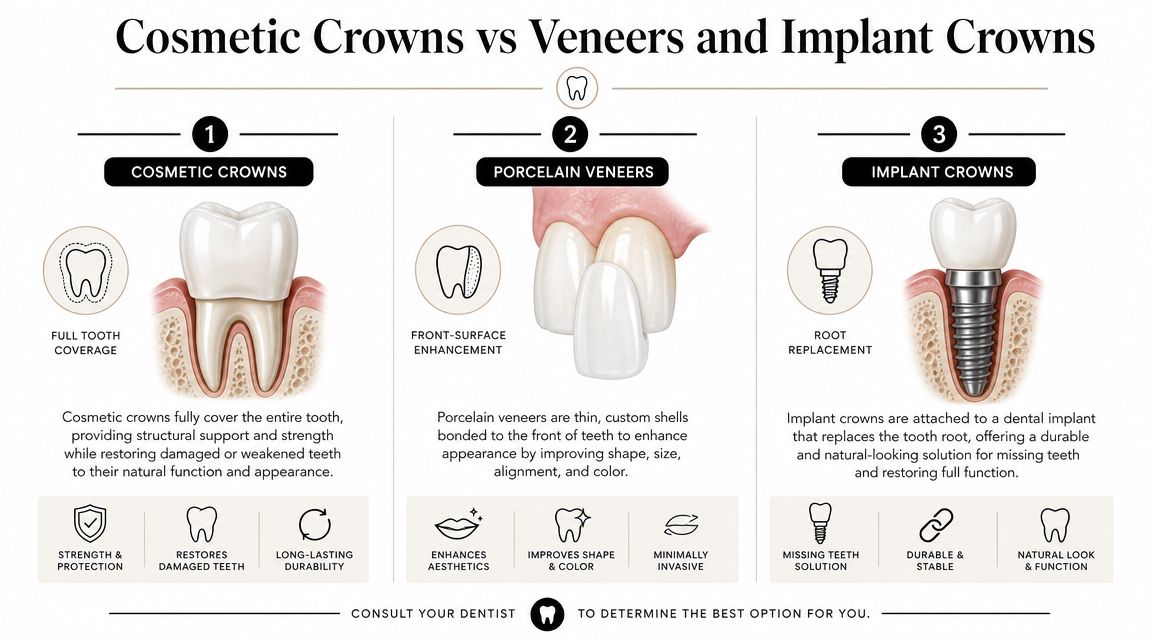
Patients often arrive thinking they need a crown when they may instead need a veneer. Others ask for a crown when the tooth is missing entirely, which changes the discussion to an implant crown. These treatments can all improve a smile, but they solve different problems.
When a crown makes more sense than a veneer
A veneer covers the front surface of a tooth. A crown covers the entire visible portion. That difference matters.
A crown is usually the better choice when the tooth already has large fillings, significant damage, cracks, heavy wear, or a history of root canal treatment. In those situations, the tooth often needs full coverage for support, not just a cosmetic layer on the front.
A veneer is often the more conservative option when the tooth is mostly healthy and the concern is shape, mild discoloration, or front-facing cosmetic improvement. Crowns require more tooth reduction than veneers, so the decision should depend on remaining enamel, existing restorations, bite forces, and the actual condition of the tooth, not appearance alone. A conservative approach is often preferred when the tooth can support it (guidance on crowns vs veneers for front teeth).
Comparing Crowns and Veneers
| Feature | Dental Crown | Porcelain Veneer |
|---|---|---|
| Coverage | Covers the full visible tooth | Covers the front surface |
| Main purpose | Adds protection and cosmetic improvement | Primarily improves appearance |
| Tooth reduction | Usually more reduction | Usually more conservative |
| Best for | Cracked, heavily filled, worn, root canal treated, or structurally weak teeth | Front teeth with cosmetic concerns and better underlying structure |
| Bite demands | Often better when strength is a major concern | Better when esthetics drive the plan and the tooth is otherwise sound |
How an implant crown is different
An implant crown is not the same thing as a crown on a natural tooth. A standard crown fits over your existing tooth after that tooth is prepared. An implant crown attaches to a dental implant when the natural tooth is missing.
That distinction is important when considering dental implants near me or comparing smile restoration options. If the root and natural tooth can still be preserved, a regular crown may be part of restorative dentistry. If the tooth is gone or can't be saved, a dental implant with a crown may be the replacement path.
Patients in Las Vegas sometimes ask which option looks more natural. The better question is which option matches the actual condition in the mouth. Saving a restorable tooth is different from replacing a missing one. Those are not competing treatments. They are answers to different clinical problems.
Benefits and Long-Term Care for Your Dental Crown
You notice it a few weeks after treatment. The tooth looks better, chewing feels easier, and you stop avoiding one side of your mouth. That is usually the first real benefit patients describe. The cosmetic improvement matters, but the day-to-day comfort matters just as much.

A crown can restore a tooth that feels unreliable when you bite, protect a tooth that has lost a lot of structure, and improve the way that tooth fits your smile. In practice, crowns often serve patients well for many years. The exact lifespan depends on the condition of the tooth underneath, the bite, the material used, and how well the area is maintained at home.
That long-term piece is where patients should slow down and ask better questions.
A crown is not always the better cosmetic choice just because it covers more tooth. If the tooth is structurally weak, heavily filled, cracked, or worn down, a crown may be the more durable path. If the tooth is healthy and the concern is mainly color, shape, or minor surface defects, veneers can be the more conservative option. The right decision is not about which treatment photographs better on day one. It is about which option still makes sense after years of chewing, staining, gum changes, and routine maintenance.
What patients usually notice first
The benefits tend to show up in ordinary moments, not just in the mirror:
- More dependable chewing: Biting on the treated side often feels stable again.
- Support for a damaged tooth: A crown can help hold together a tooth that has already lost significant structure.
- Better smile symmetry: Contour, shape, and shade can be improved so the tooth blends with nearby teeth.
- Less mental stress: Many patients stop worrying that the tooth will chip, catch food, or stand out when they smile.
What keeps a crown looking good over time
Long-term cosmetic success takes maintenance. Crowns do not decay, but the tooth at the margin still can. Gum tissue can also change over time, which may expose an edge that was not visible when the crown was first placed. Even a strong, well-made crown can start to look less natural if plaque builds up at the gumline, the bite wears unevenly, or neighboring teeth change color while the crown does not.
This is one of the biggest practical differences between crowns and veneers in cosmetic planning. Veneers are often chosen to preserve more natural tooth, but they also require careful maintenance of the visible front surfaces and margins. Crowns add more coverage and strength, but they can look older faster if gum recession or margin staining develops. Neither option is maintenance-free.
The habits that protect the result are simple:
- Brush and floss carefully at the gumline: The edge where the crown meets the tooth needs consistent plaque control.
- Keep regular exams and cleanings: Early problems around the margin are much easier to manage than larger breakdown later.
- Avoid chewing hard non-food items: Ice, pens, fingernails, and package tearing can damage crowns and natural teeth.
- Address clenching or grinding: A nightguard may be recommended if your bite puts extra pressure on the crown.
- Watch the color of surrounding teeth: Natural teeth can stain or lighten over time, while the crown shade stays the same.
A crown can stay functional for years and still need cosmetic attention earlier if the gums recede, the margin picks up stain, or the color match changes around it.
Patients looking into cosmetic crowns teeth usually do best when they view treatment as a long-term restoration plan, not a quick cosmetic fix. That mindset leads to better decisions between crowns and veneers, and it sets more realistic expectations for how the smile will look not just after placement, but years later.
Your Cosmetic Crown Questions Answered
Some of the most important crown questions are the ones people hesitate to ask. One of them is how long a crown continues to look cosmetic. Long-term appearance can change because of gum recession, staining at the margin, and material-related differences. Shape, texture, and planning matter just as much as the initial color match (why crowns can look less natural over time).
Cost depends on the tooth, material, complexity, and whether additional treatment is needed first. The most accurate answer comes after an exam, not from a generic online number. If you're concerned about budget, ask about insurance, phased treatment, and financing options before treatment starts.
Most patients also want to know if getting a crown hurts. With local anesthesia and gentle technique, treatment is usually much easier than patients expect.
Frequently Asked Questions
| Question | Answer |
|---|---|
| Will my crown look fake? | It shouldn't if the case is planned well. Natural-looking results depend on shade, shape, surface texture, and how the crown fits your smile. |
| Is a crown better than a veneer? | Sometimes, but not always. If the tooth is structurally weak or heavily restored, a crown may be better. If the tooth is healthy and the goal is mainly cosmetic, a veneer may be more conservative. |
| How long will my crown last? | Crowns can last many years with good home care and regular dental visits. Longevity depends on bite forces, hygiene, and how the tooth is used. |
| Can a crown stain? | The crown material itself may resist discoloration differently than natural enamel, but the edge where the crown meets the tooth can show stain over time if plaque collects there. |
| What if I need more than one treatment? | That's common. Some patients pair a crown with whitening, cleanings and exams, or other restorative dentistry to create a more even result. |
If you're weighing a crown against a veneer, trying to fix a damaged front tooth, or comparing options like implants and cosmetic dentistry in Las Vegas, the next step is a personalized exam. Aspiring Smiles Dental and Braces provides new patient exams, dental x-rays, restorative care, emergency dental services, and smile-focused treatment planning for patients across Las Vegas, NV. Schedule a consultation to get a clear answer about what fits your tooth, your bite, and your long-term goals.