
Affordable Emergency Dental Care Pittsburgh No Insurance
A tooth can start throbbing at the worst possible time. It might wake you up after midnight, hit during work, or flare up right before a family event. If you don't have dental insurance, the pain is only part of the problem. The other part is the question racing through your mind: where can I go right now, and what is this going to cost?
That search often starts with terms like emergency dental care Pittsburgh no insurance, but if you're in Las Vegas, the decision still comes down to the same practical issues. You need pain relief, you need to know whether this is a true emergency, and you need a path that won't leave you more stressed than when you started. Families in Desert Shores, Sunhampton, Sun City Summerlin, Monterrey, Lone Mountain, Mar-A-Lago, and Painted Desert Estates deal with this every day.
A calm plan helps. Most dental emergencies can be stabilized, diagnosed, and treated without panic. The key is making the right first move.
A Dental Emergency in Las Vegas Does Not Have to Be a Crisis
A common scenario looks like this. You bite down, feel a sharp crack, and within an hour your whole jaw seems to ache. Or a child wakes up crying because a tooth hurts and one side of the face looks puffy. If you're uninsured, it's easy to freeze because pain and cost hit at the same time.
That reaction is understandable. It also leads many people to wait too long, try home remedies that don't solve the problem, or end up in the wrong setting for care.
You're Not the Only One Facing This
Urgent dental problems without insurance are not unusual. The CDC reported an annual average of 1,944,000 emergency department visits for tooth disorders during 2020 to 2022, and 12.2% of those visits involved uninsured patients. That matters for one simple reason: if you're dealing with serious dental pain and no insurance card in your wallet, you're part of a very real and recurring group of patients, not an outlier.
The problem is that the emergency room usually isn't the place that fixes the tooth. In many cases, hospital care can rule out dangerous medical issues, help with short-term stabilization, and then send you back out to find a dentist for the actual treatment.
Practical rule: If the problem is mainly tooth pain, a broken tooth, a lost filling, or swelling that isn't affecting breathing or swallowing, start by contacting a dentist, not a hospital.
What Helps Most Right Away
When people are scared, they often look for certainty. In dentistry, the first useful kind of certainty is smaller and more realistic. You need to know three things:
- Whether you're safe and can stay home long enough to get to a dental office
- Whether the tooth can be saved or at least stabilized
- What the next financial step looks like before treatment moves forward
That is what turns a crisis into a plan.
For Las Vegas patients, especially those looking for an emergency dentist near me or a dentist in Las Vegas, NV, the smartest approach is usually direct dental triage, a focused exam, and a clear discussion of treatment choices before anything proceeds. That takes the situation out of guesswork and puts it back into manageable steps.
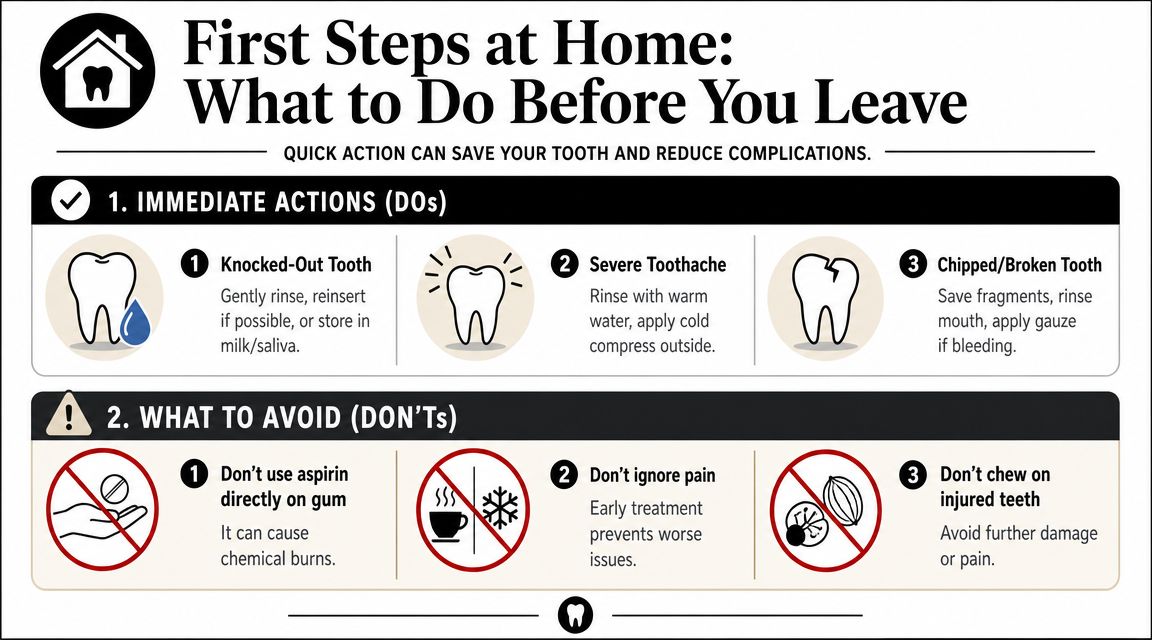
First Steps at Home What to Do Before You Leave
Before you get in the car, slow things down for a few minutes. A few basic steps at home can reduce pain, protect the area, and help your dentist do more for you once you arrive.
For a Severe Toothache
A deep, throbbing toothache often means inflammation, infection, a crack, or advanced decay. Home care won't fix any of those, but it can keep the problem from getting worse on your way in.
- Rinse gently with warm water. This helps clear debris around the tooth and gumline.
- Floss carefully around the area. Sometimes food trapped between teeth can intensify pressure.
- Use a cold compress on the outside of the face. This may help with swelling and can make the area feel less intense.
- Keep your head raised. Lying flat can make pressure feel worse for some patients.
Don't place aspirin directly on the gum or tooth. It can irritate the tissue and create a chemical burn.
For a Knocked-Out Tooth
This is one of the few dental emergencies where what you do in the first minutes matters a lot.
If a permanent tooth is knocked out, pick it up by the crown, not the root. If it's dirty, rinse it gently. Don't scrub it. If you can place it back into the socket without forcing it, do that carefully. If not, keep it moist in milk or saliva while you travel for care.
A baby tooth is different. Don't try to force a baby tooth back into place.
For a Chipped or Broken Tooth
Some broken teeth hurt immediately. Others don't hurt until air, temperature, or pressure reaches the exposed area.
Use these steps:
- Rinse your mouth with warm water to remove loose particles.
- Save any fragments if you can find them.
- Place gauze on the area if there is active bleeding.
- Use a cold compress outside the cheek to help control swelling.
- Avoid chewing on that side until the tooth is examined.
A cracked tooth can turn from manageable to severe very quickly if you keep biting on it. Soft foods only, or avoid chewing altogether if the pain is significant.
For a Lost Crown or Filling
A lost filling or crown may not sound dramatic, but it can expose sensitive tooth structure and leave a weak tooth vulnerable to further damage.
- Keep the crown if you have it. Bring it with you.
- Avoid sticky or hard foods. Those can worsen the damage.
- Chew on the opposite side.
- Don't try household glue. Dental materials are specific for a reason.
Pain after a lost crown or filling often means the tooth was already vulnerable. Waiting usually makes treatment more complicated, not simpler.
What Not to Do on the Way In
Some choices create more trouble than the original problem.
- Don't chew on the injured side. Extra pressure can deepen a crack.
- Don't ignore swelling. Swelling can change quickly.
- Don't keep testing the tooth. Repeated biting, tapping, or poking only adds irritation.
If you need a same-day dentist in Las Vegas, these first-aid steps buy time. They don't replace treatment, but they can preserve options.
Dentist or ER Making the Right Call in Las Vegas
The hardest part for many uninsured patients isn't the pain. It's deciding where to go. The wrong choice can cost time, money, and a lot of frustration.
Go to the ER for These Red Flags
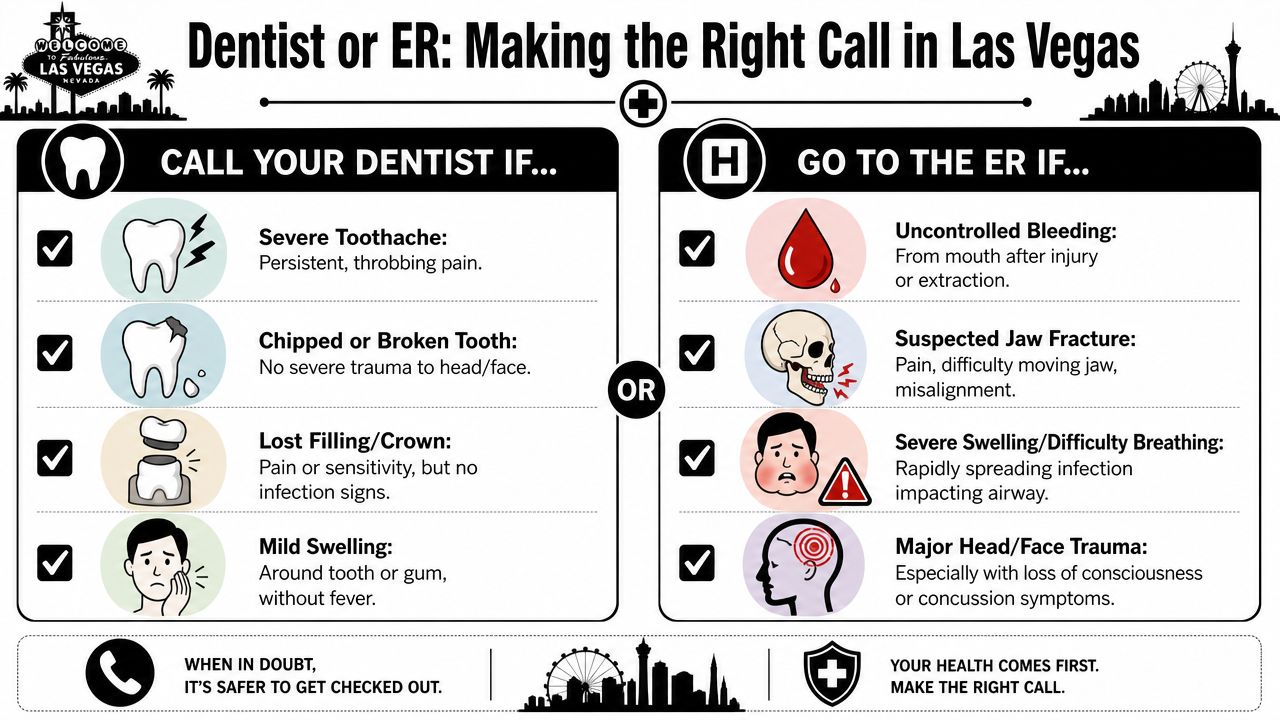
Some situations are medical emergencies first and dental emergencies second. In those cases, the hospital is the right call. Guidance on emergency dentistry states that you should go to an emergency room for severe dental-related trauma such as jaw fractures or dislocations, serious cuts to the face and mouth, or abscesses and infections causing significant swelling that affects your ability to breathe or swallow.
That means the ER comes first if you have:
- Trouble breathing or swallowing
- Rapidly spreading swelling
- Suspected jaw fracture or jaw dislocation
- Serious facial or oral lacerations
- Major trauma involving the head or face
- Bleeding that won't stop
If any of those are happening, don't wait for a dental office callback.
Call a Dentist for Most Other Dental Emergencies
Most urgent dental problems belong in a dental chair, not a hospital bed. That includes:
| Problem | Best first stop | Why |
|---|---|---|
| Severe toothache | Dentist | The tooth and surrounding tissue need diagnosis and treatment |
| Broken or chipped tooth | Dentist | The tooth may be restorable or protectable |
| Lost crown or filling | Dentist | The tooth needs coverage or repair |
| Swelling around a tooth without breathing trouble | Dentist | The source is often dental and needs direct treatment |
| Pain when biting | Dentist | Cracks, nerve irritation, or infection need dental evaluation |
A hospital can help with medical danger. A dentist can diagnose the tooth, take dental x-rays, stabilize the damage, and move toward definitive care.
For patients weighing the difference between urgent dental treatment options, this guide on emergency dentist vs same-day dentist differences can help clarify what kind of appointment fits the problem.
The simple test is this. If the danger is to your airway, jaw, or overall physical safety, go to the ER. If the danger is to your tooth, call a dentist.
Why This Choice Matters When You Don't Have Insurance
Without insurance, every wrong turn is more stressful. Going to the ER for a tooth problem that still needs a dentist afterward usually doesn't solve the source. It often adds another stop, another bill, and another delay.
For a cracked tooth, infected tooth, lost restoration, or urgent need for tooth extraction, seeing a dental office first is usually the most direct route to pain relief and a treatment plan.
Finding Affordable Emergency Care in Las Vegas Without Insurance
Individuals seeking emergency dental care Pittsburgh no insurance usually aren't looking for trivia. They're trying to answer a practical question: where can I get treated without walking blindly into unknown costs?
That same concern applies in Las Vegas. Cost transparency matters because "emergency care" can mean very different things depending on where you go. One local source discussing uninsured dental treatment published cash prices of $179 to $249 for a tooth extraction and $159 to $349 for a composite filling, while the University of Pittsburgh School of Dental Medicine lists a $50 adult emergency consultation fee with radiographs and treatment billed separately, showing how much pricing structures can vary depending on setting and what is included in the visit (cash price examples and consultation fee context).
The Three Paths Most People Consider
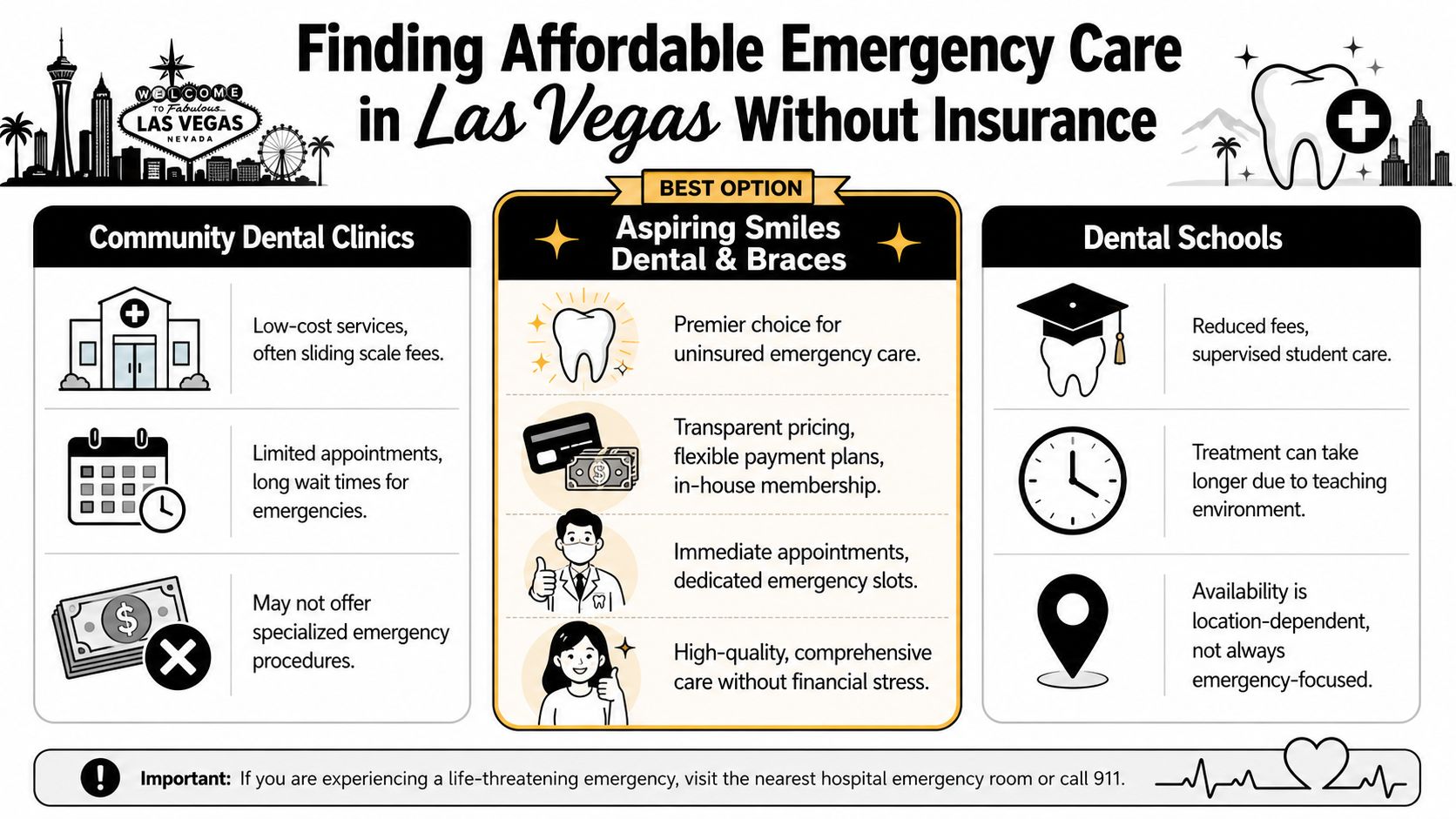
Uninsured patients usually look at three categories of care.
Community or Safety-Net Clinics
These settings can be important for patients with limited access to care. Pennsylvania's oral-health resources note that safety net dental clinics serve people with limited access, including low-income patients and patients on public insurance who can't find a private dentist willing to see them, and treatment may be offered at no cost or on a sliding fee scale through the state oral-health resource center.
That kind of model can help, but there are trade-offs. Eligibility rules may apply. Appointment availability can be limited. Emergency procedures may not always be immediately accessible.
Dental Schools
Dental schools can provide lower-cost care, and for some patients they are worth considering. The trade-off is time. Teaching environments can involve longer visits, more steps, and scheduling limitations that don't always match the urgency of same-day pain.
If you're swelling, losing sleep, or unable to chew, speed matters almost as much as price.
A Private Dental Office With Clear Payment Options
This route often works best when the office can do three things well:
- Explain what the emergency visit includes
- Discuss treatment choices before moving forward
- Offer ways to spread out cost when needed
That's where a true dental home makes a difference.
Why the Dental Home Model Works Better
The American Dental Association promotes an emergency access model that links patients to a dental home for definitive treatment, and the association says this approach improves continuity of care with treatment acceptance rates of over 93% through its emergency department referral model.
That idea matters because pain relief alone isn't the finish line. If you only get temporary help and never address the underlying tooth, the problem usually returns.
A dental home means one place handles the sequence that works:
- Urgent evaluation
- Dental x-rays and diagnosis
- Definitive treatment or stabilization
- Follow-up care to prevent a repeat crisis
What to Ask Before You Book
If you're uninsured, don't be shy about asking direct financial questions. A good emergency call should make the next step clearer, not foggier.
Ask things like:
- What does the emergency visit include
- Are dental x-rays separate
- Will I get a treatment plan before treatment begins
- What payment options are available if I need more than an exam
- Do you offer a membership plan instead of insurance
For Las Vegas patients exploring local options, emergency dental care without insurance often comes down to choosing a setting that can both diagnose the problem and discuss manageable payment pathways at the same visit. At Aspiring Smiles Dental and Braces, that means emergency care is part of the office's service mix, alongside flexible payment options and a membership program for patients who don't have traditional coverage.
Cheap care isn't always affordable if it delays the real treatment. The most affordable path is usually the one that solves the problem with the fewest detours.
What to Expect During Your Emergency Visit at Aspiring Smiles
Patients feel better once they know what the visit will look like. Uncertainty makes dental pain feel worse. A straightforward process lowers the temperature right away.
The Call and Arrival
When you call, the first goal is simple triage. The team needs to know what happened, how much pain you're in, whether there is swelling or trauma, and whether any symptoms suggest you should be directed to a hospital instead.
If you're coming in without insurance, say that up front. That helps the office frame the visit around diagnosis, relief, and a practical discussion of treatment choices. Bring a photo ID, a list of medications, and any relevant health information. If a crown, bridge piece, or tooth fragment came out, bring that too.
The office is located at 3211 N Tenaya Wy Suite 122, Las Vegas, NV 89129, which makes it accessible for patients in Lone Mountain, Sun City Summerlin, Desert Shores, and nearby neighborhoods looking for a dentist near me or an emergency dentist in Las Vegas.
The Exam and Diagnosis
Once you're seated, emergency care usually begins with a focused conversation and exam. The dentist will want to know:
- When the pain started
- Whether hot, cold, or biting makes it worse
- If swelling is present
- Whether the problem began with trauma, decay, or a lost restoration
Dental x-rays are often part of the visit because they show what can't be seen from the outside. A tooth may look mildly damaged but have a deeper crack, infection, or bone involvement that changes the treatment plan.
The point of this stage isn't to overwhelm you with terminology. It's to answer the question that matters most: what is causing the pain, and what can be done today?
A short overview of emergency dental concerns can also help you know what these visits are designed to handle.
Relief First, Then a Clear Plan
Patients often worry that an emergency visit means being rushed into treatment. It shouldn't feel that way. The normal sequence is diagnosis first, then discussion.
Depending on the problem, the immediate treatment may involve stabilizing a tooth, addressing an infection source, placing a temporary protective restoration, or planning a tooth extraction if the tooth can't be predictably saved. In other situations, the best first move is to relieve pressure and schedule the definitive procedure as the next step.
You should leave an emergency visit understanding what happened, what was done today, what still needs to be done, and what the financial path looks like.
If More Than One Option Exists
Not every emergency has a single answer. A badly damaged tooth may be restorable, or it may be better removed depending on the fracture, the infection, the surrounding support, and your budget.
That conversation should be honest. If a filling can safely buy time, you should know that. If a crown is the more durable option, you should know that too. If tooth extraction is the only realistic path, that should be explained clearly and calmly.
That kind of transparency matters whether you're seeking emergency care, restorative dentistry, or a long-term dentist in Las Vegas, NV for your family.
After Your Emergency Visit Your Path to Lasting Oral Health
The emergency visit is the start of getting back to normal. It isn't the end of the dental problem unless the underlying cause has been fully treated.
If the visit stabilized pain but more care is needed, don't put the next step off. Temporary fixes are useful because they create breathing room. They are not meant to become permanent by accident. A cracked tooth can worsen. Decay under a lost filling doesn't stop on its own. An infection that quiets down can flare up again.
What Prevents the Next Emergency
Long-term prevention is usually less dramatic than emergency dentistry, but it's where the biggest benefits show up in daily life.
Focus on:
- Routine exams and cleanings so problems are found while they're still smaller
- Dental x-rays when needed to catch hidden decay or infection
- Repairing damaged teeth early instead of waiting for pain
- Following through on recommended restorative care such as fillings or crowns
- Having one regular office for ongoing care instead of bouncing from crisis to crisis
For patients without insurance, a membership plan can make preventive visits and follow-up care easier to budget because it creates a more predictable way to stay on track.
The bigger goal is simple. You want fewer emergencies, less time in pain, fewer surprise decisions, and a dental office that already knows your history when something urgent happens. That is how emergency treatment turns into lasting oral health for families across Las Vegas, from Monterrey to Painted Desert Estates.
If you're in pain and need a practical next step, contact Aspiring Smiles Dental and Braces to request an appointment. The office serves Las Vegas patients who need emergency dental care, tooth extraction, dental x-rays, and follow-up treatment, with support for patients seeking care without insurance.