Overbite Correction in Las Vegas: Your Guide
If your bite feels off, your front teeth cover too much of your lower teeth, or you're tired of hiding your smile in photos, know that you're not alone in seeking a dentist near me. Many people live with an overbite for years before they realize it can affect comfort, tooth wear, and confidence, not just appearance.
Families across Las Vegas, NV often start looking for answers when a child's bite seems deep, a teen asks about Invisalign, or an adult notices jaw strain, uneven wear, or a smile that never felt quite balanced. Overbite correction can help, and the right plan depends on who has the overbite, what's causing it, and when treatment begins.
Your Trusted Las Vegas Dentist for Overbite Correction
A lot of patients begin this search after a small moment that keeps repeating itself. Maybe your child's front teeth seem to disappear when they bite down. Maybe you've noticed your lower teeth hitting the roof of your mouth. Maybe you're an adult who has wondered for years whether your bite can be fixed without surgery. Those concerns are valid, and they deserve a clear answer.
Deep bite malocclusion, the clinical term for excessive overbite, affects approximately 15% to 20% of the United States population, making it a common but highly treatable condition, according to this overview of overbite correction and treatment options. In practice, that means overbite problems are something dental teams see regularly, and modern care offers more than one path forward.
Patients in Desert Shores, Sunhampton, Sun City Summerlin, Monterrey, Lone Mountain, Mar-A-Lago, and Painted Desert Estates usually want the same thing. They want a bite that feels healthy, a smile that looks natural, and a treatment plan that fits real life. That may include clear aligners, braces, cosmetic dentistry to refine worn teeth, or restorative dentistry when an overbite has already damaged the smile.
Local care that looks at the whole picture
A good overbite evaluation shouldn't happen in isolation. Bite problems can overlap with routine dental care, cleaning and exams, dental X-rays, new patient exams, and sometimes emergency concerns if a tooth chips or wears unevenly. Patients who are also comparing options for a cosmetic dentist near me, tooth extraction, restorative dentistry, or even dental implants near me often need one office that can coordinate treatment rather than treating each problem separately.
Practical rule: If an overbite is causing wear, discomfort, or self-consciousness, it's worth getting evaluated sooner rather than waiting for the problem to become more complicated.
Good communication matters too. If you've ever felt frustrated by missed calls or delayed scheduling when trying to book care, Recepta.ai's ultimate guide offers a useful look at how dental practices handle patient communication and responsiveness.
What Is an Overbite and Why Does It Matter
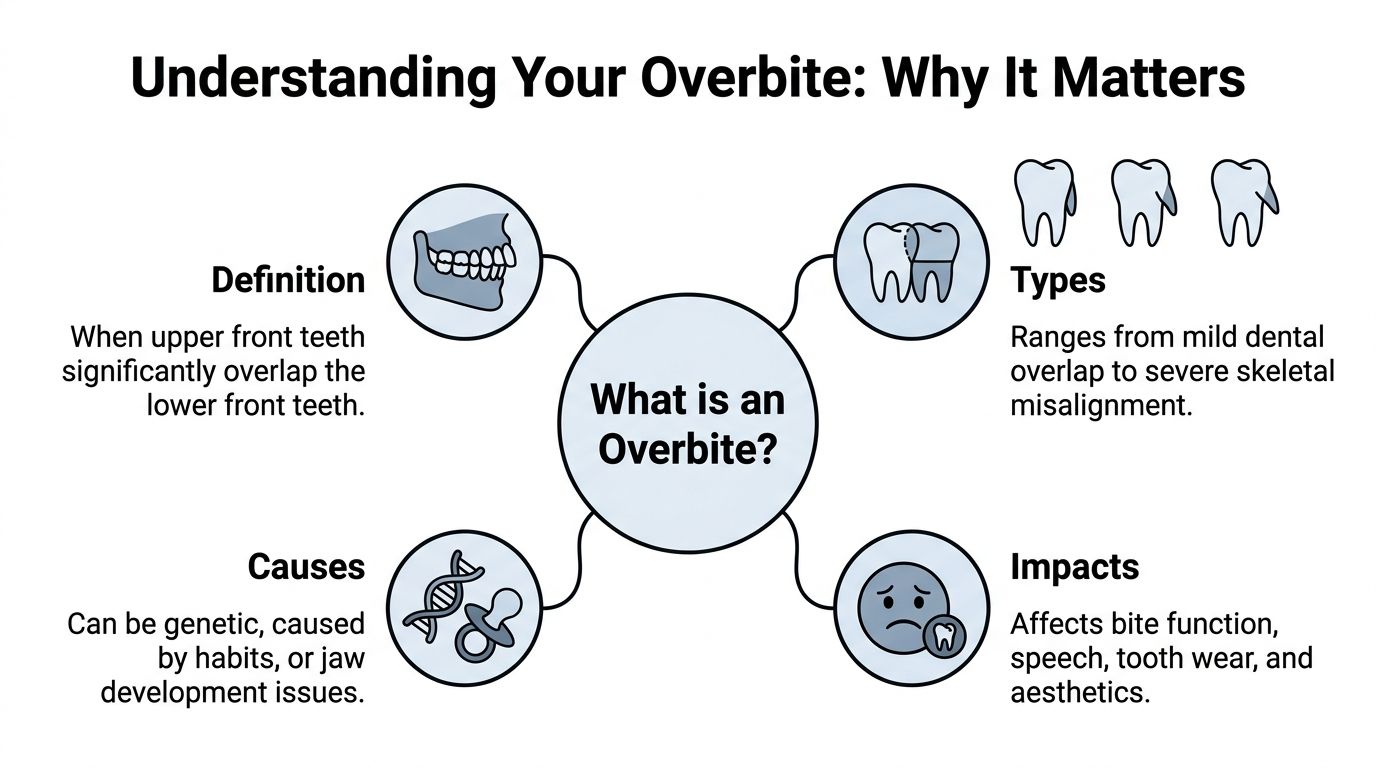
An overbite describes how much the upper front teeth overlap the lower front teeth. A small overlap is healthy. Too much overlap can create a bite that functions poorly and places extra stress on teeth, gums, and jaw joints.
One simple way to think about it is like a door that closes properly versus one that shuts too far past the frame. A normal bite protects the teeth and lets them work together. An excessive overbite puts certain teeth into positions they weren't meant to stay in every day.
Two common reasons overbites happen
Some overbites are mostly dental. That means the teeth are tipped, crowded, or positioned in a way that creates too much overlap even though the jaws themselves are reasonably balanced.
Others are more skeletal. In those cases, jaw size or jaw position plays a larger role. The upper jaw may sit too far forward, the lower jaw may sit back, or the vertical relationship between the jaws may create a deep bite pattern.
This difference matters because it shapes treatment. Dental overbites are often corrected with braces or clear aligners. Skeletal overbites can still improve with orthodontics, especially in children and many adults, but the most severe adult jaw discrepancies may require a different conversation.
Why correction is often about health, not vanity
Patients sometimes assume overbite correction is only cosmetic. That isn't usually the full story. An untreated overbite can lead to issues that become harder to manage over time.
- Tooth wear can increase when the front teeth strike each other too heavily.
- Gum irritation may happen when lower teeth contact tissue behind the upper front teeth.
- Jaw discomfort can develop when the bite doesn't close evenly.
- Speech changes may show up in some patients when tooth position interferes with sound formation.
- Cleaning challenges can make home care less effective when teeth overlap excessively.
A bite that looks only slightly off can still place heavy force on a small number of teeth every day.
Normal versus excessive overlap
A healthy bite isn't perfectly flat. There should be overlap, just not too much. When the overlap becomes excessive, the concern isn't only how the smile looks from the side. It's how the teeth function together when you chew, speak, and rest your jaw.
That's why overbite correction often connects with other services patients already search for, including cosmetic dentistry, teeth whitening, restorative dentistry, and even emergency dentist care when a weakened or worn tooth finally cracks. The bite is the foundation. If the foundation is off, cosmetic and restorative work can be harder to protect long term.
How We Diagnose Overbite Severity at Our Las Vegas Office
A parent may bring in a child whose front teeth seem to disappear when they bite down. An adult may come in after years of chipping, wear, or jaw fatigue and ask whether the problem is cosmetic or something more. The first visit answers that question with records, measurements, and a clear look at whether the bite problem is coming from the teeth, the jaws, or both.
What happens during the exam
The exam starts with what you are noticing day to day. Some patients are worried about smile appearance. Others mention difficulty biting into sandwiches, sore jaw muscles, or lower front teeth hitting the tissue behind the upper teeth. Those details help shape the diagnosis because two people can have a similar-looking overbite and very different functional problems.
We then examine how the teeth come together in motion and at rest. That includes the amount of vertical overlap, the position of the upper and lower front teeth, crowding, spacing, and whether certain teeth are carrying too much force. Dental X-rays and photos help confirm what we cannot judge accurately from a visual exam alone.
How severity is classified
One part of the diagnosis is measuring how much the upper front teeth overlap the lower front teeth. Orthodontic references generally describe a small amount of vertical overlap as normal, while a deeper overlap is classified as a deep bite. The American Association of Orthodontists describes overbite as the vertical overlap of the upper front teeth over the lower front teeth in its patient education materials on overbite and deep bite.
That measurement matters, but it never stands alone. I also look at how the incisors are angled, whether the lower face height is reduced, whether the back teeth are supporting the bite properly, and whether the jaw pattern suggests growth guidance, tooth movement alone, or a conversation about surgery in adulthood.
| What we evaluate | Why it matters |
|---|---|
| Tooth position | Shows whether tooth movement with braces or aligners is likely to correct the bite predictably |
| Jaw relationship | Helps determine whether the overbite is mainly dental, skeletal, or a combination |
| Tooth wear and trauma | Reveals whether the bite is already damaging enamel, edges, or supporting structures |
| Gum and tissue health | Identifies irritation where lower teeth contact tissue behind the upper front teeth |
| Age and growth stage | Changes what is possible for children, teens, and adults, and affects timing |
| Patient priorities | Helps balance esthetics, comfort, visibility of appliances, and long-term stability |
Why imaging and records matter
Records guide decisions that patients often find confusing, especially adults deciding between a non-surgical and surgical path. A teenager in Las Vegas who still has growth remaining may benefit from treatment choices that are not available later. An adult with a deep bite caused mostly by tooth position may do very well with orthodontic correction alone. An adult with a significant jaw discrepancy may still improve with braces or aligners, but the limits of camouflage treatment should be fully discussed before treatment starts.
That is why we take photos, X-rays, and digital scans seriously. They let us compare what the bite looks like from the front, side, and inside the mouth, and they help us explain what can change, what cannot, and what trade-offs come with each option.
A careful diagnosis makes the roadmap clearer for kids, teens, and adults. It also helps us set realistic expectations from the first consultation through retention and long-term smile maintenance.
A Full Range of Overbite Correction Options
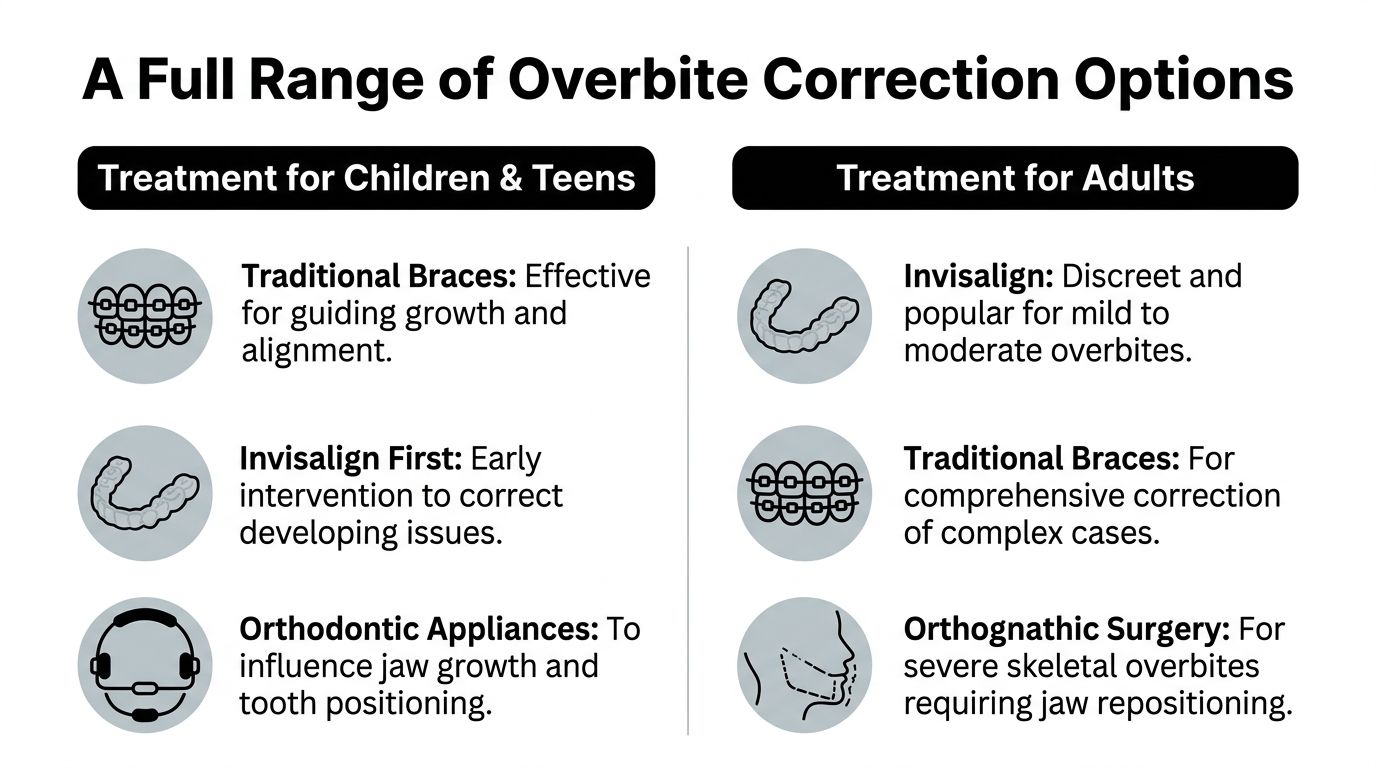
Children, teens, and adults don't all need the same kind of treatment. The right option depends on age, severity, jaw development, oral health, and how much change is possible with tooth movement alone.
For children and teens
When a younger patient still has active growth, early treatment can sometimes guide development in a way that isn't possible later. That doesn't mean every child needs treatment immediately. It means timing matters.
In growing patients, the plan may involve:
- Observation with records when the bite is developing but not yet ready for treatment.
- Orthodontic appliances when the jaws need help growing into a healthier relationship.
- Braces or clear aligners when the main issue is tooth position and bite depth.
For kids and teens, early action can reduce the need for more complex correction later. It can also protect front teeth that are taking too much force.
For adults who want non-surgical correction
This is the question many adults ask first. Can a severe overbite be corrected without jaw surgery?
In many cases, yes. While some severe adult cases require orthognathic surgery, many adults can benefit from orthodontics alone. Modern techniques using clear aligners, braces, and advanced anchorage methods can successfully correct many adult overbites non-surgically, as noted in this discussion of when overbite treatment can work without surgery.
That matters because adult treatment isn't automatically surgical. Plenty of adults are candidates for bite correction using tooth movement, bite-opening mechanics, and carefully planned camouflage strategies. Clear aligners can be part of that conversation, especially for mild to moderate dental overbites. If you're comparing aligners specifically, this page on whether Invisalign can fix an overbite gives a useful treatment-focused overview.
Aspiring Smiles Dental and Braces provides Invisalign clear aligners, which are one option for patients whose overbite can be managed through planned orthodontic tooth movement.
Braces versus Invisalign
Both can work. The better question is which one gives enough control for your specific bite.
| Option | Often a strong fit for | Trade-offs |
|---|---|---|
| Braces | More complex tooth movement, deeper bite mechanics, difficult rotations | More visible, harder to clean around, fixed in place |
| Invisalign | Mild to moderate dental overbites, adults who want discreet treatment, patients committed to wear time | Requires discipline, may not be ideal for every severe case |
| Combined planning | Patients who need orthodontics plus restorative finishing | Takes coordination and a phased plan |
Braces give the doctor direct, continuous control. Invisalign offers flexibility and appearance advantages, but it works only when the case is suitable and the patient wears the aligners as directed.
When surgery is the better answer
Some adults have a true skeletal discrepancy that tooth movement alone can't fully solve. In those cases, trying to force a non-surgical solution may improve the smile a little while leaving the bite unstable or compromised.
Surgery is usually considered when jaw position is the core problem and realistic orthodontic camouflage would fall short. That doesn't mean failure. It means the diagnosis is honest. For the right patient, surgery provides the most complete correction of function and facial balance.
Related services that may support the final result
Once the bite is corrected, some patients also benefit from:
- Restorative dentistry to repair worn or chipped teeth
- Cosmetic dentistry to refine shape or symmetry
- Crowns or bonding when long-standing wear changed tooth edges
- Dental implants if missing teeth affect bite support
- Tooth extraction in selected orthodontic plans where space management is necessary
The best overbite correction plan isn't about choosing the fanciest tool. It's about choosing the method that matches the biology of the case.
Treatment Timelines and Understanding Costs
A parent may bring in a 10-year-old whose front teeth cover too much of the lowers. An adult may come in after years of chipped edges, jaw strain, or feeling that their bite never sat right. Both are asking the same practical questions. How long will this take, and what will it cost?
How long treatment usually takes
There is no honest one-size answer. Treatment time depends on who is being treated, when treatment starts, and whether the overbite comes from tooth position, jaw position, or both.
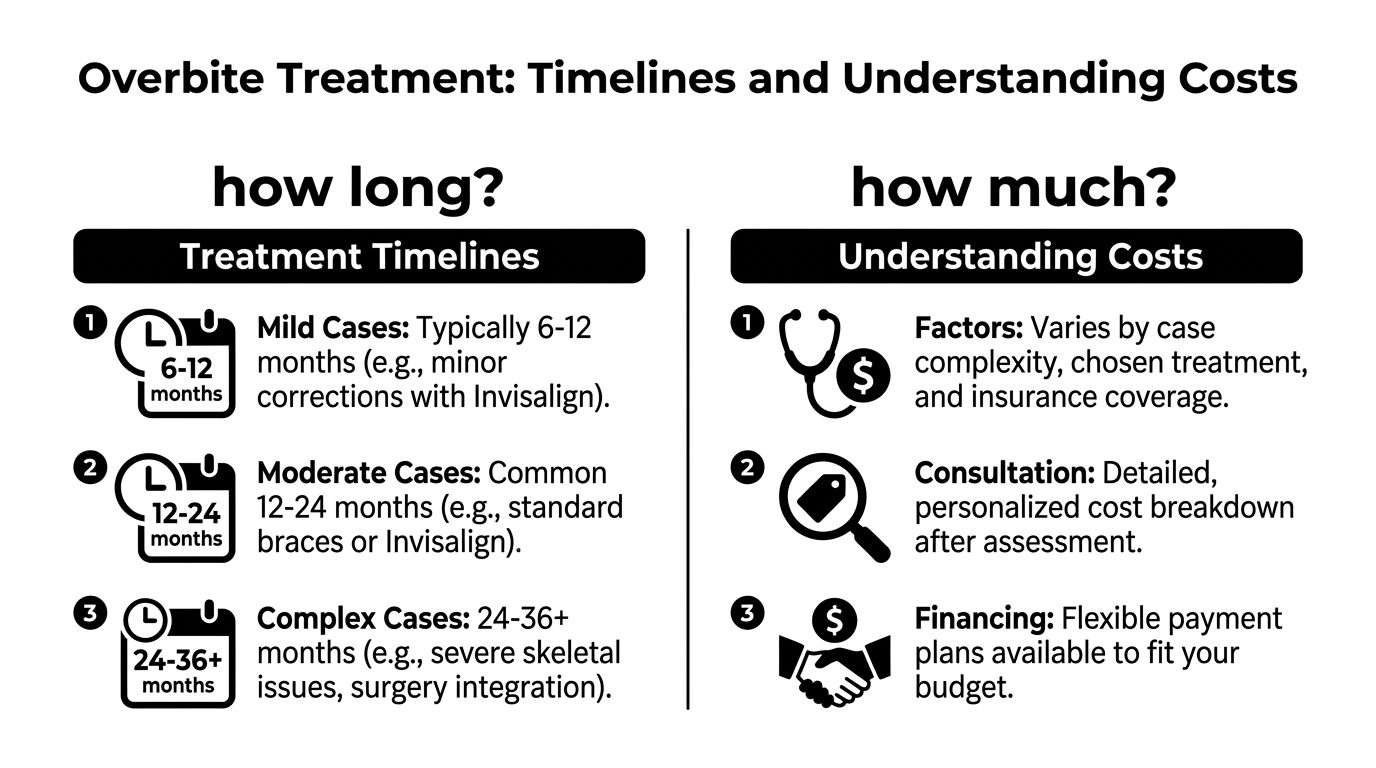
For many patients, overbite correction is measured in months, not weeks. Mild to moderate dental cases often fit within the general orthodontic window of about one to two years. Patients comparing appliances can get a clearer sense of those differences in our guide to Invisalign vs. traditional braces for orthodontic treatment.
Kids and teens may have an advantage because growth can help us guide the bite while the jaws are still developing. Adults can still get excellent results, but treatment usually relies on tooth movement alone unless surgery is part of the plan.
Surgical adult cases take the most planning. Orthodontic preparation often comes first, then surgery, then finishing the bite afterward. The recovery period after jaw surgery is usually counted in weeks, and the full treatment process is longer than a non-surgical plan. The American Association of Oral and Maxillofacial Surgeons explains the hospital, healing, and follow-up stages in its patient information on orthognathic surgery: https://myoms.org/what-we-do/corrective-jaw-surgery/
Why timelines vary so much
Two Las Vegas patients can both have a deep overbite and still need very different plans.
A younger patient with a developing bite may respond efficiently with growth-friendly treatment and braces. A teenager with crowding and a deep bite may need a more controlled orthodontic phase. An adult with worn teeth, missing teeth, or a true skeletal discrepancy may need staged care that involves more than straightening.
Cooperation matters too. Aligners work only if they are worn as prescribed. Missed appointments, broken appliances, or long gaps in care can slow progress.
What affects cost
Cost follows complexity. The fee reflects the amount of diagnosis, appliance design, monitoring, and finishing needed to get a stable result.
| Cost factor | Why it changes the total |
|---|---|
| Age and stage of treatment | Early interceptive care, teen treatment, and adult correction are not planned the same way |
| Case complexity | Deeper bites and combined dental-jaw problems usually take more time and control |
| Appliance choice | Braces, aligners, and surgical coordination involve different materials, visits, and lab work |
| Need for additional care | Extractions, restorative work, or surgical planning can add phases to treatment |
| Insurance benefits | Orthodontic coverage and age limits vary from plan to plan |
The consultation is where these numbers become real. After the exam, records, and diagnosis, we can explain whether your child is a good candidate for early correction, whether a teen is likely looking at standard orthodontic treatment, or whether an adult is choosing between camouflage and surgical correction.
That clarity matters. Families in Las Vegas usually feel more comfortable once they understand the trade-offs, the likely timeline, and the payment options available before treatment begins.
Maintaining Your New Smile After Correction
Finishing treatment is a major milestone, but it isn't the end of overbite care. Teeth move because bone and supporting tissues adapt. Those same tissues can also allow relapse if retention is ignored.
Retainers are part of treatment, not an extra
Once the bite has been corrected, retainers help hold the teeth in their new positions while the supporting structures settle. Depending on the case, that may involve a removable retainer such as a Hawley or Essix design, a bonded retainer, or a combination.
Some patients are surprised by how strongly this is emphasized. It shouldn't be surprising. A corrected bite stays corrected best when retention is treated as essential, not optional.
Adults usually need a longer retention mindset
Adult patients need especially realistic expectations. Due to higher relapse rates related to bone density and lack of growth, adult overbite correction often requires permanent or long-term nighttime retainer use to maintain the results achieved during the 1-2 year treatment period, according to this guide to adult overbite correction and retention.
That doesn't mean adults are poor candidates. It means adults do well when they understand the full process from the beginning. Straightening the bite is one phase. Keeping it stable is the next phase.
If you're an adult fixing an overbite, think in terms of long-term maintenance, not short-term finishing.
Daily habits that protect the result
Retention works best alongside good home care and regular dental visits. A corrected bite is easier to keep clean, but it still needs attention.
- Wear retainers as prescribed so the bite doesn't drift.
- Keep up with cleaning and exams because gum health supports tooth stability.
- Replace damaged retainers promptly instead of waiting and hoping nothing shifts.
- Address grinding or clenching if your dentist sees signs of force that could affect the result.
A healthy bite also makes other services more predictable over time. If you later want teeth whitening, veneers, bonding, or restorative work, stable tooth positions give those treatments a better foundation.
Your Overbite Consultation at Aspiring Smiles in Las Vegas
Patients usually feel better once they know the first step is simple. You don't need to arrive knowing whether you need braces, Invisalign, or something more advanced. You only need a clear evaluation and an honest discussion.
At 3211 N Tenaya Wy Suite 122, Las Vegas, NV 89129, patients can expect a welcoming visit that starts with listening. Dr. Patel and the team evaluate the bite, review imaging as needed, and talk through goals without pressure. Some people come in focused on overbite correction. Others are also looking for a dentist in Las Vegas, NV for ongoing family dentistry, new patient exams, cleaning and exams, dental X-rays, or emergency dentist care.
What your visit can include
A first appointment may involve several parts depending on your needs:
- Detailed exam to evaluate bite function and visible wear
- Orthodontic discussion about braces or Invisalign options
- Cosmetic dentistry planning if worn edges or smile balance are concerns
- Restorative review if damaged teeth need crowns, bonding, or future implant support
- Financial discussion about insurance, payment options, and scheduling
Patients from Sunhampton, Mar-A-Lago, Sun City Summerlin, and Painted Desert Estates often appreciate having one office where general, cosmetic, and restorative needs can be discussed together instead of split across multiple appointments.
For a closer look at the practice experience, this short video offers a helpful introduction.
If your bite feels uncomfortable, your smile looks too deep, or you're weighing braces against clear aligners, the most useful next step is a consultation with a treatment plan built around your case, not a generic answer.
Frequently Asked Questions About Overbite Correction
Is overbite correction painful
Most patients describe treatment as manageable rather than painful. Braces can cause soreness after adjustments, and Invisalign can create pressure when switching to a new tray. If surgery is part of the plan, recovery is more involved, but that's a separate pathway and is discussed in detail beforehand.
Can an overbite return after treatment
Some minor change is possible after treatment, which is why retainers matter. Long-term stability is still strong when treatment is done well and retention is followed. Research on incisor intrusion mechanics found only a 0.7 mm increase in overbite after retention, which was considered clinically insignificant, according to this long-term study summary on overbite stability.
Will my dental insurance help pay for overbite correction
Coverage depends on your individual plan. Some policies help more when treatment is tied to function and oral health rather than appearance alone. The office can review benefits and explain what applies before treatment begins.
At what age is it too late to fix an overbite
It's not too late just because you're an adult. Children and teens may benefit from growth-related options, but adults can still achieve meaningful correction with braces, clear aligners, or other carefully planned treatment. The key question isn't age by itself. It's what kind of overbite you have and what result is realistic.
If you're ready to take the next step, schedule a consultation with Aspiring Smiles Dental and Braces. Patients across Las Vegas, including Desert Shores, Lone Mountain, Sunhampton, Monterrey, Mar-A-Lago, Painted Desert Estates, and Sun City Summerlin, can come in for a clear exam, personalized recommendations, and a practical plan for a healthier, more confident smile.