Average Price of False Teeth: Las Vegas Guide 2026
If you're trying to price false teeth in Las Vegas, a full set of conventional dentures often falls in the $2,000 to $6,000 range locally, and partials are usually less. In practice, that lines up with per-arch pricing in Las Vegas, where complete removable dentures typically cost $1,000 to $3,000 per arch and partial dentures often run $700 to $1,800 per arch depending on materials and design.
Losing teeth affects more than appearance. It can change how you chew, how clearly you speak, and how comfortable you feel smiling in public. Many people searching for a dentist near me or a dentist in Las Vegas, NV are dealing with that mix of frustration and urgency right now, especially if missing teeth followed broken teeth, gum disease, or a recent tooth extraction.
Dr. Patel helps patients across Las Vegas, including Desert Shores, Sunhampton, Sun City Summerlin, Monterrey, Lone Mountain, Mar-A-Lago, and Painted Desert Estates, sort through denture choices without confusion. The primary goal isn't just to quote a number. It's to match the right treatment to your mouth, your health, your daily routine, and your budget.
Your Guide to Denture Costs from a Dentist in Las Vegas
When patients call about the average price of false teeth, they're usually not asking out of curiosity. They're trying to solve a daily problem. Maybe eating has become difficult, maybe a temporary appliance keeps slipping, or maybe they're comparing options after an emergency visit or years of putting treatment off.
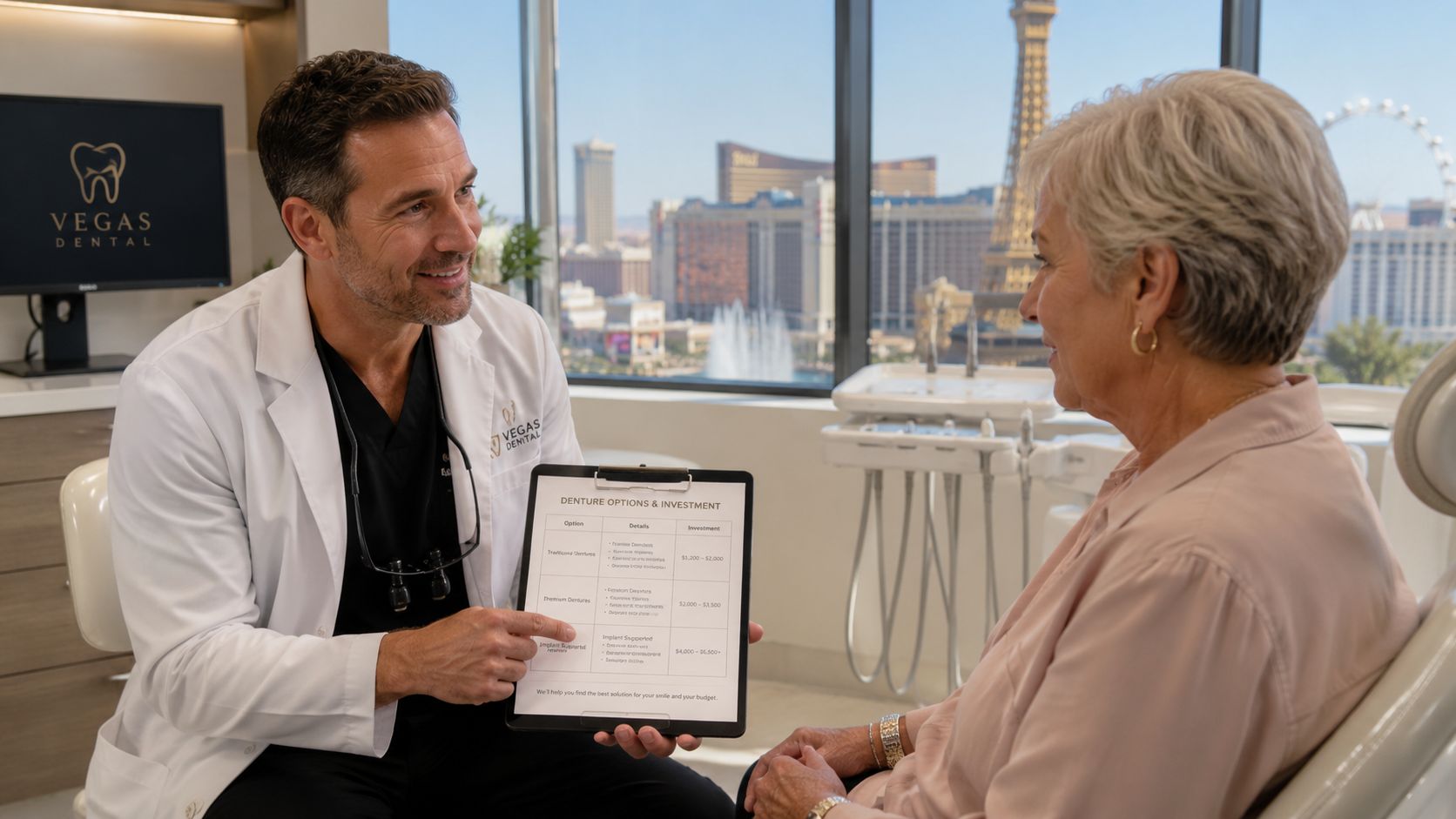
In Las Vegas, local pricing gives a clearer picture than broad national estimates. Complete removable dentures generally range from $1,000 to $3,000 per arch, while partial dentures usually cost $700 to $1,800 per arch, depending on the type and materials used, according to Las Vegas denture cost information.
What those local numbers usually mean
A single arch means either upper or lower teeth. If you need both, the total commonly doubles from the single-arch range. That's why many Las Vegas patients hear a wider total estimate for a full set than they expected at first.
A partial denture usually costs less because it replaces some teeth rather than a full arch. It can be a practical option when healthy natural teeth remain and can help support the appliance.
Practical rule: The first useful question isn't “What do dentures cost?” It's “Do I need a partial, a full denture, or a more stable implant-supported option?”
Why local care matters
Price matters, but so does follow-up. Dentures often need refinements after delivery. A nearby office makes those visits easier, especially if you're adjusting to a new bite, healing after extractions, or balancing denture treatment with other care like cleaning and exams, dental x-rays, or restorative work.
Patients in Sun City Summerlin or Lone Mountain often tell me they delayed treatment because they assumed dentures would be out of reach. Once they understand the local price ranges and the reasons behind them, the process usually feels much more manageable. That's the point of a proper consultation. Clear options, clear expectations, and no guesswork.
Understanding Your Denture Options from Full to Implant-Supported
A patient from Summerlin recently told me, “I thought dentures were just dentures until I started getting estimates.” That confusion is common. The price changes because the treatment itself changes. A removable partial, a full denture, and an implant-supported denture solve different problems and come with different levels of stability, lab work, and follow-up care.
Full dentures and partial dentures
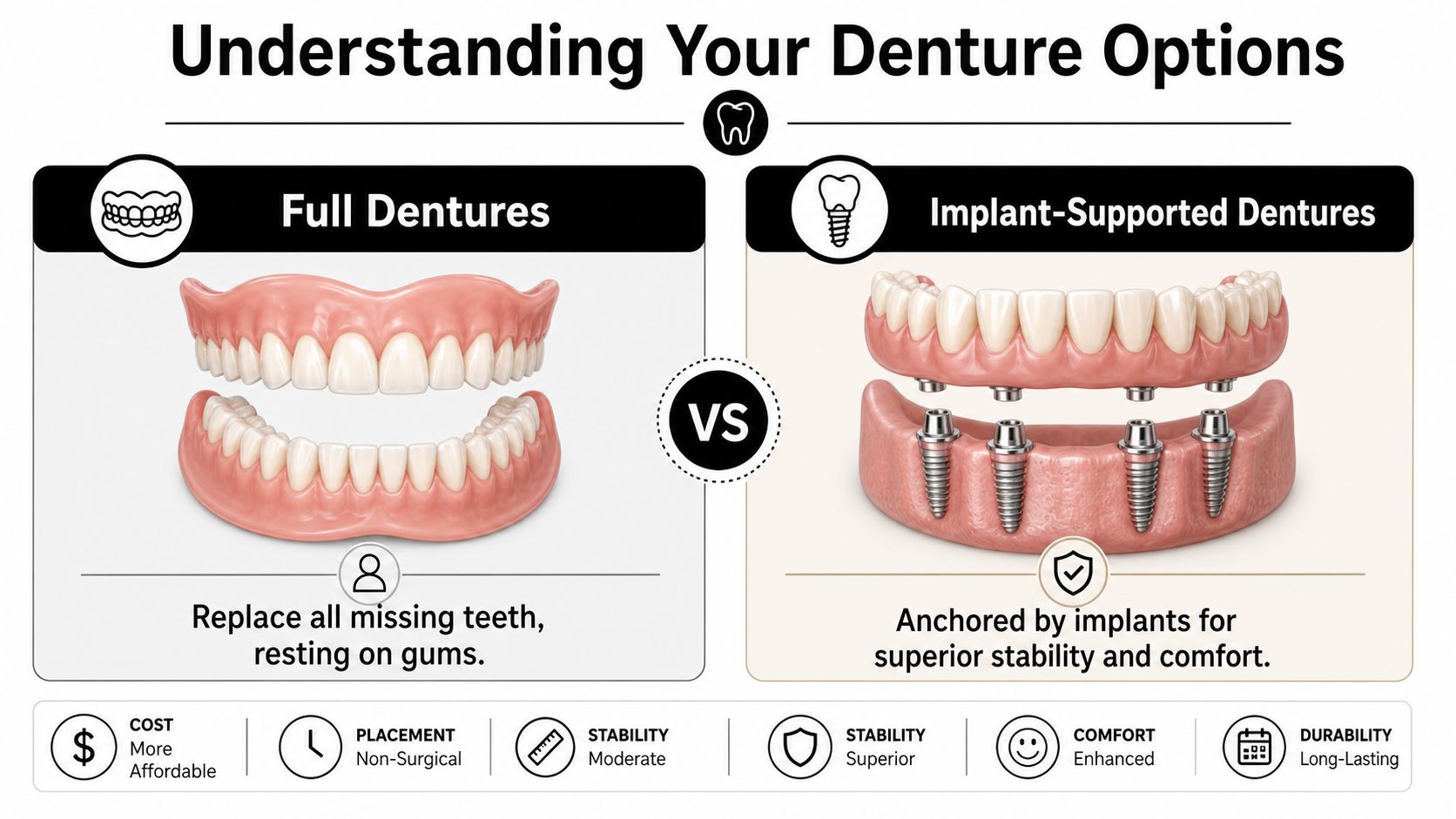
A full denture replaces all teeth on the upper arch, lower arch, or both. It is often the most direct removable option for patients who have already lost all teeth in an arch or need the remaining teeth removed because they can no longer be predictably saved.
A partial denture replaces several missing teeth while working around the healthy teeth you still have. In practice, this can be a very sensible middle ground. It usually costs less than replacing a full arch, and it helps maintain chewing function without committing to implant surgery.
The trade-off is support. A partial relies on remaining teeth and the way those teeth are positioned. A full denture relies on the gums and underlying bone, so fit and retention matter more, especially on the lower arch where movement is more common.
Here is the simplest way to compare them:
| Option | Best fit for | General cost direction |
|---|---|---|
| Full dentures | Missing all teeth on an arch | More than a partial, less than implant-supported options |
| Partial dentures | Missing several teeth but keeping some healthy teeth | Usually lower than full dentures |
| Implant-supported dentures | Want more retention and stability | Higher because surgery is involved |
Implant-supported dentures and All-on-4
Some patients adapt well to traditional removable dentures. Others want more security when they eat, laugh, or speak in public. Implant-supported dentures hold more firmly because the denture connects to implants placed in the jaw.
That added stability comes with a higher fee because the plan includes surgery, healing time, components that attach the denture to the implants, and a more complex prosthetic design. The American Dental Association explains that implant-supported dentures can improve retention and function for the right patient, but they also require adequate bone, good home care, and a budget that accounts for the surgical phase as well as the denture itself, as described in the ADA's overview of implant-supported dentures.
Traditional dentures sit on the gums. Implant-supported dentures anchor to implants, so they usually move less during chewing and speaking.
At Aspiring Smiles, this is often the point where Las Vegas patients ask the practical question: “Do I need the lowest upfront cost, or do I want the strongest hold I can afford?” That is the central decision. Neither option is automatically better. The right choice depends on bone support, medical history, daily comfort, and how much movement you are willing to tolerate.
For patients comparing materials, fit, and retention styles, this page on the latest dentures available gives a helpful overview of modern designs.
A short visual explanation can also help if you're deciding between removable and implant-retained options:
When each option tends to work best
- Choose a partial denture if you still have stable teeth and want a conservative replacement.
- Choose a full denture if an entire arch is missing and you want the most straightforward removable solution.
- Choose an implant-supported denture if stability is the main concern and you're open to a surgical plan.
- Ask about immediate dentures if teeth must be removed and you don't want to be without teeth during healing.
Appearance matters too. Denture treatment is not only about replacing teeth. Tooth shape, shade, smile line, and lip support all affect whether the final result looks natural and feels like your smile.
What Key Factors Influence the Price of False Teeth
A patient in Las Vegas may get two treatment estimates for dentures and wonder why the numbers are not even close. In practice, that usually comes down to four things: the type of denture, the materials used, the amount of customization, and the clinical work needed before the denture is ready to wear comfortably.
National ranges help show how broad denture pricing can be. CareCredit's denture cost overview notes that low-cost removable dentures can average $452, while premium dentures with advanced customization and materials can average $6,514 for both upper and lower plates. Here in Las Vegas, the specific number depends less on a national average and more on your mouth, your goals, and whether the plan includes extra treatment.
Material and customization
Lower-cost dentures are usually made with simpler materials and a more standardized process. They can be a reasonable short-term or budget-conscious option, especially for someone who needs teeth replaced quickly.
Higher-end dentures often involve stronger acrylics, more natural-looking tooth setups, and more detailed shaping of the gum portion. That extra work can improve appearance, speech, and day-to-day comfort. It also takes more lab time and more chair time.
I tell patients this often. A denture is not just a set of replacement teeth. It is a custom prosthetic that has to sit on living tissue without causing ongoing soreness.
Clinical complexity changes the price
The denture itself is only part of the total cost. Some patients need extractions first. Others need a reline, tissue healing, bite correction, or treatment for infection before a final denture can fit the way it should.
A few common price factors include:
- Condition of remaining teeth: This affects whether a partial denture is possible and how stable it will be.
- Shape of the jaw and gums: Flat ridges or uneven bone can make retention harder and increase adjustment needs.
- Appearance goals: A patient who wants more detailed smile design and facial support usually needs a more customized appliance.
- Number of follow-up visits: Some cases need more adjustments to get the fit right.
Two patients asking for "false teeth" may need very different treatment plans, emphasizing the need for precise communication.
The lowest price is not always the lowest cost
A denture that saves money upfront but slips, rubs, or stays in the drawer often becomes expensive in a different way. It can lead to more sore spots, more remake costs, more soft-food eating, and more frustration. On the other hand, some patients are quoted for upgrades they may not need.
Good planning means matching the denture to the patient, not selling every available add-on. Clear pricing matters too. AONMeetings' pricing transparency guide explains why patients benefit when treatment fees are broken down in plain language before they commit.
At Aspiring Smiles, I prefer to show patients what is driving the fee so they can make a decision that fits both their mouth and their budget. For Las Vegas patients who need flexibility, our dental payment plan options can help spread out the cost in a practical way.
Making Your New Smile Affordable with Insurance and Financing
Cost stops many people from replacing missing teeth longer than they should. I understand that hesitation. Most families in Las Vegas aren't looking for abstract averages. They want to know what they'll likely owe, how insurance works, and whether monthly payment options make treatment realistic.
Insurance often helps, but it rarely removes the full expense. In the United States, denture coverage typically pays about 50% of the cost after deductibles and annual maximums are met, often leaving a realistic out-of-pocket cost of $1,500 to $2,500 for a standard set, according to this overview of denture costs and insurance.
How to think about your real out-of-pocket cost
Dental benefits can be useful, but they come with limits. A plan may contribute toward the prosthesis while still leaving the patient responsible for deductibles, uncovered upgrades, or treatment that falls outside the plan's annual maximum.
That means two patients with the same clinical need may end up with very different final bills. The only reliable way to know is to verify benefits against a specific treatment plan.
A good rule is to ask for three things during your consultation:
- A clear treatment estimate: You should know what the appliance costs and whether related services affect the total.
- A benefit review: Insurance language can be confusing. It helps to have the office check the details.
- A payment path: If insurance doesn't cover enough, financing can bridge the gap.
Flexible payment options matter
Some patients prefer to pay in full. Others need monthly payments to move forward with treatment now instead of waiting. That's why pricing transparency matters so much in healthcare generally. If you want a broader non-dental example of how organizations communicate costs more clearly, AONMeetings' pricing transparency guide is a useful read.
For local patients comparing options, Aspiring Smiles Dental and Braces payment plans outline one available path for spreading treatment costs over time.
Financial reality check: Insurance can reduce the cost of dentures, but most patients should still expect a personal share. Planning for that upfront makes the decision much less stressful.
If you don't currently have insurance, don't assume dentures are automatically out of reach. Many offices can still structure care in stages, especially when a patient also needs emergency dentist services, extractions, or restorative work before the final denture is delivered.
What to Expect During Your Denture Treatment at Aspiring Smiles
Starting denture treatment feels easier when you know the sequence. Most patients aren't nervous about the concept of dentures. They're nervous about the unknowns. How many visits, whether the fit will feel right, and what happens if extractions or implants are part of the plan.
Your first visit
The process starts with a conversation and an exam. Dr. Patel evaluates the condition of your teeth, gums, and bite, and reviews any symptoms you're having with chewing, speaking, or soreness. If needed, dental x-rays help show support structures that aren't visible in a visual exam alone.
This visit is also where the treatment path becomes clearer. Some patients are good candidates for a partial. Others need a full denture because the remaining teeth can't be predictably saved. If you're also considering dental implants near me, this is when implant-supported options enter the discussion.
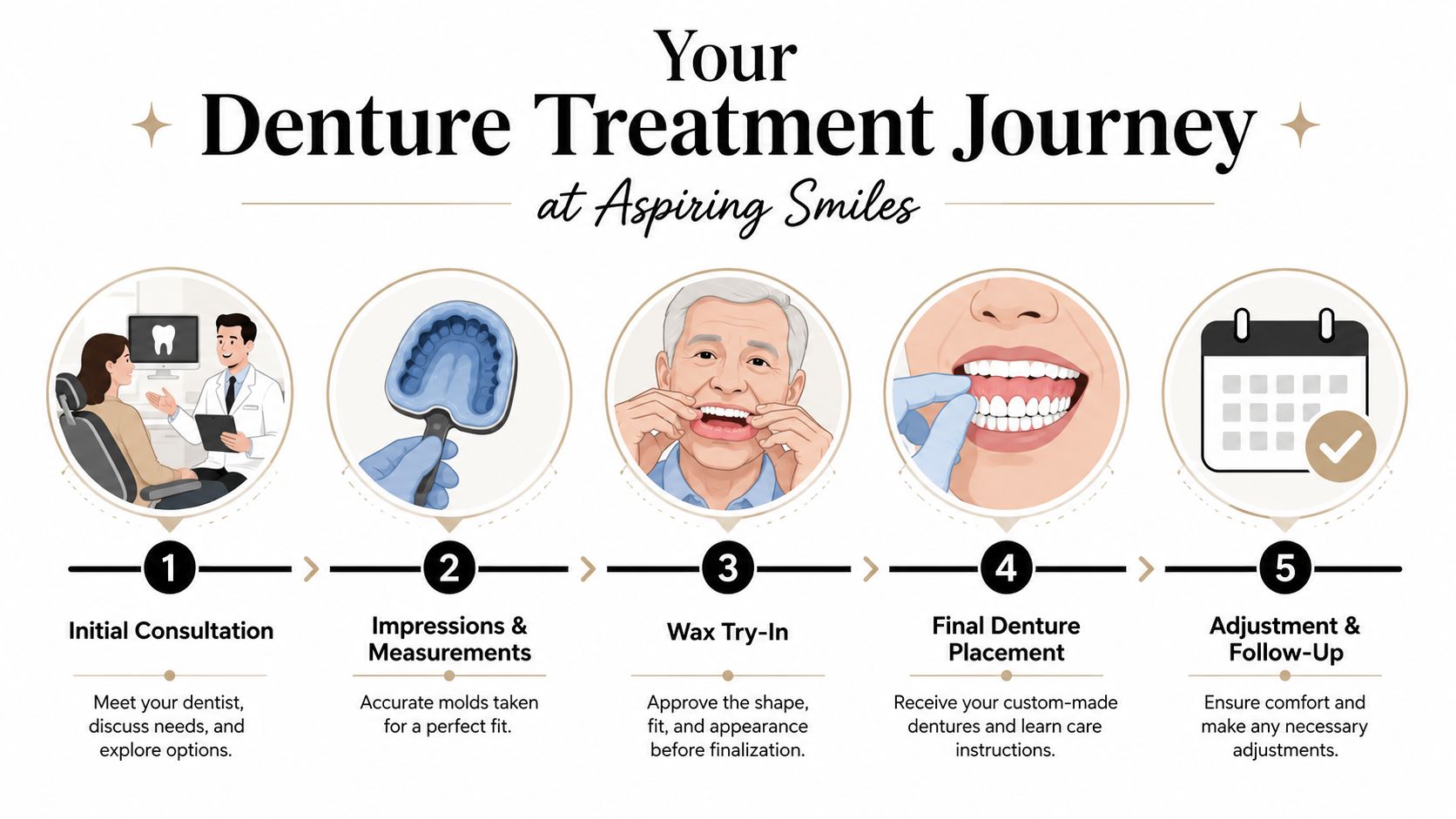
The denture workflow step by step
Consultation and planning
Your goals matter here. Some patients want the most affordable removable solution. Others care most about stability or a natural cosmetic result.Impressions and measurements
Accurate molds and bite records guide the laboratory work. Precision at this stage has a direct effect on comfort later.Try-in appointment
Before the final appliance is finished, you may try a preview version to check shape, bite, and appearance. At this stage, adjustments can be made before final processing.Delivery day
The finished denture is inserted, pressure areas are checked, and you get instructions for cleaning, speaking, and eating during the adjustment period.Follow-up adjustments
A new denture almost always needs refinement. Small sore spots or bite changes are common early on and are usually manageable with follow-up care.
If extractions or implants are involved
When teeth need to be removed first, healing affects timing. Some patients receive an immediate denture so they don't go without teeth during the transition. Others wait until the gums settle before making the final prosthesis.
If implant-supported dentures are part of your plan, there is also a surgical phase. That adds appointments and healing steps, but it can improve retention significantly for the right patient.
Most denture success comes from two things. Careful planning before fabrication, and patient follow-up after delivery.
Patients looking for a dentist in Las Vegas, NV often appreciate that this process can be coordinated alongside routine dental care, preventive visits, and any needed restorative treatment instead of handled in disconnected pieces.
Long-Term Care and Maintenance Costs for Your Dentures
Dentures aren't a one-time event. They work best when patients treat them like an ongoing part of their oral health, not a finished purchase they never need to think about again.
Daily habits that protect the fit
Clean dentures every day with products intended for denture care, and handle them gently over a folded towel or sink with water so they don't crack if dropped. Keep them stored properly when they're out of the mouth, and follow the wear schedule your dentist recommends.
Your gums and supporting tissues still need attention too. Even if you wear full dentures, routine dental visits matter. Those appointments help check tissue health, fit, pressure points, and any changes that could affect comfort.
What changes over time
Your mouth doesn't stay exactly the same after teeth are removed. The shape of the ridges and soft tissue can change, which means a denture that fit well at delivery may eventually feel loose or uneven.
That doesn't always mean you need a brand-new denture right away. Sometimes an adjustment or reline solves the problem. Other times replacement makes more sense because the bite, wear, or appearance no longer supports good function.
A few practical warning signs include:
- Soreness when chewing
- Movement while speaking
- Food trapping more often than before
- Cracks, worn teeth, or visible damage
If you're already established with a local office for cleaning and exams, emergency care, or restorative dentistry, denture maintenance usually fits naturally into those ongoing visits.
Schedule Your Denture Consultation Near Sun City Summerlin
Replacing missing teeth is part health decision and part quality-of-life decision. If you're eating differently, covering your mouth when you laugh, or avoiding photos, the issue usually isn't getting smaller on its own. Dentures, partials, and implant-supported options each solve different problems, and the right choice depends on your mouth, your goals, and what feels financially realistic.
For families and adults in Sun City Summerlin, Monterrey, Sunhampton, Desert Shores, Lone Mountain, Mar-A-Lago, and Painted Desert Estates, local access matters. You want a dental office that can handle the exam, any needed tooth extraction, denture planning, follow-up adjustments, and related services like cosmetic dentistry, teeth whitening, or implant discussions in one place when appropriate.
If you've ever wondered why some practices answer quickly while others are harder to reach, this overview of AI and live agent virtual receptionists gives useful context on how modern front-office communication works. For patients, the takeaway is simple. Faster answers make it easier to book care before a small problem turns into a bigger one.
The next step is straightforward. Schedule a consultation, bring your insurance information if you have it, and get a treatment plan based on your actual needs instead of internet averages. That visit can clarify whether you need a partial denture, a full removable appliance, or a conversation about implant retention.
If you're ready to get clear answers about the average price of false teeth and which option fits your smile, schedule a visit with Aspiring Smiles Dental and Braces. Dr. Patel and the team serve Las Vegas, NV from 3211 N Tenaya Wy Suite 122, Las Vegas, NV 89129, and can help you review your denture options, insurance, and next steps in a comfortable, patient-focused setting.