Dental Implants Success Rate Guide for Las Vegas Patients
97.3% of dental implants survive at 1 year after loading, and 96.1% survive at 5 years after loading, according to a systematic review and meta-analysis. Long-term results are strong, but your personal outlook still depends on factors such as implant timing, bone and gum health, medical conditions, daily habits, and consistent follow-up care in Las Vegas.
You may be searching for a dentist near me after losing a tooth, struggling to chew, or feeling self-conscious when you smile. You may also be wondering whether dental implants will fail, whether you'll need a tooth extraction first, or whether another treatment would be more comfortable and affordable. Those concerns are common, and a careful consultation can replace general internet percentages with a treatment plan based on your mouth and your health.
Dental Implants Near Me in Las Vegas and Why Success Rate Matters
A missing tooth can affect more than appearance. You might avoid certain foods, cover your mouth when speaking, or feel uncomfortable in family photos. If you're comparing dental implants near me in Las Vegas, the success rate is often the first figure you see, but the number only becomes useful when you understand what researchers are measuring.
Consider a typical patient who has delayed replacing a missing molar because they're afraid the implant won't work. They may have heard that implants are reliable, yet still worry about surgery, healing, cost, or the possibility of starting over. A responsible dental consultation doesn't promise a universal result. It identifies the factors that can support healing and explains alternatives if an implant isn't the right first step.

At Aspiring Smiles Dental and Braces, led by Dr. Patel, patients from Desert Shores, Sun City Summerlin, Sunhampton, Monterrey, Lone Mountain, Mar-A-Lago, and Painted Desert Estates can discuss dental implants, restorative dentistry, and related care in one setting. The team also provides preventive exams, dental cleanings, dental x-rays, cosmetic dentistry, and emergency dental services, so your implant plan can fit into broader mouth health needs.
A single missing tooth may require an examination, imaging, and sometimes a tooth extraction before replacement. Someone with several missing teeth might discuss an implant-supported denture or a full-arch option instead. You can review the treatment process and request a local consultation through Aspiring Smiles' dental implants near me service.
Practical rule: A high average survival rate is reassuring, but your own plan should account for bone, gums, bite forces, health conditions, and how you'll maintain the result.
Understanding What Dental Implants Success Really Means
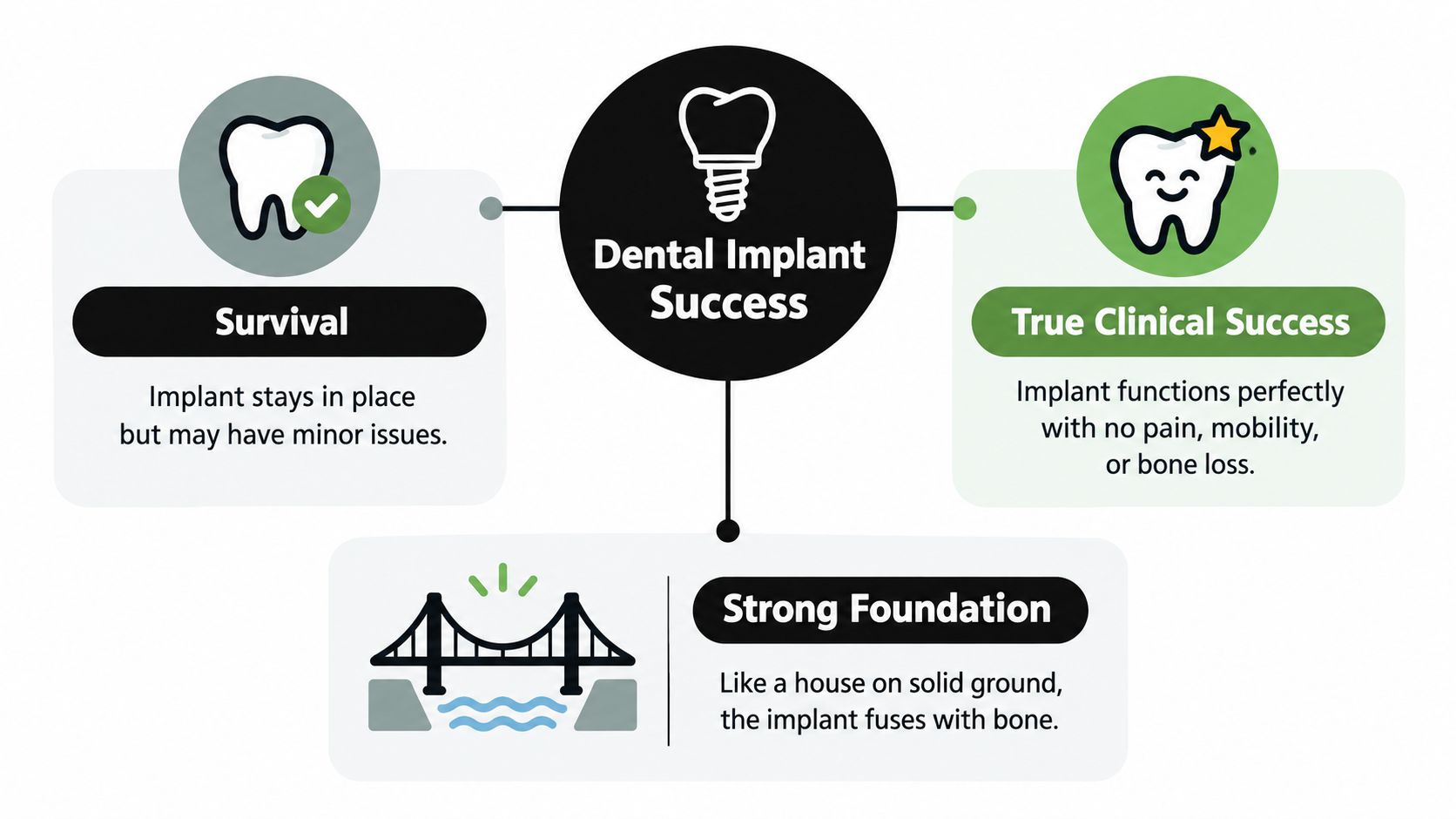
The phrase dental implant success rate can hide an important distinction. Researchers often report survival, meaning the implant remains in place and functions. That doesn't necessarily mean the implant has had no inflammation, loosened crown, aesthetic concern, bone change, or need for repair.
Think of an implant as a foundation beneath a replacement tooth. If the foundation remains standing, it has survived. A successful result also involves healthy surrounding gums, stable supporting bone, comfortable chewing, and a restoration that continues to work as intended.
Survival is not the same as complication-free care
A long-term review of 10,871 implants reported 94.0% implant-level survival at 15 years, while another systematic review found that only 61.3% of patients with fixed reconstructions were completely free of technical and biological complications over 5 years. These findings come from different measures, so they shouldn't be treated as contradictory. They show why patients should ask two questions: Will the implant remain in place, and what maintenance or repairs might be needed? The long-term review explains this survival and complication distinction.
Earlier implant research used minimum benchmarks of 85% success at 5 years and 80% at 10 years, as summarized in a BDJ Open meta-analysis review of historical implant success targets. Modern outcomes often exceed those older standards, but the comparison doesn't remove the need for professional monitoring.
Why bone monitoring matters
Osseointegration describes the process in which the implant becomes firmly connected with the jawbone. The implant needs a stable foundation before it can reliably support a crown, bridge, or denture. Healing may look and feel normal while changes around the implant still require attention, which is why follow-up appointments matter after the initial treatment is complete.
The Albrektsson criteria, formalized by 1986, helped clinicians evaluate implant success using measures that included less than 1.5 mm of marginal bone loss in the first year and less than 0.2 mm annually thereafter, as described by the Foundation for Oral Rehabilitation history of osseointegration and implant success criteria. Your dentist may use examinations and dental x-rays to monitor the tissues around an implant over time.
How High Is the Dental Implants Success Rate Over Time
The most useful way to read implant survival data is as a timeline. Early healing focuses on whether the implant integrates with bone. Later follow-up considers inflammation, bite forces, restoration wear, hygiene, and changes in overall health.
A 2018 systematic review and meta-analysis reported 97.3% overall implant survival at 1 year after loading, 96.1% at 5 years after loading, and another estimate of 96.7% at 1 year post-loading clinical evidence on implant survival after loading. These figures describe implants across study populations, not a guarantee for every patient.
Reading short-term and long-term results
Immediate implant treatment has its own evidence base. A systematic review of immediate dental implants reported an annual failure rate of 0.82%, with a 2-year survival rate of 98.4%, with a 95% confidence interval of 97.3% to 99% systematic review of immediate dental implants. Immediate placement can be appropriate in selected cases, but the timing decision depends on the socket, infection status, bone, gums, bite, and treatment plan.
Longer-term results remain encouraging. A 2019 systematic review found a 10-year implant-level survival estimate of 96.4%, with a 95% confidence interval of 95.2% to 97.5% and a prediction interval of 91.5% to 99.4% 10-year dental implant survival review. The prediction interval illustrates that outcomes can vary across settings and patient groups.
A separate 20-year meta-analysis described long-term survival as roughly 4 out of 5 implants, while also emphasizing that survival and ideal clinical success aren't identical 20-year implant outcome meta-analysis. That is why an implant can remain functional while still needing crown maintenance, gum care, bite adjustment, or bone monitoring.
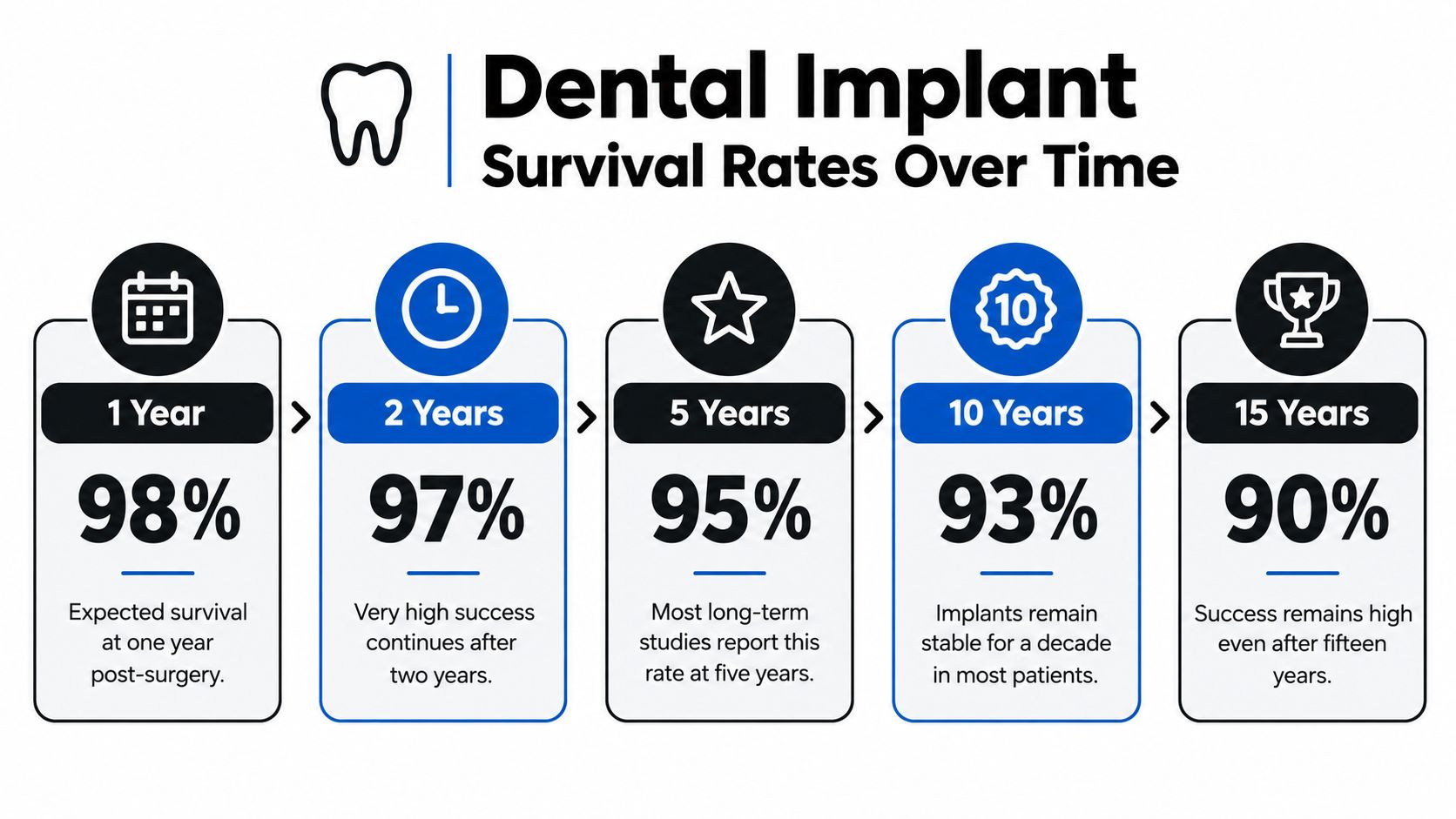
The chart above is a visual aid, not a substitute for the verified study estimates. Your dentist should explain which evidence applies to your implant location and treatment timing.
Why Success Varies by Health Habits and Implant Location
The most helpful question isn't, “What is the success rate of dental implants?” It's, “What factors could change the outlook for my specific implant?” Smoking, uncontrolled diabetes, periodontitis, bone quality, bruxism, and excessive loading can all affect healing or long-term stability. Implant timing and anatomy also require individualized planning.
Research has separated early failures during osseointegration, reported at about 0.5% to 5.2%, from late failures, reported at about 0.5% to 7.8% review of implant failure risks and timing. These ranges vary by study and clinical situation.
Factors That Raise or Lower Implant Success
| Factor | Effect on Success | What Helps |
|---|---|---|
| Smoking | Can impair healing and increase biologic risk | Discuss cessation before treatment and during healing |
| Uncontrolled diabetes | Can interfere with healing and infection control | Coordinate care with your medical provider and improve glycemic control |
| Periodontitis | Can threaten the gums and bone supporting the implant | Treat active gum disease and maintain periodontal care |
| Poor bone quantity or quality | May limit stability or require a modified plan | Use dental x-rays and imaging to evaluate the foundation; discuss grafting when appropriate |
| Bruxism or excessive loading | Places extra force on the implant and restoration | Review occlusion, consider protection for nighttime grinding, and monitor wear |
| Immediate versus delayed placement | Timing can change the planning demands and risk profile | Choose timing after evaluating infection, bone, soft tissue, and stability |
| Implant location | Upper and lower jaw sites can present different anatomic and loading considerations | Plan around available bone, nearby structures, chewing forces, and restoration design |
A review of examined risk factors includes smoking, uncontrolled diabetes, osteoporosis, poor bone quantity or quality, peri-implantitis, excessive loading, and bruxism clinical review of implant failure risk factors. These aren't reasons to assume you can't receive implants. They are reasons to plan carefully.
Recent evidence also shows why global averages can mislead. One analysis reported 97.79% overall survival across 158,824 implants, while early failure during osseointegration was 1.56%. Another study reported 95.9% success in carefully selected cases without primary stability, and immediate implants reached 100% compared with 94.6% for delayed implants in that study's reported comparison evidence on case selection, timing, and implant outcomes. Those findings don't mean immediate placement is always better. They show that selection and clinical circumstances shape the result.
Signs of Implant Failure and When to See an Emergency Dentist
Most patients recover without major problems, but persistent or worsening symptoms deserve attention. An implant should not feel mobile, and ongoing pain after the expected healing period isn't something to ignore.
Early failure can occur when the implant doesn't integrate securely with bone. Later problems may involve inflammation and bone loss around an implant, commonly associated with peri-implantitis, or mechanical concerns such as a loose crown, screw, or restoration.
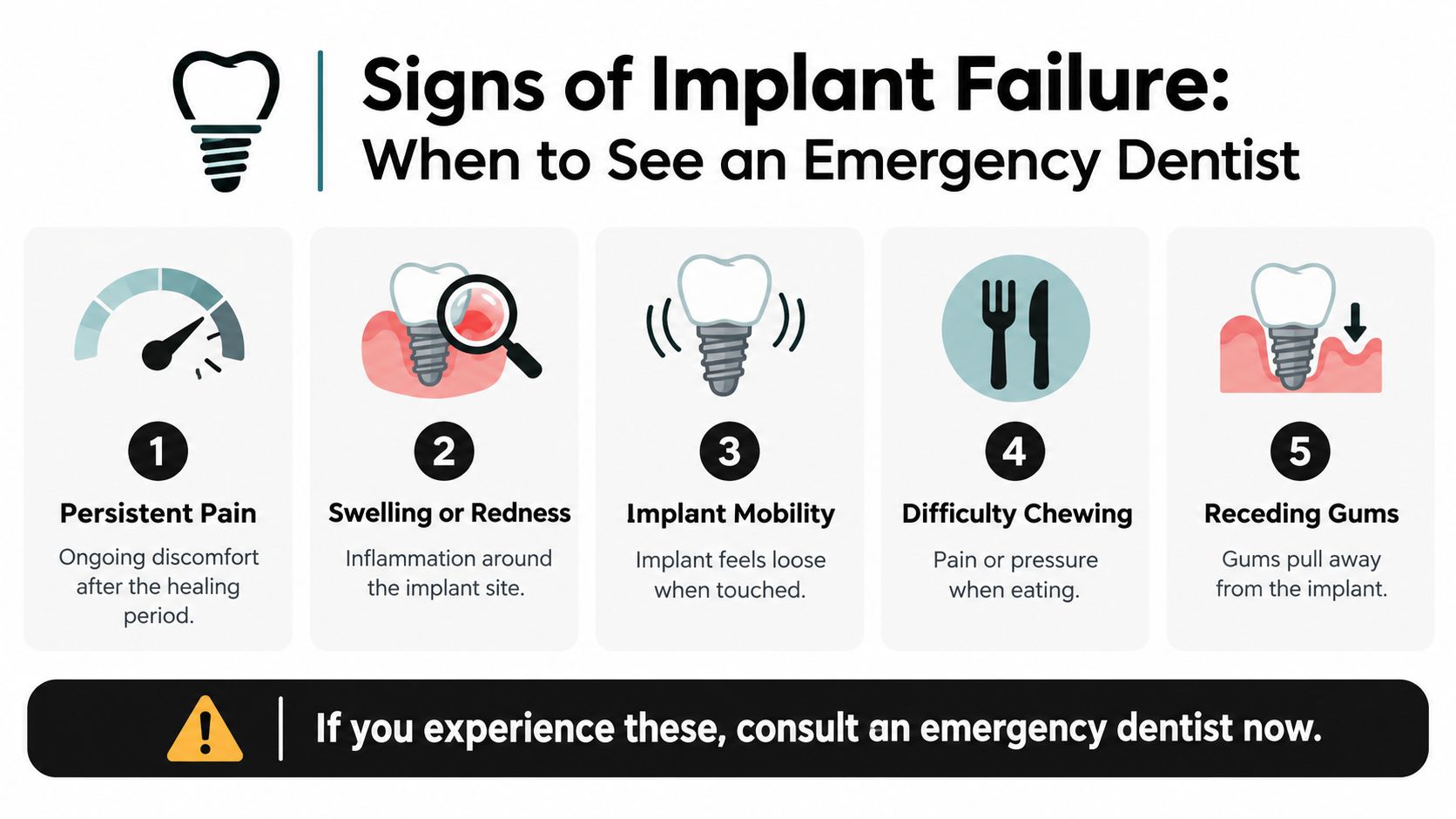
Contact a dentist promptly if you notice
- Persistent pain: Discomfort that continues or worsens after healing needs an examination.
- Swelling or redness: Inflammation around the implant may signal a local problem.
- Mobility: An implant or crown that moves should be assessed rather than tested repeatedly at home.
- Difficulty chewing: Pain or pressure when eating may indicate a bite or tissue concern.
- Receding gums: Changes in the gumline can expose more of the implant or restoration and deserve professional review.
If you have facial swelling, severe pain, uncontrolled bleeding, fever, difficulty swallowing, or breathing problems, seek urgent dental or medical help. An emergency dentist in Las Vegas can determine whether you need immediate treatment, imaging, antibiotics when clinically appropriate, bite management, or another intervention.
Don't wait for a loose implant to become a larger problem. Prompt care may protect surrounding bone and preserve more treatment options. If saving the implant isn't possible, your dentist can discuss removal, healing, a replacement plan, or alternatives such as a bridge or denture. For broader guidance on habits that can improve oral health with Peak Performance, use trusted educational resources alongside direct clinical advice.
How Dental Care Helps Maximize Your Implant Success
Good results begin before surgery. A dentist reviews your medical history, gum health, bite, missing-tooth pattern, bone foundation, and treatment goals. Dental x-rays and advanced imaging can help the team evaluate anatomy and select an appropriate position, timing, and restoration.
A sound plan may include treatment for active gum disease, a tooth extraction, bone grafting, or restorative care before implant placement. If you grind your teeth, occlusion management can reduce stress on the implant and crown. If you smoke or have diabetes, your care team can discuss steps that support healing and safer treatment.
Your daily role matters
Brush carefully around the implant and clean between teeth and under the restoration as directed. Avoid using the implant as a tool to open packages or chewing unusually hard foods during the healing period. Keep every recommended cleaning and exam appointment, even when the implant feels completely normal.
Implants don't develop cavities in the same way natural teeth do, but the surrounding gums and bone still need protection. Ask your dental team which brush, interdental cleaner, or rinse fits your restoration. If you're comparing products, you can review information about buying Colgate Peroxyl mouthwash online, but don't substitute an over-the-counter rinse for an examination when you have pain, bleeding, swelling, or mobility.
Aspiring Smiles Dental and Braces uses gentle techniques, clear communication, and personalized planning for patients considering implants and other restorative options. You can also read its guidance on how to properly care for dental implants.
Protecting the smile around the implant
Regular cleaning and exams support overall mouth health and help identify changes early. A replacement crown should also look natural and fit comfortably. Patients may discuss crowns, veneers, or Zoom teeth whitening with a cosmetic dentist near me when they want nearby teeth and the implant restoration to look harmonious. Cosmetic dentistry should complement a healthy foundation, not replace treatment for infection or gum disease.
What to Expect at Aspiring Smiles Dental and Braces in Las Vegas
Your first visit should give you clear answers, not pressure. At 3211 N Tenaya Wy Suite 122, Las Vegas, NV 89129, Aspiring Smiles Dental and Braces welcomes new patients for exams, dental x-rays, consultations, cleaning and exams, restorative dentistry, cosmetic dentistry, and emergency dental services.
For an implant consultation, the team reviews your concerns and examines the area around the missing tooth. Imaging helps assess the bone and nearby anatomy. From there, you can discuss a single implant, multiple implants, All-on-4, All-on-6, or implant-supported dentures when those options fit your needs.
A visit designed around your needs
The practice serves families in Las Vegas and nearby communities, including Desert Shores, Sunhampton, Sun City Summerlin, Monterrey, Lone Mountain, Mar-A-Lago, and Painted Desert Estates. Flexible payment options, insurance acceptance, and a membership program can help patients plan ongoing care. Extended weekday and Saturday hours, along with online appointment requests, make it easier to arrange a visit around work and family schedules.
Whether you first searched dentist in Las Vegas, NV, dental implants near me, cosmetic dentist near me, or emergency dentist, the next step is a personalized evaluation. A five-star community reputation can offer reassurance, but your consultation should focus on your examination findings, choices, risks, maintenance needs, and goals.
Aspiring Smiles Dental and Braces offers implant consultations, dental implants, All-on-4 solutions, implant-supported dentures, restorative dentistry, and emergency dental care for Las Vegas families. Schedule a visit with Aspiring Smiles Dental and Braces to discuss your dental implants success rate, smile goals, or urgent dental concern and take the next step with a plan built for your needs.