How Long Do Dental Implants Last? a Las Vegas Guide
Dental implants can last 25 to 30 years or even a lifetime with proper care, but that outcome depends on your daily habits, your bone and gum health, and regular professional maintenance. The implant itself is designed to be a long-term investment in your health, while the visible tooth on top often needs maintenance sooner.
If you're reading this, there's a good chance you're tired of working around a missing tooth. You may be chewing on one side, hiding your smile in photos, or wondering whether a bridge, denture, or implant will hold up over time. That question matters because this isn't just about appearance. It's about comfort, confidence, and whether you're choosing something that will still serve you well years from now.
Patients looking for a dentist in Las Vegas, NV or searching dental implants near me usually want a straight answer. The honest one is this: implants are one of the most durable options in restorative dentistry, but they are not maintenance-free. The titanium post in the jaw and the crown you see above the gumline don't have the same lifespan, and understanding that difference helps you make a smarter decision from the start.
Your Permanent Smile Solution in Las Vegas
A missing tooth changes more than your smile. Many people notice it first when they eat. Crunchy foods become awkward, certain words feel different, and smiling starts to feel less automatic. If the missing tooth is in a visible area, people often compensate without realizing it. They smile with their lips closed, angle their face away, or delay treatment because they assume every option is temporary or uncomfortable.
That hesitation is common. Patients often come in after spending months or even years trying to decide whether they want a removable option or something that feels more like a real tooth. Most aren't asking for something flashy. They want to chew normally, speak clearly, and stop thinking about the gap.
Why implants appeal to so many adults
A dental implant replaces the missing root as well as the tooth above it. That matters because it creates a stable foundation in the jaw instead of resting on neighboring teeth or sitting loosely on the gums. For many adults in Las Vegas, that stability is the main reason implants feel worth exploring.
People from Desert Shores, Sunhampton, Sun City Summerlin, Monterrey, Lone Mountain, Mar-A-Lago, and Painted Desert Estates often tell us the same thing. They don't want a short-term patch. They want a tooth replacement that looks natural, feels secure, and supports long-term oral health.
A well-planned implant doesn't just fill a space. It helps restore how your bite works day to day.
What patients usually want to know first
Before inquiring about the procedure, individuals often ask practical questions:
- Will it feel like a real tooth? In function and stability, that’s the goal.
- Is it worth the investment? For many patients, yes, especially if they want a long-term solution.
- How long do dental implants last? Long enough to make maintenance planning part of the conversation, not an afterthought.
- What if I already need a tooth extraction? Extraction and replacement planning can often be coordinated as part of restorative care.
If you've been looking for a dentist near me, cosmetic dentist near me, or an office that can handle everything from dental x-rays and new patient exams to implant planning, it's helpful to start with realistic expectations. A permanent-looking smile is achievable. The key is choosing treatment that matches your goals and committing to the upkeep that protects it.
What the Research Shows About Dental Implant Lifespan
Dental implants have strong long-term evidence behind them. A major 22-year clinical study of 10,871 dental implants found cumulative survival rates of 98.5% at 5 years, 96.8% at 10 years, and 94.0% at 15 years, with just 0.5% failures during the surgical phase according to this long-term implant survival study.
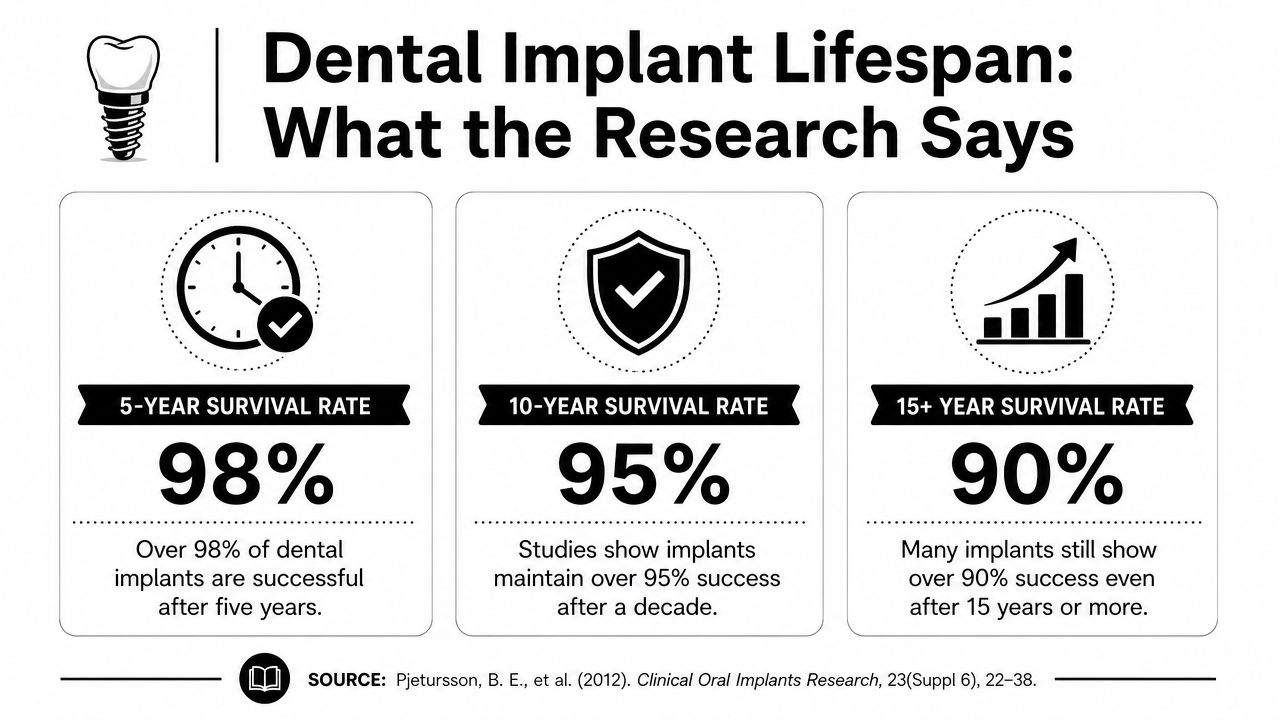
Those are strong numbers, but patients deserve a plain-English explanation of what they mean. In implant dentistry, survival rate means the implant remains in place and functional over time. It doesn't mean every patient had the exact same experience, or that no maintenance was needed along the way.
What survival rate means in real life
An implant can survive for many years and still need occasional attention to the parts above the gumline. That's one reason implant dentistry can sound confusing online. Some articles talk about the implant as if it's one single piece with one single lifespan. It isn't.
The study above also showed that patient-level outcomes were not identical to implant-level outcomes over very long follow-up. That matters because biology, home care, bite force, gum health, and follow-up visits all affect the result over time.
Why implants are considered a long-term solution
Implants are often described as long-term or lifelong because the fixture placed in the bone is highly durable when it integrates well and stays healthy. In everyday practice, that makes implants very different from a short-term restoration.
A practical way to think about it is this:
| Research finding | What it means for patients |
|---|---|
| 98.5% at 5 years | Most implants remain stable well past the early healing period |
| 96.8% at 10 years | Implants continue to perform well over a full decade |
| 94.0% at 15 years | Long-term durability is strong, but maintenance still matters |
| 0.5% surgical-phase failures | Early placement-related failure is uncommon in the long view of the study |
Clinical takeaway: Dental implants are built to be durable foundations, not temporary placeholders.
For someone comparing options in restorative dentistry, this matters. A bridge may restore appearance quickly. A denture may solve an immediate problem. But if your goal is a replacement that functions more like a natural tooth root and holds up over the long term, implant treatment has a much stronger durability profile than most patients realize.
Factors That Determine Your Implant’s Longevity
The biggest misconception about implant lifespan is that there's one number for the whole restoration. There isn't. The implant post, abutment, and crown do different jobs, and they don't wear the same way.
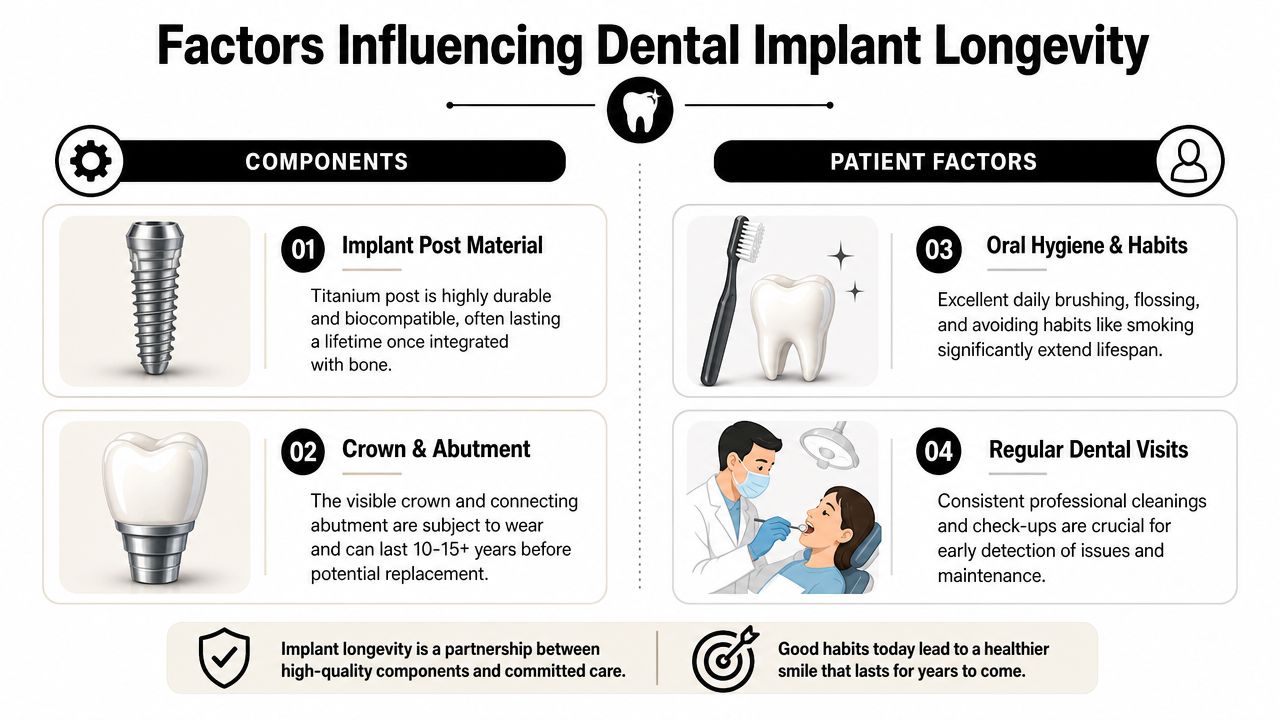
Historical and review data consistently show that the implant fixture can outlast the visible tooth replacement by many years. A clinical summary notes that dental implants commonly last 25 to 30 years, while the crown often needs replacement after 10 to 15 years and the abutment may last 15 to 20 years, as explained in this component-based overview of implant lifespan.
The part in the bone and the part you see
The implant post is the titanium anchor placed in the jaw. If the bone stays healthy and the implant remains stable, that part may function for decades and can last a lifetime in some patients.
The crown is different. It absorbs chewing forces every day. It can wear down, chip, loosen, or age out before the implant does. A patient page that focuses on this distinction notes that the implant post may last a lifetime with proper bone support, while the crown commonly needs replacement around 10 to 15 years, as described in this implant post versus crown explanation.
What helps and what shortens lifespan
Some factors are in the dentist's hands. Others are in yours. Both matter.
- Daily hygiene: Plaque doesn’t ignore implants. If the gumline around the implant stays inflamed, the bone underneath can be affected over time.
- Smoking: Smoking makes healing and long-term tissue health harder to maintain.
- Grinding and clenching: Bruxism increases force on the crown, screw, and implant system.
- Diet choices: Chewing ice, hard candies, or using teeth as tools raises the risk of damage to the prosthetic part.
- Regular maintenance visits: A crown that loosens slightly or tissues that start to inflame are much easier to manage when caught early.
Bite force and maintenance planning matter
People often hear "lifetime implant" and assume they won't need future care. That's not how real life works. The better expectation is that the anchor is the durable part, while the visible replacement may need servicing over time.
The implant lasting doesn't always mean the crown lasted. Those are two different outcomes.
That distinction is useful when you're comparing implants with bridges or removable options. It also helps with budgeting. Long-term value isn't only about whether the implant stays in the bone. It's also about whether you're prepared for maintenance, routine exams, and occasional replacement of the parts that take the daily wear.
For patients who already come in for cleaning and exams, general dental care and implant care find common ground. Consistent recall visits give your dentist a chance to monitor the bite, the gum tissues, and the condition of the crown before a minor issue turns into a larger repair.
How to Protect Your Implant for Decades to Come
The main threat to a healthy implant years after placement is peri-implantitis, a form of gum disease around the implant that can lead to bone loss. Long-term success isn't guaranteed after the first few years, and failures can still happen after 10 years if hygiene and professional maintenance are neglected, as noted in this discussion of peri-implantitis and late implant failure.
What daily care should look like
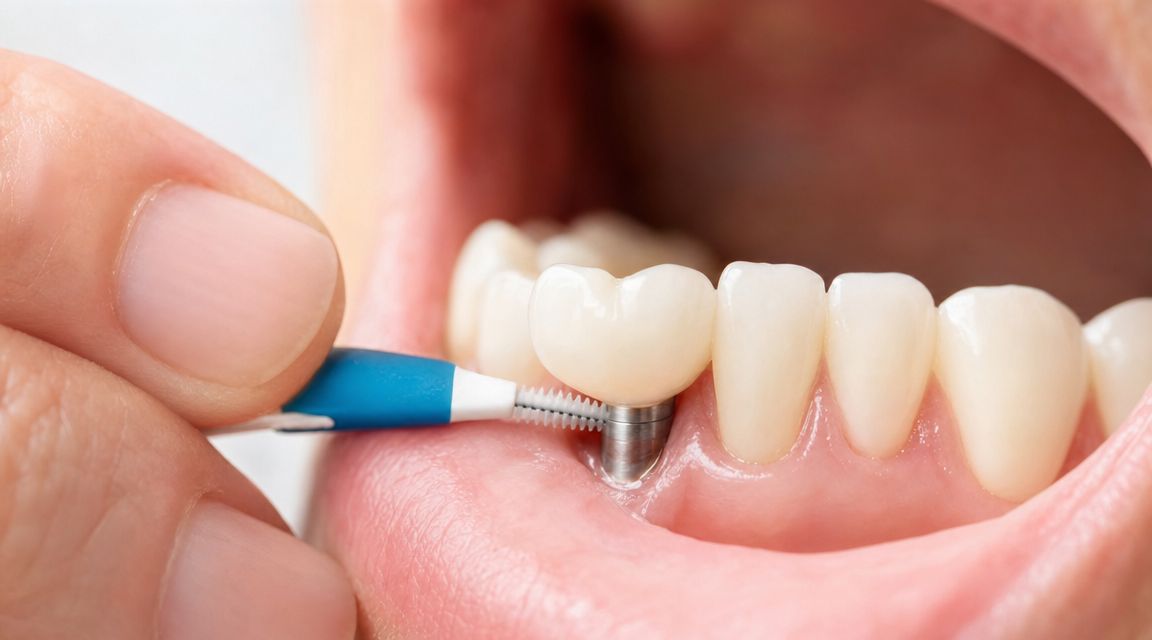
An implant needs careful cleaning at the gumline, not just a quick brush over the crown. A soft toothbrush helps, but many patients also do better with an interdental brush, floss threader, or water flosser depending on the shape of the restoration.
If flossing around implants has ever felt awkward, this key dental flossing advice gives a useful refresher on technique. The goal isn't aggressive pressure. It's consistent plaque removal around the areas where inflammation starts.
A simple home routine usually includes:
- Brushing thoroughly: Clean around the gumline, not just the visible crown.
- Cleaning between teeth: Floss, a floss threader, or an interdental brush can help where a toothbrush can’t.
- Watching for changes: Bleeding, puffiness, tenderness, or a new odor around the implant shouldn’t be ignored.
- Protecting against grinding: If you clench or grind, a nightguard may reduce stress on the crown and implant components.
Warning signs that deserve a visit
Patients sometimes wait because the implant doesn't hurt much. That's a mistake. Implant problems often start subtly.
Call your dental office if you notice:
- Bleeding when you clean around it
- Swelling or persistent redness
- A loose or shifting feeling
- Food trapping more than usual
- Discomfort when biting
Video can make these care steps easier to understand in practical terms:
Why maintenance visits matter
Home care is essential, but it isn't the whole picture. Professional exams help monitor the bone level, gum attachment, bite pressure, and condition of the crown. That's especially important for patients with a history of gum disease, smoking, or heavy clenching.
For patients who want a more detailed overview of home care and follow-up, this guide on how to properly care for dental implants covers the habits that protect the restoration over time.
Comparing Implants to Bridges and Dentures
A patient in my Las Vegas office might ask a simple question about lifespan, but the ultimate decision usually comes down to daily life. How will it feel to chew steak or salad? Will it stay put when you talk? Will the replacement tooth affect the teeth beside it? Those answers matter as much as the calendar.
The biggest point to understand is that these options age differently. With an implant, the post in the jaw is designed to serve as the long-term foundation, while the visible crown may need replacement over time from normal wear. A bridge and a denture have their own maintenance cycle, and both are more dependent on surrounding teeth or changing gum and bone support.
Implant vs bridge vs denture lifespan and impact
| Feature | Dental Implant | Dental Bridge | Removable Denture |
|---|---|---|---|
| Longevity approach | Bone-supported implant post with a crown that may need future replacement | Fixed option supported by neighboring teeth | Removable option that often needs relines, adjustments, or replacement as fit changes |
| Effect on nearby teeth | Doesn’t rely on adjacent teeth for support | Uses neighboring teeth as anchors | Doesn’t depend on anchor teeth in the same way, but support can shift as the mouth changes |
| Feel while chewing | Usually the most stable and tooth-like | Often feels fixed and functional | Can feel less secure, especially with tougher or sticky foods |
| Daily maintenance | Needs careful brushing, flossing, and regular exams | Needs cleaning under the bridge and monitoring of support teeth | Needs removal, cleaning, and routine fit checks |
| Long-term value | Strong option for stability and function when bone and gum health are good | Useful in selected cases, especially if nearby teeth already need crowns | Helpful for broader tooth loss or when a removable solution makes more sense right now |
Where each option fits
A bridge can make sense when the teeth next to the gap already need crowns, or when implant treatment is not the right medical or financial fit. A removable denture can also be a practical choice, especially for someone replacing several teeth or looking for a lower upfront cost.
Implants stand apart because they replace the root as well as the tooth above the gumline. That usually gives better stability and helps preserve how the bite feels over time. It also means expectations should be realistic. The implant post and the crown are not the same part, and they do not always have the same lifespan.
That distinction is one of the main reasons many people choose implants after reviewing fixed and removable options carefully.
If your goal is to replace a missing tooth in the closest way to a natural root-and-crown structure, an implant is often the strongest long-term option.
If you want a closer look at how these choices affect comfort, maintenance, and cost, this guide on evaluating implants versus dentures for everyday life is a helpful next step.
Your Dental Implant Journey at Aspiring Smiles
You come in with a missing tooth, a temporary fix that keeps shifting, or a tooth that cannot be saved. The first question is usually simple. How long will this last, and what will the process involve?
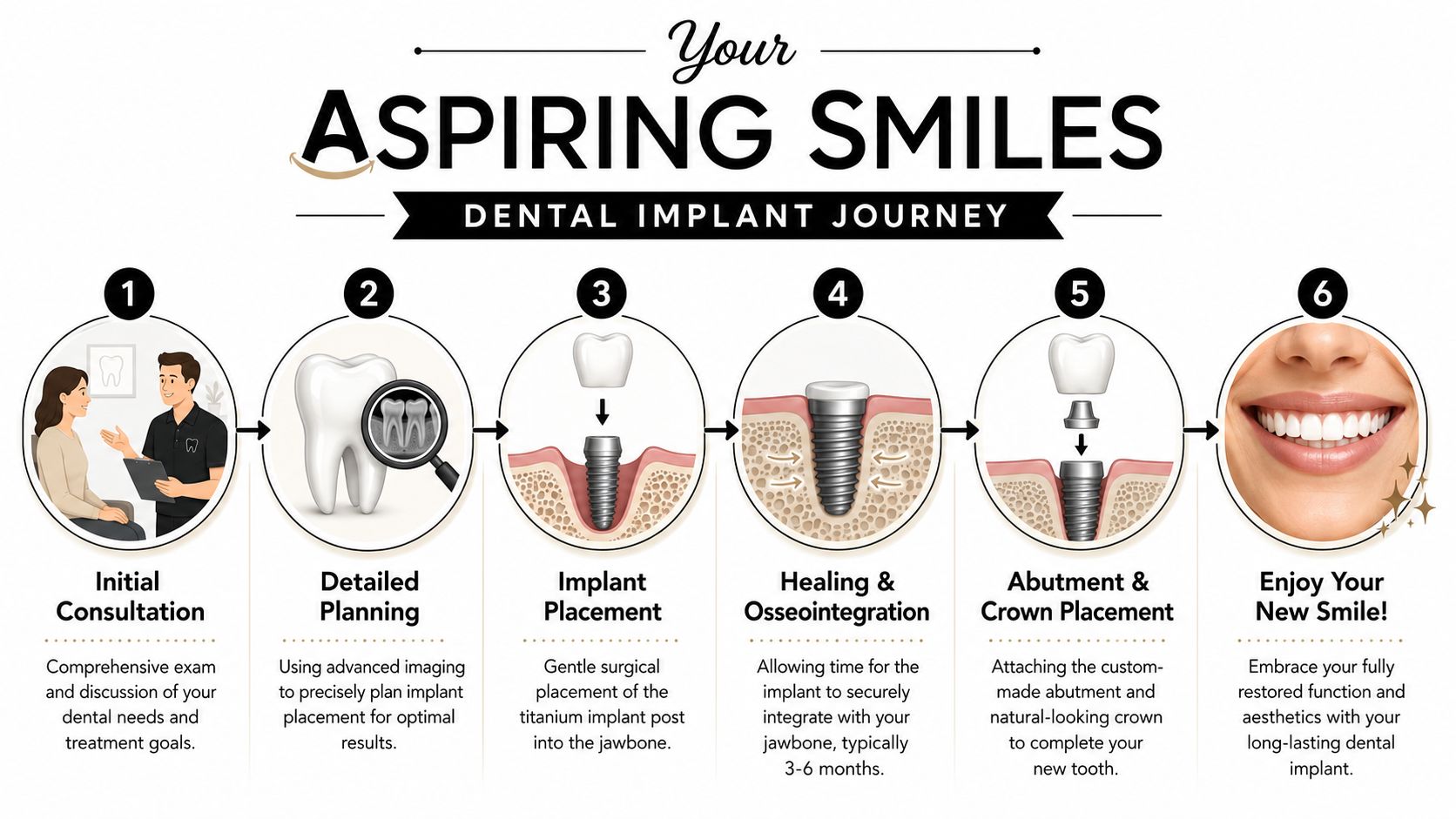
At Aspiring Smiles, treatment starts with an exam and a plan. We look at the missing area, your bite, your gum health, and the bone that would support an implant. That first visit often includes a new patient exam, dental x-rays, and a review of whether you need preparatory care such as a tooth extraction, gum treatment, or other restorative work before implant placement.
What the treatment path usually includes
No two cases move at the same speed, but the sequence is usually similar.
-
Consultation and planning
Your dentist evaluates the site, reviews imaging, and checks bone support, gum condition, and bite forces. -
Site preparation if needed
Some patients need an extraction, periodontal treatment, or time for the area to heal before implant surgery. -
Implant placement
The implant post is placed in the jaw during a planned surgical visit. -
Healing and integration
The bone attaches to the implant over time. The infographic above shows a common healing range of 3 to 6 months. -
Abutment and crown placement
After healing, the connector and final crown are attached to complete the tooth.
That final step is where expectations need to be clear. The implant post in the bone and the crown you see in the mouth are different parts. They do not always wear on the same timeline. In many patients, the post is intended to be the long-term foundation, while the crown may need maintenance or replacement later from normal wear, bite changes, or cosmetic updates.
Why planning matters
Good implant treatment is not just about placing the post. It is about placing it in the right position, managing the bite, and choosing a restoration that fits how you chew and clean around it. A patient who grinds at night, has a history of gum disease, or needs bone support may still be a candidate, but the plan has to account for those trade-offs from the start.
That is also why I tell patients not to judge implant longevity by one number alone. A well-integrated implant can serve for many years. The visible crown has its own lifespan and its own maintenance needs.
At Aspiring Smiles Dental and Braces, implant care is part of a broader treatment approach that can also include preventive visits, emergency dentistry, cosmetic dentistry, crowns, and tooth replacement planning when several options need to be weighed together.
What to expect at your visit in Las Vegas
Patients usually feel more comfortable once the process is laid out clearly. The decision should fit your health, your budget, and your goals.
Some patients from Sun City Summerlin, Lone Mountain, and nearby Las Vegas neighborhoods want the most stable long-term tooth replacement possible. Others want to know whether they need to act now or can wait. Both are reasonable questions. Our job is to examine the site carefully, explain the trade-offs, and tell you what gives the implant the best chance to last, and what parts may need attention over time.
Frequently Asked Questions About Dental Implants
Is getting a dental implant painful
Most patients tolerate the procedure well. During treatment, the area is numbed, and soreness afterward is usually managed with routine post-op instructions. The anxiety is often worse than the procedure itself.
Do implants feel like real teeth
They can feel very natural once healed. Because the implant is anchored in the jaw, patients often say it feels more secure than a removable option. The final crown is shaped to blend with your bite and smile.
How soon can I get my final tooth
That depends on healing, bone quality, and whether other treatment is needed first. Some cases move more quickly than others, while others need a longer healing period before the final crown is attached.
Can an implant fail even if it was fine at first
Yes. Early success doesn't guarantee lifelong success. Ongoing gum health, bite management, and maintenance remain important over time.
Should I replace one missing tooth, or can I wait
Waiting can create more problems with chewing, shifting teeth, and the way your bite functions. If you've lost a tooth or think you may need an extraction, it's worth getting evaluated before the area changes further.
If you're looking for a dentist near me in Las Vegas and want clear guidance on whether an implant is the right long-term choice, schedule a consultation with Aspiring Smiles Dental and Braces. We can evaluate the missing tooth area, review your options, and help you plan treatment that fits your health, bite, and long-term goals.