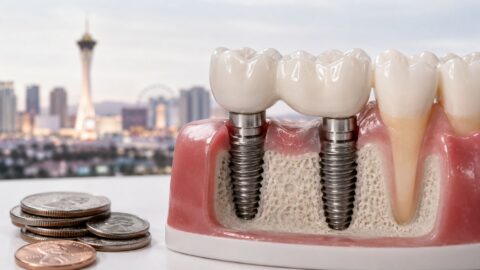
Implant Supported Bridge Cost: A Las Vegas Patient’s Guide
In Las Vegas, an implant-supported bridge typically costs between $10,000 and $15,000 for replacing 3 to 4 teeth on two implants, and this guide will break down what goes into that price. If you're comparing options after losing teeth, dealing with a loose old bridge, or searching for dental implants near me because you want something that feels more secure, understanding the full financial picture is the right place to start.
Living with missing teeth affects more than your smile. Chewing gets harder. Speech can change. Some people start avoiding photos, social events, or certain foods because they don't want to think about the gap. Others are trying to decide between a traditional bridge, dentures, or implants and feel stuck once they see the price difference.
That sticker shock is real. So is the value of getting this decision right.
For patients looking for a dentist in Las Vegas, NV, especially in areas like Desert Shores, Sunhampton, Sun City Summerlin, Monterrey, Lone Mountain, Mar-A-Lago, and Painted Desert Estates, the most useful discussion isn't just a national average. It's what a Las Vegas patient is likely to pay, why one treatment plan costs more than another, how insurance may fit in, and whether the long-term result justifies the investment.
Your Guide to Implant Supported Bridges in Las Vegas
A patient usually lands here after a real problem disrupts daily life. A tooth breaks. An older bridge loosens. An extraction leaves a gap that catches the tongue every time they speak or eat. Some are searching for a dentist near me because of pain, then learn the next step may involve more advanced restorative dentistry than they expected.
For several missing teeth in a row, an implant-supported bridge is often the strongest fixed option. The bridge is supported by implants in the jawbone instead of neighboring natural teeth. That usually gives better stability and a more durable long-term plan, but it also raises the initial cost.
What Las Vegas patients usually want to know first
The first question is usually simple. What will this cost me in Las Vegas?
For many local patients, an implant-supported bridge replacing 3 to 4 teeth on two implants typically falls between $10,000 and $15,000. The final number depends on what is included, the condition of the bone and gums, the materials used for the bridge, and whether additional treatment is needed before implant placement.
Local context matters. National averages can be a rough starting point, but they rarely reflect what a patient in Las Vegas pays once planning, surgery, lab work, and follow-up care are added. Office overhead, surgical complexity, sedation needs, and the quality of the final prosthesis all affect the fee.
Patients who call several offices after searching cosmetic dentist near me or dental implants near me often hear very different numbers. In my experience, a surprisingly low quote often leaves out key pieces of treatment. We advise patients to confirm whether the fee includes the implant surgery, abutments, and the final bridge, not just one phase of care.
Why people still choose this treatment
An implant-supported bridge is a significant investment. Patients still choose it because they want teeth that feel secure, stay in place, and do not require support from healthy adjacent teeth.
That distinction is important because the lowest upfront price is not always the lowest long-term cost. A removable option may need more adjustments. A traditional bridge may place added stress on neighboring teeth. An implant-supported bridge usually costs more at the beginning, but many patients value the stability, chewing function, and confidence it can provide over time.
Some people arrive at this decision after an emergency dentist visit or a failed restoration. Others are already planning ahead and want a replacement that fits into a broader oral health plan alongside tooth extraction, cleaning and exams, dental x-rays, new patient exams, or cosmetic treatment such as teeth whitening once function is restored.
The key question is not only the sticker price. It is whether the treatment plan is complete, whether the quote is transparent, how insurance may apply, and what kind of result you are paying for over the next several years.
Understanding the Structure of an Implant Supported Bridge
An implant-supported bridge makes more sense once you picture it like a real bridge. The visible teeth are the roadway. The implants are the support pillars underneath. Without strong support, the top structure can't stay stable.
That foundation is what separates this treatment from a traditional bridge.
The three parts that work together
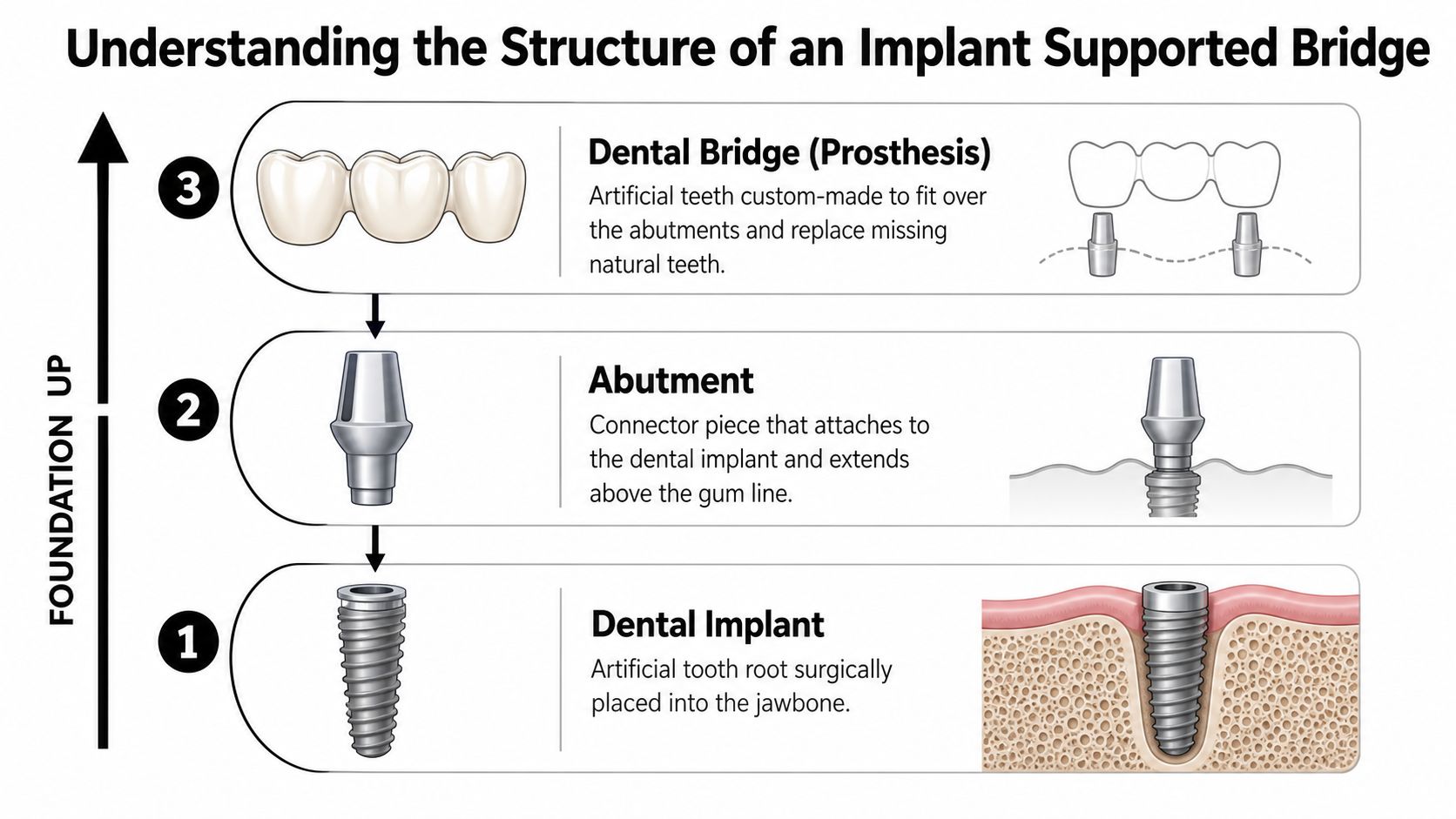
Each implant-supported bridge has three core components:
- Dental implant. This is the titanium post placed in the jawbone. It acts like an artificial tooth root and becomes the anchor for the restoration.
- Abutment. This small connector attaches to the implant and rises above the gum line so the bridge can be secured.
- Bridge prosthesis. This is the custom-made row of replacement teeth that restores your smile and bite.
Why this structure matters for health
A traditional bridge sits on neighboring teeth. An implant-supported bridge gets its support from the jawbone through the implants. That matters because the treatment isn't only replacing what shows when you smile. It's also rebuilding support where the natural tooth roots used to be.
When those roots are gone, the bone in that area can change over time. A removable option may restore appearance, but it doesn't create the same anchored feeling many patients want for chewing and speaking. An implant-supported bridge is designed for stability first.
Think of the implants as the part you don't see but feel every time you chew. Most of the value is in the support, not just the visible teeth.
Why understanding the parts helps with cost
Patients often focus on the final bridge because that's what they can see. But the fee covers a sequence of surgical and restorative work, advanced planning, precision placement, healing, and a custom prosthesis built to fit your bite.
That's why the implant supported bridge cost is tied to more than the number of replacement teeth. It's also tied to how many support points are needed, how the bridge is fabricated, and whether the jawbone is ready to support implants safely.
A Detailed Breakdown of Implant Bridge Cost Factors
An implant-supported bridge fee can feel high until you see what is included. In my office, the total is rarely about "the bridge" alone. It reflects diagnosis, planning, surgery, healing, custom lab work, and the final bite adjustment that makes the teeth feel natural in daily use.
The main line items in the fee
For a standard case, local pricing is often shaped by the components outlined in this Las Vegas implant bridge cost breakdown. That source notes that surgical placement of each implant ranges from $1,500 to $2,500, abutments cost $500 to $800 each, and the custom-fabricated bridge prosthesis ranges from $2,000 to $5,000.
Those numbers help explain why two patients replacing the same number of teeth may still receive different estimates. One patient may need a straightforward two-implant bridge with a simple bite. Another may need extra planning, stronger materials, or more support because of clenching and force patterns.
Patients who want a broader view of how these fees are typically organized can review our page on dental implant costs in Las Vegas.
What changes the total most
Several details have the biggest effect on the final investment:
- How many teeth are being replaced. A longer bridge usually requires more material, more design time, and sometimes another implant.
- How many implants are needed. A short span is often supported by two implants, while a larger span may need more support for long-term stability.
- The bridge material. Zirconia, porcelain-fused-to-metal, and other options differ in appearance, durability, and lab cost.
- Your bite forces. Patients who grind, clench, or have an uneven bite often need more planning and more adjustment time to protect the bridge.
- Whether treatment is staged or bundled. Some offices list imaging, surgery, temporary teeth, and the final restoration separately. Others combine them into one treatment fee.
Bone grafting and sinus lifts
Site preparation is one of the biggest reasons a quote changes after the exam.
If the bone has thinned after teeth were lost, the implant may need more support before it can be placed safely. That can mean bone grafting, a sinus lift in the upper back jaw, or extra healing time before the final bridge is started. Those steps add cost, but they also reduce the chance of placing an implant into bone that cannot support it predictably.
I tell patients this plainly. If grafting is recommended, the goal is to build a foundation that can carry the bridge well for years, not just get the implant in quickly.
A lower starting fee is not a bargain if the bone support is inadequate for the case.
Why one office quote may differ from another
Las Vegas patients often compare estimates from several offices, and the ranges can be confusing. Part of that difference comes from what is included. A quote may or may not include CBCT imaging, sedation, extraction of failed teeth, temporary restorations, follow-up visits, or the final abutments.
Lab quality also matters. A bridge that looks good in a photo is not always the same as one that fits accurately, handles bite pressure well, and is designed to be maintained over time. Lower fees can be appropriate in some straightforward cases, but they can also reflect fewer included services, lower-cost materials, or a simpler lab process.
The most useful estimate comes after an exam, updated dental x-rays, and a review of your bone levels, bite, and goals. That is how patients get a real Las Vegas treatment number instead of a broad national average that may not match their case.
Implant Bridges vs Traditional Bridges and Dentures
Price matters, but it shouldn't be the only filter. Most patients choosing between a bridge and another option are trying to balance three things at once: what they can afford now, what they'll live with every day, and what will hold up best over time.
How the options compare
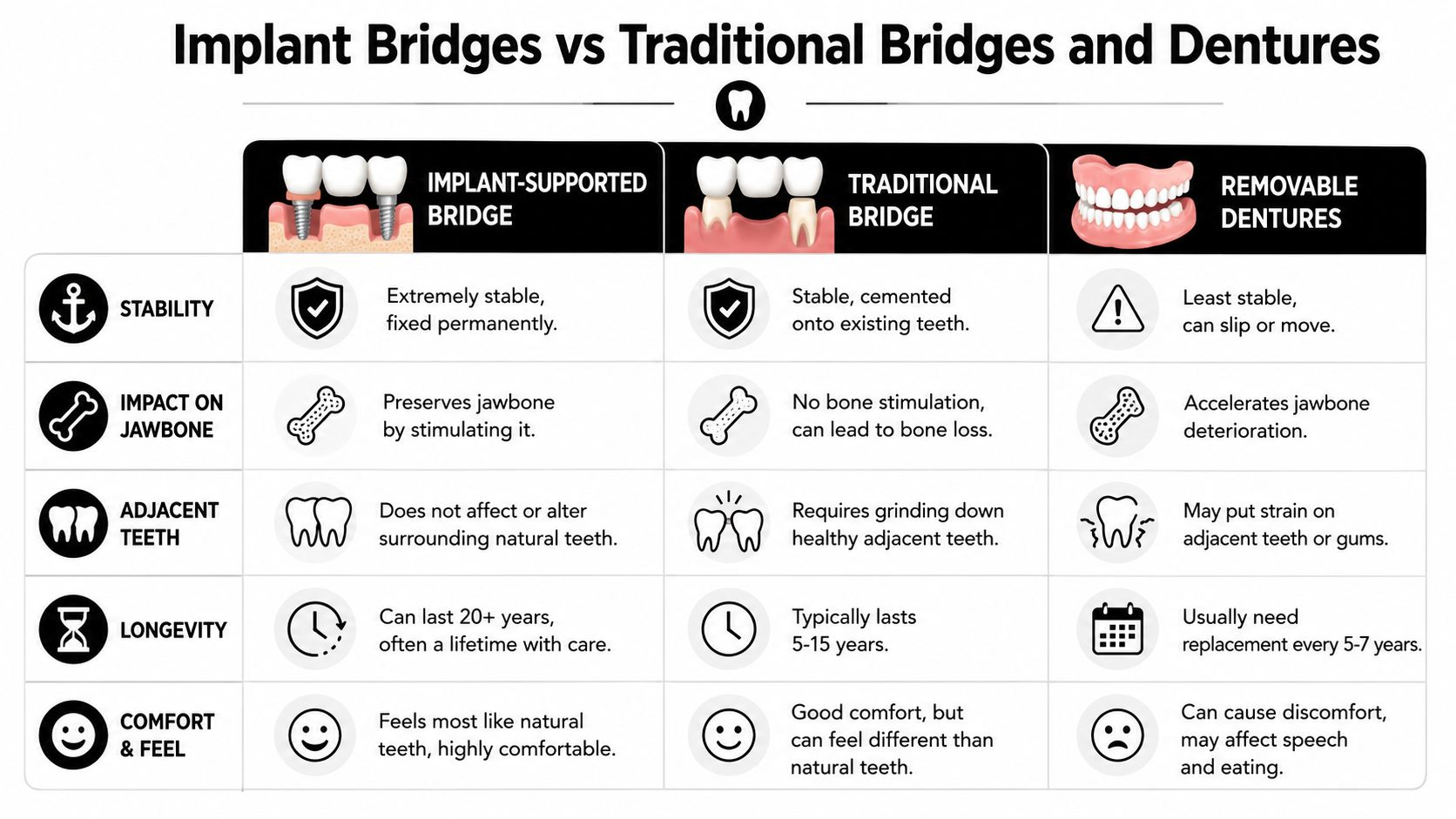
A useful starting point comes from this comparison of bridge types and long-term value, which states that a standard 3-unit implant bridge costs $5,000 to $15,000, while a traditional 3-unit bridge costs $2,000 to $3,000. The same source notes that implant-supported bridges can be more cost-effective over a 20 to 30 year horizon because implants help preserve jawbone health.
That captures the central trade-off. Traditional bridges usually cost less up front. Implant-supported bridges usually ask for more investment early in exchange for greater independence and support.
Side-by-side practical differences
| Option | What patients usually like | What patients usually struggle with |
|---|---|---|
| Implant-supported bridge | Fixed in place, strong chewing support, doesn't rely on adjacent teeth | Higher upfront fee, surgery required |
| Traditional bridge | Lower initial cost, fixed option, shorter treatment path in many cases | Requires altering neighboring teeth |
| Removable denture | Lower initial barrier, non-surgical option | Movement, bulk, daily removal, less natural feel |
What works well for the right patient
A traditional bridge can work well when adjacent teeth already need crowns or when a patient isn't a good candidate for surgery. A removable denture can also serve an important role when immediate affordability is the top concern.
But if the goal is a fixed restoration with stronger support and less dependence on neighboring teeth, implant-supported treatment usually offers the most complete result.
- For comfort. Implant-supported bridges tend to feel closest to natural teeth because they are anchored.
- For maintenance. Patients don't remove them nightly like dentures.
- For adjacent teeth. A traditional bridge often requires shaping neighboring teeth to support the restoration.
Some patients come in focused on the lowest price and leave focused on the option they'll still be comfortable with years from now. That's usually the better way to decide.
Why long-term value changes the conversation
The phrase implant supported bridge cost can make the treatment sound like a single purchase. In reality, patients are comparing years of comfort, function, maintenance, and future dental needs. For many people, that's why the least expensive option on day one isn't the most economical option for their mouth over time.
The Treatment Timeline From Consultation to Final Smile
The process feels less intimidating once you know the order. Most implant bridge cases follow a clear sequence, and each stage has its own purpose.
Early planning matters because a good implant case starts long before surgery. We look at bone, bite, gum health, healing ability, and the final shape of the bridge before anything is placed.
What the sequence usually looks like
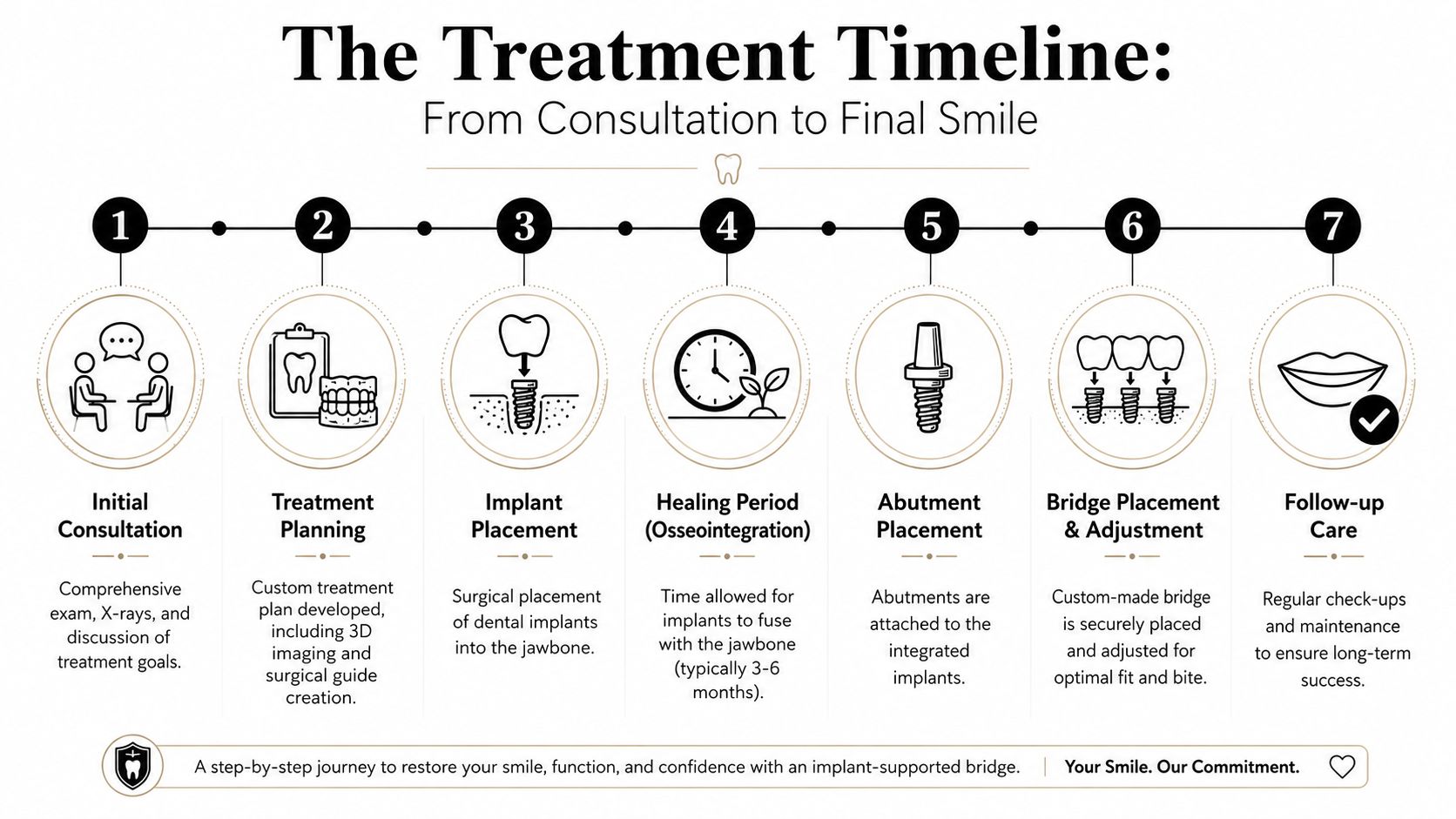
Consultation and records
This visit includes an exam, imaging, and a discussion about goals. Some patients first arrive through a routine visit, while others come in after pain, a broken tooth, or a failed restoration.Treatment planning
The implant positions, bridge design, and any preparatory care are mapped out. If a tooth needs removal first, that is coordinated into the plan.Implant placement
The implants are surgically placed into the jawbone. After that, the body needs time to heal and integrate with the implants.Healing period
This stage is often called osseointegration. The treatment timeline infographic above notes a typical healing period of 3 to 6 months as part of the staged process shown in the visual.
A short walkthrough can help patients visualize how the process fits together in real life.
What happens after healing
Once healing is complete, the restorative phase begins.
- Abutment placement. The connector pieces are attached.
- Bridge fabrication. Impressions or digital records are used to create the final prosthesis.
- Try-in and adjustment. Bite, shape, and comfort are refined before final delivery.
- Follow-up care. Ongoing maintenance helps protect both the bridge and the surrounding gums.
What patients in Las Vegas can expect at visits
Patients from Desert Shores, Sun City Summerlin, Lone Mountain, and nearby neighborhoods often tell us the unknown is the hardest part. In practice, the visits are structured and predictable. You'll know what the next step is, what healing is expected, and when you're moving from surgery to final restoration.
The process also fits into broader care when needed. Some patients start with new patient exams, cleaning and exams, or emergency dental services before restorative work begins. Others pair implant planning with cosmetic goals after the bridge is complete.
Insurance and Financing for Your Implant Bridge
Insurance usually helps some patients, but it rarely removes the full financial hurdle. That's why it helps to approach this as a coverage conversation first and a payment-planning conversation second.
A national reference point appears in this overview of implant-supported bridge pricing and CareCredit data, which notes that an implant-supported bridge in the United States typically costs $5,000 to $15,000 for a three-tooth span on two implants, and cites CareCredit April 2026 data reporting an average cost of $5,200 for standard implant-supported bridges. That gives useful background, but your actual out-of-pocket cost depends on how your plan treats surgery, prosthetics, and annual maximums.
How to think about insurance realistically
Many dental plans contribute toward parts of treatment rather than the whole case. Patients often find that exams, imaging, or portions of the restorative work are easier to apply benefits to than the full implant sequence. The exact split varies by plan, so a benefits review matters more than assumptions.
If you're self-employed or buying coverage on your own, it's smart to compare policy structure before treatment begins. Resources on dental plans for self-employed professionals can help you evaluate waiting periods, annual maximums, and how major restorative procedures are handled.
Ways patients make treatment manageable
This kind of treatment is not typically paid for casually. Patients plan for it.
- Insurance coordination. A pre-treatment estimate can clarify what your carrier may cover before work begins.
- Healthcare financing. Third-party financing can spread a larger dental investment into monthly payments.
- Phased treatment. Some cases can be sequenced so the surgical and restorative phases don't fall at the same time.
- Practice payment options. Reviewing available plans in advance helps avoid delays once you're ready to move forward.
For patients comparing options locally, Las Vegas dental payment plans can be a practical place to start when you're trying to turn a major treatment recommendation into a realistic monthly budget.
Coverage is helpful when it applies. A workable payment plan is often what actually gets treatment done.
Your Questions About Implant Bridges Answered
By the time patients reach this point, the big question is usually less about whether an implant bridge works and more about what life looks like after they commit to it. That is a fair question in a city like Las Vegas, where fees can vary from office to office and the long-term value matters just as much as the starting quote.
How long do implant-supported bridges really last
Implant-supported bridges are designed to be a long-term solution. How long they hold up depends on the quality of the materials, the precision of the bite, daily cleaning, and whether the patient has habits like clenching or grinding.
That matters because this is a meaningful investment.
In my experience, patients who do well over time are usually the ones who treat maintenance as part of the treatment, not as an optional extra. The bridge must be kept clean underneath, and the gum tissue around the implants needs regular attention. Professional cleanings, routine exams, and a night guard when the bite calls for one can make a real difference in how well the work holds up over the years.
Is recovery painful
Recovery is usually easier than patients expect, but it is still surgery. Some soreness, swelling, and temporary changes in chewing are normal after implant placement. The recovery period can be a little more involved when extractions or bone grafting are part of the plan.
A smoother recovery usually depends on a few simple things:
- Follow the post-op instructions carefully so the area stays protected while it heals.
- Stick with softer foods at first and avoid chewing hard foods on the surgical side too early.
- Keep your follow-up visits so healing can be checked and small issues can be addressed before they become bigger ones.
The goal is steady healing, not rushing back to normal too fast.
Can I still get an implant bridge if I have bone loss
Often, yes. Bone loss does not automatically rule out implant treatment, but it does change the planning. Some patients need grafting or a different implant approach. Others still have enough support for treatment without adding major surgical steps.
An older opinion should not be the final word. A past assessment that you are "not a candidate" often means further evaluation is needed, rather than a permanent disqualification. Updated imaging, a current exam, and a clear review of the area usually give a much more accurate answer.
I also remind patients to look at the full financial picture here. A case that needs additional preparation may cost more up front, but that does not always make it the worse value. In many situations, a well-planned implant bridge provides better stability, fewer day-to-day frustrations, and a longer service life than choosing the lowest initial fee and dealing with repeat repairs later.
Schedule Your Implant Bridge Consultation in Las Vegas
A patient comes in after months of chewing on one side, avoiding photos, and putting off treatment because the price feels hard to pin down. That is common. The consultation is where those loose estimates turn into a plan with real numbers, realistic timing, and a clear explanation of what is driving the cost in Las Vegas.
An implant-supported bridge is a significant investment, so the first visit should answer more than one question. Patients need to know whether implants are a good fit, what preparatory treatment may be needed, how insurance may apply, and what the long-term maintenance costs are likely to be. National averages only go so far. Local fees, lab choices, imaging, sedation needs, and the condition of the bone and gums all affect the final total here in Las Vegas.
Patients in Sun City Summerlin, Desert Shores, Lone Mountain, Sunhampton, Monterrey, Mar-A-Lago, Painted Desert Estates, and nearby parts of Las Vegas often tell me the same thing. They want a fixed solution that feels stable, looks natural, and makes daily life easier. They also want to understand whether the higher upfront cost makes sense compared with replacing a traditional bridge again later or continuing to manage a denture that never feels fully secure.
For patients seeking a dentist in Las Vegas, NV who provides thoughtful restorative dentistry, dental implants, tooth extraction, preventive care, and cosmetic services in one place, the next step is a consultation and a personalized review of the options.
If you are ready to talk through the full cost picture for an implant-supported bridge, schedule a consultation with Aspiring Smiles Dental and Braces. Dr. Patel and the team provide patient-centered care with clear recommendations, modern technology, and practical support for both straightforward cases and more complex restorative treatment.