Aspiring Smiles: Pediatric Dental Care in Las Vegas
If you're a parent in Las Vegas, this may feel familiar. Your child's first tooth appears, or maybe you've noticed dark spots, sensitivity, or a battle every night over brushing. Many parents aren't sure when to book that first appointment, what's normal, or whether they need a pediatric specialist or a family dentist who also treats kids.
That uncertainty is common, but the next step doesn't have to be complicated. Good pediatric dental care starts earlier than commonly realized, and it works best when parents have a clear roadmap. For families in Desert Shores, Sunhampton, Sun City Summerlin, Monterrey, Lone Mountain, Mar-A-Lago, and Painted Desert Estates, the goal is simple: catch problems early, build healthy habits, and make dental visits feel routine instead of stressful.
Why Early Dental Care Matters for Your Child
Many parents assume baby teeth matter less because they eventually fall out. In practice, they matter a great deal. Baby teeth help children chew comfortably, speak clearly, and hold space for adult teeth. When decay starts early, it can affect daily life fast.
The public health data is a reminder that cavities in children are still common. The CDC reports that 15% of children ages 5 to 11 had untreated dental caries in 2017 through March 2020, and the rate was 23% for children in poverty compared with 9% for children at or above 200% of the poverty level in the same period, according to CDC child oral health data. That gap matters because early treatment is usually simpler than late treatment.

Small concerns turn into bigger ones quickly
A white spot near the gumline can be an early warning sign. A child who avoids cold foods may be telling you something before they can explain it. Waiting for pain is what usually does not work.
What helps is establishing a dental home early. That means your child has a regular office for checkups, guidance, cleaning and exams, dental x-rays when needed, and follow-up if something changes. Parents also get coaching on brushing, diet, thumb-sucking, and what to expect as adult teeth start coming in.
Practical rule: The first years of dental care are usually more about prevention and coaching than major treatment.
Why early visits are easier than parents expect
A first visit for a young child is often gentle and brief. The dentist looks at tooth development, checks the gums, reviews home care, and talks through feeding, fluoride, and habits that can affect the bite. For many families, the appointment is as much for the parent as it is for the child.
That early relationship matters in a busy city like Las Vegas, where schedules get packed and small problems are easy to postpone. Families often search for a dentist near me, an emergency dentist, or even tooth extraction only after a child is already uncomfortable. Preventive visits lower the chance that care begins in crisis mode.
A local approach for Las Vegas families
For parents near Lone Mountain or Sun City Summerlin, convenience matters. So does trust. Children do better when the office feels familiar, the language is simple, and the care team knows how to pace an appointment based on age and comfort level.
That's why early pediatric dental care should feel steady, not intimidating. The right start helps children accept routine visits, and that often shapes how they view dental care for years.
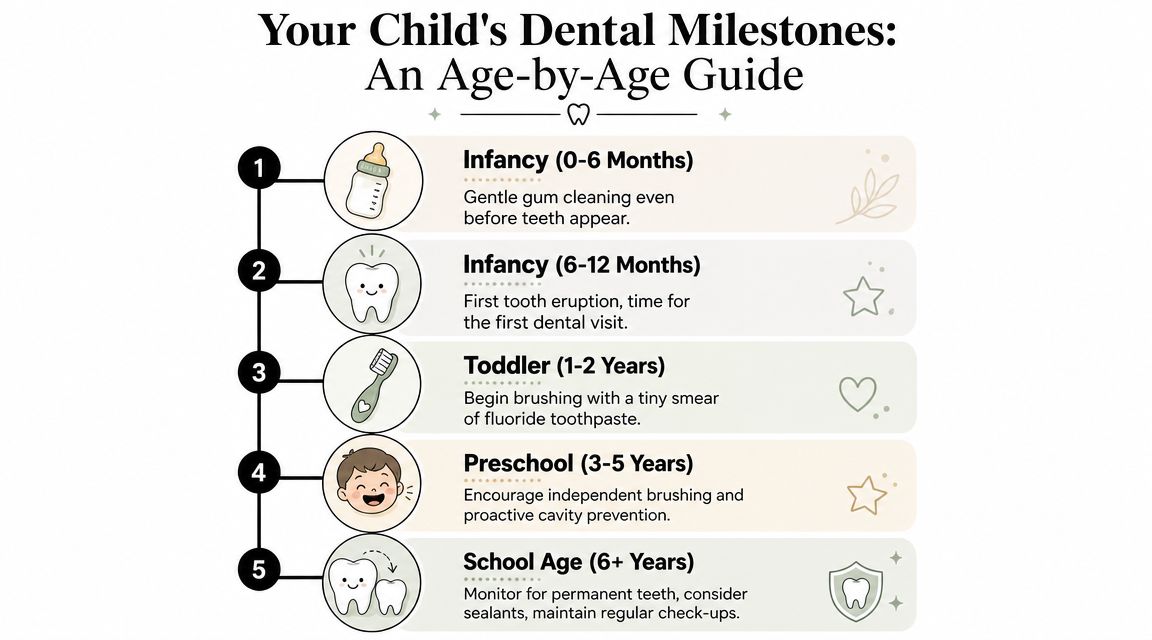
Your Child's Dental Milestones An Age-by-Age Guide
The biggest question most parents ask is not whether dental care matters. It's when to do what. A checklist helps because children's needs change quickly from infancy to the teen years.
The first milestone most parents miss
The American Academy of Pediatric Dentistry recommends a child's first dental visit by the first birthday or within six months of the first tooth erupting, as noted by Cleveland Clinic's overview of pediatric dentistry. That visit sets the tone for prevention instead of waiting until a child has visible decay or pain.
For many Las Vegas parents, that timing feels early. It isn't. An age-one visit lets the dentist check development, discuss brushing and feeding habits, and spot concerns before they become harder to manage.
A short video can also help parents know what early dental guidance looks like in practice.
Pediatric dental care checklist by age
| Age Group | What to Expect | Home Care Focus | Recommended Professional Care |
|---|---|---|---|
| Infancy 0 to 2 years | Teething, first tooth eruption, curiosity about objects in the mouth | Clean gums gently, then brush new teeth with a tiny smear of fluoride toothpaste, avoid sending a child to bed with sugary drinks | First dental visit by age one or within six months of first tooth eruption |
| Toddler and preschool 2 to 5 years | More independence, possible thumb-sucking, more exposure to snacks and juice | Help with brushing twice a day, begin flossing when teeth touch, keep routines consistent | Regular checkups, cleaning and exams, monitoring for early decay and bite habits |
| School-age 6 to 12 years | Baby teeth loosen, adult teeth erupt, chewing grooves on molars become more important | Supervise brushing, improve flossing skill, watch sports-related injury risk | Routine checkups, dental x-rays when needed, discussion of sealants and cavity prevention |
| Teenagers 13 to 18 years | More self-care responsibility, orthodontic concerns, sports and diet choices matter more | Reinforce technique, watch for skipped brushing, discuss mouthguards and sugar exposure | Ongoing preventive visits, monitoring of permanent teeth, gum health, alignment, and restorative needs if problems develop |
What parents should watch for at each stage
Infants and toddlers
Start simple. Wipe the gums before teeth erupt, then switch to a baby toothbrush once teeth appear. If your child falls asleep with milk or juice on the teeth regularly, that raises concern because liquid sugars can sit on enamel for long periods.
If thumb-sucking becomes a recurring question, some families find it useful to read outside guidance on understanding autism and thumb sucking because sensory needs, comfort habits, and behavior patterns can overlap in ways that deserve a thoughtful response.
Preschool and early school years
Consistency in routine usually yields the best results. Children may want to brush by themselves, but most still need active help to do a thorough job. Parents should watch the back teeth closely because deep grooves collect food easily.
A child who can hold a toothbrush well still may not have the coordination to clean every surface well.
Older kids and teens
As adult teeth come in, the focus shifts toward long-term protection, injury prevention, and keeping habits steady. Teens often need reminders more than instruction. The issue usually isn't knowledge. It's consistency.
For many families, new patient exams during these stages are also when discussions begin about orthodontic concerns, restorative dentistry after damage, or cosmetic issues such as discoloration that affect confidence.
Common Preventive Treatments to Protect Young Smiles
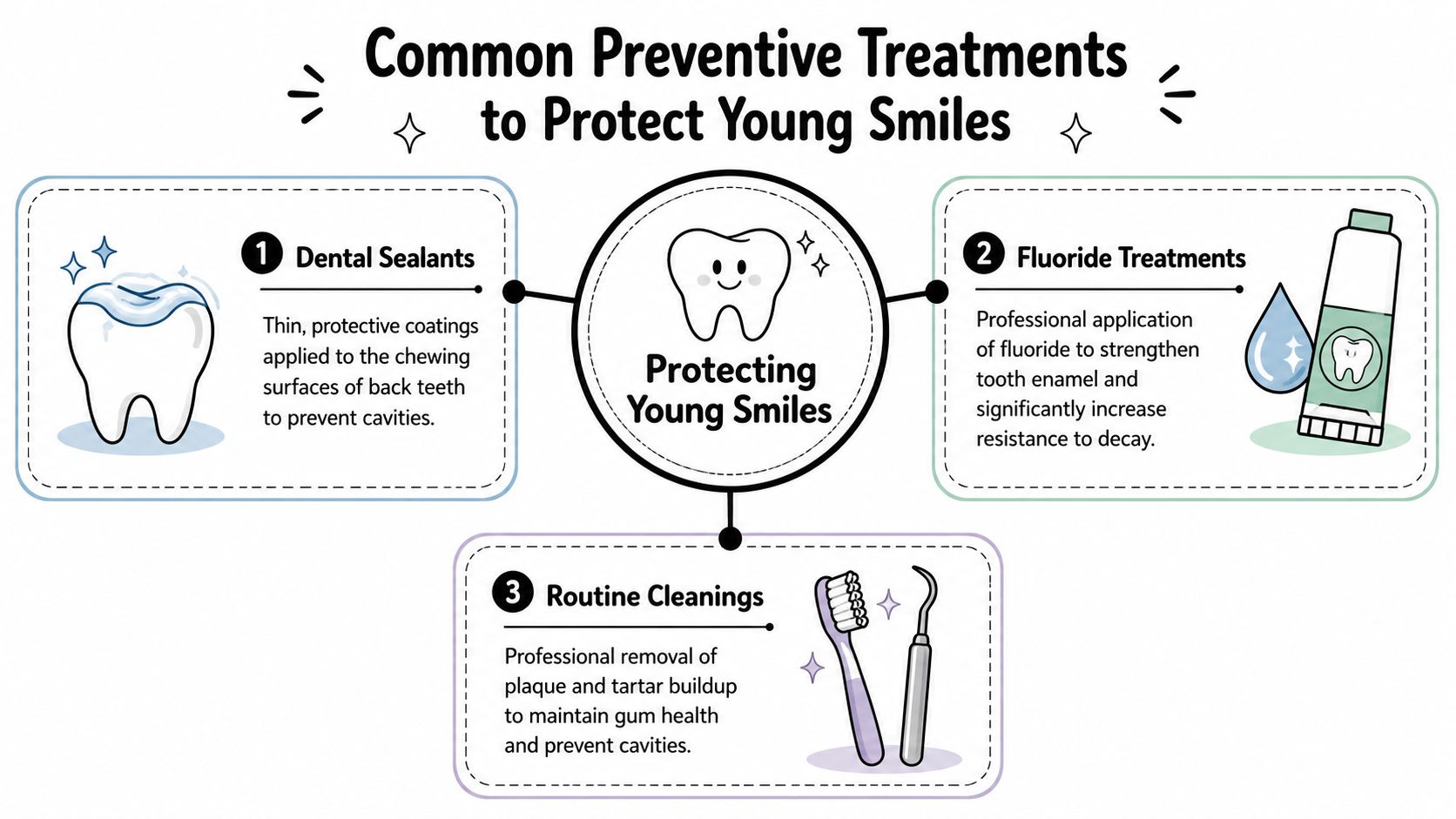
Most pediatric dental care is designed to prevent treatment from getting more invasive later. Parents often hear terms like sealants, fluoride, and digital dental x-rays without a clear picture of what those mean in everyday life.
Sealants, fluoride, and routine cleanings
Sealants are thin protective coatings placed on the chewing surfaces of back teeth. I often explain them to parents as raincoats for molars. They don't fix a cavity, but they can help block food and bacteria from settling into the grooves where brushing misses.
Sealant timing matters. Dental quality benchmarks focus on getting sealants on permanent first molars by the 10th birthday and permanent second molars by the 15th birthday, according to the American Dental Association Dental Quality Alliance measure specifications. In plain terms, it's most useful to protect those teeth soon after they come in.
Fluoride treatments strengthen enamel. That's different from routine toothpaste use at home. Professional fluoride is applied in a controlled setting and can be especially helpful for children with early signs of weakness in the enamel or a history of cavities.
Routine cleanings remove plaque buildup in areas kids tend to miss. They also give the dentist a chance to catch changes early, before a small issue turns into a filling or more involved restorative dentistry.
What usually works and what doesn't
Some parents hope brushing harder will solve everything. It usually doesn't. Technique, consistency, diet, and timing all matter more than force.
What tends to help most:
- Regular recall visits that keep small issues from being overlooked
- Targeted prevention such as fluoride or sealants when a child is at higher risk
- Home routines that are short, repeatable, and realistic for the child's age
What tends not to help:
- Waiting for pain before booking a visit
- Assuming baby teeth don't count
- Letting children manage brushing completely alone too early
Prevention is usually faster, easier, and less stressful than repair.
A note on x-rays and fillings
Parents often ask whether dental x-rays are necessary for children. When they're used, they're used for a reason. Digital dental x-rays help the dentist check between teeth, monitor eruption patterns, and find problems that aren't visible in a standard exam.
If a cavity is already present, a filling may be the right next step. That's still preventive in a practical sense because treating a small area early is far easier than waiting until the tooth hurts or breaks down.
Pediatric vs Family Dentistry Finding the Best Fit in Las Vegas
Parents often ask a fair question. Should a child see a pediatric-only dentist, or is a family dentist enough? The answer depends on the child's needs, the office's comfort with children, and how much convenience matters for your household.
Where pediatric specialists stand out
A pediatric specialist has additional training focused on children, behavior guidance, tooth development, and age-specific treatment. That can be especially useful for very young children, complex developmental cases, or children with strong dental anxiety.
That said, many families prefer one office where parents and children can all be seen. That setup can reduce scheduling friction, simplify records, and help children feel more comfortable because they see dental care as a normal family routine rather than a separate event.
What a strong family practice should offer kids
A family office isn't a good fit for pediatric dental care unless it does a few things well:
- Age-appropriate communication that explains care in child-friendly language
- Gentle pacing so a hesitant child doesn't feel rushed
- Preventive focus with regular monitoring as the bite and adult teeth develop
- Broad services in case a child later needs restorative dentistry, emergency dentist care, or long-term planning as a teen
National child health data shows that untreated dental caries in children ages 5 to 11 fell from 27% in 1999 to 2004 to 16% in 2009 to 2010, then remained relatively stable at 15% in 2017 through March 2020, as reported by America's Children and oral health indicators. The takeaway is practical, not abstract. Progress in children's oral health holds when families stay connected to consistent preventive care.
The practical trade-off for busy households
For many Las Vegas families, the decision comes down to whether one office can care for everyone well. If a practice can provide child-focused preventive care, new patient exams, dental x-rays, restorative treatment when needed, and adult services like cosmetic dentistry, teeth whitening, dental implants, or even dental implants near me searches later in life, that continuity has real value.
Some parents also appreciate that modern offices use systems that make scheduling and follow-up smoother. If you're curious how that side of care works behind the scenes, Dental practice management solutions offer a useful overview of the tools practices use to coordinate appointments, communication, and patient flow.
How to Prepare Your Child for a Positive Dental Visit
The car ride to the dentist often tells you how a visit will go. If a child hears nervous language all morning, they tend to arrive guarded. If the visit sounds simple and familiar, they usually settle much faster.
What to say before the appointment
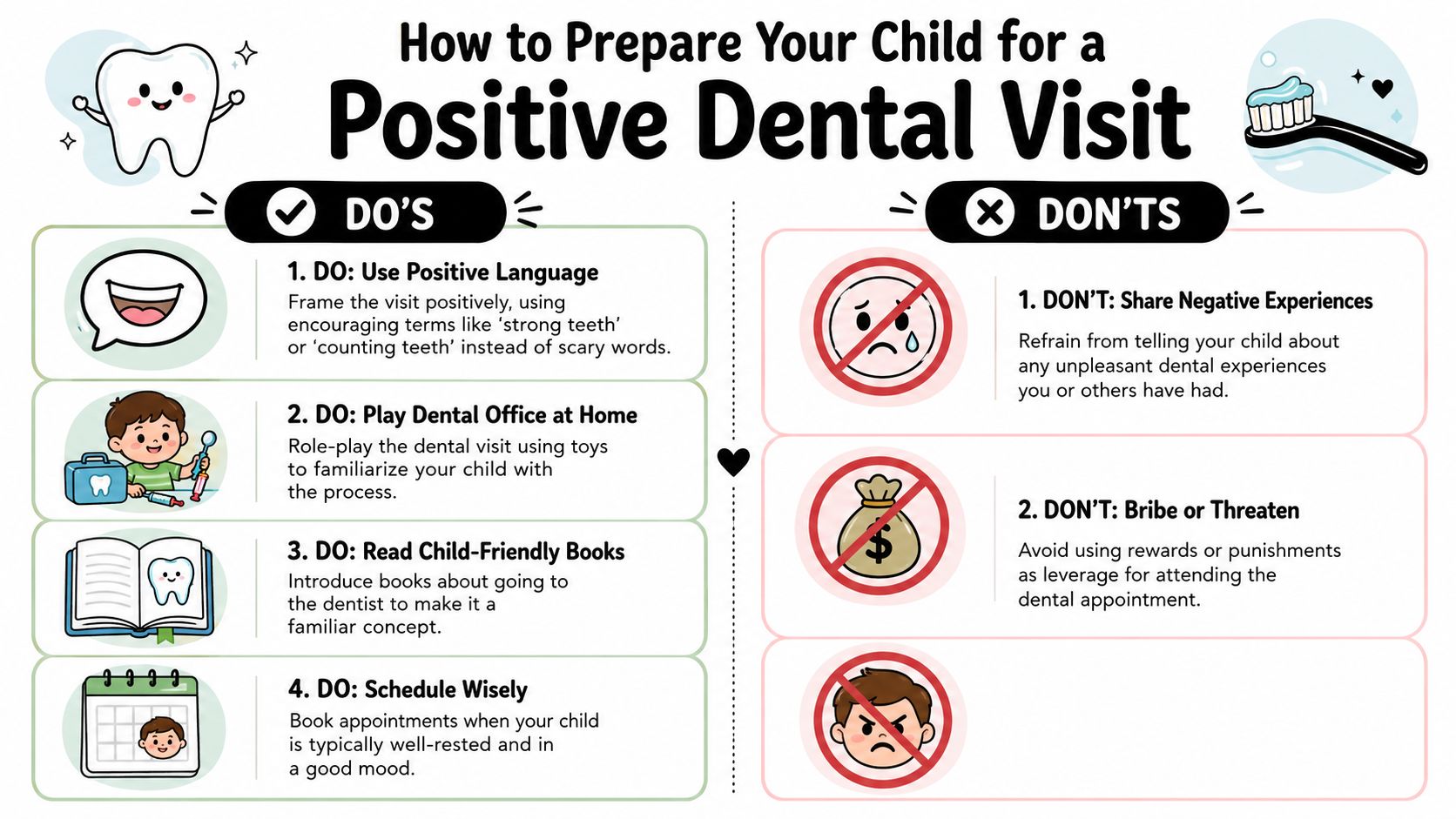
Children don't need a dramatic speech. They need calm, simple expectations. Try language like, “They're going to count your teeth,” or “They'll help us keep your smile strong.”
Avoid promising that “nothing will happen” or asking, “Are you scared?” Those phrases can create worry even when a child felt fine to begin with.
Say less, keep it positive, and let the dental team guide the details once your child arrives.
A few things that help at home
Some preparation works better than others. These are the steps parents usually find most useful:
- Practice open-and-close games so your child gets used to opening wide on cue.
- Read a child-friendly book about the dentist a day or two before the visit, not weeks in advance.
- Role-play at home with a toothbrush and mirror. Count teeth, look at the tongue, and keep it playful.
- Schedule smartly when your child is usually rested and fed, not during a normal nap window.
A common behavior tool in children's dentistry is Tell-Show-Do. First, the team explains in simple language. Then they show the child the mirror, toothbrush, or suction straw. Then they do the step gently. That sequence builds trust because the child isn't surprised.
What parents should avoid
Some well-meant habits make appointments harder:
- Don't share your bad dental stories. Your child doesn't need them.
- Don't use the dentist as a threat. That turns care into punishment.
- Don't over-bribe. A small reward after a good visit is fine, but heavy bargaining can signal that something scary is coming.
I've seen many children change their attitude once parents stop overexplaining. Kids often do better when the visit feels ordinary.
Handling Pediatric Dental Emergencies in Las Vegas
When a child has a dental emergency, parents need a plan more than a lecture. The first job is to stay calm, control the situation, and get the right kind of help quickly.
What to do right away
For a toothache, rinse the mouth gently with warm water and check for trapped food around the tooth. If there's swelling, call promptly. Pain that lingers rarely improves by waiting it out.
For a chipped or broken tooth, keep any pieces you can find and rinse the mouth carefully. If the lip or cheek is bleeding, use clean gauze with light pressure.
For a knocked-out tooth, what you do depends on whether it's a baby tooth or a permanent tooth. Don't force a baby tooth back in place. If it may be a permanent tooth, call an emergency dentist right away for instructions and next steps.
When to seek urgent care
Contact a dentist promptly if your child has:
- Persistent pain that doesn't settle
- Swelling in the gums, face, or jaw
- Bleeding that doesn't stop with gentle pressure
- A broken or displaced tooth after a fall or sports injury
If you want a fuller step-by-step guide before coming in, this page on how to prepare for seeing an emergency dentist is useful for parents trying to make quick decisions under stress.
In Las Vegas, where kids are active year-round, sports injuries, playground falls, and sudden tooth pain are all common reasons families search for an emergency dentist. Quick attention can protect comfort, preserve the tooth structure, and reduce the chance that a small accident becomes a bigger treatment problem.
Your Child's First Visit at Aspiring Smiles Dental and Braces
A child's first dental visit should feel manageable from the moment the family walks in. Parents want to know where to park, what the front desk will ask, whether their child will be pressured, and how the dentist responds if the child is shy. Those details matter.
At Aspiring Smiles Dental and Braces, the first visit is built around familiarity, comfort, and a clear explanation of what your child needs right now. Families can expect a welcoming setting at 3211 N Tenaya Wy Suite 122, Las Vegas, NV 89129, along with a pace that matches the child in front of us. Some children are ready for a full cleaning and exam. Some need a shorter happy visit first. Both approaches can be appropriate.
What the appointment usually includes
A first visit may include:
- A gentle exam to check existing teeth, gums, and development
- Cleaning and exams when the child is ready
- Dental x-rays if they're clinically appropriate
- A parent conversation about brushing, flossing, diet, habits, and timing of future visits
If treatment is needed later, the same office can also discuss restorative dentistry, tooth extraction, cosmetic concerns as children get older, and long-term family care under one roof. That continuity is helpful for parents managing school schedules, work, and multiple family members.
Why local families value one trusted office
Parents in Desert Shores, Sunhampton, Sun City Summerlin, Monterrey, Lone Mountain, Mar-A-Lago, and Painted Desert Estates often want the same thing. They want an office that treats kids kindly, explains things clearly, and makes it easy to keep up with appointments.
A good first visit should lower anxiety, not increase it. Children remember tone, pace, and how adults speak to them. When the experience is calm and predictable, future visits usually get easier.
A positive first appointment doesn't require perfection from a child. It requires patience from the adults in the room.
If you're looking for more details about services for children, the practice's pediatric dentist near me page gives a clear overview of what local families can expect.
If your child is due for a first visit, overdue for a checkup, or dealing with tooth pain, Aspiring Smiles Dental and Braces is here to help families across Las Vegas with thoughtful pediatric dental care, routine exams, and urgent treatment when needed. Reach out to schedule an appointment and give your child a comfortable start with care that fits your family's routine.