
Safe Teeth Whitening While Breastfeeding: 2026 Guide
A new baby changes everything, including how you feel about your smile. If you're in Las Vegas, short on sleep, and wondering whether it's reasonable to brighten your teeth while breastfeeding, you're not alone. The safest answer depends on the product, the way it's used, and how comfortable you are with an elective cosmetic treatment while lactating.
For most nursing mothers, the main concern isn't that whitening is known to cause harm. The issue is that direct clinical research is limited, so professional guidance leans on the chemistry of peroxide-based whitening agents and lactation expertise rather than large trials. That's why some dentists advise waiting, while other expert sources say the available evidence does not show harm.
Aspiring Smiles Dental and Braces in Las Vegas takes that same careful, patient-first approach. Families from Sun City Summerlin, Desert Shores, Lone Mountain, Sunhampton, Monterrey, Mar-A-Lago, and Painted Desert Estates deserve straight answers, not guesswork. A good cosmetic recommendation should protect your peace of mind as much as your smile.
A Brighter Smile for New Moms in Las Vegas
You may be looking in the mirror between feedings and thinking your teeth look dull, stained, or just more tired than you feel. That's a very normal reaction after pregnancy and early motherhood, especially when coffee, tea, and irregular routines start showing up in your smile. The question is whether teeth whitening while breastfeeding fits your situation without creating unnecessary stress.

The real decision is about timing and comfort
The safest place to start is with the fact that whitening is an elective cosmetic procedure. Because there's little direct clinical research on whitening during lactation, some clinicians recommend delaying until breastfeeding ends, while others point out that the available evidence doesn't show harm and that peroxide absorption is likely minimal Walrus summary of the evidence gap. Both views come from the same problem, a shortage of dedicated studies.
Practical rule: if you want the most cautious path, wait. If you want to whiten now, choose the lowest-risk method and use it exactly as directed.
That's the framework I'd use in a Las Vegas dental chair. If you're a new mom in Sunhampton or Desert Shores, you don't need a dramatic answer. You need a clear one, based on what the ingredients do, how much is used, and whether there's any realistic pathway to your milk.
Aspiring Smiles can help you sort through that decision without pressure. A consultation should leave you understanding your options, not more confused than when you walked in. For many mothers, that alone is a relief.
How Teeth Whitening Ingredients Actually Work
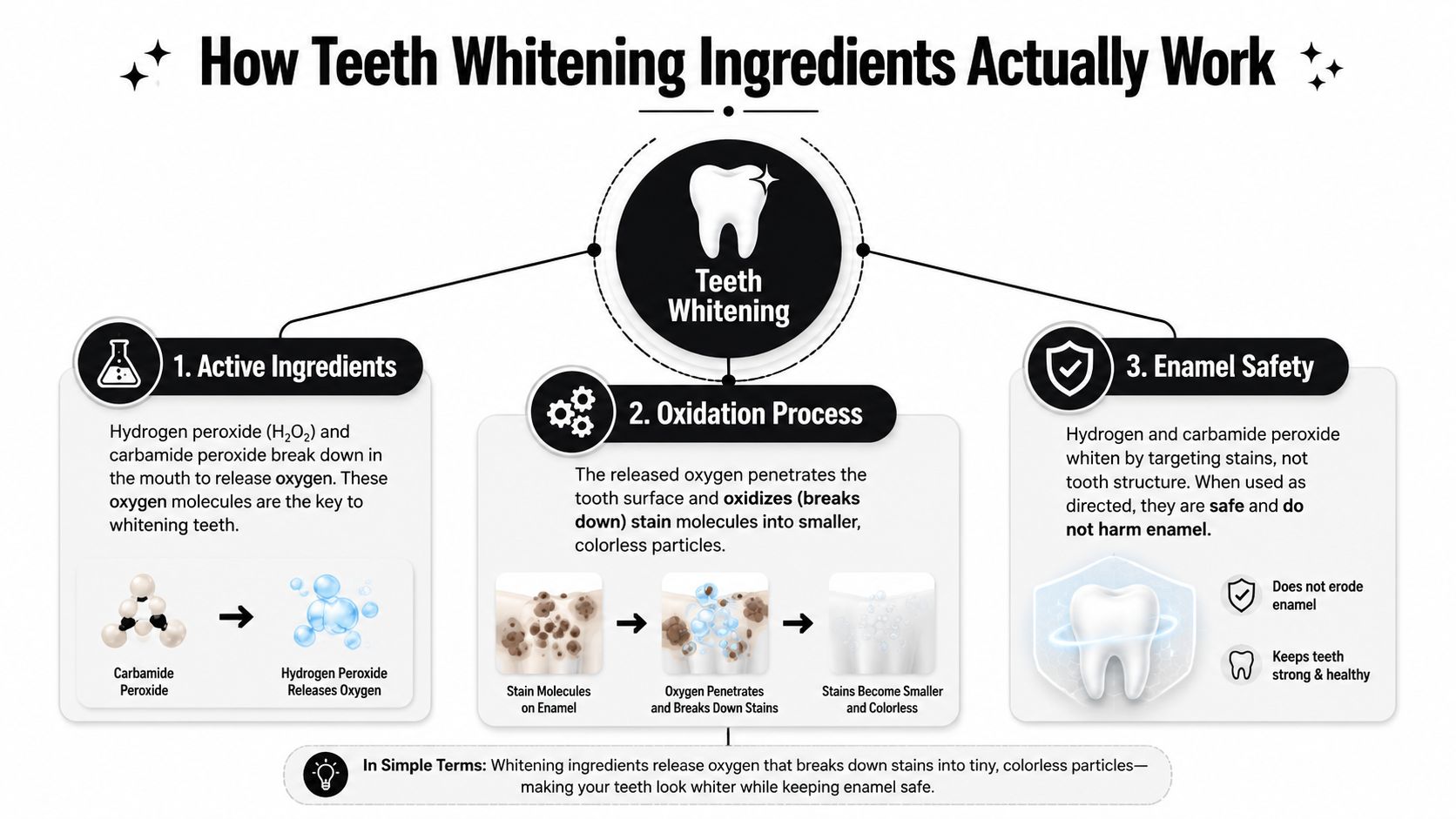
A mother in Las Vegas can look at a whitening label and see a few different active ingredients, but the chemistry behind most strips and gels is usually the same. Peroxide-based agents, most commonly hydrogen peroxide or carbamide peroxide, sit on the tooth surface and break apart stain molecules through oxidation. That process lightens discoloration where it starts, on the enamel, rather than spreading through the body.
That local action is why the safety question feels more manageable than many moms expect. The ingredient works where it is placed, and it does not need to circulate widely to do its job.
Why the milk transfer concern stays low
The main concern for nursing mothers is whether whitening ingredients can enter the bloodstream in a way that matters for breast milk. Lactation-focused references say the amount expected to enter maternal circulation is very small when these products are used as directed, and MotherToBaby says transfer into breast milk is unlikely.
A breastfeeding medication reference also quotes Dr. Thomas Hale as saying it would be “all but impossible” for peroxide to reach breast milk except under “extreme overdose,” and that if absorbed it would be metabolized “in seconds” Breastfeeding Basics. That is a strong reason many clinicians see whitening as a low-risk cosmetic choice when it is used correctly.
The whitening light used in some in-office systems is part of the cosmetic process, not the ingredient itself. It is not expected to affect milk production or the breastfed infant either MotherToBaby.
What matters more than the brand name
The bigger safety difference usually comes from how the product is used, not just which product is on the box. Low-dose, well-fitted trays and careful application help keep the gel where it belongs and reduce irritation to the gums.
- Use the product as directed: the timing on the package is there for a reason.
- Keep the gel off the gums when you can: that lowers irritation and limits unnecessary contact.
- Do not swallow it: whitening is meant to stay on the teeth, not move through the digestive tract.
- Choose products from a dentist when you want more oversight: if you are comparing professional treatment with store-bought options, Aspiring Smiles can explain the differences clearly.
Those are simple steps, but they are the steps that keep the chemistry local and help a new mother make a cautious, practical choice.
Professional vs At-Home Whitening for Nursing Mothers
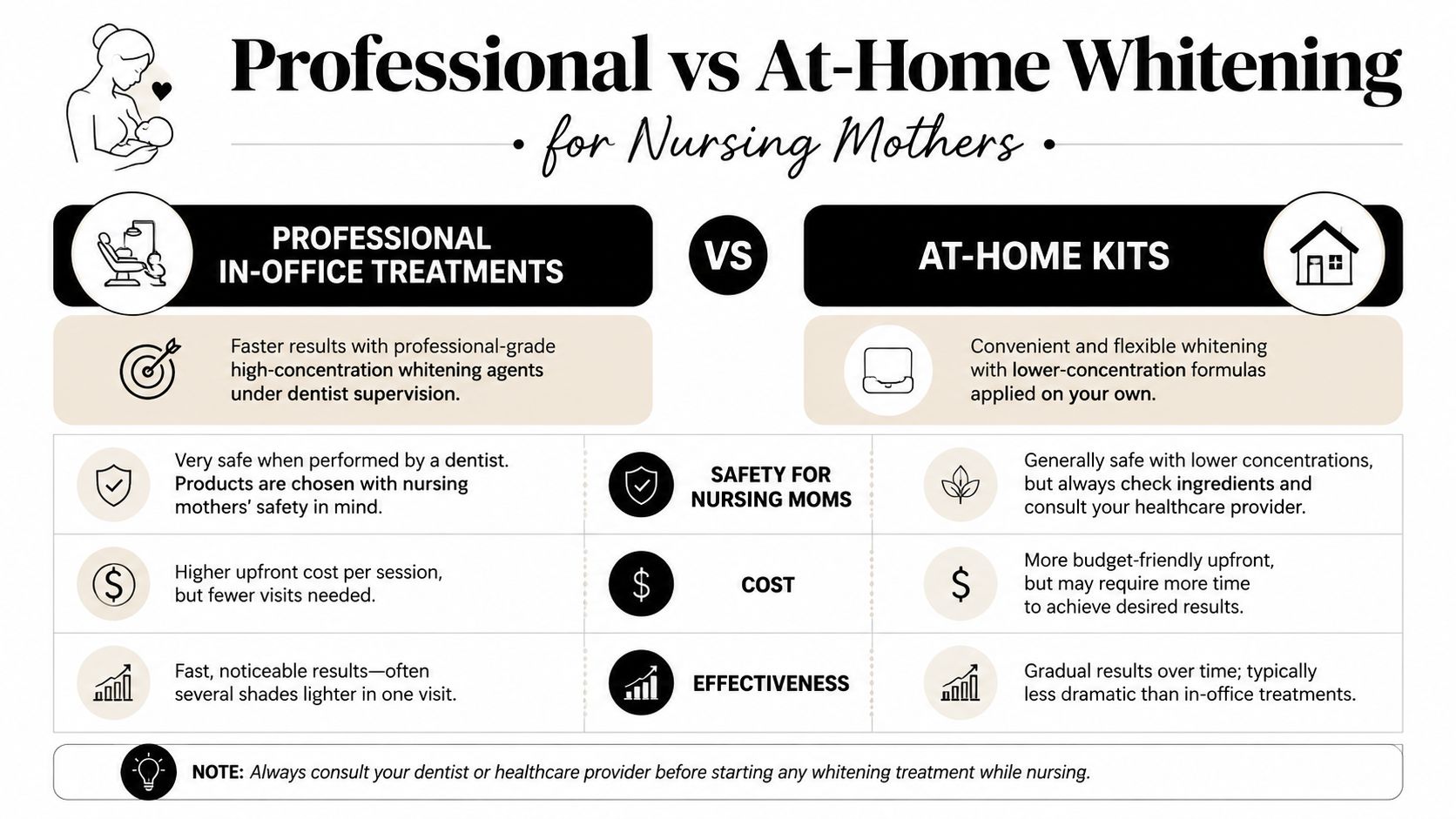
A breastfeeding mom usually has to weigh supervision against convenience. In-office whitening gives a dentist more control over the process, clearer oversight, and less room for user error. At-home whitening gives more flexibility, but it depends on careful use and on how well the trays or strips fit.
In-office care offers tighter control
A professionally managed treatment uses protective barriers, precise application, and a dentist's ability to stop if your gums react. That matters if you are already sleep-deprived and do not want to troubleshoot a whitening kit at home. The main advantage is not only speed, it is control.
At Aspiring Smiles, a cosmetic consult can also screen for issues that whitening will not fix, like uneven restorations or sensitivity from other causes. If you are comparing options and want a dentist near me in Las Vegas, NV, that kind of evaluation can help you choose the safer cosmetic route for your mouth, not just the faster one.
At-home kits can be reasonable if you're careful
For home use, one patient-facing source describes low-concentration kits, typically 10% carbamide peroxide or less, as safe when used properly, with custom or well-fitting trays and the exact package duration YouTube guidance. Overuse or poorly fitting trays can irritate the gums, though that irritation does not create a direct risk to the baby.
If you choose a home kit, fit and timing matter more than enthusiasm.
For a Las Vegas mother balancing feeds, naps, and errands, that distinction is real. A kit you cannot tolerate for the full recommended wear time usually is not the right kit. A quick, supervised in-office visit may be the simpler route if you want predictability.
Compare supervised whitening and take-home options
Bornbir's advice on nursing while sick can be a useful reminder here, too, because many breastfeeding decisions come down to the same question, what is low-risk, what is temporary, and what deserves extra caution.
Reviewing the Evidence on Whitening Safety and Lactation
A new mother in Las Vegas often wants a clear answer fast, especially when a bright smile feels overdue. The evidence on whitening during breastfeeding is reassuring, but the research base is still limited. There are not many dedicated lactation trials on whitening agents, which is why some clinicians stay conservative and advise waiting until breastfeeding ends Edgecliff Dental Care.
What the best available evidence does say
One of the clearest findings in the sources you shared comes from a study in the Journal of the American Dental Association. It found no difference in carbamide peroxide levels in breast milk between women who used whitening products and those who did not ToothFeed. That matters because it addresses the ingredient and the outcome most nursing mothers worry about first.
Other guidance points in the same direction. Dental and lactation references say there is no strong evidence that whitening changes breast milk composition or harms a breastfed infant, and some cite the American Dental Association as considering whitening safe for breastfeeding women. Sources that urge caution still make the same basic point, the available evidence is limited. For a Las Vegas patient, that usually means the choice comes down to a low biologic risk, plus uncertainty about how much direct study exists, versus waiting for a later time.
That is the practical framework I use in consultation. If a treatment has a low likelihood of affecting milk, but the direct evidence is not broad, the decision is not a simple yes or no. It becomes a question of your comfort level, the type of whitening you want, and whether your baby's feeding routine gives you room to be conservative.
Why good medical advice can sound different
If you have read one article that says yes and another that says wait, both may be acting responsibly. In lactation care, similar judgment calls come up in other situations too. A useful parallel is Bornbir's advice on nursing while sick, which also weighs day-to-day practicality against a cautious approach.
For mothers who want to understand the trade-off more fully, this overview of costs and risks gives a helpful way to compare comfort, timing, and treatment choice. The main takeaway is straightforward. The available evidence supports a low risk profile, but it is not large enough to promise the same answer for every nursing mother.
Cosmetic Alternatives for a Brighter Smile
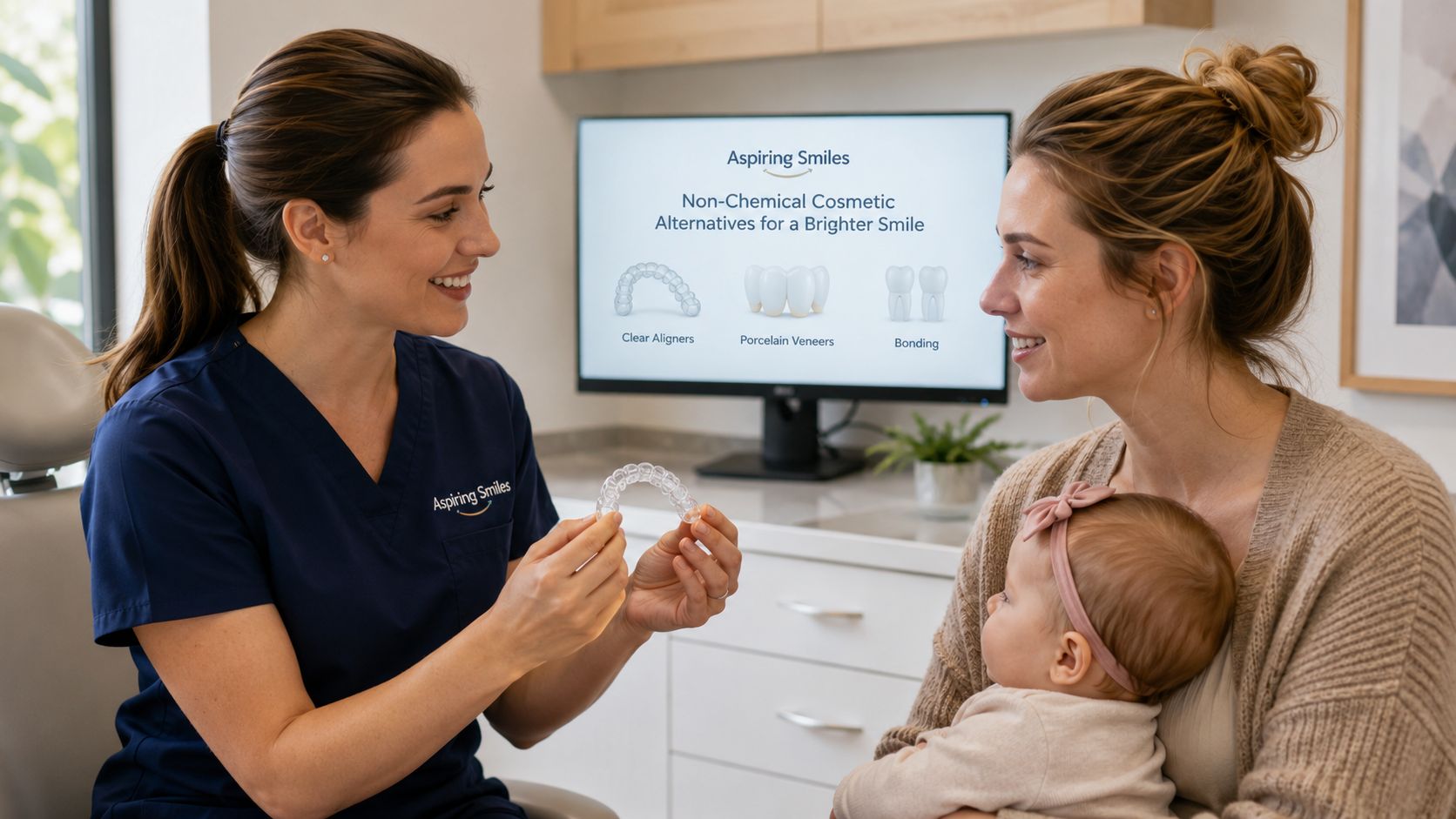
If you'd rather avoid peroxide for now, you still have good options. A smile can look noticeably brighter without a whitening gel, especially when surface stains are the main issue. That's often the best fit for mothers who want to stay as conservative as possible.
Start with the simplest brightening steps
A professional cleaning can remove plaque and surface stains that make teeth look darker. That won't change the natural shade of the enamel, but it often makes a bigger difference than people expect. Daily brushing and flossing also matter more than most cosmetic products because they keep new stain from building up.
You can also help your smile by limiting frequent contact with staining drinks and rinsing after meals. The goal is not perfection, it's prevention. If you're postponing whitening, that mindset keeps your smile looking fresh without adding a single chemical step.
Know what whitening won't fix
Bleaching doesn't change crowns, veneers, or fillings, so a dentist should look at existing dental work before recommending any whitening plan. If your discoloration is deeper or related to another dental issue, cosmetic bonding or other restorative treatment may fit better than a whitening product Serene Dental Spa background on alternatives.
Useful rule: if the stain is on the surface, cleaning may help. If it's inside the tooth or tied to dental work, whitening may not be the right tool.
That's where a good cosmetic exam earns its value. Even if you never whiten, you still leave with a cleaner, brighter, more predictable plan.
Your Whitening Consultation at Aspiring Smiles
A thoughtful consultation should feel calm, not rushed. In a Las Vegas practice, that usually starts with a conversation about what bothers you, whether you're breastfeeding, and how soon you'd like a visible change. For mothers in Lone Mountain, Mar-A-Lago, Sunhampton, and Painted Desert Estates, that discussion should also account for schedule, sensitivity, and how much supervision you want.
What a good visit should cover
The dentist should examine your gums, existing restorations, enamel condition, and the kind of staining you have. That is the only way to tell whether whitening is a strong fit or whether a cleaning, polishing, or another cosmetic option makes more sense. A one-size-fits-all answer does not belong in cosmetic dentistry.
The appointment should also look at your breastfeeding routine and how comfortable you feel with a cosmetic treatment right now. If you are coordinating baby feeding with Cradlo, that kind of organization can make it easier to plan a visit around your day and keep stress low. At Aspiring Smiles, the goal is to match the treatment to your real situation, not force a generic plan.
Why local care matters
A local dentist in Las Vegas, NV can keep the plan practical. If you live near Desert Shores or Sun City Summerlin, you are probably balancing family routines, work, and errands. You need a recommendation that fits real life, not just textbook chemistry.
A good consultation should leave you with a clear risk assessment. You may decide to whiten now with a plan you understand, choose a lower-risk cosmetic alternative, or wait and stay on a maintenance track until you are ready. Any of those can be the right answer if the choice is made carefully and with your comfort in mind.
Frequently Asked Questions From Las Vegas Moms
Do I need to pump and dump after whitening?
No, that is not a standard recommendation when a whitening product is used as directed. For breastfeeding mothers, the practical question is usually whether the product stays local to the mouth and how much of it is absorbed. With that in mind, routine whitening is generally treated as a low-exposure cosmetic treatment, not something that automatically calls for interrupting nursing.
Is whitening toothpaste the same thing?
No. Whitening toothpaste usually works more gently than peroxide gel treatments, and it relies more on polishing and lifting surface stains than on deeper bleaching. For a mom who mainly wants to keep coffee, tea, or everyday staining in check, that can be a reasonable maintenance option. It is also easier to fit into a normal routine without committing to a stronger cosmetic treatment.
Are natural whitening methods better?
Not automatically. A product being labeled “natural” does not mean it is easier on enamel or gums, and some at-home methods can be overly abrasive or irritating. A careful plan usually starts with the least aggressive option that still fits your goals, such as a professional cleaning, polishing, and a home routine that does not scrape at the teeth. That approach is usually more predictable than trends that sound gentle but may create more wear.
What if I want to wait?
That is a reasonable choice too. If you want the most cautious path, waiting until breastfeeding ends avoids the uncertainty that still exists around whitening agents and lactation, especially since the evidence base is limited. Some mothers prefer that peace of mind, even if they still want a brighter smile later.
If you are juggling feeding times and appointments, coordinating baby feeding with Cradlo can help keep your day organized while you think through dental decisions. A steadier routine makes it easier to choose the right timing for a cosmetic visit and lowers stress around the appointment itself.
For a personalized answer about teeth whitening while breastfeeding, schedule a visit with Aspiring Smiles Dental and Braces. We will look at your smile, review the trade-offs, and help you choose the safest path for your goals and your baby.