Veneers vs Bonding Cost: A Las Vegas Dentist’s Guide
You're probably weighing two competing thoughts right now. You want a smile that looks better in photos, at work, and in everyday conversation, but you also don't want to make an expensive decision you'll regret later. For many people in Las Vegas, NV, that decision comes down to one practical question: veneers vs bonding cost.
I walk patients through this choice often. Some are bothered by one chipped front tooth. Others are tired of stains, uneven edges, or small gaps that make them hide their smile. Some have searched for a cosmetic dentist near me or a dentist in Las Vegas, NV because they're ready to fix it, but the price difference between veneers and bonding can feel confusing at first.
Bonding usually costs less upfront. Veneers usually last longer and deliver a broader cosmetic change. The better option depends on what you want to fix, how long you want the result to last, and how you want to balance short-term affordability with long-term value.
Your Guide to a New Smile in Las Vegas NV
If you live in Desert Shores, Sunhampton, Sun City Summerlin, Monterrey, Lone Mountain, Mar-A-Lago, or Painted Desert Estates, you've likely seen how common smile concerns are. People ask about chips after an accident, discoloration that didn't improve with teeth whitening, or small gaps that make teeth look uneven even when they're healthy.
Cosmetic concerns may not always cause physical pain like a toothache does, but they still affect daily life. Patients often smile less, cover their mouth when talking, or avoid close-up photos. That kind of self-consciousness matters. Good dental care isn't only about treating infection, performing a tooth extraction, or seeing an emergency dentist when something hurts. It's also about helping you feel comfortable with your appearance and protecting overall mouth health.
Why this decision feels harder than it should
Many patients start by comparing the price per tooth and stop there. That's understandable, but it doesn't tell the whole story. A lower starting fee can still lead to more maintenance later, while a higher upfront treatment can make more sense for someone who wants a longer-lasting cosmetic result.
A smart decision usually comes from asking a few direct questions:
- What are you fixing: One small chip is different from several teeth with discoloration, shape issues, and spacing concerns.
- What's your timeline: Some people want a fast improvement in one visit. Others are willing to go through a longer process for a more thorough result.
- What's your long-term plan: If you want a quick cosmetic refresh now, bonding may fit. If you want a larger smile redesign, veneers may be the better path.
Practical rule: Don't choose a cosmetic treatment based on price alone. Choose it based on what problem you're solving and how long you want the solution to hold up.
Looking at your smile as part of overall dental care
Cosmetic treatment works best when it starts with a healthy foundation. Before recommending veneers or bonding, I look at the condition of the teeth, gums, bite, and any restorative needs. Some patients also benefit from cleaning and exams, dental x-rays, or a new patient exam before cosmetic work begins. If a tooth is structurally weak, cosmetic dentistry may need to be paired with restorative dentistry first.
That same practical thinking applies across other services too. A patient searching for dental implants near me has a different need than someone exploring veneers. Cosmetic work improves appearance, while implants replace missing teeth. The right care always starts with the right diagnosis.
Understanding Your Cosmetic Options Veneers and Bonding
Before you compare costs, it helps to know what each treatment is.
What porcelain veneers are
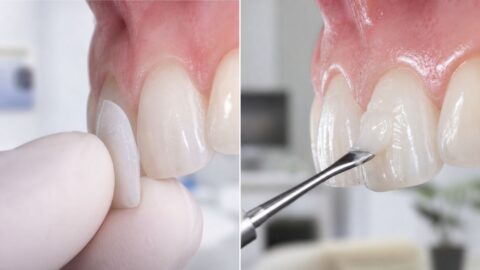
Porcelain veneers are thin, custom-made shells that cover the front surface of the teeth. They're designed to change the appearance of color, shape, width, and overall symmetry. Veneers are often the better fit when someone wants a more complete cosmetic change across several visible teeth.
Because veneers are made from porcelain and custom fabricated, they can create a polished, uniform look that's difficult to match with simpler chairside techniques. They're commonly chosen when the goal is a smile makeover rather than a single-tooth repair.
What dental bonding is
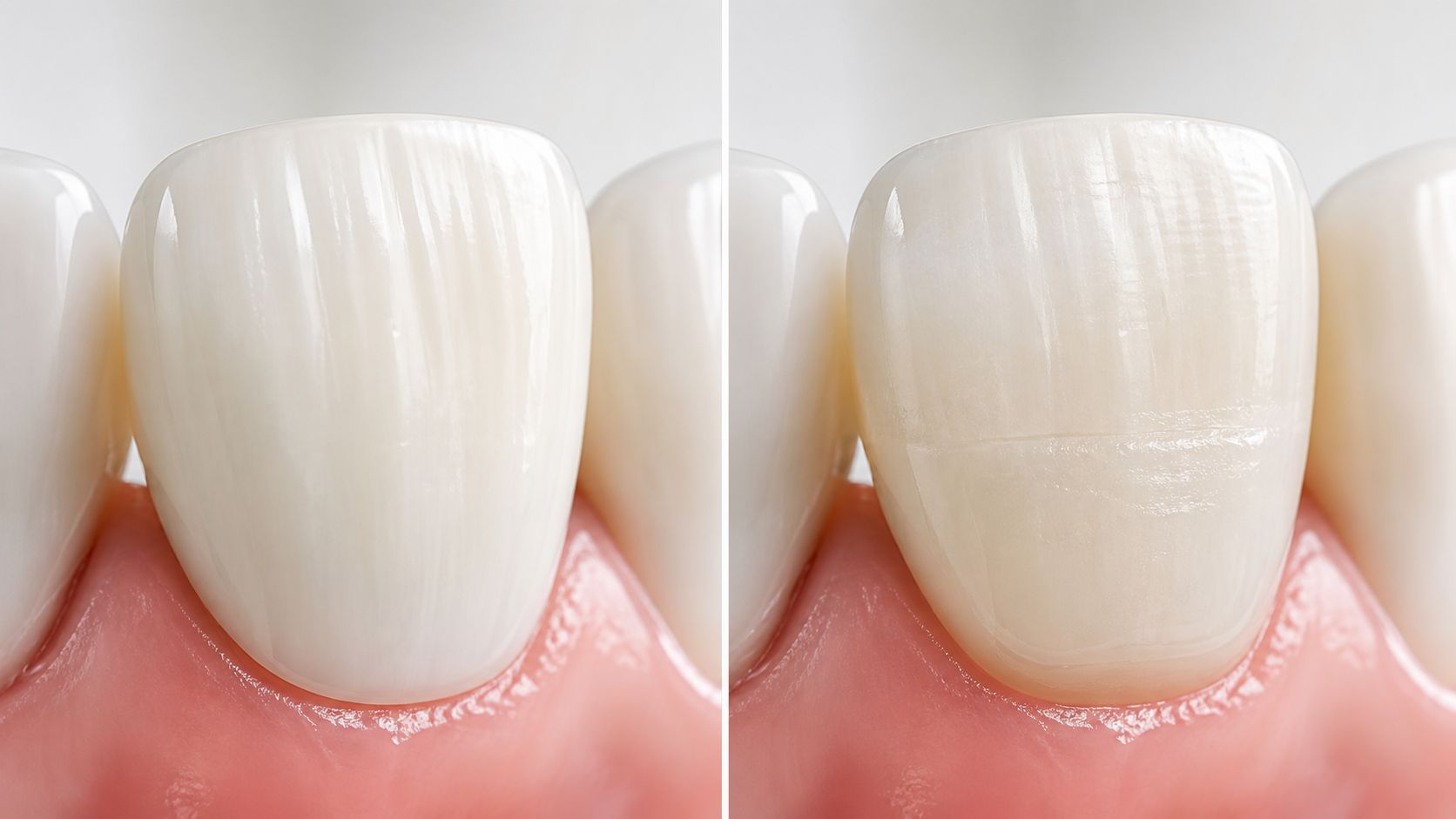
Dental bonding uses tooth-colored composite resin that's applied directly to the tooth, shaped by the dentist, and hardened in the office. It's a more conservative option for smaller cosmetic corrections and is often completed in one visit.
If you want to learn more about how this works in practice, our page on dental bonding treatment in Las Vegas gives a closer look at the service itself.
Bonding is often well suited for:
- Small chips: A corner of a front tooth that broke or wore down
- Minor gaps: Small spaces that don't require orthodontic movement
- Localized discoloration: A spot or area that stands out from nearby teeth
- Small shape changes: Slight length or contour adjustments
What each option does well
Veneers do best when the cosmetic issues are broader and more visible across the smile. Bonding does best when the concern is smaller and more localized.
Veneers usually make the most sense when you want to redesign a smile. Bonding usually makes the most sense when you want to repair or refine it.
That difference matters. If a patient has one chipped tooth, bonding may be exactly right. If a patient wants to brighten, reshape, and improve symmetry across several front teeth, bonding can start to feel like the wrong tool for the job. In those cases, veneers often produce a more cohesive result.
A Detailed Cost Comparison of Veneers vs Bonding
A patient might sit in my chair wanting to improve one chipped front tooth today, then realize they may want to refresh several visible teeth over the next few years. That is where cost needs to be viewed in context. The first number matters, but so does the amount you are likely to spend keeping that result looking good.
Here is the side-by-side comparison patients usually ask for first.
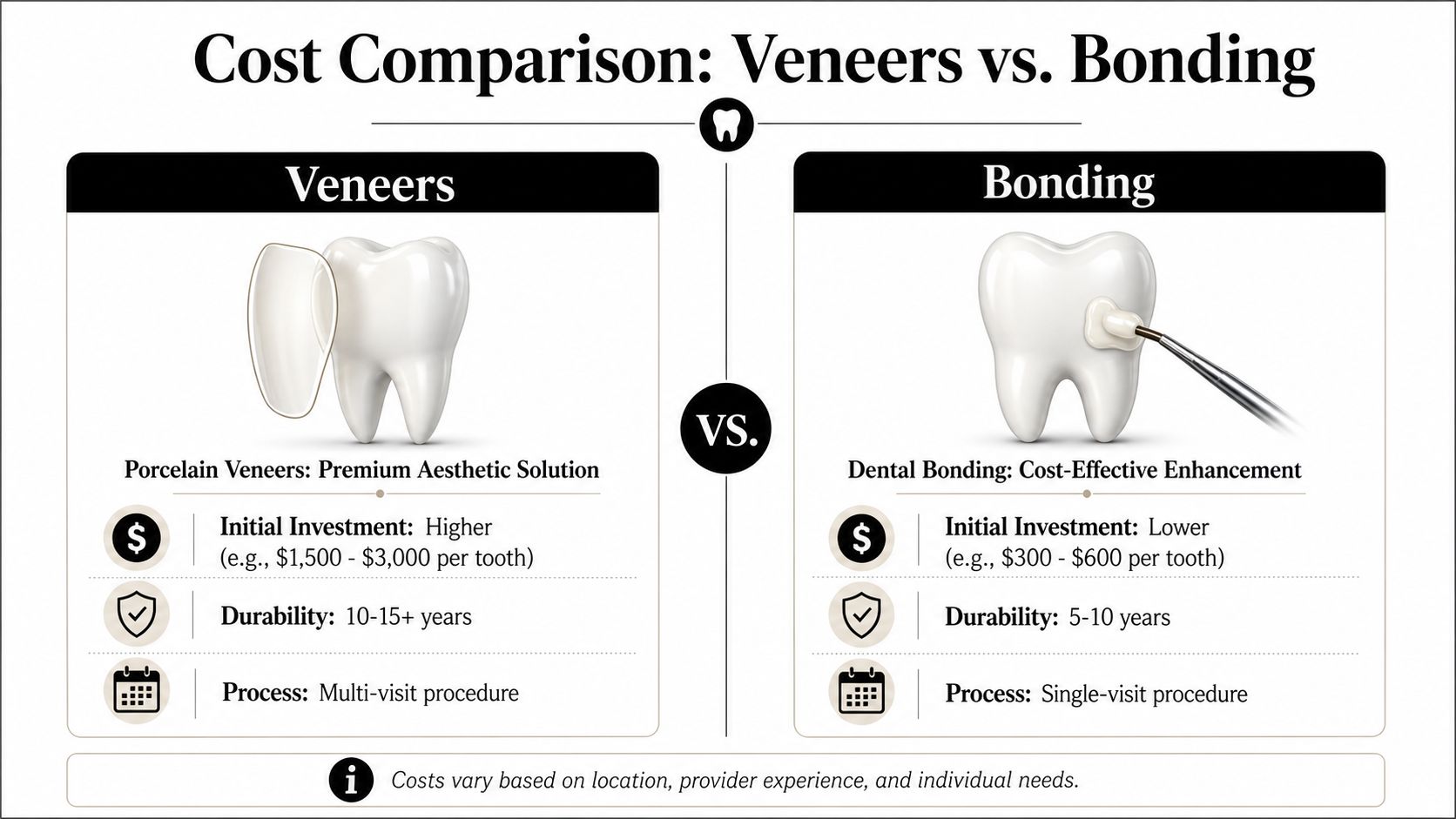
| Treatment | Typical Las Vegas cost per tooth | Best known cost advantage |
|---|---|---|
| Composite bonding | $350 to $700 per tooth | Lower starting cost |
| Porcelain veneers | $1,200 to $2,500 per tooth | Longer-term cosmetic investment |
For a small repair, bonding usually wins on day one. If the goal is a broader smile upgrade across multiple front teeth, the upfront gap starts to mean less than patients expect once they factor in maintenance, touch-ups, and replacement over time.
Why veneers cost more upfront
Veneers cost more because they involve more steps, more precision, and a different material.
Porcelain veneers are custom-made restorations. They require planning, tooth preparation in many cases, impressions or scans, lab fabrication, and careful placement. You are paying for a bespoke restoration designed to change color, shape, and symmetry in a more controlled way.
Bonding is done directly on the tooth with composite resin in the office. That makes it a more affordable option for smaller corrections because there is no custom porcelain lab work and treatment is often completed in one visit.
If you want a closer look at what affects porcelain pricing locally, our page on veneer pricing in Las Vegas explains the cost factors in more detail.
What actually changes your total cost
The final fee depends less on the label, veneers or bonding, and more on the treatment plan.
A few factors make the biggest difference:
- How many teeth are involved: Repairing one tooth is a different decision than treating six or eight teeth in the smile zone.
- How visible the issue is: Small edge chips and minor shape corrections are often handled efficiently with bonding.
- How stable you want the result to be: Patients who want a long-lasting smile design often place more value on durability and stain resistance.
- How often you are comfortable returning for maintenance: A lower initial fee can still lead to more spending over the life of the treatment.
This is the practical point I want Las Vegas patients to understand. Bonding often feels like the budget option because the starting cost is lower per tooth. Over a longer window, especially if several front teeth are involved, repeated repairs or replacement can narrow that gap enough that veneers become easier to justify financially.
For one tooth, bonding may be the smartest use of your money. For a smile you want to keep polished for many years, the better question is not just what costs less now. It is what you are likely to spend over the full life of the result.
Durability and Long-Term Financial Value
A patient will often ask me a simple question in the consult room: "Doctor, if bonding costs less now, why would I spend more on veneers?" The answer usually comes down to how long you want the result to hold up, how many teeth are involved, and whether you want to keep paying to refresh the same cosmetic work over the years.
The better way to measure cost
Upfront fee matters. Lifecycle cost matters just as much.
Porcelain veneers generally hold their appearance and structure much longer than composite bonding. Bonding is more prone to chipping, staining, edge wear, and touch-ups, especially on front teeth that do a lot of work when you bite, talk, and drink coffee or red wine. Veneers ask for a larger initial investment, but they usually ask for less maintenance along the way.
That difference becomes easier to see over a ten-year window.
If a patient bonds several front teeth now, then returns for repairs, polishing, stain correction, or replacement as the material ages, the total spending can approach veneer territory. In some cases, it can reach it. The lower starting price is real, but it does not always stay lower over time.
Cosmetic dentistry should be priced over the life of the result, not just the day it is placed.
Where bonding still makes financial sense
Bonding is still a very good option in the right case. I recommend it often for a small chip, a minor shape correction, or a patient who wants a conservative cosmetic change without committing to porcelain.
It can also make sense when flexibility matters. Composite is easier to adjust directly in the mouth, and for limited treatment, that can be the smartest use of money.
The trade-off is maintenance. Bonding usually needs more attention to keep looking polished, especially in the smile zone.
When veneers often give better long-term value
Veneers start to make more financial sense when the goal is a stable smile design over many years. That is especially true if you are treating multiple visible teeth and want consistent color, shape, and surface gloss that does not fade as quickly.
Here is how I explain it to Las Vegas patients:
- Bonding usually wins on initial cost
- Veneers usually win on lifespan and stain resistance
- As the number of treated front teeth goes up, repeat bonding maintenance becomes more expensive and less convenient
For one tooth, bonding may still be the right answer. For six or eight teeth in the smile line, the math often changes. At that point, I want patients comparing ten-year spending, not just the first invoice.
Value depends on what you are trying to avoid
Some patients want the lowest entry cost. Others want to avoid repeat appointments, recurring cosmetic repairs, and the frustration of seeing the result lose its polish sooner than expected.
Both goals are reasonable.
My job is to help you choose the option that fits your priorities. If you want an affordable fix for a modest issue, bonding may be the better choice. If you want a smile that stays stable and refined for the long haul, veneers often provide stronger long-term financial value even with the higher initial fee.
Comparing the Treatment Process and Timeline
Cost matters, but so does the experience of getting the work done. Veneers and bonding feel different from the patient's side of the chair.
What bonding usually feels like
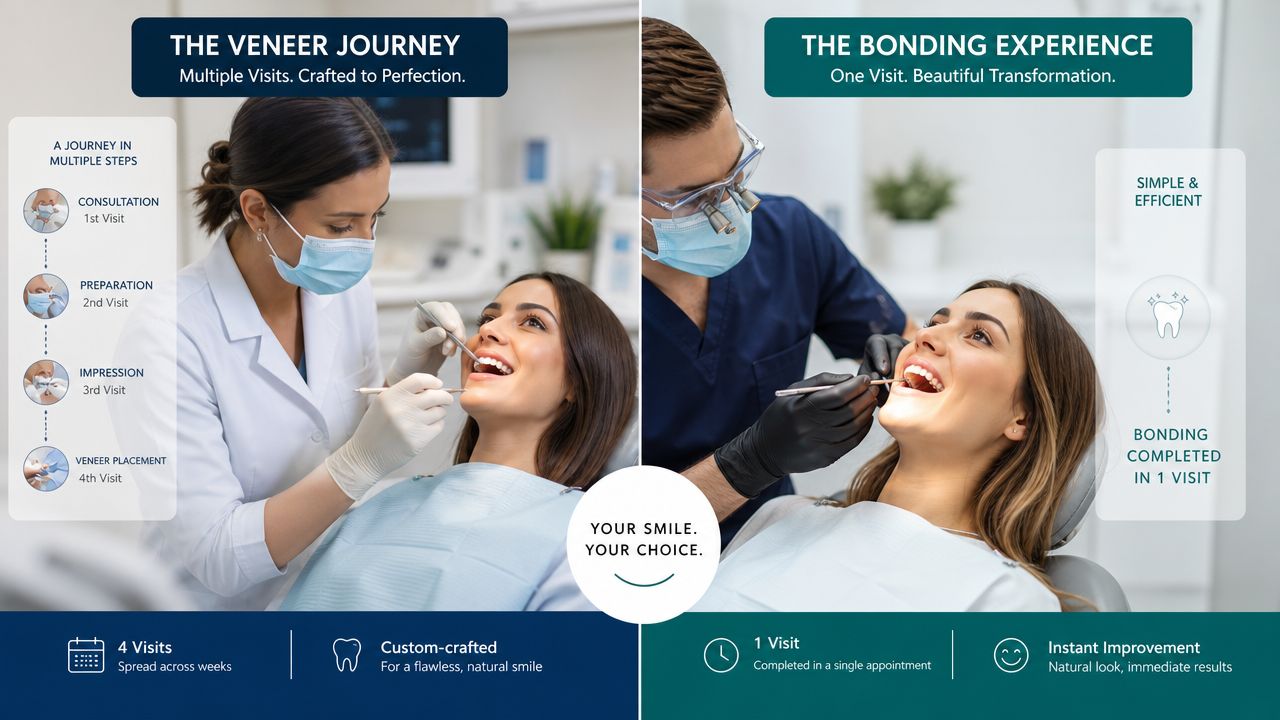
Bonding is generally the simpler process. The tooth is prepared conservatively, the composite resin is placed directly on the tooth, and the shape is refined in the same appointment. For the right case, it's efficient and straightforward.
Patients often choose bonding because it fits busy schedules. It's especially appealing when the issue is limited to one or two teeth and the goal is a visible improvement without a longer treatment sequence.
What veneer treatment involves
Veneers take more planning. The process usually starts with a consultation and design discussion. Teeth are prepared, impressions or scans are taken, and the final porcelain veneers are fabricated before the placement visit.
That longer process is part of why veneers cost more. It also explains why veneers are often used for cases where precision, uniformity, and a larger cosmetic redesign matter most.
Bonding is usually the faster path. Veneers are usually the more staged and customized path.
A helpful overview of the patient experience is below.
Choosing based on lifestyle and comfort
Some patients don't want multiple cosmetic appointments, and that's a valid reason to lean toward bonding. Others don't mind the added steps if the treatment better matches their long-term goals.
A few practical examples make the difference clearer:
- Fast cosmetic fix: A small chip before an event or photos often points toward bonding.
- Broader smile redesign: Multiple front teeth with shape and color concerns often point toward veneers.
- Conservative mindset: Patients who want the least involved option often feel more comfortable starting with bonding.
This part of the decision isn't only clinical. It's personal. Your comfort with treatment time, planning, and permanence should be part of the recommendation.
Who Is the Best Candidate for Each Smile Solution
A patient might sit in my chair wanting to fix one chipped front tooth before a wedding, while the next patient wants to change the color, shape, and symmetry of six upper teeth. Those are very different situations, and they should not get the same recommendation.
The best candidate for bonding is usually someone with a limited cosmetic problem and a reason to stay conservative. The best candidate for veneers is usually someone with broader smile goals who wants a result that holds up longer and looks more uniform from tooth to tooth.
Bonding tends to work best for small, targeted changes
Bonding is often the right place to start if the tooth is healthy and the issue is localized. I recommend it most often for a small chip, a minor gap, slight edge wear, or one tooth that needs a shape correction.
Bonding usually fits patients who want:
- A single-tooth repair: One chipped or worn front tooth can often be improved nicely without treating neighboring teeth
- A more conservative approach: Less tooth modification matters to patients who are not ready for a more permanent cosmetic change
- A lower initial fee: Bonding keeps the starting cost down, which can make sense for students, young adults, or anyone phasing treatment
- A short-term cosmetic improvement: Some patients want to improve a smile now and revisit a longer-term option later
There is a trade-off. Bonding generally needs more maintenance. It can stain, chip, or lose its polish sooner than porcelain, so the lower entry price does not always mean the lower total cost over time.
Veneers make more sense for bigger smile goals
Veneers are a better fit when the smile concerns are layered together. If teeth are discolored, slightly uneven, worn, misshapen, or inconsistent across the front, veneers let me correct those issues in a coordinated way rather than patching each one separately.
I usually recommend veneers for patients who want:
- A multi-tooth cosmetic redesign: Several front teeth can be matched for color, proportion, and shape
- Better long-term value: The upfront fee is higher, but the lifespan is usually longer
- More stain resistance: Porcelain tends to hold its appearance better than composite resin
- A polished, uniform result: Veneers are often the better choice when the goal is a more dramatic change
Lifecycle cost comes into play. A patient may pay less for bonding today, then pay again for repairs or replacement over the next several years. If multiple front teeth are being treated, that repeat cost can narrow the gap with veneers over a decade. In some cases, it can come surprisingly close.
How I guide the decision in real life
In Las Vegas, I see both ends of the spectrum. A younger patient in Lone Mountain with one chipped incisor after sports is often a good bonding candidate. A professional in Desert Shores who is unhappy with the shade, shape, and alignment of several visible teeth is often better served with veneers because the result is more cohesive and usually holds its appearance longer.
I do not push veneers just because they cost more. I also do not recommend bonding if I think the patient will end up paying for the same cosmetic fix again and again.
The right choice comes down to three questions. How many teeth are involved? How long do you want the result to last? Are you trying to solve one small problem, or are you trying to change the overall smile?
Those answers usually point clearly in one direction.
Your Cosmetic Dentistry Journey at Aspiring Smiles
When you come in for cosmetic dental care, the first goal is clarity. Patients often arrive after searching for a dentist near me, a cosmetic dentist near me, or even an emergency dentist because they're worried a damaged tooth has become both a cosmetic and functional problem. The first visit should make the situation feel simpler, not more complicated.
What happens at the first visit
A cosmetic consultation starts with listening. Dr. Patel spends time understanding what you want to change, what bothers you most, and what kind of result you're hoping to achieve. That conversation matters because two patients with the same tooth may want very different outcomes.
Then comes the clinical side. Your smile, bite, gum health, and tooth condition are evaluated carefully. If needed, that may include new patient exams, dental x-rays, or a closer review of any underlying dental care needs. Cosmetic treatment works best when the mouth is healthy first.
How the treatment plan comes together
Once Dr. Patel understands both the cosmetic goal and the dental condition, the next step is a personalized plan. That may involve bonding, veneers, teeth whitening, or restorative care depending on what your smile needs.
Patients also appreciate knowing what to expect beyond the dentistry itself:
- Clear explanation: You'll review which option fits your goals and why
- Practical scheduling: The team helps you understand the time commitment for care
- Financial discussion: Payment options and insurance questions are addressed directly
- Whole-mouth view: If you also need crowns, implants, or other restorative dentistry, those needs are factored into the plan
Good cosmetic planning starts by listening, then moves to treatment. It shouldn't happen in the opposite order.
Why this matters for long-term results
The best cosmetic outcome isn't just the prettiest option on paper. It's the one that fits your bite, habits, budget, and goals. A patient who clenches, has uneven wear, or needs other care may need a more strategic plan than a simple price comparison suggests.
That's why a thoughtful exam matters whether you came in asking about veneers, bonding, dental implants near me, or routine cleaning and exams. Good dentistry connects the cosmetic result to the health of the whole mouth.
Frequently Asked Questions About Veneers and Bonding
A question I hear often in Las Vegas is simple: “Am I saving money with bonding, or just delaying a bigger expense?” That is the right question to ask. The better comparison is not only the day-one fee. It is what you are likely to spend to keep the smile looking good over the next decade.
Do veneers or bonding stain over time
Yes, and the difference matters.
Bonding is made from composite resin, which tends to pick up stains more easily from coffee, tea, red wine, and smoking. Porcelain veneers are much more color-stable, so they usually keep their appearance longer. If a patient wants a brighter smile with less ongoing maintenance, veneers often hold that result better.
Is bonding or veneer treatment painful
Both are usually very manageable.
Bonding is the more conservative option and often requires little to no numbing. Veneers usually involve some enamel shaping, so the process is more involved, but treatment should still feel controlled and comfortable. In my office, the goal is straightforward: make sure patients know what to expect and stay comfortable throughout the visit.
Can I fix just one tooth
Often, yes.
Bonding works very well for a single chipped tooth, a small gap, or a minor shape correction. A veneer can also be placed on one tooth, but matching the color, translucency, and shape to the surrounding teeth takes careful planning. For small isolated issues, bonding is often the simpler and more budget-friendly choice.
Which option is actually more affordable over time
Patients can make the wrong call if they only compare the first quote.
Bonding usually costs less upfront, but it tends to need more maintenance, touch-ups, or replacement because it does not last as long and can stain or chip more easily. Veneers cost more at the start, but they often hold up longer and keep their appearance with fewer cosmetic repairs. Over a ten-year period, repeated bonding on the same front tooth or teeth can end up costing close to what veneers would have cost in the first place.
That does not mean veneers are automatically the better value. If the correction is small and the tooth is otherwise healthy, bonding may still be the smartest financial choice. If you want a longer-lasting cosmetic change across multiple visible teeth, lifecycle cost often favors veneers.
How do I know which one fits me best
It depends on the size of the change, the condition of the teeth, and how long you want the result to last.
Bonding is a good fit for smaller fixes, lower upfront cost, and patients who are comfortable with more maintenance over time. Veneers are usually better for bigger cosmetic changes, stronger stain resistance, and patients who want a longer-term result with a more predictable appearance.
The right answer is personal. A good recommendation should account for your smile goals, habits, budget, and how often you want to revisit the same tooth in the future.
If you're comparing veneers and bonding and want guidance you can trust, schedule a consultation with Aspiring Smiles Dental and Braces. Dr. Patel and the team provide patient-focused cosmetic, restorative, preventive, and emergency dental care for Las Vegas, NV, including Desert Shores, Sunhampton, Sun City Summerlin, Monterrey, Lone Mountain, Mar-A-Lago, and Painted Desert Estates. Whether you're looking for a cosmetic dentist near me, a dentist in Las Vegas, NV, dental implants near me, or help with a chipped tooth, you'll get clear recommendations built around your goals, timeline, and long-term oral health.