
Dental Payment Plans in Las Vegas NV Your Guide
A lot of people start looking for a dentist in Las Vegas, NV only when something is already wrong. A cracked tooth before work. A child who wakes up with pain. A missing tooth that finally makes you ask about dental implants near me. Then the second worry shows up fast. How am I going to pay for this?
That concern is normal. Many families across Las Vegas, including Desert Shores, Sun City Summerlin, Lone Mountain, and Painted Desert Estates, put off treatment because the cost feels uncertain. In my experience, most patients aren't only worried about the procedure itself. They're worried about surprise bills, confusing financing, and agreeing to care before they understand the numbers.
Dental payment plans exist to remove that stress, but only if they're explained clearly. The right plan can help you move forward with a new patient exam, a tooth extraction, cosmetic dentistry, restorative work, or emergency dental care without feeling financially trapped afterward.
Affordable Dental Care for Your Family in Las Vegas
A parent in Sunhampton notices their child is overdue for a cleaning and exams. A retiree in Sun City Summerlin has been told a crown can't wait much longer. Someone in Desert Shores searches for an emergency dentist after breaking a tooth during dinner. The dental problem is different in each case, but the hesitation is the same. They need care, yet they're trying to figure out whether treatment will create a bigger financial burden.
That's why payment conversations matter so much. Patients don't need vague promises about “flexible options.” They need a real explanation of what can be paid now, what can be divided into smaller payments, and which path makes the most sense for the kind of treatment they need.

Why cost anxiety keeps people from getting care
Patients seeking a dentist near me are often balancing more than oral health. They're juggling rent, groceries, school schedules, and work. A treatment recommendation can feel overwhelming if nobody slows down and explains the financial side in plain language.
Common situations include:
- Unexpected urgent care: A toothache or swelling can turn into a same-day need for an exam, dental x-rays, or tooth extraction.
- Bigger restorative work: Crowns, implants, and other restorative dentistry services often raise questions about paying over time.
- Cosmetic goals put on hold: Patients interested in teeth whitening, veneers, or a cosmetic dentist near me search often assume these services are out of reach before they ask.
Good payment guidance should lower stress, not add to it.
Patients also pay attention to how a practice communicates. Offices that explain treatment clearly, present options transparently, and make next steps easy tend to earn more trust. If you're interested in how clear communication shapes the patient experience, these actionable dental marketing tips offer a useful outside perspective on what patients respond to when choosing care.
Navigating Your Payment Options at Aspiring Smiles
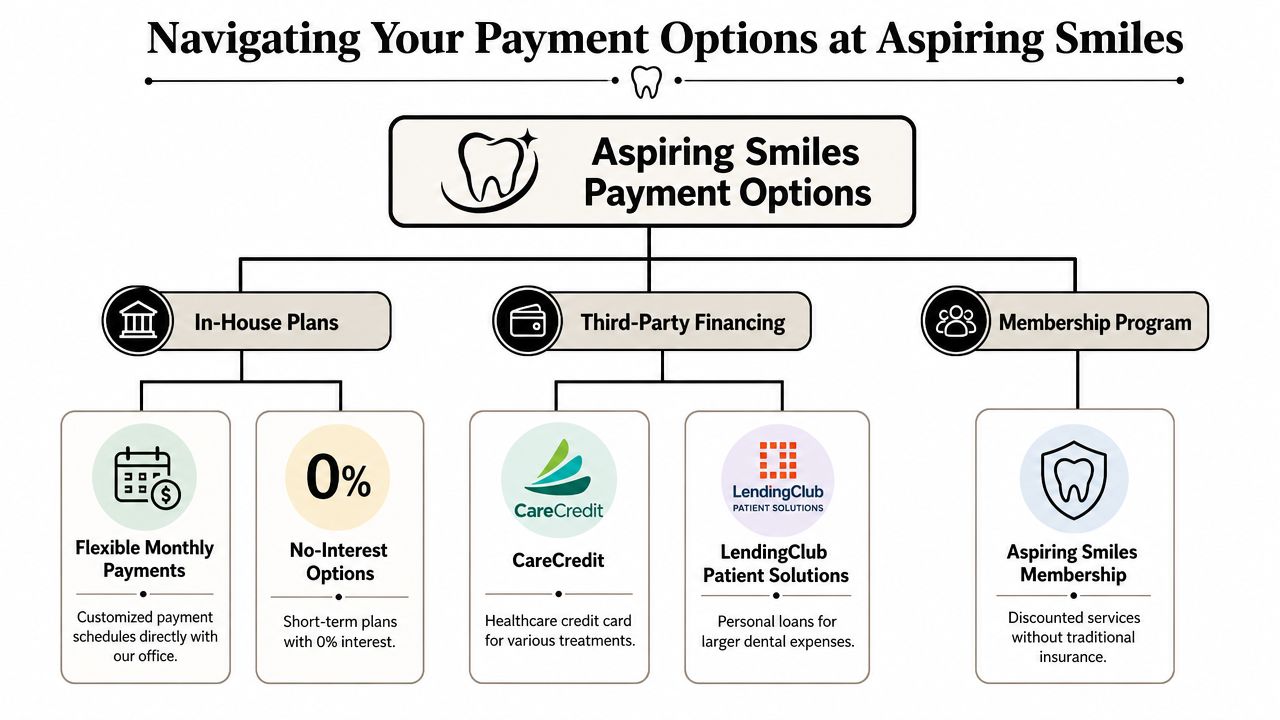
Most dental payment plans fall into three practical paths. One keeps payments directly with the office. One uses outside financing. One works more like a membership model for ongoing care. Knowing the difference helps you match the option to your treatment instead of guessing.
In-house plans for shorter-term needs
An in-house payment plan is handled directly through the dental office. This is often the simplest route for patients who need to spread out a bill for a shorter period and want a more straightforward process.
These plans are often a practical fit for:
- Moderate treatment needs: A crown, deep cleaning, or other restorative care that doesn't require a long repayment window.
- Patients who value simplicity: Fewer outside steps can make the process feel easier to manage.
- People who want direct communication: Questions about payments are handled with the office team instead of a lender.
Third-party financing for larger treatment plans
A third-party financing plan usually works better when treatment is more extensive and the monthly payment needs to stay lower. This is common for larger restorative or cosmetic cases, including implant dentistry, Invisalign, or more complex treatment completed over multiple visits.
Outside financing can be useful when a patient needs:
- A longer repayment term.
- A structured application process.
- A way to begin treatment sooner instead of waiting to save the full amount.
For patients comparing office communication styles and billing approaches, these customer payment strategies are helpful background reading because they show how payment clarity affects trust.
Membership programs for patients without traditional insurance
A membership program isn't the same thing as financing. Instead of borrowing for a large treatment, patients pay for access to routine care and reduced fees on additional services. That can be especially useful for households without dental insurance or for patients who want more predictable preventive care costs.
If you want a direct overview of available options, the practice's dental payment plan information gives a starting point for comparing what may fit your situation.
Practical rule: The best option is the one that fits both the treatment type and the way you actually budget month to month.
In-House Plans vs Third-Party Financing A Clear Comparison
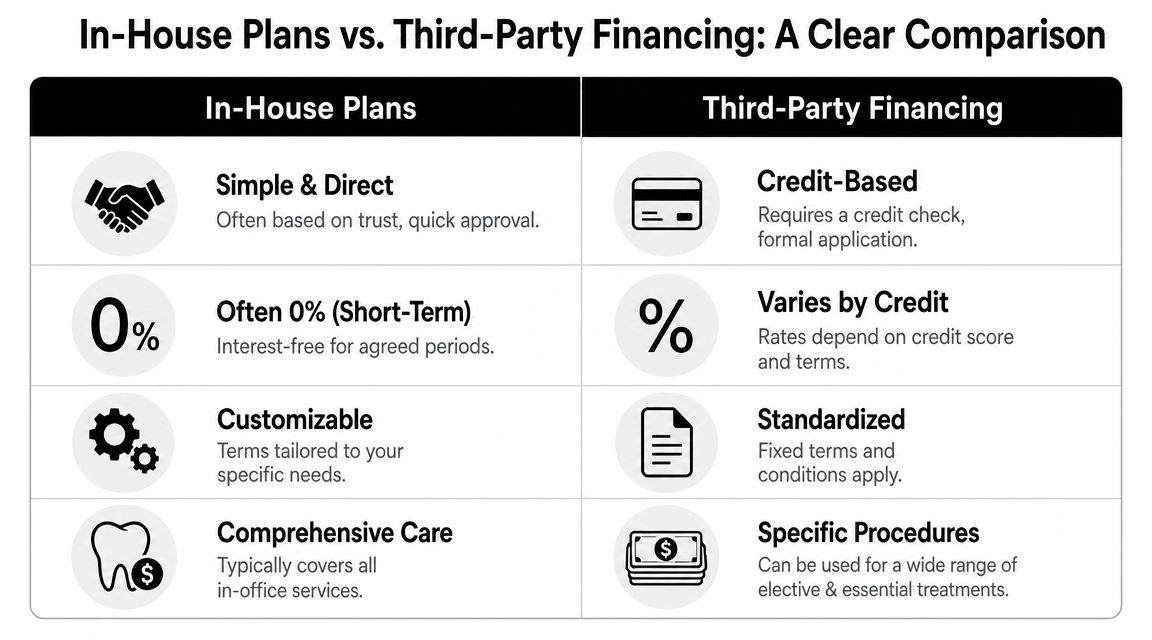
The biggest mistake patients make is assuming all dental payment plans work the same way. They don't. The monthly number may look manageable in both cases, but the structure behind that payment can be very different.
A visual comparison helps:
The practical difference in repayment length
One of the clearest differences is timing. Third-party dental financing often extends repayment to 12 to 84 months, while in-house plans are usually shorter at about 3 to 6 months, which creates a real tradeoff between a lower monthly payment and greater long-term financing risk, according to this dental payment plan guidance.
That matters because a shorter in-house term may be easier to understand and resolve quickly, while a longer outside term may make a larger procedure feel affordable enough to begin.
Side-by-side comparison
| Comparison point | In-house plans | Third-party financing |
|---|---|---|
| Best fit | Shorter-term treatment costs | Larger treatment plans |
| Payment timeline | Usually shorter | Often much longer |
| Monthly payment | Often higher because payoff is quicker | Often lower because repayment is stretched out |
| Application style | Direct through the office | Formal lender process |
| Main caution | Shorter term may strain monthly budget | Longer term may increase total cost risk |
For many patients, the choice comes down to treatment type.
- In-house plans often fit a crown, smaller restorative case, or treatment that can reasonably be paid off over a shorter stretch.
- Third-party financing often fits implants, Invisalign, emergency treatment, or multi-step care where preserving monthly cash flow matters more.
Here's a helpful overview before going further:
What patients need to ask before signing
Longer repayment can be useful, but it isn't automatically cheaper. The same guidance notes that long terms improve affordability for larger procedures such as crowns, implants, or emergency care, but patients need to verify whether the offer is interest-free or whether interest can accrue across the term. It also warns that some “no-interest” offers can become expensive if the balance isn't paid before the promotional period ends.
That's why these questions matter:
- Is this interest-free: Ask whether the plan stays interest-free for the full agreed term or only during a promotional period.
- What happens if there's a remaining balance: Deferred interest can change the cost quickly if the payoff timing slips.
- Is the lower monthly payment worth the longer obligation: A smaller monthly bill can feel easier now while costing more over time.
A low monthly payment can solve a short-term budget problem. It can also create a long-term cost problem if the details aren't clear.
Patients looking for dental implants near me, cosmetic work, or treatment after a dental emergency should pay special attention here. The more expensive the procedure, the more important it is to compare total repayment terms, not just the amount due each month.
The Aspiring Smiles Membership An Alternative to Insurance
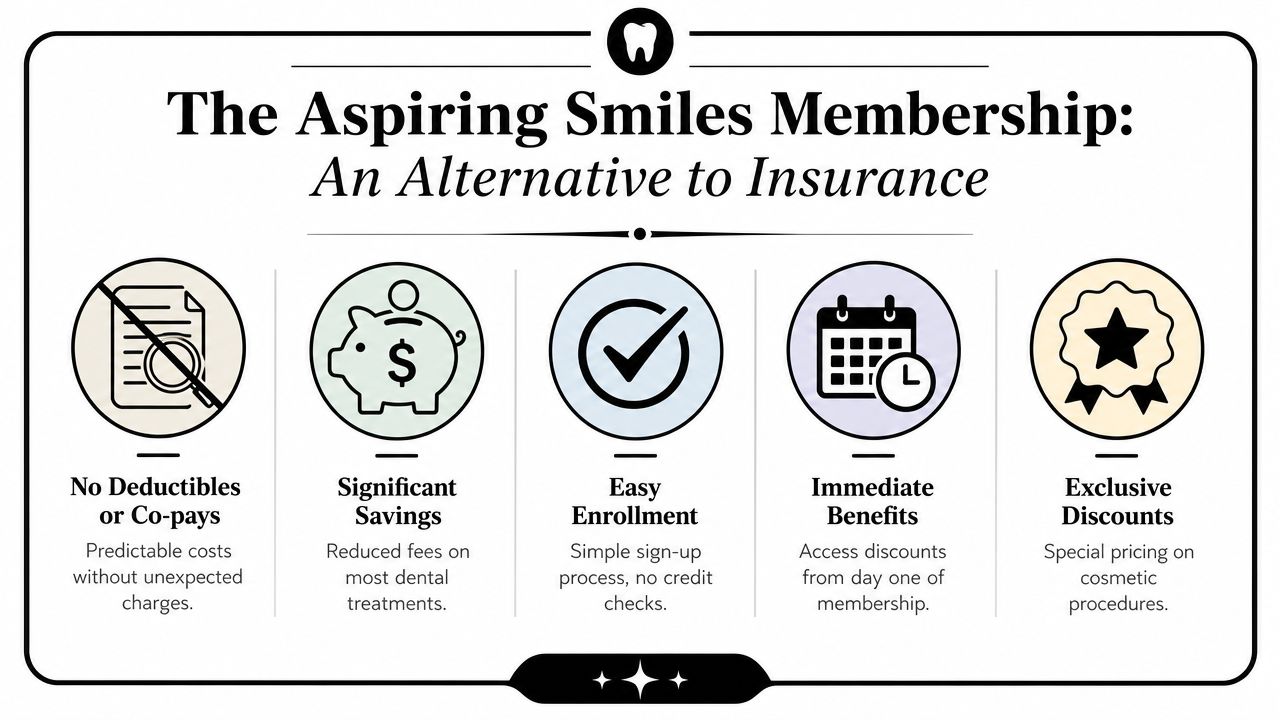
For patients without dental insurance, financing isn't always the first or best answer. If the main goal is staying current on preventive care and lowering the cost of future treatment, a membership model can be easier to live with than applying for credit every time something comes up.
That's where a dental membership can make practical sense. Instead of waiting until there's pain, patients can plan for regular cleanings, exams, and dental x-rays while also getting access to reduced fees on additional treatment.
Why some patients prefer membership over traditional insurance
Traditional dental coverage can feel complicated. Patients often ask about waiting periods, annual limits, and whether a service is covered the way they expected. A membership program is appealing because it tends to be more direct.
The strongest reasons patients choose it usually include:
- Predictable routine care: Preventive visits are easier to budget for when the structure is straightforward.
- Less paperwork frustration: Many patients want a simpler path than dealing with outside benefit restrictions.
- Discounts on additional treatment: That matters when a patient later needs restorative dentistry, cosmetic dentistry, or emergency follow-up care.
Where membership fits best
Membership works especially well for people who want to stay on top of oral health instead of reacting only when something hurts. That includes families scheduling cleanings and exams, adults planning cosmetic improvements, and patients who know they may need future restorative work.
It can be a strong fit for:
- People without employer dental benefits.
- Self-employed patients who want predictable care costs.
- Families in Las Vegas who want ongoing access to care without the complexity of traditional insurance.
- Patients who've delayed routine visits and want a manageable way to return.
The practice offers a membership program for patients who want that kind of alternative.
Membership isn't designed to replace every financing need. It works best when you want simpler access to preventive care and more predictable pricing on additional treatment.
A useful option for uninsured households
Patients in Painted Desert Estates, Monterrey, and Mar-A-Lago often ask whether payment help always requires a credit application. The answer is no. A membership plan can serve a different purpose. It supports routine care and can reduce the cost of treatment that comes later, without turning every dental need into a borrowing decision.
That makes it different from a standard financing plan. Financing helps you spread out a bill. Membership helps you reduce friction around getting regular care in the first place.
How to Choose the Right Plan for Your Dental Needs
Choosing among dental payment plans gets easier when you stop asking only one question. A common question is, “What's the monthly payment?” That's understandable, but it's incomplete. A better question is, “What will this treatment cost me overall, and can I manage it comfortably?”
That distinction matters because many discussions about dental financing focus on monthly affordability without explaining total cost, even though financing may involve interest, down payments, fixed fees, or promotional terms that can leave patients paying more over time, as noted in this practice-management discussion of affordability and transparency.
Start with the total treatment picture
Before choosing a plan, ask for the full treatment estimate. That should include what needs to be done, what can wait, and whether there are phases that can be scheduled separately.
A useful checklist looks like this:
- Total cost first: Don't compare plans until you understand the full treatment amount.
- Monthly comfort second: Pick a payment amount that fits your real budget, not your most optimistic month.
- Timing matters: Emergency treatment, implants, and cosmetic work may call for different financing decisions.
Then look at access and qualification
Not every patient qualifies for every type of financing. Some plans are easier to access than others, and approval criteria can differ.
From a practical perspective:
| If your priority is | The option to ask about |
|---|---|
| Simple short-term payoff | In-house payment plan |
| Lower monthly amount for larger care | Third-party financing |
| Routine care without traditional insurance | Membership program |
Another issue that often gets overlooked is qualification itself. Existing payment-plan content often sounds broad, but the fine print matters. Some in-house plans may require a down payment, some third-party plans involve credit checks or other eligibility standards, and lower-cost community or sliding-fee models may sit outside standard financing altogether. Patients with weaker credit or no credit history shouldn't assume “payment plan available” means universal approval.
Questions worth asking in the consultation
Bring these questions with you and write down the answers:
- What is the full expected cost of treatment
- What am I paying in total under this option
- Is there interest, a fixed fee, or a promotional condition
- Do I need a credit check
- Is there a down payment
- Would paying another way change the total cost
If you only compare monthly payments, you may choose the most comfortable bill and the least comfortable total cost.
This is especially important for patients in Lone Mountain or Mar-A-Lago considering cosmetic dentistry, implant work, or urgent treatment. The right choice depends on your credit profile, your timeline, and whether your main goal is the lowest monthly payment or the lowest overall financial burden.
Schedule Your Financial Consultation in Las Vegas Today
A good financial consultation should feel calm and specific. You should leave knowing what treatment is recommended, what can be prioritized, what your payment choices look like, and what questions still need answers. You shouldn't feel rushed into a decision because a form was placed in front of you.
At Aspiring Smiles Dental and Braces, that conversation is part of the care experience. Patients come in for a new patient exam, emergency visit, cosmetic consultation, or restorative evaluation, and the financial discussion follows the same principle as the clinical one. Clear information first. No guessing.
What the visit usually feels like
A patient may arrive thinking they need one thing and learn they have several options. Someone searching for a tooth extraction might also need to hear about replacement choices. Someone asking about dental implants near me may want to compare phased treatment against immediate full financing. A parent booking cleaning and exams for the family may want the simplest predictable option for ongoing care.
During the financial part of the visit, patients should expect:
- A written treatment outline: So the recommendation is easy to review.
- A discussion of timing: What needs attention now, and what may be planned later.
- An explanation of payment paths: Including what each option is good for and where caution is needed.
- Space for questions: Especially around monthly obligations, qualification, and total cost.
Why transparency matters
The American Dental Association advises practices to treat financing as consumer credit, not casual billing, and to pay attention to disclosure, affordability checks, staff training, and recordkeeping because poorly structured plans can create compliance problems while well-structured options can reduce upfront financial friction for patients, according to the ADA's guidance on patient financing options.
That matters to patients because it reinforces a simple standard. Financial arrangements should be explained carefully. Fees and interest terms should not be vague. Treatment should never feel like a financial trap.
If you're looking for a dentist near me in Las Vegas, NV for family dentistry, emergency care, cosmetic dentistry, dental implants, cleanings, exams, or dental x-rays, the most helpful next step is a consultation where both the clinical plan and the payment plan are discussed with the same level of care.
If you're ready to get answers without pressure, schedule a visit with Aspiring Smiles Dental and Braces. The office serves Las Vegas families with preventive, cosmetic, restorative, implant, and emergency dental care, along with clear payment guidance designed to help you move forward confidently.