
Cavity Filling Cost in Las Vegas: Prices & Options
A single filling in the U.S. may cost anywhere from $100 to $1,150 per tooth, and the average starting point is about $160. But that number often isn't the full story, because the final bill can also reflect the exam, dental X-rays, anesthesia, and how complex the repair is.
If you're reading this because a tooth feels sensitive when you drink something cold, or food keeps catching in one spot, the cost question is probably right behind the health question. That's normal. Most patients don't just want to know whether they need a filling. They want to know what the visit is going to cost, whether insurance will help, and whether they're walking into a surprise bill.
For families looking for a dentist in Las Vegas, NV, especially in neighborhoods like Desert Shores, Sunhampton, Sun City Summerlin, Monterrey, Lone Mountain, Mar-A-Lago, and Painted Desert Estates, the most useful answer is a transparent one. A cavity filling cost isn't one flat fee. It depends on the material, the tooth, the number of surfaces involved, and whether the appointment includes diagnostics or other treatment.
That's why a real estimate should look at the whole visit, not just the filling itself.
Your Trusted Dentist for Cavity Fillings in Las Vegas
A cavity rarely announces itself in a convenient way. It starts with a small twinge, a rough spot on a tooth, or a little sensitivity that you hope will go away. Then the practical questions show up fast. Is this serious? Can it wait? How much is this going to cost?
In practice, the biggest source of frustration for new patients isn't always the filling. It's uncertainty. They've looked up a national average, but they still don't know what applies to their own situation in Las Vegas. That's understandable, because online price guides usually focus on the restoration itself and skip over the details that shape the actual bill.
What patients usually need to know first
Individuals often want clear answers to four things:
- Whether it's really a cavity: Sensitivity can come from decay, but it can also come from a cracked tooth, worn enamel, or a loose old filling.
- Whether treatment is urgent: Small cavities are simpler to manage. Waiting usually makes the decision harder, not easier.
- Whether the tooth can be saved with a filling: Some teeth still need only a straightforward restoration. Others need more than that.
- What the total visit cost may include: Many estimates often fall short.
Practical rule: The sooner a dentist confirms what's happening, the easier it is to match treatment to both your oral health needs and your budget.
For patients searching dentist near me, emergency dentist, or even tooth extraction because they fear the worst, it helps to know this first. Not every painful tooth needs to come out. Many can be treated with conservative restorative dentistry if the decay is caught before it reaches deeper structures inside the tooth.
Why local clarity matters
In a busy city like Las Vegas, pricing conversations need to be simple and direct. New patient exams, dental care recommendations, and follow-up planning should feel understandable, not rushed. That matters whether you're scheduling routine care, dealing with a sudden ache, or comparing options like cosmetic dentist near me, dental implants near me, or basic restorative treatment.
A filling is one of the most common ways dentists stop decay, protect the remaining tooth, and relieve symptoms before they turn into a larger problem. But a trustworthy estimate has to account for what's happening in your mouth, not just a generic price pulled from a chart.
Why Cavity Filling Costs Vary So Much
The phrase cavity filling cost sounds simple, but it covers several different decisions. A small filling on an easy-to-reach tooth is different from a larger restoration on a back molar. A tooth-colored filling has different handling and appearance benefits than a metal one. Geography matters too, because office overhead, materials, and local practice patterns affect how care is delivered.
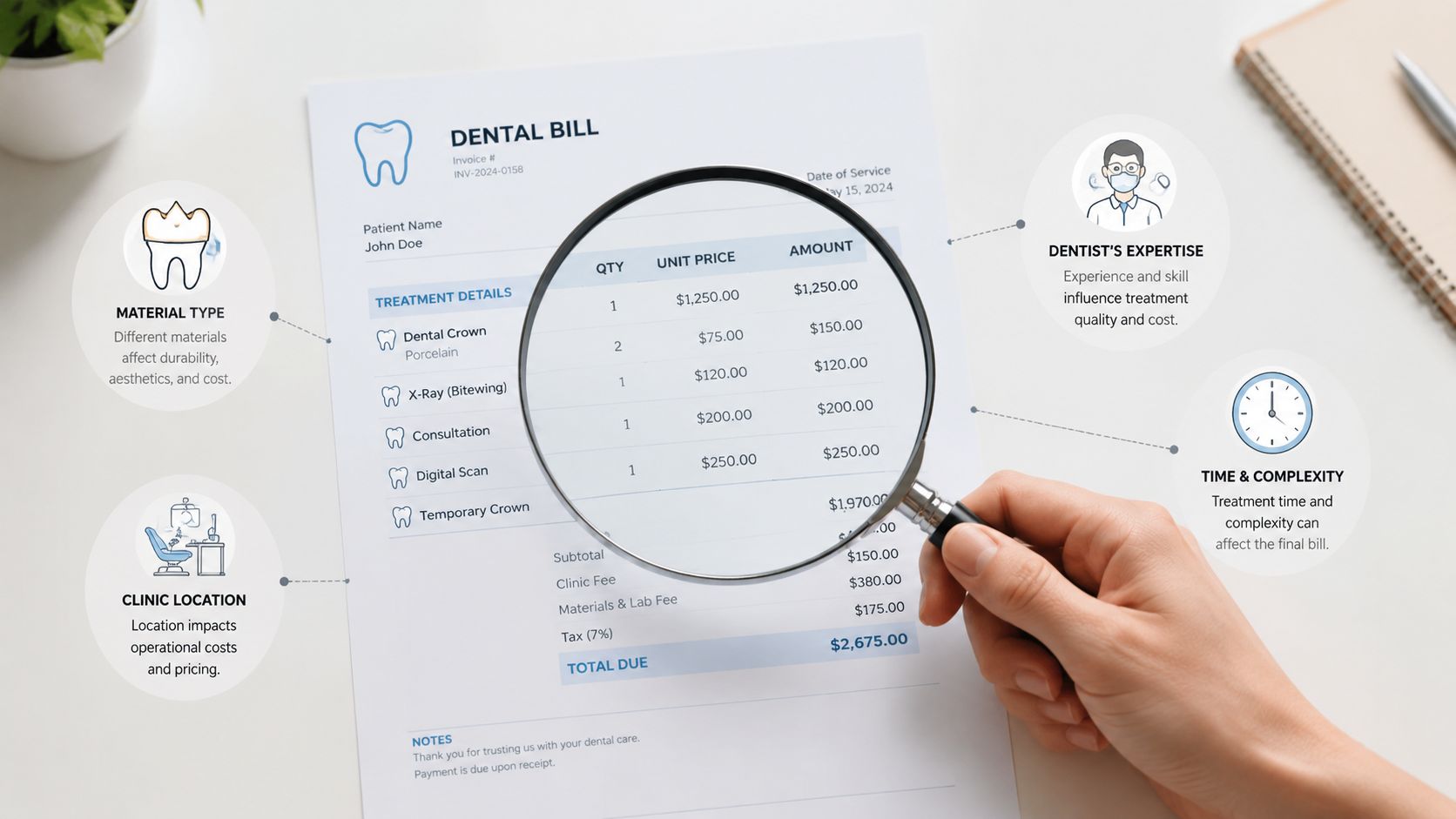
According to GoodRx's breakdown of cavity filling cost by material, the U.S. average starts at about $160, with a reported range of $100 to $1,150 per tooth. That spread is the first clue that there's no single universal price.
The main reasons one filling costs more than another
Three factors drive most of the variation:
| Factor | Why it changes the cost |
|---|---|
| Material used | Different materials have different lab, handling, and cosmetic considerations |
| Tooth location | Front teeth and back teeth present different aesthetic and access challenges |
| Size of the repair | A larger or multi-surface cavity takes more time and more material |
A patient in Las Vegas may hear “you need a filling” and assume that means one standard procedure. In reality, dentists are deciding how to remove decay, preserve healthy tooth structure, rebuild the tooth's shape, and make sure your bite still feels natural when you leave.
Why averages can mislead
An average can be useful as a starting point, but it doesn't tell you what applies to your tooth. It doesn't tell you whether the cavity is tiny or spread across multiple surfaces. It doesn't tell you if the tooth is visible when you smile, or whether the repair needs to hold up under heavy chewing.
A filling estimate becomes more accurate only after the dentist examines the tooth and determines both the extent of decay and the best material for that location.
That's especially important for anyone in Las Vegas looking for dental care, cleaning and exams, dental x-rays, or a new patient exam after putting off treatment. The cost question is valid, but the answer gets better once the diagnosis is clear.
Las Vegas patients should think in terms of value, not just price
The least expensive option upfront isn't always the best fit. A back molar may call for a durable material choice. A front tooth may put appearance at the top of the list. Patients who want the “cheapest filling” sometimes really mean something more specific. They want the most sensible treatment for their tooth, their smile, and their budget.
That's a much better question, and it's the one a good dentist should help answer.
Cost Breakdown by Dental Filling Material
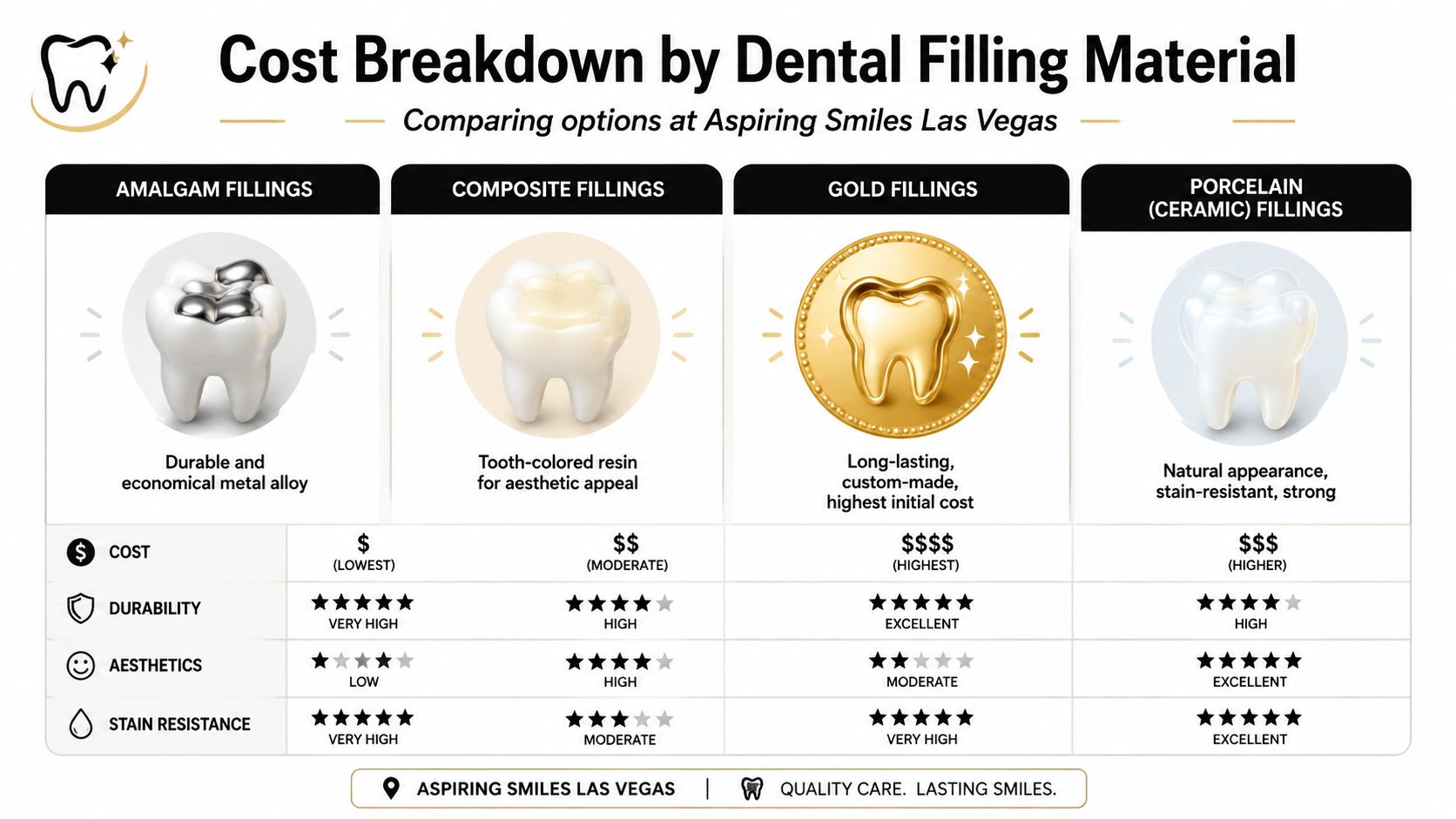
Material choice is one of the clearest reasons cavity filling costs differ. Some materials are more economical. Some are more natural-looking. Some are chosen because they handle chewing forces well, while others are selected because appearance matters most.
National cost benchmarks by material
GoodRx's national filling cost guide reports these average figures:
| Filling material | Reported average |
|---|---|
| Amalgam | About $160 |
| Composite resin | Around $191 |
| Gold | About $400 |
| Porcelain | Around $1,150 |
Those numbers are useful benchmarks, but they still don't replace a personalized estimate. Material choice should always follow the tooth's needs and the patient's goals.
Amalgam and composite
Amalgam is the traditional silver-colored filling material. It's often chosen when function and economy matter more than appearance. For some back teeth, that can make practical sense. The trade-off is obvious. It doesn't blend in with natural enamel.
Composite resin is tooth-colored, so it's a common choice when the filling may show when you speak or smile. Many patients prefer it for cosmetic reasons, and it can work beautifully in many situations. The trade-off is that appearance-focused materials often come with a higher fee than basic metal options.
If you want a simple overview of how dentists choose materials, this cavity filling material guide gives a helpful starting point.
Gold and porcelain
Gold is a less common choice today, but it still has a place in restorative dentistry. Patients who choose it are usually prioritizing long-term function and don't mind that it's visible. It tends to be discussed less for routine small fillings and more when a patient values strength and longevity over aesthetics.
Porcelain, sometimes discussed as a ceramic restoration, is usually the most appearance-driven option among the materials listed here. It offers a natural look and can resist staining well. It also sits at the high end of the reported national averages, so it's rarely selected on price alone.
The right filling material isn't the one with the lowest sticker price. It's the one that fits the tooth, the bite, the smile, and the patient's priorities.
What usually works best
There isn't one material that wins every time. In everyday family dentistry, the best option often depends on where the tooth sits and how the patient uses it.
- For visible teeth: Composite is often attractive because it blends with the smile.
- For budget-focused decisions: Amalgam may still be the practical choice in selected cases.
- For patients prioritizing premium restorations: Gold or porcelain may come up when a dentist is balancing appearance, durability, and case design.
- For larger treatment planning discussions: The filling choice should also fit with any nearby crowns, cosmetic dentistry, or future restorative work.
Patients who are also considering teeth whitening, veneers, crowns, or other cosmetic dentistry often benefit from discussing shade and appearance before a visible filling is placed. On the restorative side, patients planning more extensive care, such as crowns or dental implants near me, should think about how each treatment fits into the long-term plan for the whole mouth.
Other Factors That Affect Your Final Bill
The filling itself is only part of what you may pay for. This is the piece many cost guides miss, and it's the reason two patients with “one cavity” can receive very different estimates.
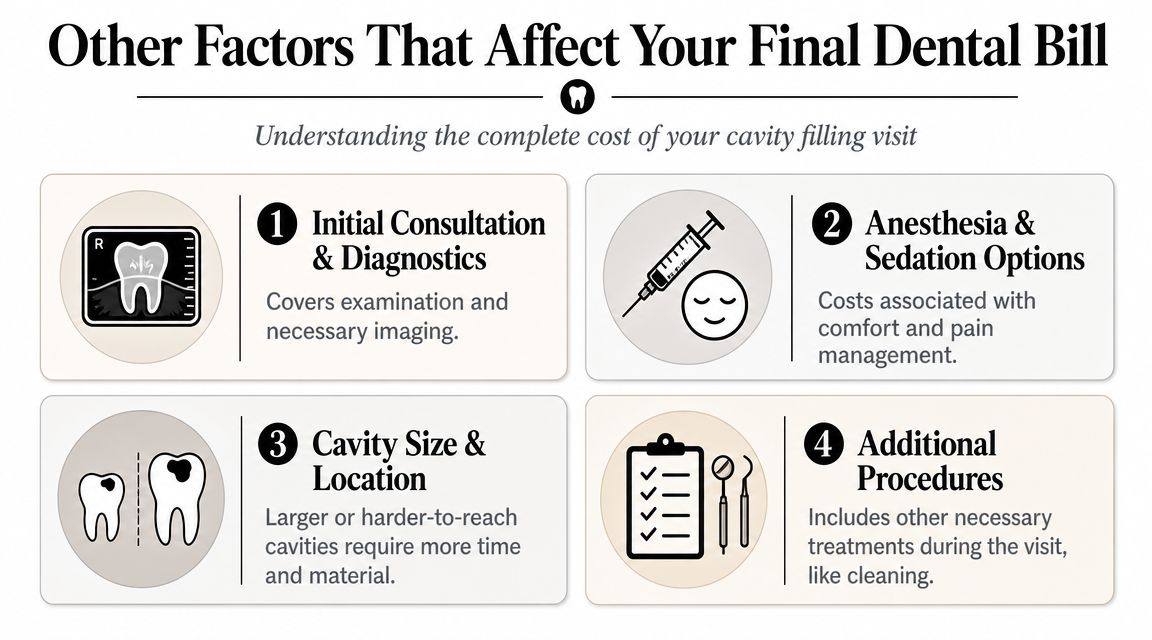
A dental cost guide focused on total visit charges notes that the final bill can include an exam, X-rays, anesthesia, and charges that scale with the number of tooth surfaces treated. That's one of the most important things a new patient in Las Vegas should understand.
The visit may start before the filling starts
If the cavity is discovered during a new patient appointment, the dentist may need to confirm the diagnosis before treatment begins. That can involve a clinical exam and dental X-rays to see how deep the decay goes and whether the tooth can still be treated with a simple filling.
This is especially common for patients who haven't had recent cleaning and exams or who come in because of pain rather than a routine checkup. The concern may be “I need a filling,” but the first job is making sure it's a filling case and not a cracked tooth, a failing old restoration, or decay that has gone deeper.
Surface count changes the procedure
Dentists often describe fillings by how much of the tooth needs repair. A cavity affecting one part of the tooth is simpler than one extending across several surfaces. More involved repairs typically take more shaping, more time, and more material.
That's why a patient can hear “you need one filling” but still receive a different estimate than a friend who also had “one filling.” The number of teeth matters, but so does the extent of damage on each tooth.
If you want a no-surprises estimate, ask whether the quote includes diagnostics, how many tooth surfaces are involved, and whether anything else may be recommended the same day.
Comfort options and additional care
Local anesthesia is often part of straightforward restorative treatment, but not every patient has the same comfort needs. Patients with strong dental anxiety may ask about extra comfort measures. If a visit includes sedation-related services or other add-ons for comfort, that can affect the final fee.
There's also an important clinical boundary here. Sometimes a tooth looks like it needs a filling, but examination shows that decay has progressed too far. In that situation, a dentist may recommend a different procedure instead of placing a filling that won't last. That's not upselling. It's trying to avoid a short-term fix on a tooth that needs more support.
Questions worth asking before treatment
A clear estimate should answer practical questions like these:
- Does this include the exam: If you're a new patient, diagnostics may be separate from the filling itself.
- Will I need dental X-rays: They're often necessary to confirm the extent of decay.
- How many surfaces are being restored: This affects the complexity of the procedure.
- Is this definitely a filling case: If decay is deeper than expected, treatment may change.
For patients in Lone Mountain, Desert Shores, or Sun City Summerlin looking for a dentist near me or emergency dentist, this is often where trust is built. Not by quoting the lowest possible number, but by being honest about what the visit includes.
Using Insurance and Managing Out-of-Pocket Payments
Insurance can help, but it doesn't remove the need to understand your own share of the cost. That's why patients are often surprised even when they have dental coverage. According to ValuePenguin's dental spending report, out-of-pocket payments accounted for 38.9% of dental spending.
The insurance terms that matter most
Here are the terms that usually shape what you'll pay:
- Deductible: This is the amount you pay first before certain plan benefits begin.
- Co-pay or coinsurance: This is the portion of the fee that remains your responsibility after your plan processes the claim.
- Annual maximum: This is the limit your plan may pay during the benefit period.
A filling is commonly treated as restorative care, but the exact benefit depends on your plan, the material used, and whether your dentist is in network with your carrier. That's why front-desk verification matters. A benefits check won't change your coverage, but it can reduce surprises.
What patients should do before the appointment
If you're using dental insurance in Las Vegas, keep the process simple:
- Bring current insurance information: Old cards and outdated employer plans create billing confusion.
- Ask for a pre-treatment estimate if needed: This can help when more than one filling or a more involved restoration is possible.
- Confirm material coverage: Some plans handle tooth-colored restorations differently depending on the tooth.
- Review your remaining benefits: This matters if you've already used coverage for exams, cleanings, crowns, or other treatment.
Insurance is a tool, not a price list. The only meaningful number is what your specific plan will pay for your specific procedure.
Why out-of-pocket planning still matters
Even insured patients often pay part of the visit themselves. That's why a good office conversation should include both the insurance estimate and the likely patient portion. Families comparing routine dental care, restorative work, and future needs like dental implants, crowns, or tooth extraction should think about timing and sequencing, not just individual procedures.
If you don't have insurance, you still have options. Many practices offer financing, phased treatment planning, or membership-style savings programs that make care more manageable than a one-time payment.
Affordable Care Options at Aspiring Smiles Las Vegas
For many patients, the biggest relief comes from hearing that treatment can be planned in a flexible way. You don't need to guess your way through the cost of a filling visit. You need clear numbers, realistic options, and a team that explains what matters now versus what can be scheduled later.

Patients in Las Vegas who don't have traditional dental coverage often do well with a membership-based approach. A practice-level plan can make routine care more predictable and reduce the stress of paying full fee at every visit. If you're looking into lower-cost options, the office's affordable dental care program in Las Vegas is worth reviewing.
What helps patients the most
The most useful affordability tools are usually straightforward:
- Membership savings plans: These can help patients budget for preventive care and reduce the cost of restorative services.
- Flexible payment options: Breaking treatment into manageable payments can make it easier to move forward sooner.
- Phased care planning: If more than one tooth needs attention, treatment can often be prioritized by urgency.
- Clear written estimates: Patients make better decisions when they can compare immediate needs with longer-term care.
This matters for families across Sunhampton, Mar-A-Lago, Painted Desert Estates, and nearby parts of Las Vegas who are choosing between catching a problem early or waiting until it becomes an emergency.
What a new patient visit should feel like
A good first appointment should be calm, direct, and easy to follow. You should know what the dentist found, what treatment is recommended, what can wait if necessary, and what your financial options look like before any work begins.
This short video gives a feel for that kind of patient-centered experience:
That same transparency matters whether you came in for a possible cavity, routine dental x-rays, restorative dentistry, or broader goals like Invisalign, implants, or a brighter smile. Affordable care doesn't mean stripped-down care. It means a treatment plan that fits your health needs and your real-life budget.
Frequently Asked Questions About Filling Costs
Can I get a filling on the same day as my exam
Sometimes, yes. It depends on the schedule, the dentist's findings, and whether the tooth turns out to be a straightforward filling case. If the exam shows that you need more diagnostics or a different procedure, same-day treatment may not be the best move.
Is a more expensive filling always better
No. A higher fee doesn't automatically mean a better outcome for every tooth. The best choice depends on where the tooth is located, how visible it is, how much pressure it handles when you chew, and what you want the final result to look like.
How long should I wait if my tooth only hurts a little
Don't use pain level as your only guide. Some cavities cause very little discomfort until they become much more serious. If a tooth feels different, catches food, reacts to cold, or has a rough edge, it's smart to have it checked before the repair becomes more involved.
What if I'm worried I'll need more than a filling
That's exactly why an exam matters. Patients often assume the worst and search for tooth extraction or emergency dentist care when the tooth may still be restorable. The opposite can happen too. A tooth that seems like a minor cavity may need more support than expected. A proper diagnosis keeps you from guessing.
If you're dealing with tooth sensitivity, a possible cavity, or questions about the cost of treatment, Aspiring Smiles Dental and Braces can help you get clear answers without the confusion. Schedule a visit to review your exam findings, discuss filling options, and receive a transparent estimate based on your needs in Las Vegas, NV.