
Dentist in Las Vegas: How Often Should You Get Dental X Rays
Healthy, low-risk adults typically need dental bitewing X-rays every 24 to 36 months, while patients with higher cavity risk may need imaging every 6 to 18 months, often once or twice a year. At Aspiring Smiles Dental and Braces in Las Vegas, the right schedule depends on your age, symptoms, oral health history, and current risk, not on a one-size-fits-all calendar.
How often should you get dental X-rays if your teeth feel fine? That question exposes the problem with the common belief that everyone needs annual images. A painless mouth can still have decay between teeth, changes around tooth roots, or bone concerns that a visual exam can't fully reveal. At the same time, repeating an image without a clinical reason isn't responsible care.
A new patient exam with a dentist in Las Vegas, NV should give you more than a routine cleaning. It should help you understand whether imaging is useful now, which type is appropriate, and when your next set may be needed. The same careful approach matters whether you're looking for a dentist near me, planning dental implants near me, considering cosmetic dentistry, or seeking prompt help for pain.
Why X-Ray Frequency Depends on Your Unique Dental Health
The practical answer changes from patient to patient because dental X-rays are diagnostic tools, not calendar appointments. The FDA and ADA dental radiographic selection guidance bases bitewing timing on factors such as age, current disease, and caries risk. The American Dental Association guidance on dental X-rays also emphasizes that images should be taken when they provide necessary diagnostic information.
A dentist considers what can be seen during an examination and what may be hidden between teeth or below the gumline. Someone with stable oral health and no clinical caries may safely have longer intervals. Someone with active decay, high cavity risk, gum disease, or new symptoms may need imaging sooner so the team can identify changes before they become more difficult to manage.
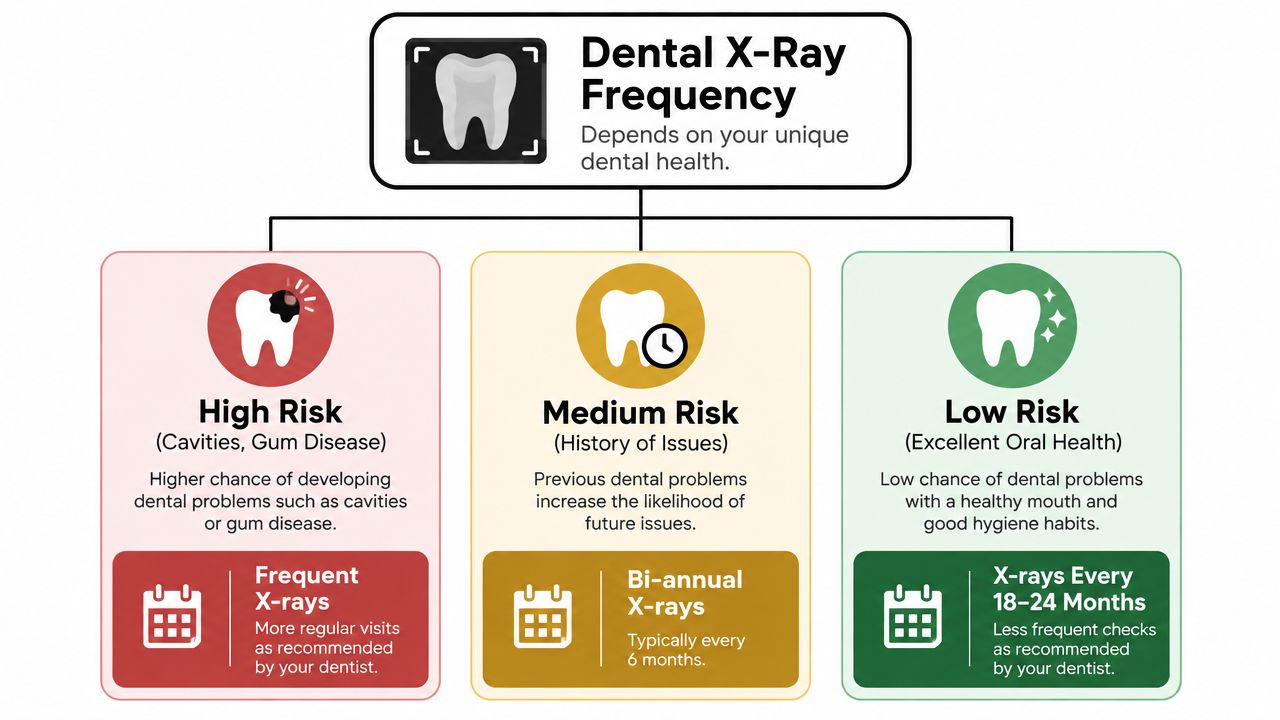
The reason annual imaging isn't universal
An annual appointment may still be appropriate for cleaning and examination, but that doesn't mean every patient needs the same X-ray series at every visit. The ADA's risk-based approach helps avoid two problems: unnecessary repeat exposure and delayed diagnosis when a patient's condition has changed.
Practical rule: Your dentist should be able to explain what question an X-ray is answering before taking it.
Aspiring Smiles Dental and Braces serves patients across Las Vegas, including Desert Shores, Sunhampton, Sun City Summerlin, Monterrey, Lone Mountain, Mar-A-Lago, and Painted Desert Estates. During a visit, Dr. Patel and the team can review your history, examine your teeth and gums, and decide whether new images add meaningful information.
That conversation matters if you've recently had a toothache, noticed sensitivity, changed dental providers, or haven't had records transferred. It also matters before treatments such as a tooth extraction, crown, orthodontic care, or dental implants, because the imaging needed for planning may differ from routine cavity screening.
Understanding Age and Risk Factors in Dental Imaging
Age affects how quickly the mouth changes, but it doesn't determine the schedule by itself. The FDA and ADA selection tables recommend posterior bitewings for recall patients with no clinical caries and no increased risk at 12 to 24 month intervals for children, 18 to 36 month intervals for adolescents, and 24 to 36 month intervals for adults, when the surfaces between teeth can't be examined visually or with a probe. These ranges come from the FDA's radiographic examination recommendations.
A child whose teeth are developing and whose cavity risk is low may therefore have a different plan from a healthy adult. An adolescent with braces, changing tooth positions, or a history of decay may need closer monitoring than another teenager with no clinical concerns. Your dentist uses the examination findings to place your situation in context.
Comparing lower-risk and higher-risk situations
For recall patients with clinical caries or increased risk, the same guidance shortens posterior bitewing intervals to 6 to 12 months for children, adolescents, and adults. For older adults in the higher-risk category, the listed interval is 6 to 18 months. The recommendation reflects the likelihood that imaging may reveal disease that isn't visible during a routine inspection.
| Patient situation | Practical imaging pattern |
|---|---|
| Child with no clinical caries and no increased risk | Bitewings may be recommended every 12 to 24 months |
| Adolescent in the same low-risk category | Bitewings may be recommended every 18 to 36 months |
| Low-risk adult with hidden proximal surfaces | Bitewings may be recommended every 24 to 36 months |
| Patient with active decay or elevated caries risk | Imaging may be needed every 6 to 12 months |
| Older adult with clinical caries or elevated risk | Imaging may be needed every 6 to 18 months |
These are not promises or automatic prescriptions. A patient with a recent filling, frequent cavities, periodontal concerns, dry mouth, or symptoms may need a different plan. Conversely, a person with healthy gums, no clinical caries, and surfaces that can be examined directly may not need repeat images because a certain month has arrived.
Symptoms can change the timing
Pain, swelling, unusual sensitivity, a broken tooth, or discomfort when biting can justify an X-ray outside your normal recall pattern. In those situations, the dentist isn't checking a routine box. The image helps answer a focused question, such as whether a tooth has an infection, a fracture concern, or changes around its root.
Balancing Diagnostic Benefits with Radiation Safety
How can a dentist balance useful diagnostic information with radiation safety? Dental X-rays use very small doses. The International Atomic Energy Agency reports typical effective doses of about 1 to 8 μSv for intraoral dental imaging and about 4 to 30 μSv for panoramic exams in its radiation dose information for dentistry.
Those units may feel abstract. An X-ray works like a brief measurement taken to answer a specific health question. The purpose is to gather enough information to diagnose or monitor a condition, while avoiding an image that would not change your care.
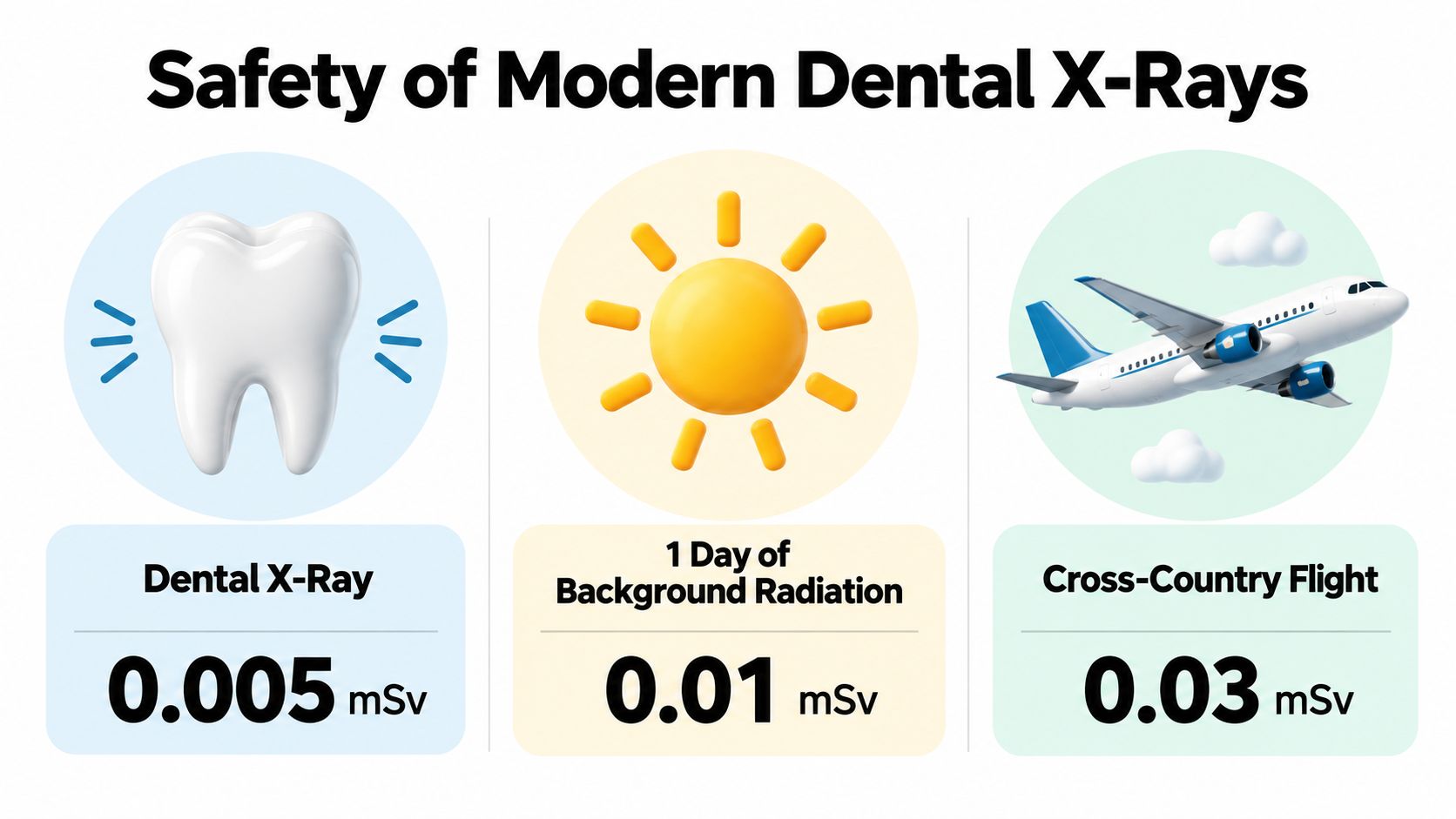
What ALARA means for patients
Dental teams follow the ALARA principle, meaning As Low As Reasonably Achievable. They choose the image that fits the clinical question, use the lowest exposure that can produce a useful result, and avoid repeat imaging when existing records provide the needed answer.
The ADA's ALARA guidance states that panoramic radiographs and full-mouth surveys do not have a recommended repeat frequency. Dentists order them according to individual patient need, rather than insurance limits or a preset calendar. That approach matters for patients considering implants, orthodontics, extensive restorative dentistry, or assessment of broader jaw structures.
At Aspiring Smiles, safety includes explaining why an image is recommended and listening to your concerns. Tell the team before imaging if you are pregnant, managing a medical condition, or unsure whether previous images are available. Your dentist can review existing records, consider the clinical need, and choose the most appropriate approach.
A safe imaging plan isn't the plan with the fewest pictures. It's the plan that provides necessary information without avoidable exposure.
A visual examination remains important, but it cannot reveal everything. Bitewings can show areas between back teeth that are difficult to inspect directly. Other images can display roots, surrounding bone, or jaw structures. In a Las Vegas practice, personalized intervals help match each image to the patient's actual needs instead of treating a calendar schedule as a rule.
Types of Dental X-Rays and When Each Is Used
Not every dental X-ray answers the same question. The dentist chooses the view based on symptoms, examination findings, treatment planning, and whether an existing image is still clinically useful.
Bitewing X-rays show the crowns of upper and lower teeth in a matching area. They are commonly used to look for decay between back teeth and to evaluate areas that may be difficult to inspect with a mirror and probe. For routine cavity monitoring, bitewings are the imaging type with defined FDA and ADA interval guidance.
Periapical X-rays capture an entire tooth, from the crown through the root tip, along with nearby bone. A dentist may choose this view when you're experiencing localized pain, swelling, sensitivity, or a concern involving an infection, root, or bone.
Panoramic X-rays provide a broad image of the jaws and teeth. They can support evaluation for wisdom teeth, orthodontic planning, jaw concerns, or certain implant-related assessments. They aren't a substitute for every targeted image, and the dental X-ray service at Aspiring Smiles explains how imaging fits into a focused examination.
Why modality matters more than a generic schedule
A full-mouth survey combines multiple views to document the mouth when a thorough assessment is clinically needed. It may be considered for a new patient with limited records or for complex restorative care, but the ADA doesn't recommend repeating full-mouth surveys on a fixed timetable.
That is why the question isn't just, “How often do I get X-rays?” A better question is, “Which image do I need, and what will it help my dentist determine?” A panoramic image may be useful when planning dental implants near me, while a periapical view may be more appropriate for a painful tooth. Routine bitewings may be enough for a low-risk recall examination when the concern is hidden decay between teeth.
How Aspiring Smiles Personalizes Your X-Ray Schedule
At a new patient exam in Las Vegas, Dr. Patel and the team begin with your story. They ask about previous cavities, dental work, gum concerns, sensitivity, pain, and the timing of your last images. If records are available, reviewing them can help prevent unnecessary repetition and give the team a more complete view of changes over time.

A personalized visit in practice
Suppose you're an adult from Sun City Summerlin with no current pain, no clinical caries, and a stable dental history. The team may determine that routine bitewing imaging doesn't need to be repeated at every visit. If you're instead arriving from Lone Mountain with recent sensitivity or a history of recurring cavities, the examination may support a shorter interval or a targeted image.
Those examples don't create a diagnosis. They show why two patients who sit in the same waiting room can receive different recommendations. Your dentist considers the evidence in front of them, including what can be examined directly and what remains hidden.
The practice provides general, cosmetic, restorative, and emergency dental care in a modern setting. That means the imaging decision can remain connected to the reason you're visiting, whether you need preventive cleaning and exams, a tooth extraction consultation, teeth whitening, a crown, Invisalign care, or an evaluation for dental implants.
Clear communication is part of that process. You should know whether the image is intended to check for decay, evaluate a painful tooth, assess bone support, or help plan treatment. You can also ask whether the office has recent records and when the team expects imaging to be useful again.
What to Expect During Your Next Dental Exam
A new patient exam starts with information, not assumptions. At Aspiring Smiles Dental and Braces, bring a list of current medications, details about past dental treatment, and any records you can obtain from a previous office. Tell the team about pain, sensitivity, swelling, bleeding gums, or a change in how your teeth fit together.
Your visit in clear steps
Health history comes first. The team reviews your concerns, dental history, previous images, and treatment goals. This helps distinguish a routine examination from a visit that needs focused diagnostic attention.
The dentist examines your mouth. Dr. Patel evaluates your teeth, gums, existing restorations, bite, and visible signs of disease. A visual examination and clinical evaluation guide the decision about whether an X-ray can add necessary information.
Imaging is selected for a reason. If a bitewing, periapical, panoramic image, or full-mouth survey is appropriate, the team can explain what it will show and why that view fits your needs. The ADA recommends radiographs when they provide necessary diagnostic information, rather than automatically at every appointment.
You review the findings together. Ask to see your images and request an explanation in plain language. The guide to reading dental X-rays can also help you become familiar with the basic areas your dentist may point out.
Questions worth asking
You don't need to know the technical names of every image before your appointment. Ask what the X-ray is checking, whether the office can use a previous image, and what symptoms or risk factors would change your future schedule.
If you're in Desert Shores, Sunhampton, Monterrey, Mar-A-Lago, Painted Desert Estates, or another Las Vegas neighborhood, the same principle applies. A dental visit should give you a clear plan for preventive care, treatment, and follow-up, whether you need a regular exam or an urgent appointment for dental pain.
Aspiring Smiles Dental and Braces provides personalized exams, clinically appropriate dental X-rays, preventive care, restorative dentistry, cosmetic services, dental implants, and emergency dental services in Las Vegas, NV. Schedule an appointment or consultation by visiting Aspiring Smiles Dental and Braces to discuss your imaging history and create a dental care plan that fits your needs.