How Dental Crowns Are Made in Las Vegas
A sharp twinge when you bite into ice at a Strip brunch, a dark line in the mirror, or a large filling that suddenly feels loose can make you wonder what happens next. If you're searching for a dentist in Las Vegas, NV, you may be trying to understand whether a crown is necessary, how long treatment takes, and whether the process will hurt.
A dental crown is a custom restoration that protects a weakened tooth and helps you chew and smile comfortably again. At Aspiring Smiles Dental and Braces, patients from Desert Shores, Sunhampton, Sun City Summerlin, Monterrey, Lone Mountain, Mar-A-Lago, and Painted Desert Estates can discuss crowns alongside restorative dentistry, emergency dental services, dental implants, cosmetic dentistry, dental cleaning and exams, and dental X-rays. Understanding how dental crowns are made can make your appointment feel much more predictable.
When a Tooth Needs a Crown in Las Vegas
A patient who works long shifts in Las Vegas hospitality may notice a cracked molar but postpone care until the tooth hurts during a meal. An active retiree in Sun City Summerlin may spot a worn, darkened tooth but assume it's only a cosmetic concern. Both situations are common reasons to schedule an evaluation rather than wait for a larger break.
Dentists may recommend a crown when a tooth has:
- Deep decay: A filling alone may not leave enough strong tooth structure.
- A crack: A crown can hold the remaining visible tooth together when the root and supporting tissues are healthy enough.
- Severe wear: Grinding or clenching can flatten enamel and change the way the teeth meet.
- Root canal treatment: A treated tooth may need added protection because much of its internal structure has been removed.
- A failing large filling: A filling that leaks, fractures, or leaves thin walls may no longer protect the tooth adequately.
A crown is a custom tooth-shaped cap. It covers the visible portion of the prepared tooth, rather than filling one small area. The goal is to preserve the natural tooth when possible while restoring its shape, appearance, and ability to handle everyday chewing.
A crown doesn't replace the root. It protects the part of the tooth you can see, while the dentist checks the root, bone, gums, and bite before recommending treatment.
Busy schedules often lead people to delay care. A hospitality worker may not want to take time away from a shift, while a parent in Desert Shores may keep managing occasional sensitivity between family responsibilities. Early evaluation can help identify whether a crown, filling, root canal, tooth extraction, or another treatment is appropriate before the tooth becomes harder to restore. Patients who need help coordinating calls outside office hours may also find 24/7 dental patient call handling useful when trying to reach a dental practice.
The process itself is organized into clear stages. You'll receive an examination, tooth preparation, an impression or scan, a temporary restoration when needed, fabrication, and a final fitting. You don't have to memorize the technical terms. Your Las Vegas dental team should explain what's happening and what you'll feel at each appointment.
Diagnosis and Tooth Preparation
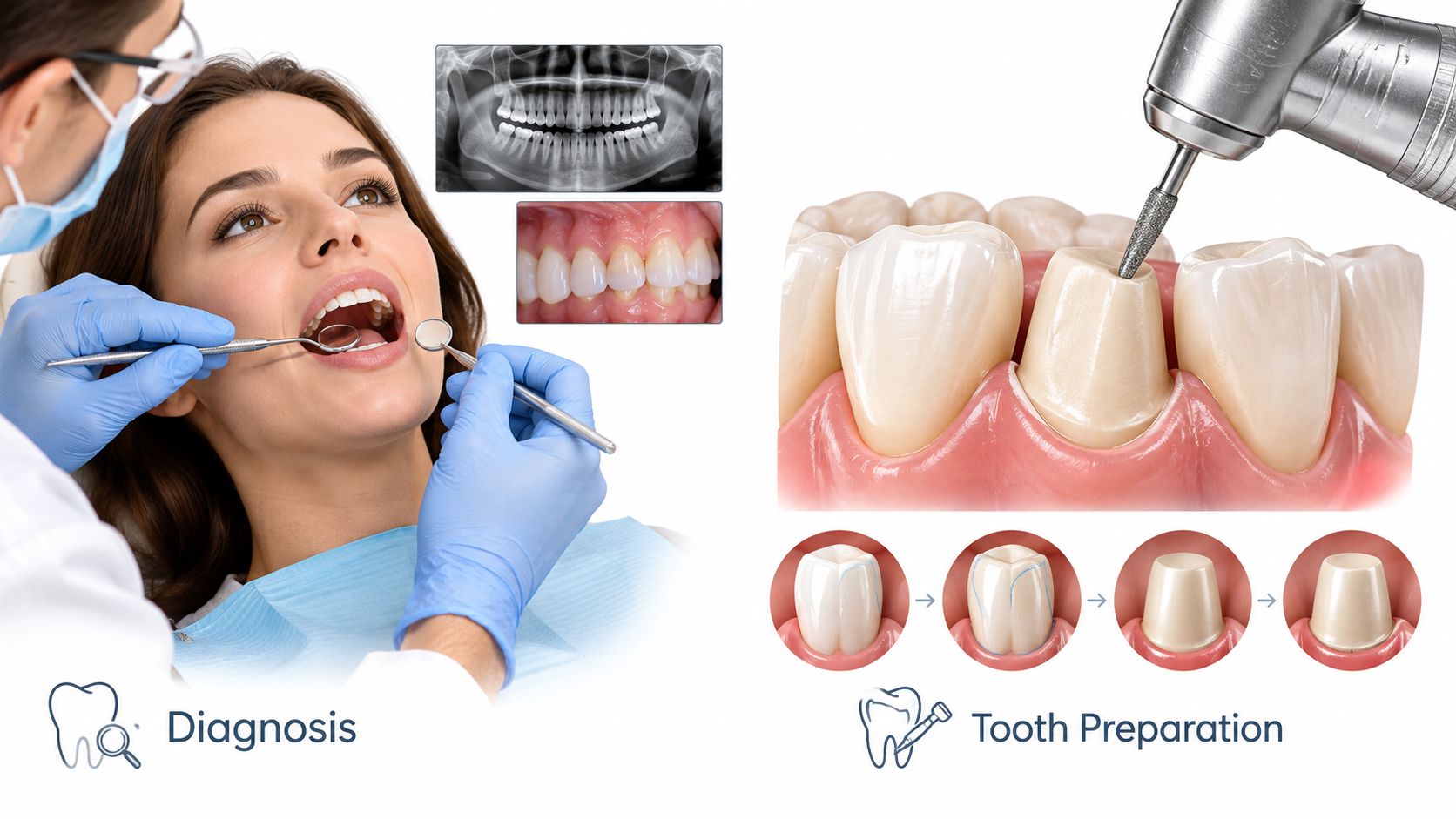
The dentist first confirms that the tooth can support a crown. A visual examination may be paired with bite checks, gum measurements, and digital X-rays or 3D imaging. These records help reveal decay below the visible surface, the condition of the root, the surrounding bone, and whether an infection or crack changes the treatment plan.
What the examination is checking
The dentist is looking for enough healthy structure to hold the restoration securely. They'll also assess whether the tooth needs treatment before preparation, such as decay removal, a build-up, or root canal therapy. If the tooth can't support a crown predictably, the discussion may instead include tooth extraction and a replacement option such as a dental implant.
After the area is numbed, the dentist removes decay and any weak filling material. The outer tooth is shaped carefully to create room for the crown's material. Think of trimming a damaged tree branch before fitting a protective sleeve. The dentist reduces only the amount needed for the crown to sit over the tooth while preserving sound structure underneath.
Creating a stable foundation
A tooth that has lost substantial structure may receive a core build-up before the crown is designed. This material replaces missing support and gives the restoration a more reliable base. The dentist also smooths the preparation and creates a clean margin, the edge where the crown will meet the natural tooth.
During preparation, you'll usually notice pressure, vibration, and water spray. You shouldn't feel sharp pain because local anesthetic keeps the area numb. If you do feel discomfort, raise your hand so the dentist can pause and improve your comfort.
Capturing Your Bite with Impressions or Digital Scans
Once the tooth is prepared, the dental team needs an accurate record of its shape and position. That record includes the prepared tooth, neighboring teeth, the opposing teeth, and the way your upper and lower teeth meet. A crown that looks attractive but doesn't fit the bite can feel high or interfere with chewing.
Traditional impressions
With a conventional impression, the dentist fills a tray with a soft material and seats it over the teeth. The material may feel slightly gooey, but it sets quickly enough for the team to remove the tray and send the record to a dental laboratory. This method remains useful in many practices and can work well for complex cases or laboratories that prefer physical models.
Digital scanning
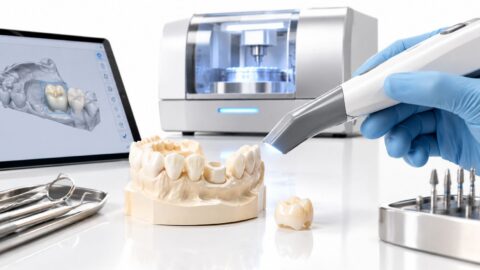
A digital intraoral scanner uses a small handheld wand to capture many images inside the mouth. Software combines those images into a three-dimensional model that appears on a screen. You can often see the tooth and bite record immediately, and the dentist can rescan an area if the image isn't clear.
Digital scanning may feel easier for patients who dislike impression material. There's no full tray of putty, and the wand can be moved in short passes. It also gives the team an immediate opportunity to inspect the preparation and surrounding teeth. Still, the choice depends on the case, the office's technology, and the laboratory workflow. Both methods can provide the information needed to design a well-fitting crown.
The team also records the shade of the neighboring teeth. A shade guide, photographs, or digital shade equipment can help the laboratory create a restoration that blends with the rest of your smile. Your opposing bite is recorded as well, because the crown needs to function with the teeth above or below it.
Wearing a Temporary Crown While You Wait
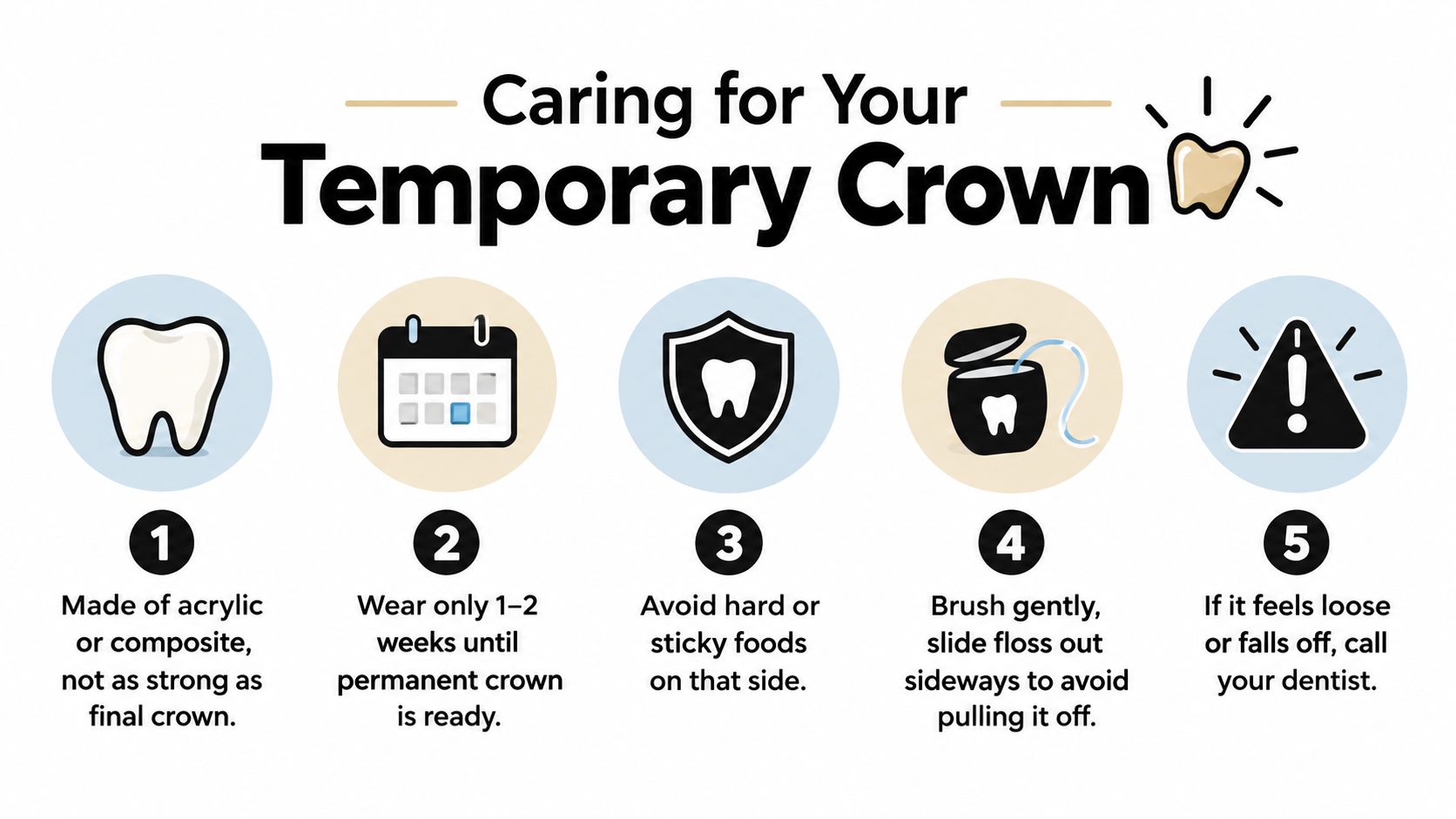
A temporary crown is a protective placeholder placed after preparation. It's commonly made from resin or acrylic, and it covers the prepared tooth while the permanent restoration is fabricated. A conventional lab-made crown usually takes about two to three weeks, according to Cleveland Clinic's overview of dental crowns, although the schedule varies by case and office.
The temporary is attached with a provisional adhesive rather than the final cement. That makes it easier for the dentist to remove later. You may notice mild sensitivity to temperature, pressure around the gum, or a slightly different chewing sensation. Minor roughness or a shade difference is also normal because the temporary isn't designed to match the precision and finish of the final crown.
Protecting the temporary
For the waiting period:
- Choose softer foods: Avoid chewing ice, very hard foods, or sticky caramels on that side.
- Brush gently: Clean around the crown and gumline without scrubbing aggressively.
- Floss carefully: Slide the floss out sideways instead of lifting it straight up, which can pull on the temporary.
- Keep the piece if it comes off: Place it in a clean container and call the Las Vegas dental office promptly.
- Report discomfort: A loose temporary, sharp edge, or worsening pain deserves an office call.
The temporary helps protect the prepared tooth, but it isn't a permanent restoration. If it comes loose, don't try to force it back into place with household glue. A dentist can check the tooth, clean the area, and reattach or replace the temporary safely.
Inside the Dental Lab How Crowns Are Actually Made
Your crown begins as a physical impression or digital file, then becomes a restoration designed for one particular tooth. A traditional impression is poured into a stone model and placed on an articulator, a device that reproduces how your upper and lower teeth meet. With an intraoral scan, the lab receives a digital image of your mouth and uses it to design the crown in CAD software.
You may never see these steps from the dental chair, but they explain why the crown should feel personal rather than generic. The shape, contacts, bite, and shade all depend on the information captured earlier.
Selecting the material
Material choice balances appearance, strength, available space, bite forces, and the tooth's location. The ADA lists noble metal alloys, base metal alloys, ceramics, resin-based composites, and metal-ceramics among modern indirect restoration materials. Metals have long been valued for durability and strength, while tooth-colored ceramics offer a more natural appearance. The ADA's materials reference explains why choosing a crown involves more than selecting the whitest option.
| Material | Strength | Best use | Key trade-off |
|---|---|---|---|
| Layered porcelain | Natural-looking translucency | Visible teeth where appearance is important | May be less suitable for heavy biting forces than stronger alternatives |
| Zirconia | High strength in appropriate designs | Molars and patients with higher chewing demands | Appearance and adjustment depend on the specific zirconia and finishing method |
| Metal-ceramic | Proven balance of a metal foundation and porcelain surface | Restorations requiring durability with a tooth-colored exterior | The metal substructure can affect translucency |
| Gold alloy | Strong, wear-resistant, and conservative in some designs | Posterior teeth where function is the priority | Metallic appearance isn't preferred by every patient |
The lab may mill a crown from a ceramic or zirconia block, press ceramic into a mold, or layer porcelain over a substructure. Zirconia commonly goes through a sintering furnace, which develops its final properties. A technician can then add stains, glaze, or polish. Those finishing steps give the surface texture and color variation that help it look less like a blank white shell when you see it in your mouth.
Why digital doesn't remove clinical judgment
CAD/CAM entered dentistry in the 1980s, and a landmark 1989 development introduced chairside fabrication of ceramic restorations in Germany, as described in this review of digital dentistry and CAD/CAM development. Today, an office may scan, design, and mill a crown while you wait. Other cases still go to a laboratory for specialized materials, detailed shading, or additional technician work.
A same-day crown can suit a straightforward case, but a laboratory-made restoration may be better for another tooth. One review reports that a chairside CAD/CAM sequence can take about 45 minutes to 2 hours, depending on complexity. Training, software selection, material, and workflow also affect the result. If you are considering same-day dental crowns in Las Vegas, ask what you will see and feel during the visit, which material fits your bite, and why that workflow suits your tooth.
The Final Fitting and Cementation Visit
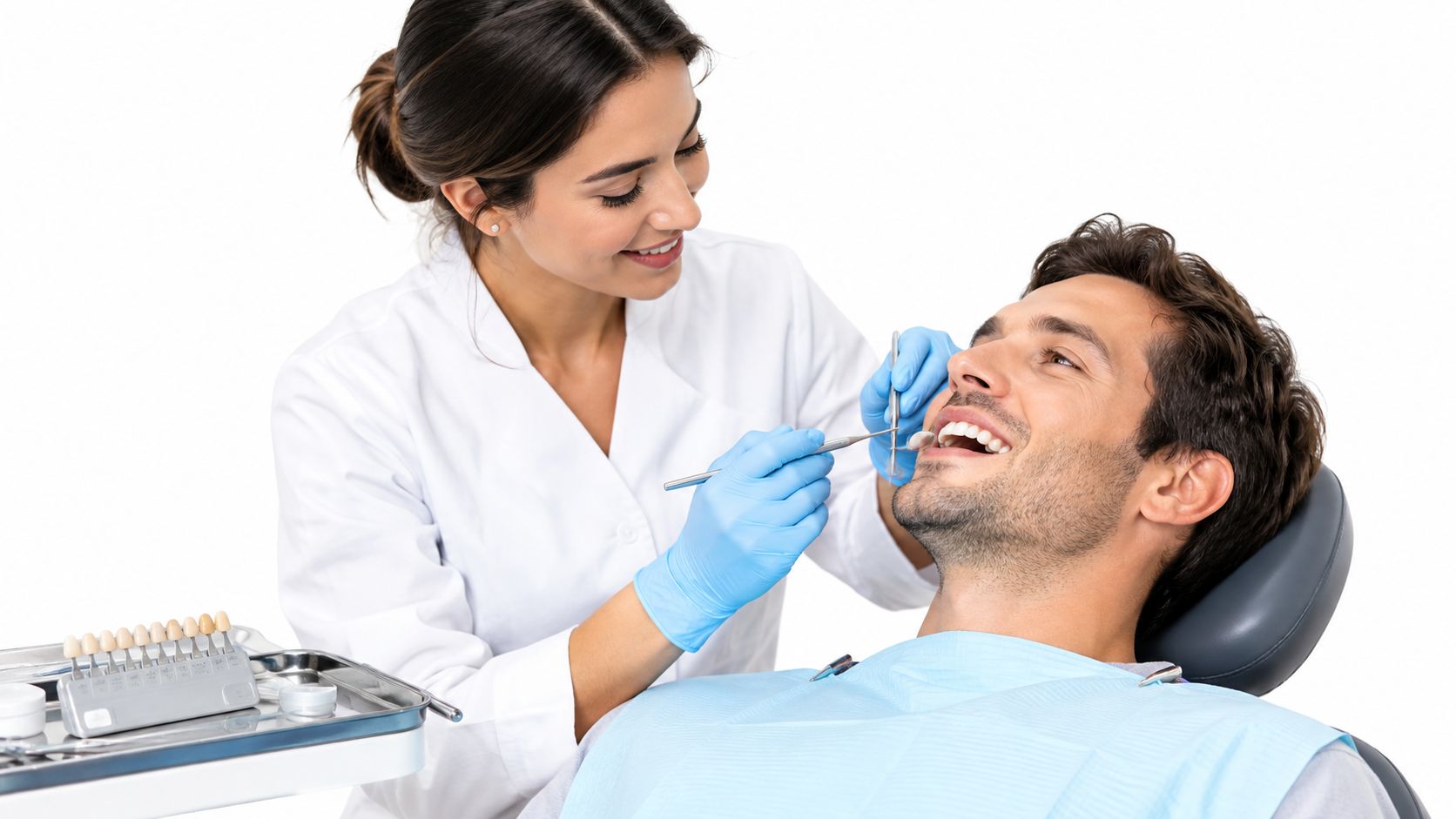
At the final visit, the dentist removes the temporary and cleans the prepared tooth. The permanent crown is tried in before cement is used. You'll look at the shade and shape, while the dentist checks the contact points against neighboring teeth and confirms that the margins sit properly.
Checking the bite before bonding
The dentist may use articulating paper or a disclosing material to mark areas where the crown contacts too strongly. You'll bite and move your jaw in different directions. If the crown feels as though it hits first, the dentist can make a small adjustment before cementation.
The crown must look right, but comfort and function matter just as much. A good fit should feel integrated with the rest of your teeth, not like a raised object that changes your bite.
Securing the restoration
The dentist selects cement based on the crown material and the condition of the tooth. Resin cement may be used when a strong bond is needed for certain ceramic or zirconia restorations. Glass ionomer cement may be appropriate in other situations, including some metal-ceramic restorations, posts, or build-ups.
The tooth is isolated as much as practical, the cement is placed, and the crown is seated with controlled pressure. The dentist removes excess cement before it fully sets, checks the contact with floss, and polishes the area. Mild sensitivity afterward can occur, but persistent pain, a crown that feels high, or a loose sensation should prompt a call to the office.
Crown Aftercare and Scheduling Your Visit
After the crown is cemented, give your mouth time to adjust. For the first day, avoid sticky candy, chewing ice, and very hard nuts on that side. Mild temperature sensitivity can improve with desensitizing toothpaste. Pain that continues, worsens, or disrupts sleep deserves a call to the dental office.
Clean the crown like a natural tooth. Brush carefully along the gumline, guide floss through the contact, and use a floss threader or water flosser if the area is difficult to reach. The crown material cannot decay, but plaque can still irritate the gum and cause decay where the crown meets the remaining tooth.
Protecting the result
A crown's service life depends on its material, your bite, oral hygiene, preparation, cementation, and habits such as grinding. Gold alloy, metal-ceramic, feldspathic porcelain, and CAD/CAM restorations can perform differently, so the material should match the tooth's location, appearance goals, bite forces, and long-term needs. Good daily care helps protect the margin, the gum, and the tooth underneath.
A night guard may reduce damage for patients who clench or grind. Routine cleanings and exams give the hygienist and dentist a chance to inspect the crown, gumline, bite, and neighboring teeth. Contact the office if you notice:
- Persistent pain: Especially discomfort that lingers or interferes with sleep.
- A loose feeling: The crown should not rock or shift.
- A chipped edge: A small chip can alter your bite or expose another layer.
- A new bite problem: Tell the office if the crown contacts before the other teeth.
Whitening treatments lighten natural enamel but generally do not change the shade of an existing crown. If you are considering cosmetic treatment, discuss shade planning before the crown is made and review this whitening crowns and bridges guide. For practical cleaning and maintenance steps, see this dental crown care guide.
Scheduling an evaluation in Las Vegas gives your dentist time to review your X-rays, bite, material choices, and whether same-day digital dentistry fits your case. The visit can also clarify alternatives, including extraction or dental implants near me, when saving the tooth is not predictable. Patients searching for a dentist near me, an emergency dentist, or a cosmetic dentist near me can begin with that consultation.
Aspiring Smiles Dental and Braces offers custom dental crowns, same-day dentistry options, restorative and cosmetic care, dental implants, and emergency dental services in Las Vegas, NV. Visit Aspiring Smiles Dental and Braces to request a consultation and discuss the next step for your tooth.