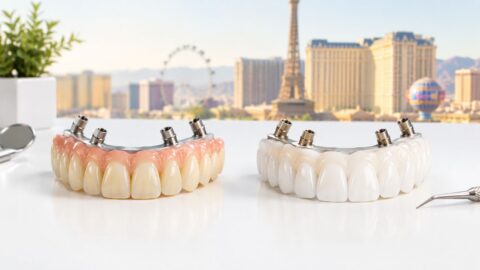
All on 4 Temporary vs Permanent: A Las Vegas Patient Guide
You've just left an implant surgery appointment with a fixed row of teeth attached to four implants. You can smile, speak, and show up for work, but your dentist has already told you these aren't the final teeth. That creates a natural question: what's the actual difference between an All-on-4 temporary bridge and a permanent prosthesis, and which one should you choose?
For patients searching for a dentist near me, dental implants near me, or an All-on-4 consultation in Las Vegas, NV, the honest answer is that temporary and permanent restorations aren't competing products. They're two stages of one treatment plan. The temporary bridge helps protect healing implants and test the design. The permanent prosthesis is made after your dentist has more information about your bone integration, bite, speech, gum contours, hygiene access, and appearance.
Why Las Vegas Patients Compare Temporary and Permanent All-on-4
A patient may arrive at the office exhausted by loose dentures, painful chewing, broken teeth, or a smile they no longer trust. After extractions and implant placement, that same patient may leave with a fixed temporary arch attached across four implants. It can feel like a dramatic change, especially after years of avoiding restaurants, photos, or conversations.
Then comes the difficult part. The temporary teeth look and function immediately, while the definitive restoration waits until the implants have healed and the dental team can evaluate the result. The patient is left comparing what they have today with what they'll eventually commit to as the long-term design.
A full-mouth rehabilitation resource such as Bristol Dental full mouth rehab can help patients understand why extensive treatment is planned in stages. With All-on-4, the first stage isn't just a lower-cost version of the second. It has a clinical purpose.
The situations that bring patients to this decision
Las Vegas patients often seek this treatment because they're dealing with:
- Denture fatigue: A removable denture may move during meals, conversations, or social events.
- Failing teeth: Advanced damage can make tooth extraction and full-arch replacement more practical than repeated individual repairs.
- Time pressure: Work, travel, and demanding schedules can make remaining without fixed teeth feel impossible.
- Loss of confidence: Missing or failing teeth can affect how comfortably someone speaks, smiles, and eats.
Immediate loading protocols may connect a temporary prosthesis on the day of surgery, while other protocols deliver it after 24 or 48 hours, according to the systematic review of the All-on-4 treatment concept (systematic review of All-on-4 treatment protocols). That speed is valuable, but it doesn't mean the bridge is ready for unrestricted chewing.
The practical rule: The temporary bridge is a working prototype. The permanent prosthesis is the final engineered design, but it still needs professional maintenance.
The right comparison isn't “cheap teeth versus expensive teeth.” It's healing and testing versus long-term function and service. That distinction matters whether you live in Desert Shores, Sun City Summerlin, Lone Mountain, or elsewhere in Las Vegas.
The Two-Stage Timeline From Implant Surgery to Definitive Teeth
All-on-4 treatment follows a sequence, even when the patient receives fixed teeth quickly. Immediate loading means connecting implants to a prosthesis that contacts the opposing arch within one week of implant placement, according to the International Team for Implantology loading consensus.
Stage one begins with surgery and a temporary arch
The first stage may include removal of failing teeth, implant placement, and connection of a fixed provisional bridge. A clinical trial summarized by University College London described immediate loading as seating a provisional prosthesis within 48 hours, while the delayed comparison used a three-month interval before loading.
The bridge is fixed across the implants rather than functioning as four separate implant crowns. Splinting the implants into one connected arch helps distribute chewing forces, and global consensus guidance describes a one-piece, fixed, screw-retained cross-arch provisional that splints at least four implants when immediate loading is appropriate (global consensus guidance on immediate loading).
That doesn't make the temporary bridge indestructible. Your dental team may recommend a soft diet and careful chewing while the implants integrate with bone. Hard or forceful biting can overload a healing system, particularly when the patient grinds, clenches, struggles with hygiene, or has an unstable bite.
Stage two follows healing and clinical reassessment
The definitive restoration is commonly delayed until approximately four to six months after implant placement. Some clinical protocols move to the permanent prosthesis after two to three months, so the schedule depends on implant stability, healing, bone conditions, tissue changes, and the treatment plan (review of immediate and delayed full-arch loading).
During this phase, the office may use impressions, digital scans, bite records, photographs, and try-in appointments. The team evaluates whether the provisional bridge is comfortable, stable, cleanable, natural-looking, and compatible with your speech.
What changes is the restoration, the material selection, the tooth shape, and the level of design refinement. What stays the same is the responsibility to protect the implants, control the bite, clean thoroughly, and attend follow-up visits. Patients can review the broader process in this dental implant timeline before scheduling a consultation.
How Temporary and Permanent All-on-4 Prostheses Actually Compare
A temporary All-on-4 bridge and a permanent All-on-4 prosthesis may both be fixed in place, but they aren't designed for the same job. The provisional restoration must tolerate the early healing period while remaining adjustable. The definitive restoration is fabricated after the clinical team has observed how your implants, soft tissues, bite, and speech respond.
Material choices can differ. Evidence reviewed in a Cochrane-supported analysis describes same-day full-arch treatment using metal-reinforced acrylic provisional prostheses, followed later by full-arch metal-ceramic or metal-resin prostheses (Cochrane-supported All-on-4 analysis). Your dentist should explain the proposed framework and tooth material before surgery, not after the temporary has already been placed.
A practical side-by-side view
| Criterion | Temporary, provisional | Permanent, definitive |
|---|---|---|
| Main purpose | Protect healing implants and provide early fixed function | Serve as the long-term full-arch restoration |
| Timing | Connected immediately, the same day, or after a short interval when clinically appropriate | Delivered after healing and reassessment |
| Design | Adjustable and responsive to clinical feedback | Refined around the healed tissues, bite, speech, and appearance |
| Material approach | Often acrylic with a reinforcing framework | May use metal-ceramic, metal-resin, or another durable restorative design |
| Bite expectations | Requires careful force control and diet instructions | Intended for long-term function, but still needs bite monitoring |
| Repair and adjustment | Usually easier to modify during treatment | Repairability depends on the material and framework |
| Clinical role | Diagnostic and protective | Definitive, but not maintenance-free |
The word permanent can mislead patients. It usually means “the intended final restoration,” not “a restoration that can never chip, loosen, fracture, or require service.” A retrospective cohort of 126 patients with 136 All-on-4 restorations found high one-year implant and restoration survival for both provisional-first and definitive-first approaches, with comparable complication rates during the observation period (one-year All-on-4 cohort study). Those results don't turn a temporary bridge into a permanent one. They show that the two approaches can perform well while serving different treatment stages.
The best question isn't which bridge looks better on the day it's delivered. Ask which design gives your dentist the information needed to create a stable, cleansable, comfortable final result.
Patients considering the procedure can also review the practice's explanation of the All-on-4 dental procedure and bring specific questions about materials, maintenance, timing, and replacement.
What the Temporary All-on-4 Bridge Is Really Doing for You
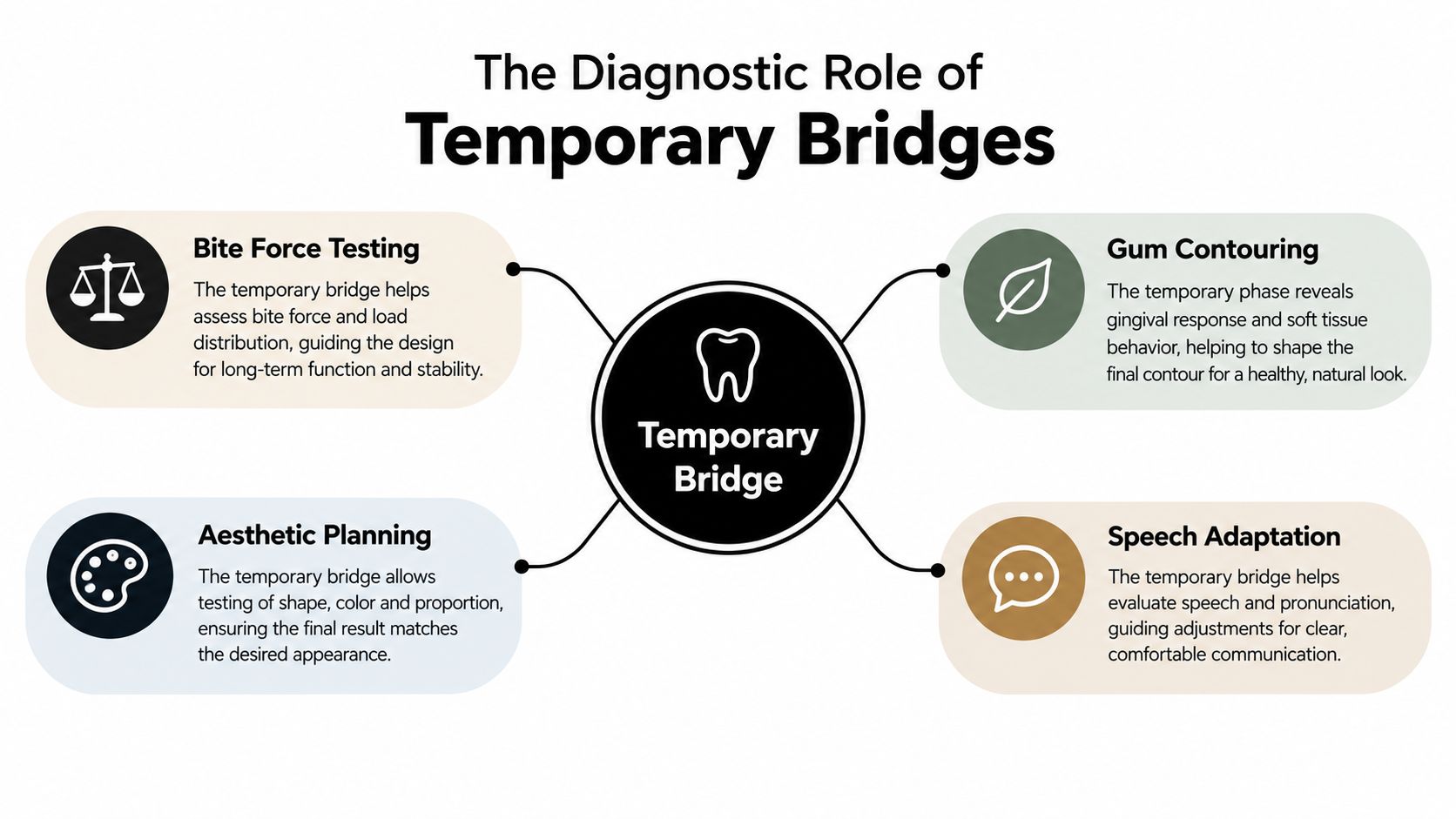
The temporary bridge is a diagnostic instrument, not disposable hardware. It gives the dental team a controlled way to observe how your mouth responds before the final prosthesis is manufactured.
Your dentist can assess whether the bite feels balanced, whether certain teeth contact too heavily, whether the smile line supports your face, and whether the bridge affects speech. The provisional also reveals whether the gum contours and cleaning spaces are practical in daily life. A patient may discover that a tooth feels too long, a speaking sound feels different, or a cleaning area is difficult to reach. Those observations can change the final laboratory prescription.
Problems during the temporary phase are useful information
One long-term retrospective study reported implant failure in 18.5% of implants supporting provisional prostheses, compared with 6.0% supporting definitive prostheses. The same report found prosthesis misfit in 24% of provisional cases and 0% of definitive cases (study of provisional and definitive All-on-4 complications).
Those figures shouldn't be used to frighten patients or predict an individual outcome. They show why the provisional stage deserves close follow-up. A loose screw, pressure area, fracture, speech problem, or difficulty cleaning isn't something to ignore until the permanent bridge arrives. It may signal excessive force, a fit problem, changing tissue, or a design issue that needs correction.
A broader review notes that denture fractures occur primarily in provisional prostheses, partly because patients may return quickly to harder foods after chewing improves (systematic review of All-on-4 complications). Immediate function doesn't equal unrestricted function.
What patients should report promptly
Contact the dental office if you notice:
- Movement or looseness: A fixed bridge should be evaluated rather than tightened or ignored at home.
- A fracture or chipped area: Small damage can change the bite and increase stress elsewhere.
- Persistent soreness: Pressure on healing tissue may require an adjustment.
- Speech changes that don't settle: The dentist may need to modify tooth position or contour.
- Cleaning difficulty: A design that traps food or blocks hygiene access needs attention.
- New bite pressure: Clenching or uneven contact can overload healing implants.
Your feedback has clinical value. The temporary bridge lets you rehearse daily life with fixed teeth while the dental team gathers information that a scan alone can't provide.
Which Patient Scenarios Need Which Prosthesis First
The starting restoration depends on the condition of your teeth, implants, bone, gums, bite, and overall treatment urgency. A patient with stable conditions may receive a fixed provisional quickly. Someone with bone loss, infection, or unresolved bite problems may need a more staged path.
| Patient Scenario | Recommended Starting Prosthesis | Typical Timeline to Permanent |
|---|---|---|
| Full-arch rehabilitation with suitable implant stability | Fixed provisional All-on-4 bridge when immediate loading is clinically appropriate | Commonly after approximately four to six months, with some protocols using two to three months |
| Failing teeth requiring extraction and immediate appearance | Fixed provisional after implant placement when stability and other conditions allow | After healing and reassessment |
| Severe bone loss or a need for grafting | A staged provisional approach, which may be removable during healing | After the grafted area and implants have been evaluated |
| Unresolved bite, periodontal, hygiene, or grinding concerns | Stabilization and diagnosis before committing to a definitive restoration | Depends on healing, disease control, and bite management |
| A patient with conditions suitable for delayed loading | Temporary or delayed restoration based on the surgical plan | After the planned healing interval |
The emergency scenario deserves special attention. If you need an emergency dentist because a tooth has fractured, an infection has worsened, or multiple teeth can't be saved, the first priority is controlling pain, infection, and damage. A tooth extraction may be part of the plan, but extraction alone doesn't determine whether immediate fixed All-on-4 is safe.
A fast appointment is not the same as a rushed decision. The dentist still needs to confirm implant stability, bone conditions, and whether the connected arch can be loaded safely.
Patients with long-standing dentures or severely resorbed ridges may need additional planning before receiving a fixed bridge. Patients in Monterrey, Mar-A-Lago, Painted Desert Estates, or Sunhampton should ask whether the proposed plan includes a removable interim option, a fixed provisional, or delayed loading.
Why Permanent All-on-4 Is Not a Lifetime Promise
“Permanent” describes the intended final stage. It doesn't promise that the prosthesis will never need adjustment, repair, or replacement.
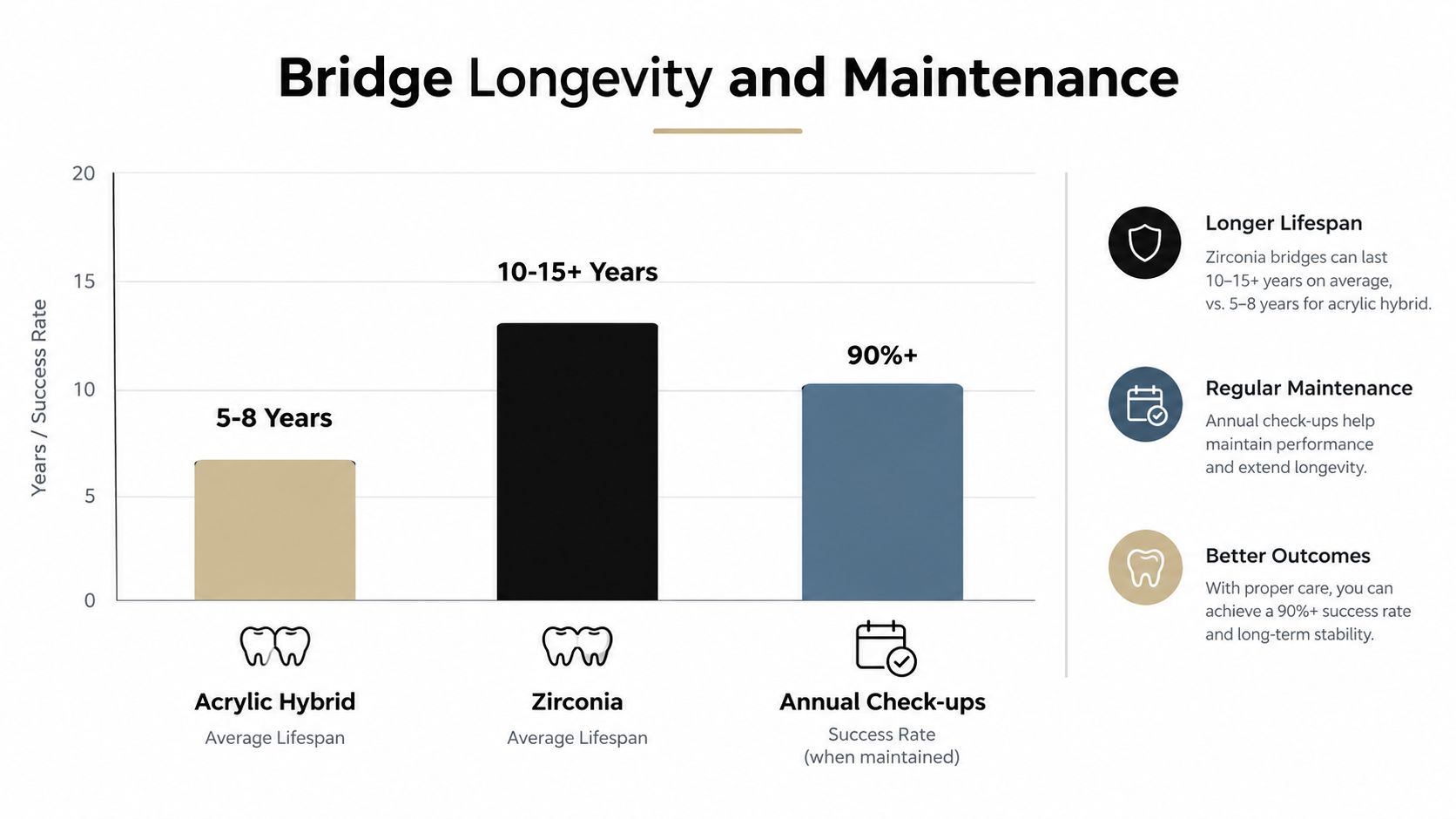
A definitive restoration can still develop technical complications. A 2024 systematic review identified screw loosening and veneering-material chipping or fracture among common complications, while biological concerns included excessive crestal bone loss and soft-tissue overgrowth (2024 systematic review of All-on-4 complications). A long-term study of implant-supported prostheses found that only 36.8% of evaluated prostheses had no recorded complications, while 85.3% remained operational and original in that report.
Those findings support a straightforward recommendation: budget for maintenance from the beginning. Your total ownership cost includes more than the initial treatment fee. It may include professional hygiene visits, bite adjustments, replacement components, repairs, relines when applicable, and eventual prosthesis replacement.
Repairability should influence the material decision
Acrylic-based designs may be easier to patch or modify when damage occurs. A ceramic or zirconia-based design may offer a different balance of appearance, strength, and repair options, but the specific response to a chip or fracture depends on the prosthesis design and location of the damage. Ask whether the restoration can be removed, repaired chairside, returned to the laboratory, or must be replaced as a larger unit.
The permanent bridge also needs hygiene access. Regular professional reviews help the team monitor the implants, soft tissues, screws, bite, and prosthesis. Patients who grind or clench may need a night guard or additional bite protection.
The smarter Las Vegas decision is not always the lowest initial price. Choose a plan that explains service intervals, warranty terms, repair limits, replacement responsibilities, and the likely maintenance relationship.
Choosing the Right Path and Scheduling Your Las Vegas Consultation
If you're missing most or all teeth in an arch, wearing a failing denture, or facing urgent extractions, start with a consultation rather than choosing a bridge material from an online comparison. The appointment should determine whether you're a candidate for a fixed temporary All-on-4 bridge followed by a definitive restoration, or whether a staged approach is safer.
A thorough evaluation may include CBCT imaging, dental X-rays, an intraoral scan, implant planning, and bite analysis. The purpose is diagnostic. You should leave understanding what happens on surgery day, what you'll wear during healing, what restrictions apply, and what must be confirmed before the final prosthesis is made.
Bring these questions:
- What is my bone condition? Ask whether imaging shows enough bone and stability for immediate loading or whether grafting or staged healing is needed.
- How does grinding affect my plan? Tell the dentist about clenching, fractured teeth, morning jaw soreness, or previous night-guard use.
- What happens if the temporary breaks or feels loose? Confirm who handles adjustments and how quickly you should be seen.
- What is the full two-phase commitment? Ask about the temporary, definitive prosthesis, maintenance, repairs, and replacement planning rather than discussing only the initial fee.
The same disciplined thinking applies to choosing a local dental provider. Clear explanations and transparent patient education matter, whether you're researching dental care, cosmetic dentistry, or even dental marketing for practices as part of understanding how dental offices communicate their services.
For patients seeking a dentist in Las Vegas, NV, the office serving Las Vegas, Summerlin, Henderson, and Northwest Vegas can evaluate All-on-4 treatment alongside restorative dentistry, dental implants, tooth extraction, preventive exams, cleanings, dental X-rays, cosmetic dentistry, and emergency dental services. Patients from Desert Shores, Sun City Summerlin, Lone Mountain, Monterrey, Mar-A-Lago, Painted Desert Estates, and Sunhampton can request an All-on-4 consultation, a second opinion, or an emergency-extraction appointment and receive a plan based on their clinical starting point.
Aspiring Smiles Dental and Braces offers All-on-4 consultations, dental implants, implant-supported dentures, tooth extraction, restorative dentistry, cosmetic services, and emergency dental care in Las Vegas. Visit Aspiring Smiles Dental and Braces to request a consultation, second opinion, or emergency-extraction appointment and get a clear plan for your temporary and permanent teeth.