Orthodontist vs Dentist: Choosing Your Best Smile Care
If you're dealing with a toothache, a chipped tooth, or a child whose teeth are coming in crooked, the first question is often simple but frustrating: do you need a dentist or an orthodontist? Patients in Las Vegas ask this all the time, especially when they want to solve the problem quickly and avoid bouncing between offices.
The confusion makes sense. Both work with teeth. Both help protect your smile. But they don't do the same job. One focuses on your overall oral health, and the other focuses on alignment, bite, and jaw position.
For many families in Las Vegas, from Desert Shores and Sun City Summerlin to Lone Mountain and Painted Desert Estates, the practical answer is to start with a general dental exam. A good dentist can identify whether you need routine care, cosmetic treatment, restorative work, emergency treatment, or alignment care such as clear aligners or braces. That first step saves time and helps you make the right decision for your smile.
Choosing the Right Dental Expert in Las Vegas
A lot of people start searching for a dentist near me or an emergency dentist when something hurts. Others search because they don't like the way their smile looks in photos, or they've noticed crowding, gaps, or a bite that doesn't feel right. Those are very different problems, and they don't always require the same provider.
A general dentist is usually the right first call when the issue involves pain, decay, gum irritation, a broken tooth, overdue cleanings, or routine care. That includes common needs like cleaning and exams, dental x-rays, new patient exams, tooth extraction, crowns, fillings, and cosmetic options such as teeth whitening or veneers. If you're looking for a dentist in Las Vegas, NV, that's where most care begins.
An orthodontist comes into the picture when the main problem is alignment. That might mean crowded teeth, spacing, an overbite, an underbite, or teeth that don't come together properly when you chew. In those cases, the goal isn't treating disease or repairing a damaged tooth. The goal is moving teeth and guiding the bite into a healthier position.
Practical rule: If the problem is pain, damage, or maintenance, start with a dentist. If the problem is tooth position or bite alignment, orthodontic care may be the better fit.
What matters most is matching the provider to the problem. In real life, patients don't always know which category they fit into, and that's okay. A thorough exam can sort that out quickly and point you toward the right treatment path.
The Fundamental Difference Generalist vs Specialist
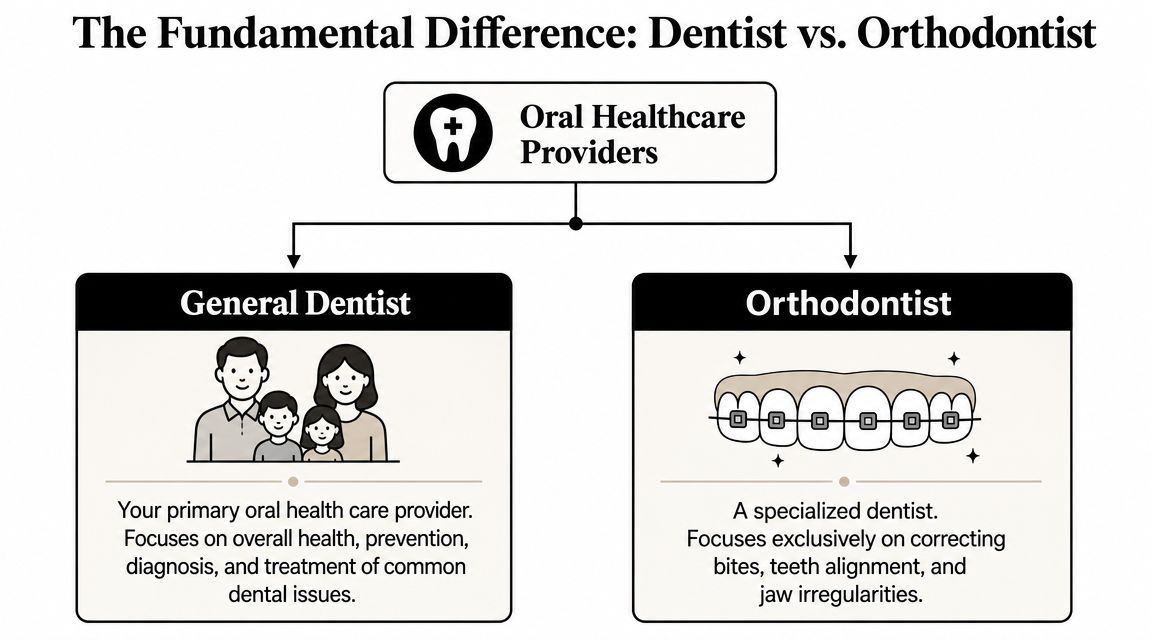
The simplest way to think about the orthodontist vs dentist question is this: a general dentist is your primary oral health provider, and an orthodontist is a specialist.
Early on, this side by side view helps:
| Provider | Main role | Typical focus | Common first reason to visit |
|---|---|---|---|
| General dentist | Broad oral health care | Prevention, diagnosis, repair, maintenance | Tooth pain, exams, cleanings, cavities, broken teeth |
| Orthodontist | Dental specialist | Tooth alignment, bite correction, jaw positioning | Crooked teeth, crowding, spacing, bite problems |
What a general dentist does
A general dentist manages the everyday needs of your mouth. That includes preventive visits, diagnosing problems, repairing damaged teeth, and helping you keep your teeth and gums healthy over time. If you want a useful overview of that broad role, this guide to common services offered by general dentists covers the kinds of care most patients use regularly.
This is why most dental journeys start with a dentist. General dentists see the whole picture. They look at your gums, teeth, existing dental work, signs of wear, infection, decay, and cosmetic concerns.
What an orthodontist does
An orthodontist is a dentist who focuses on alignment. Their work centers on malocclusion, which means the teeth or jaws don't line up the way they should. That can affect appearance, chewing, comfort, and long term function.
In the United States, the American Dental Association reported 202,485 professionally active dentists in 2024, and approximately 6% of dentists are orthodontists, which shows how narrow the specialty is compared with general dentistry's broader role in oral care (ADA dentist workforce data).
Most people will need a dentist throughout life. A smaller group will need an orthodontist for a specific alignment or bite issue.
That distinction matters because it explains why a dentist is often your first stop, while an orthodontist becomes important when the case moves beyond general care into specialty tooth movement.
Comparing Education Training and Scope
Both dentists and orthodontists begin in the same place. They complete dental school and learn the foundations of oral health, diagnosis, and treatment. The split happens after that.
Where the extra training matters
Orthodontists continue training for an additional three years focused on tooth and jaw alignment, and that specialization is reflected in earnings as well. Indeed reports a U.S. national average salary of $221,245 per year for dentists versus $271,770 per year for orthodontists, a difference of $50,525 annually (Indeed comparison of orthodontist vs dentist careers).
That doesn't just mean "more school." It means a narrower daily focus. Orthodontists spend that additional training period learning how teeth move, how bites fit together, and how jaw position affects function and appearance.
How that changes day to day care
A dentist's scope is broad. Their work may include:
- Preventive care such as exams, cleanings, and dental x-rays
- Restorative dentistry like fillings, crowns, and replacement of damaged teeth
- Cosmetic dentistry such as veneers and teeth whitening
- Urgent care for pain, infection, trauma, and tooth extraction
- Tooth replacement options, including care often associated with searches for dental implants near me
An orthodontist's scope is much narrower, but deeper in that one area. Their work centers on evaluating alignment, planning tooth movement, correcting bite problems, and managing braces or aligners in cases where positioning is the main issue.
Scope matters more than title
Many patients often get confused. They assume "both are dentists, so either one can handle anything involving teeth." That's not how care works in practice.
A broad provider is often better for broad needs. A specialist is often better for a focused problem that requires deeper training. If your issue is a cavity, swelling, a cracked tooth, or you need a new patient exam, a general dentist is the right fit. If your issue is crowding, rotated teeth, or a bite that isn't functioning correctly, specialized orthodontic planning may be the better route.
The right question isn't "who works on teeth?" It's "who works on this specific problem every day?"
That mindset helps patients choose care more confidently and avoid unnecessary delays.
Common Procedures Who Handles What
Patients typically don't choose between a dentist and an orthodontist based on job titles. They choose based on what they need done. That's the most useful way to compare them.
Procedures usually handled by a general dentist
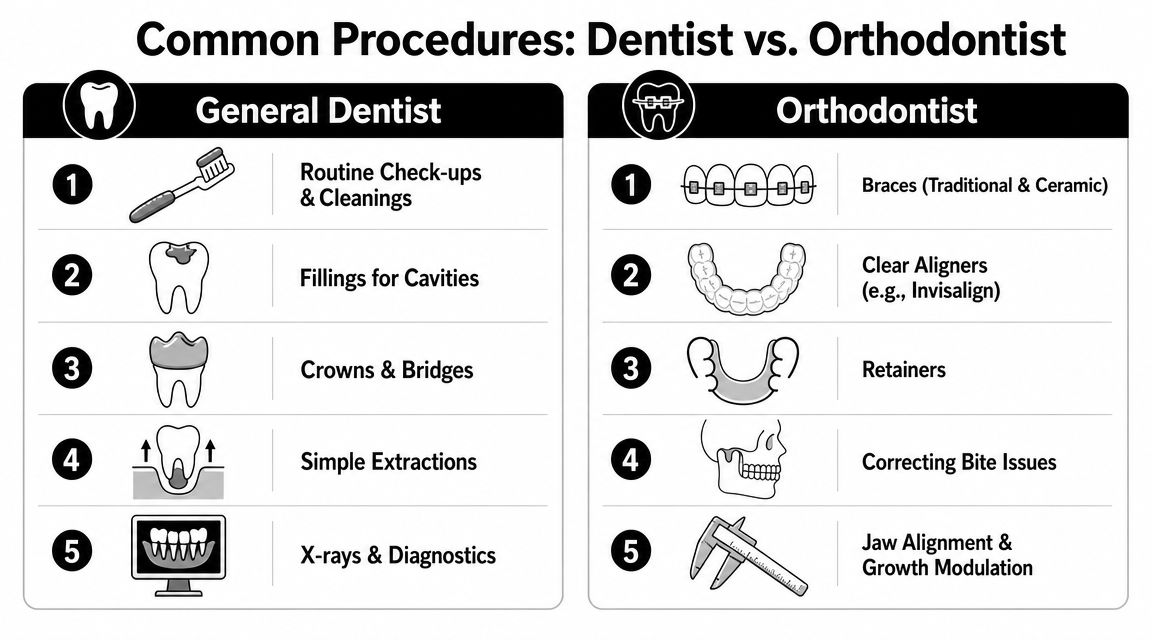
A dentist's scope covers preventive and restorative procedures such as cleanings, fillings, extractions, crowns, and veneers. An orthodontist's scope is concentrated on diagnosing malocclusion and planning tooth and jaw movement with braces or aligners (clinical comparison of dentist and orthodontist roles).
In practical terms, a general dentist usually handles care such as:
- Routine exams and cleanings for preventive care and early detection
- Dental x-rays to diagnose decay, infection, or bone concerns
- Fillings for cavities
- Crowns and veneers to restore or improve teeth
- Tooth extraction when a tooth is badly damaged or infected
- Emergency dentist visits for pain, swelling, broken teeth, or dental trauma
- Restorative dentistry when teeth need repair or replacement
- Cosmetic dentistry for smile improvement unrelated to bite correction
If a patient searches for a dentist near me because they're in pain, broke a tooth, or haven't had a cleaning in years, a general dentist is almost always the correct starting point.
Procedures usually handled by an orthodontist
Orthodontists are focused on movement and alignment. Their work often includes:
- Braces
- Clear aligners
- Retainers
- Bite correction
- Jaw position evaluation related to alignment
- Planning for crowded, spaced, or rotated teeth
When the issue is not disease or damage but position, orthodontic treatment is often the right tool.
Where the overlap happens
This is the part many patients in Las Vegas want clarified. Some general dentists provide limited orthodontic treatment, especially clear aligner therapy for straightforward cases. For patients considering aligners, this overview of how Invisalign works can help explain the process.
A full-service office such as Aspiring Smiles Dental and Braces may offer both general dentistry and orthodontic solutions like Invisalign, which can make the process simpler for patients who want one office to evaluate the case and determine whether in-house treatment is appropriate.
If your case is simple straightening, limited orthodontic treatment may be reasonable in a general dental setting. If the bite is complex, the specialist becomes much more important.
A quick procedure guide
| Need | Usually the right provider |
|---|---|
| Cleaning and exams | General dentist |
| Cavity or filling | General dentist |
| Broken tooth | General dentist |
| Tooth pain or swelling | General dentist |
| Tooth extraction | General dentist |
| Crowns, veneers, implants | General dentist |
| Mild cosmetic straightening | General dentist or orthodontic provider, depending on the case |
| Crowding, gaps, overbite, underbite | Orthodontist or orthodontic evaluation |
| Complex bite correction | Orthodontist |
What doesn't work well is guessing based only on whether a smile issue looks cosmetic. A crooked tooth may be simple. It may also be tied to bite forces, spacing limitations, or jaw position. That's why a proper exam matters.
Signs You Need a Dentist or an Orthodontist
Patients usually don't walk in saying, "I have a scope-of-practice question." They say something hurts, something feels off, or they don't like how their smile looks. These signs make the choice easier.
Signs you should call a dentist first
If you're dealing with any of the issues below, a dentist is generally the right first contact:
- Tooth pain or sensitivity that makes eating or drinking uncomfortable
- Bleeding or swollen gums that may signal inflammation or gum disease
- A chipped or broken tooth after an accident or while eating
- A cavity concern such as visible dark spots, food trapping, or sensitivity
- A loose crown or filling that needs repair
- Bad breath or an unpleasant taste that doesn’t go away
- A dental emergency involving pain, swelling, or trauma
These are health and repair problems. They need diagnosis and treatment aimed at disease control, pain relief, or restoring the tooth.
Signs an orthodontic evaluation makes sense
The problem may be more orthodontic if you notice:
- Crooked or crowded teeth
- Gaps between teeth
- Teeth that don’t meet correctly
- A bite that feels off when chewing
- Teeth that have shifted after past orthodontic treatment
- Visible rotation or overlap that affects cleaning or appearance
Those issues may not cause pain right away, but they can affect comfort, function, hygiene, and smile confidence.
Crooked teeth don't always mean you need a specialist immediately. They do mean you need someone to determine whether the case is simple alignment or a deeper bite problem.
The gray area patients often miss
Some situations sit in the middle. A patient may want clear aligners for one front tooth that's out of line, but the underlying issue may be the way the upper and lower teeth fit together. Another patient may think they need braces when the immediate problem is worn enamel, an old crown, or gum inflammation.
A practical self-check helps:
- Is it painful, broken, swollen, or urgent? Start with a dentist.
- Is it mostly about straightness, spacing, or bite fit? Ask about orthodontic care.
- Are you not sure? Book a new patient exam and let the diagnosis lead.
That approach keeps the decision simple and avoids delaying treatment.
How Dentists and Orthodontists Work Together
Dental care is often smoother when patients stop thinking of it as an either-or decision. In many cases, dentists and orthodontists work together.
The dentist’s role before alignment starts
Before any braces or aligners begin, the teeth and gums need to be healthy. If someone has untreated decay, gum inflammation, broken fillings, or an active infection, moving the teeth isn't the first priority. The foundation has to be stable first.
That means the general dentist often acts as the main coordinator of care. They identify problems, take diagnostic images, treat decay, manage gum health, and decide whether the alignment concern looks simple or more involved.
When a general dentist can manage limited orthodontics
While orthodontists are best for complex cases, many general dentists can safely provide limited orthodontic services like aligners. The key is determining if the case involves simple straightening, which a GP can handle, versus significant bite problems or rotated teeth that warrant a specialist (guidance on case selection for dentist vs orthodontist Invisalign care).
That distinction matters. It protects the patient from under-treating a complex issue or overcomplicating a minor one.
What good collaboration looks like
A coordinated approach usually looks like this:
- Healthy foundation first with exams, cleanings, x-rays, and any needed restorative work
- Case review next to decide whether limited aligner treatment is appropriate
- Referral when needed if the bite, crowding, rotation, or jaw relationship is more advanced
- Ongoing maintenance so cleanings and routine care continue during alignment treatment
For families in Sunhampton, Mar-A-Lago, and nearby Las Vegas neighborhoods, that kind of coordination saves confusion. You don't have to figure out the entire treatment map on your own. You just need a clear diagnosis and an honest recommendation.
Your Next Step for a Healthy Smile in Las Vegas
The easiest answer to the orthodontist vs dentist question is usually this: start with a thorough dental exam. That's the step that clarifies whether you need preventive care, restorative treatment, emergency help, cosmetic improvement, or orthodontic planning.
For many people, that first visit answers more than one question. You may come in because your teeth look crowded, then learn you also need a cleaning, updated x-rays, or repair of old dental work before any aligner treatment starts. Another patient may think they need braces, but the actual issue is a chipped tooth or uneven wear. A clear exam saves time and helps you move in the right direction.
What patients should expect from a first visit
A thoughtful visit should include:
- A full review of your concerns, whether that’s pain, appearance, function, or overdue care
- A clinical exam and dental x-rays when needed
- A clear explanation of whether the problem is general dental, orthodontic, or both
- Treatment options that fit your goals, schedule, and budget
- A plan for next steps, whether that means cleaning and exams, cosmetic dentistry, restorative dentistry, Invisalign, or emergency care
That matters if you're looking for a dentist in Las Vegas, NV who can help with routine care and also guide you if alignment becomes part of the conversation.

A practical starting point for Las Vegas families
If you live in Monterrey, Desert Shores, Painted Desert Estates, or Sun City Summerlin, the smartest move usually isn't trying to self-diagnose from search results. It's scheduling an exam with a provider who can evaluate the full picture.
That first step can lead in several directions. You may need routine family dentistry. You may need a tooth extraction, an emergency dentist, cosmetic treatment, or guidance on options often searched as cosmetic dentist near me or dental implants near me. Or you may be a good fit for Invisalign or braces. The key is getting an accurate diagnosis before choosing the treatment.
Your smile doesn't need guesswork. It needs the right care at the right time.
If you're looking for clear answers and personalized care, schedule a visit with Aspiring Smiles Dental and Braces. Dr. Patel and the team help Las Vegas patients with exams, cleanings, dental x-rays, emergency care, restorative dentistry, cosmetic treatment, and orthodontic solutions so you can understand your options and take the next step with confidence.