How to find a dentist that accepts my insurance.
A lot of people start the same way. A tooth starts hurting on a Thursday night, or you finally decide it is time for a cleaning, Invisalign consultation, or a second opinion about a missing tooth. Then the search shifts from dental care to insurance confusion.
You pull out your card, open your insurer’s website, and the questions pile up. Is this dentist in network. Does the office accept my exact plan. Will preventive care be covered differently than a tooth extraction or dental implants. If you live in Las Vegas, NV and you are searching for a dentist near me, those questions can feel just as urgent as the dental issue itself.
The good news is that there is a reliable way to sort it out. If you know how to search, what to verify, and what to ask on the phone, you can avoid a lot of surprises and book care with more confidence.
Finding a Las Vegas Dentist Who Takes Your Insurance
A common local scenario looks like this. A parent in Sun City Summerlin wants to book a child’s cleaning and exams. A working adult in Desert Shores has a broken filling and starts looking for an emergency dentist. Someone in Lone Mountain has been thinking about veneers or teeth whitening, but does not want to commit before understanding coverage.
The first instinct is to search fast. Type in “dentist in Las Vegas, NV” or “cosmetic dentist near me,” click a few results, and hope the office takes your insurance. That works sometimes. It also leads to dead ends when the plan name on your ID card does not match the network listed online.

One useful starting point is knowing that large dental networks are often broad. Guardian Life’s network included over 138,000 providers nationwide as of 2023, which helps explain why many patients can find in-network care in major markets such as Las Vegas (OPM guidance on checking whether your dentist is in network). A large network helps, but it does not replace verification.
An effective approach is calmer and more deliberate. Build a short list. Check the exact plan. Call the office. Ask specific questions before scheduling. Patients who do that get answers faster than people who rely on one directory result and assume it is final.
If you are trying to narrow down options in Monterrey, Sunhampton, Mar-A-Lago, or Painted Desert Estates, it also helps to look beyond the words “accepts insurance.” Look for offices that explain benefits clearly, file claims, and can talk through treatment categories like preventive care, restorative dentistry, tooth extraction, and dental implants near me. This practical approach is similar to the advice in finding the best dentist near me and what to look for in local dental care.
Tip: The fastest way to reduce billing surprises is to treat “listed in directory” as a starting point, not a final answer.
Using Your Insurer's Tools to Create a Shortlist
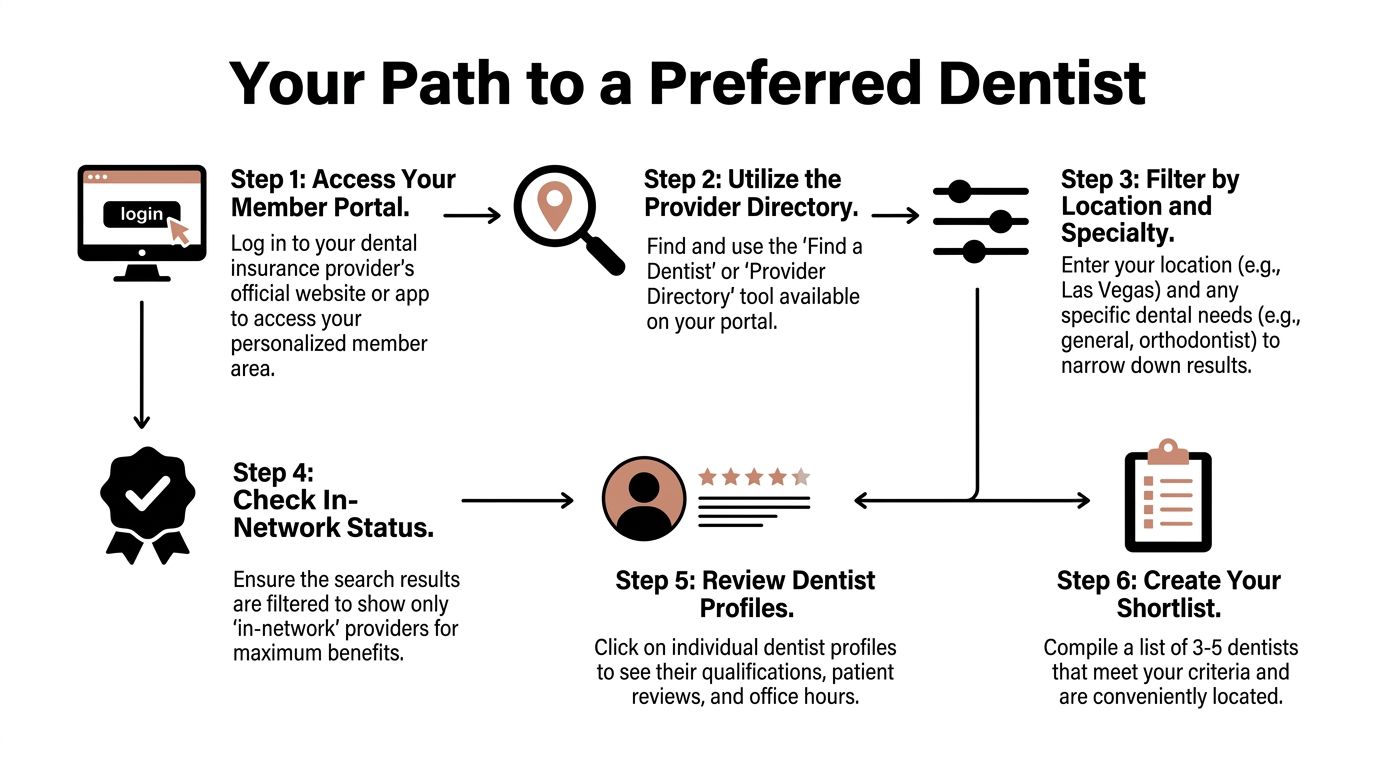
Many patients already have the first tool they need. It is the member portal connected to their dental insurance card. That portal is often more useful than a general web search because it starts with your plan, not just your location.
Start with the exact plan name
Open your insurer’s app or website and log in if you can. If the site allows guest searching, use it only if you have no other option. Logged-in searches often do a better job matching you to the network tied to your benefits.
Look at your ID card before you type anything in. Many patients know the insurance company name but not the exact network. That difference matters. A company may offer several networks, and the office may participate with one but not another.
Use filters that reflect your real needs
Do not search too broadly. If you need family dentistry, search for general dentistry. If you need Invisalign, restorative dentistry, or a consultation for dental implants, use those service filters if they are available.
A practical local search often includes:
- Location filter: Las Vegas, NV or your ZIP code
- Distance filter: A driving range that makes sense for follow-up visits
- Provider type: General dentist first, specialist only if needed
- Network filter: In-network only
- Service filter: Cleaning and exams, emergency care, cosmetic dentistry, orthodontic consults, or oral surgery depending on your concern
This is much easier than calling random offices one by one.
Add the ADA tool as a second directory
Insurance directories are not the only way to search. The ADA’s public directory can help you identify nearby dentists and compare options. The ADA’s findadentist.ada.org tool facilitated searches for over 200,000 ADA member dentists across the U.S. by 2023, and 75% of users identified nearby providers with it (Florida Blue Dental page discussing find-a-dentist tools).
That does not confirm network status by itself, but it is useful when you want to compare distance, office profile details, and whether the practice appears established in your area.
Build a short list that is realistic
Three to five offices is often enough. More than that turns the process into homework, and many patients stop before making calls.
A useful shortlist should include offices that fit your situation, not just your plan. Think about:
| What to compare | Why it matters |
|---|---|
| Office hours | Helpful for school schedules, work shifts, and urgent care |
| Services offered | Important if you may need more than a cleaning |
| Distance from home or work | Follow-up visits are easier when the office is convenient |
| Family scheduling | Useful if you want multiple household members seen together |
| Clear insurance communication | Saves time before the first appointment |
Practical takeaway: A good shortlist is not just “who is in network.” It is “who is in network and fits how my family gets care.”
For patients searching “dentist near me” in Desert Shores or Sun City Summerlin, this step is where the search becomes manageable. You are no longer looking at the entire city. You are choosing between a few workable options.
How to Verify In-Network Status and Coverage Details
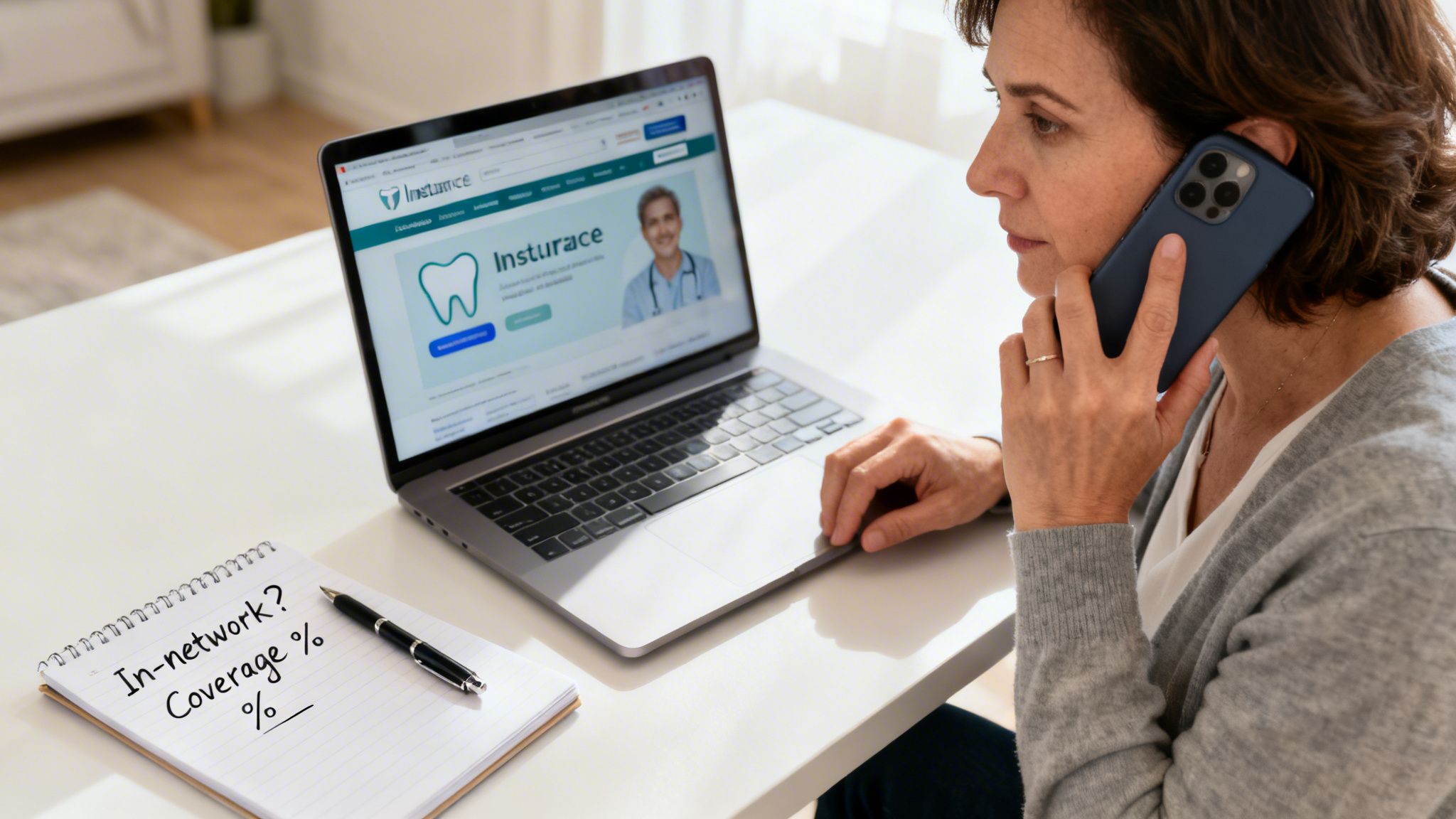
The directory got you close. The phone call provides the definitive answer.
Research on dental insurance searches shows that online directories are often not updated immediately when networks change, which is why direct phone verification with the dental office is part of the recommended process (guidance on why direct verification matters when checking in-network dentists).
Why the call matters
A listing might show the right dentist but the wrong network. It might show the office, but not clarify whether they accept your PPO plan, your HMO plan, or only certain products under that insurer.
Many surprise bills originate here. Not because a patient ignored insurance, but because the directory looked specific when it was still incomplete.
Use this phone script
When you call a dental office, keep your insurance card in front of you. You want to give the exact plan name, member ID, and any network name listed on the card.
You can say:
“Hi, I’m looking for a dentist in Las Vegas and I want to confirm whether your office is in network with my dental plan. The insurance company is [company name], and the plan or network on my card is [exact plan name]. Can you check whether you currently accept that specific plan?”
Then follow with these questions:
- Network confirmation: “Are you in network for this exact plan, not just this insurance company?”
- New patient status: “Are you currently accepting new patients with this plan?”
- Claim handling: “Do you file claims for patients, or would I need to submit anything myself?”
- Visit type: “I need [cleaning and exams / emergency visit / tooth extraction / implant consultation]. Is that service typically handled in your office?”
- Cost estimate process: “Can you help me understand what the insurance estimate might look like before I come in?”
- Records needed: “Should I bring my ID card, photo ID, and any recent dental X-rays?”
Ask one more question than patients commonly ask
Do not stop at “Do you take my insurance?”
Ask, “Can you tell me whether my plan usually treats this visit as preventive, basic, major, or not covered?” That wording often provides more useful information because the office can explain the category even when they cannot promise the final payment amount.
For a local patient comparing offices in Sunhampton or Painted Desert Estates, this question can make the difference between a routine first visit and a frustrating billing follow-up.
A short video can help if you want a quick refresher before making calls.
A simple email template
If you prefer email or a contact form, use something direct:
Hello, I’m a new patient in Las Vegas, NV. I would like to confirm whether your office accepts my dental insurance. My insurer is [company name], and my exact plan/network is [plan name]. I am looking for care for [routine exam, emergency pain, cosmetic consultation, Invisalign, extraction, implants].
Please let me know whether you are in network for this specific plan, whether you are accepting new patients, and what information you need from me to verify benefits. Thank you.
What works and what does not
Here is the honest version.
What works: Calling during business hours, giving the exact plan name, and asking about the procedure category.
What does not: Saying only the insurance company name, relying on an old screenshot from the insurer’s website, or assuming medical and dental networks are the same.
One local option patients can contact for plan verification and benefit questions is Aspiring Smiles Dental and Braces, which serves Las Vegas families and can help callers check whether their specific insurance information matches the office’s participation details.
Tip: If the first person you speak with cannot confirm the exact network, ask whether the office can verify benefits from the card information before you book.
Decoding Your Dental Benefits for Common Treatments
Finding an in-network office is only half the job. The next question is often the most important one: What will I pay.
Dental insurance is easier to use when you think of it in layers, not one blanket promise.
How most plans group care
Many plans follow a tiered structure. Preventive care such as cleanings, exams, and X-rays is typically covered at 100% with no deductible, basic procedures such as fillings and extractions are often covered at 50% to 80% after the deductible, and major restorative work such as crowns, root canals, and implants is often covered at 50% (plain-language overview of dental insurance coverage categories).
That structure matters because a patient searching for a dentist in Las Vegas, NV may be looking for very different things:
- A routine new patient exam
- Relief from pain and possible tooth extraction
- Cosmetic services like teeth whitening
- Restorative work such as crowns
- Replacement options like dental implants near me
Those are not usually handled the same way by insurance.
The terms that affect your estimate
A few insurance terms matter more than the rest.
| Term | Plain-English meaning |
|---|---|
| Deductible | The amount you may need to pay before certain covered services start applying |
| Copay | A set portion you may owe for a visit or service, depending on the plan |
| Coinsurance | Your share of the cost after insurance applies its portion |
| Annual maximum | The limit the plan may pay during the plan year |
| Waiting period | A delay before some services are covered under a new plan |
| Not covered | A service the plan excludes, even if it is valuable treatment |
Cosmetic treatments are a common point of confusion. A patient may assume a procedure that improves appearance is partly covered, but some plans classify cosmetic care separately. The right move is to ask the office how the insurer usually labels the specific treatment.
Match the benefit category to the visit
A cleaning and exam is one conversation. An implant consultation is another.
If you are planning care, ask the front desk for an estimate tied to the service you are considering. For example:
- Preventive visit: Ask whether the exam, cleaning, and X-rays fall under preventive benefits.
- Restorative visit: If you may need a filling or crown, ask about deductible and coinsurance.
- Emergency visit: If you are in pain, ask what part of the emergency evaluation may be covered before treatment starts.
- Cosmetic consultation: Ask whether the consultation itself is covered even if the final treatment is not.
If you want a more complete primer before you call, this page on how dental insurance works gives helpful background in patient-friendly language.
Key takeaway: Insurance estimates are most useful when they are tied to a specific procedure, not a general question like “How much will my insurance cover?”
Alternatives When an In-Network Dentist Isn't Available
Sometimes the search does not end neatly. You check the directory, make the calls, and the in-network options do not fit your needs, your schedule, or your location in Lone Mountain, Monterrey, or Painted Desert Estates.
That does not mean you are out of options.
When the network is the problem
This issue affects families more often than people expect. Recent 2025 HHS data says 22 million U.S. children on Medicaid and CHIP face dental deserts, which is one reason flexible alternatives matter for families who cannot easily find participating care (InsureKidsNow dentist locator and access information).
In practical terms, patients can run into several roadblocks:
- Limited availability: The office may be in network but not accepting new patients.
- Distance issues: The plan may list options, but they are not convenient for repeated visits.
- Service mismatch: A listed office may handle routine care but not the treatment you need.
- Schedule conflicts: Parents often need evening or Saturday availability that a directory does not explain well.
What to consider if you go out of network
Out-of-network care is not always the wrong choice. It depends on the urgency of your problem, the quality of communication from the office, and whether your plan offers any out-of-network reimbursement.
A patient with a painful broken tooth may reasonably choose the office that can see them quickly and explain fees clearly, even if that office is outside the preferred network. The same can apply if you are comparing offices for cosmetic dentistry, complex restorative work, or implant planning and want a practice that can coordinate the whole treatment process.
Why membership plans can solve the gap
For uninsured and underinsured patients, a membership plan can be simpler than forcing care through a plan that does not fit. Membership programs are often easier to understand because they are built around direct office pricing rather than deductibles, claim rules, and annual maximum confusion.
That kind of arrangement is especially useful for:
- Families needing routine care: cleanings, exams, and dental X-rays
- Patients delaying treatment: because coverage details feel unclear
- Adults considering larger treatment plans: including restorative or implant-related care
- People between jobs or benefits: who still want consistent care
If insurance falls short, a practice membership plan can bridge the gap with more predictable costs and clearer expectations. For many Las Vegas patients, that is better than waiting too long and letting a small issue turn into an emergency.
Practical takeaway: The best financial option is not always the directory option. It is the option that helps you get timely care with terms you understand.
What to Expect at Aspiring Smiles Dental and Braces
Once a patient finishes the insurance search, the next concern is often comfort. People want to know what the visit will feel like, how the office communicates, and whether the team will help them sort through details without making them feel rushed.
At 3211 N Tenaya Wy Suite 122, Las Vegas, NV 89129, patients can expect a modern setting designed for everyday family dentistry, cosmetic consultations, restorative care, and urgent visits. That convenience matters for households in Sunhampton, Mar-A-Lago, Desert Shores, and nearby neighborhoods that need a practical office location.

Your first visit
A first appointment starts with the basics done well. The front office helps gather insurance information and patient details. Clinical records are taken as needed, including dental X-rays for a more complete picture of your oral health.
From there, Dr. Patel and the team focus on what brought you in. Sometimes that is simple preventive care. Sometimes it is pain, a broken tooth, a cosmetic goal, or a larger restorative concern.
Care that fits real life
Many patients are balancing work, school schedules, and family responsibilities. Extended weekday hours and Saturday availability make that easier. For people searching “emergency dentist” or “dentist near me” in the northwest Las Vegas area, scheduling flexibility can matter almost as much as network status.
The office also provides a broad mix of care, which helps when your needs change over time. A patient might come in for a cleaning, return later for a crown, and eventually ask about Invisalign, veneers, or implants without having to start over at a new office.
Clear communication matters
Patients feel more at ease when the office explains findings in plain language. That includes what is urgent, what can wait, what insurance may help with, and what options exist if coverage is limited.
That kind of communication is especially helpful for new patients who have not been to the dentist in a while. A supportive conversation goes a long way toward making the next step feel manageable.
If you are looking for how to find a dentist that accepts my insurance and want help turning that search into a real appointment, contact Aspiring Smiles Dental and Braces. The team can help you understand your options, verify plan details, and schedule the dental care you need in Las Vegas, NV.