Can Invisalign Fix Overbite? See How It Works
If you're looking in the mirror, seeing your upper teeth sit too far over your lower teeth, and wondering whether clear aligners can really help, you're asking the right question. In Las Vegas, many patients want a straighter smile without the look of braces, but they also want a real answer about function, comfort, and whether treatment will work for their bite.
The short answer is yes, Invisalign can fix many overbites, especially when the problem is primarily tooth position rather than a major jaw discrepancy. The more useful answer is that success depends on the kind of overbite you have, how your treatment is planned, and how consistently you wear the aligners.
Your Trusted Las Vegas Dentist for Invisalign Overbite Correction
A lot of people with an overbite have been thinking about it for years before they ever schedule a visit. Some are bothered by photos. Some notice their front teeth hitting in an awkward way. Others are tired of feeling like their smile looks “off,” even if they can’t explain exactly why.
That’s common in a social city like Las Vegas. Whether you work with the public, spend weekends with family in Desert Shores, or commute from Sun City Summerlin or Painted Desert Estates, you want a smile that feels healthy and natural, not one you have to hide.
An overbite can also be frustrating because online answers are often too simple. Patients read that Invisalign works, then read somewhere else that it doesn’t. Both statements can be true depending on the case.
What patients usually want to know first
Most new patients ask some version of these questions:
- Will Invisalign move my bite or just straighten my teeth
- Will I need attachments or elastics
- How long will treatment take
- Am I a good candidate, or am I heading toward braces anyway
Those are the right questions because overbite correction isn't just about making teeth look even. It’s about getting the upper and lower teeth to meet better.
A well-planned Invisalign case should improve how your bite functions, not just how your smile looks in a photo.
What a practical answer looks like
For some Las Vegas patients, the answer is straightforward. Their overbite is mild to moderate, their teeth are healthy, and clear aligners are a very reasonable path. For others, the scan shows a stronger jaw-position problem, and that changes the recommendation.
That’s why the first step isn’t guessing from selfies or internet charts. It’s evaluating the bite in person, looking at tooth position, jaw relationship, wear patterns, and whether the plan will be predictable in daily life.
Patients searching for a dentist near me, a cosmetic dentist near me, or a dentist in Las Vegas, NV often start with appearance. That’s understandable. But the best overbite treatment plans also protect teeth from unnecessary wear and help support long-term comfort.
Understanding Your Overbite and Its Health Impact
An overbite means the upper front teeth overlap the lower front teeth more than they should. A small amount of overlap is normal. The issue starts when that overlap becomes excessive and begins to affect appearance, tooth wear, or jaw comfort.
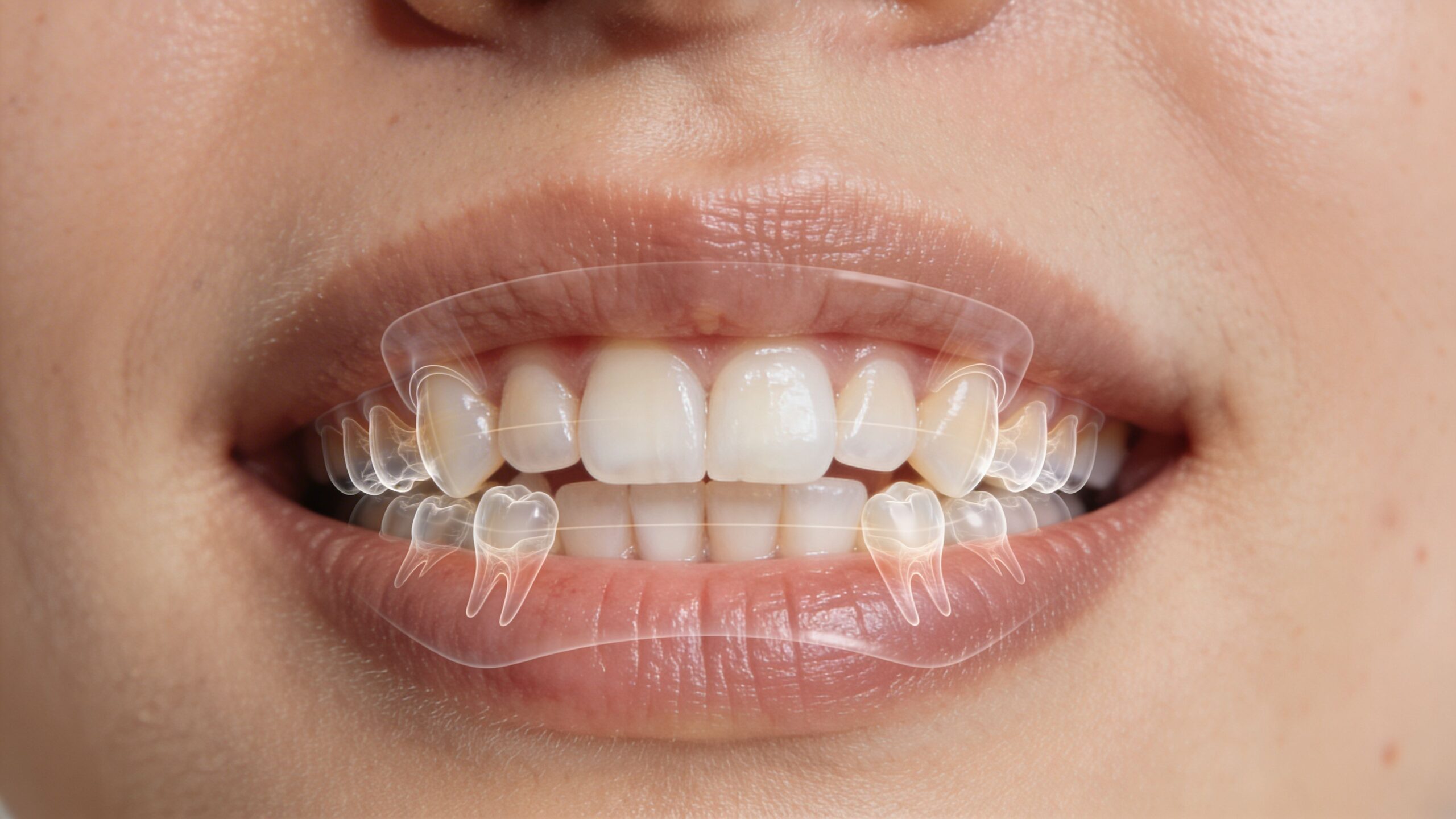
Dental overbite versus skeletal overbite
This distinction matters more than most patients realize.
A dental overbite is mainly about tooth position. The teeth are tipped, crowded, or positioned in a way that creates too much vertical overlap. These cases are often more responsive to aligner treatment.
A skeletal overbite is more about jaw position. The upper and lower jaws don't relate ideally, and the bite issue isn't coming only from the teeth.
Think of it this way:
- Dental overbite means the teeth are parked in the wrong spots.
- Skeletal overbite means the foundation itself is part of the problem.
That difference is why one patient can be an excellent Invisalign candidate while another needs a more involved plan.
Why overbites aren't just cosmetic
People often start by noticing the look of their smile, but overbites can affect comfort and oral health too.
Common problems include:
- Tooth wear because front teeth contact in a way they shouldn’t
- Jaw strain when the bite forces the joints and muscles to work unevenly
- Chewing difficulty if the teeth don’t meet in a balanced way
- Speech concerns in some cases
- Gum irritation when lower teeth contact tissue behind the upper front teeth
If you already deal with jaw soreness, popping, or tension headaches, a bite issue may be part of the picture. For patients trying to understand that connection, this overview of Temporomandibular Joint Dysfunction (TMD) is a useful resource.
Some patients come in asking for straighter teeth and only realize later that their bite may be contributing to the jaw discomfort they’ve been living with.
Why diagnosis comes before treatment choice
Many generic articles fall short, as they skip the part where candidacy is decided.
For severe skeletal overbites in adults, success with Invisalign alone drops below 50% according to the source discussed in this section, which is why a 3D scan at the office matters so much for separating a jaw-position problem from a tooth-position problem before treatment begins (https://www.nationalorthodontist.com/blog/does-invisalign-fix-overbite?p=qgSP3yXkGYXkeAdsL).
That early distinction helps avoid the most common mistake in overbite treatment. Starting with the wrong tool.
How Invisalign Technology Corrects an Overbite
When patients ask, “can invisalign fix overbite,” they’re often picturing a simple clear tray. In reality, overbite correction usually involves a much more detailed system.
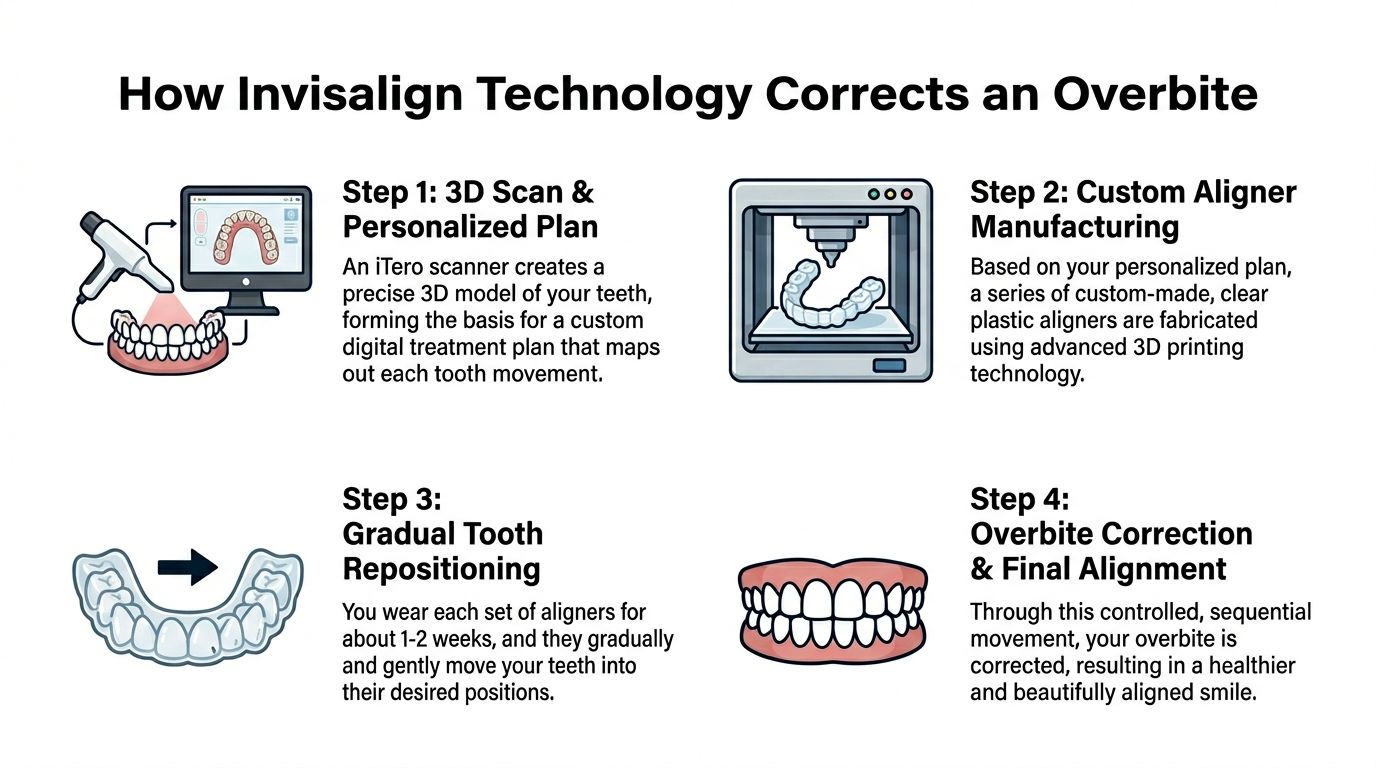
It starts with a 3D digital plan
The process begins with a digital scan of your teeth. That scan creates a model of your bite so treatment can be mapped before you ever start wearing trays.
Instead of thinking of Invisalign as a single appliance, it’s better to think of it as a sequence of planned tooth movements. Each aligner is one step in that sequence. The goal isn't random straightening. The goal is guided repositioning.
What the aligners are doing
Clear aligners place gentle, controlled pressure on selected teeth. For overbite cases, that movement may include:
- bringing certain front teeth into a better vertical position
- helping lower teeth come into a more favorable relationship
- improving how upper and lower arches meet
- coordinating movement so the bite changes as the teeth align
Some overbite cases can be treated with aligners alone. Many need additional tools to make the movement more precise.
Why attachments and elastics are often part of the plan
Patients are sometimes surprised when they hear they may need small attachments or rubber bands. That doesn’t mean treatment is failing. It usually means the case is being treated properly.
To correct an overbite, Invisalign may use attachments, which are small composite buttons bonded to teeth for grip, and it may also use elastics applying a specific amount of force in a Class II configuration. For teens, Invisalign with Mandibular Advancement includes precision wings that gradually move the lower jaw forward over 12-24 months (https://www.innovativeorthocenters.com/invisalign-treatment-with-mandibular-advancement/).
Here’s what that means in real life:
- Attachments help the aligner hold and direct force more accurately.
- Elastics help guide the bite relationship between the upper and lower arches.
- Precision wings are used in growing patients when jaw guidance is part of treatment.
What day-to-day wear feels like
Most patients adjust quickly, but the first days with a new aligner can feel tight. That pressure is expected. It means the tray is engaging the planned movement.
Daily life with overbite Invisalign usually includes:
- Wearing aligners through the day and night except for meals and hygiene.
- Reinserting them after coffee, snacks, and lunch, not hours later.
- Changing to the next set on the schedule provided.
- Using elastics exactly as prescribed if they’re part of the case.
Practical rule: If your aligners are spending long stretches in a napkin, cup, or car console, your bite correction will slow down.
Why supervision matters
Overbite correction is not a mail-order situation. Teeth can look straighter before the bite is corrected, which is one reason follow-up visits matter. The plan has to be checked, refined when needed, and adjusted to how your teeth are responding.
Tools and planning are also important. At Aspiring Smiles Dental and Braces, overbite Invisalign treatment is built around digital imaging and case-specific planning so the movement is based on your actual bite, not a generic template.
Are You a Good Candidate for Invisalign Treatment
Some patients know right away they want clear aligners. The better question is whether clear aligners fit the kind of overbite they have and the kind of daily habits they can realistically maintain.

The strongest candidates
Invisalign is usually most appropriate when the overbite is mild to moderate and the patient is willing to wear the trays as directed.
Clinical data shows Invisalign achieves an 80-90% success rate for correcting mild to moderate overbites, with mild cases sometimes finishing in under 12 months and moderate cases averaging 12-18 months, depending on wearing aligners for 20-22 hours daily (https://richmondtxdentists.com/blog/invisalign-effectiveness/).
That last part matters as much as the diagnosis. Invisalign only works when it’s in your mouth.
A quick self-check before you book
You may be a good candidate if:
- You want a discreet option and don’t want brackets on your teeth
- You can follow a routine around meals, brushing, and reinserting trays
- Your schedule is busy and you value fewer interruptions to daily life
- Your overbite seems manageable rather than obviously severe or jaw-driven
You may need a different recommendation if your bite problem looks strongly skeletal, if you know you won’t wear trays consistently, or if your case needs more fixed control.
For a deeper look at candidacy questions, this page is a useful next step: https://aspiringsmileslasvegas.com/blog/am-i-a-good-candidate-for-invisalign/
Adults and teens aren't always the same
Adults often make excellent Invisalign patients because they’re motivated and consistent. Teens can do very well too, especially when treatment is supervised closely and the plan fits growth and compliance.
A teenager with an overbite may also need elastics or a jaw-guidance feature. An adult with a similar-looking smile may not be treatable the same way because growth has already finished.
This short video gives helpful visual context on how aligner treatment is evaluated in real life.
The part patients underestimate
Patients often focus on whether Invisalign can work. Fewer ask whether they’re likely to follow the routine well enough for it to work.
That’s the honest trade-off with removable treatment. If you’re disciplined, Invisalign can be a very attractive option. If you know you tend to lose things, snack frequently without putting trays back in, or ignore elastics, braces may be the more dependable path.
Invisalign vs Traditional Braces for Overbites
If your main concern is whether clear aligners are “better” than braces, the answer depends on what better means to you. For some patients, better means less visible. For others, it means stronger control in a difficult case.
Compared with braces, Invisalign offers meaningful lifestyle advantages. Patients report 70% less pain, office visits are reduced by 40%, and aligner removability lowers decay risk by 25% because brushing and flossing are easier (https://www.invisalign.com/resources/treatable-cases/overbite).
Invisalign versus braces in practical terms
| Feature | Invisalign | Traditional Braces |
|---|---|---|
| Appearance | Clear and low-profile | More visible on the teeth |
| Comfort | Often preferred by patients who want less irritation | Fixed hardware can rub cheeks and lips |
| Oral hygiene | Easier to brush and floss because trays are removable | Cleaning takes more effort around brackets and wires |
| Eating | Remove aligners to eat | Food restrictions are more common |
| Office routine | Fewer visits for many patients | More adjustment visits are common |
| Mild to moderate overbites | Often a strong option | Also effective |
| Severe or more complex cases | May be limited depending on jaw relationship | Often offers more fixed control |
Which one works better for your case
Honest planning is critical here. If a patient has a manageable dental overbite and will wear aligners properly, Invisalign can be a very appealing choice. If the overbite is more complex, braces may give more direct control.
The best appliance is the one that matches the biology of the case and the habits of the patient.
If you’re comparing both systems side by side, this page adds more detail: https://aspiringsmileslasvegas.com/las-vegas-nv/invisalign-vs-traditional-braces/
Patients who come in asking for a cosmetic dentist near me often prefer Invisalign for appearance. Patients looking for broader care from a dentist in Las Vegas, NV may also be balancing other needs like cleanings and exams, restorative dentistry, teeth whitening, or planning around existing crowns and dental work. Those details can influence which orthodontic option makes the most sense.
Your Invisalign Journey at Aspiring Smiles in Las Vegas
Most patients feel better about treatment once they know what the process looks like. Overbite correction is easier to commit to when the steps are clear and the timeline isn't a mystery.
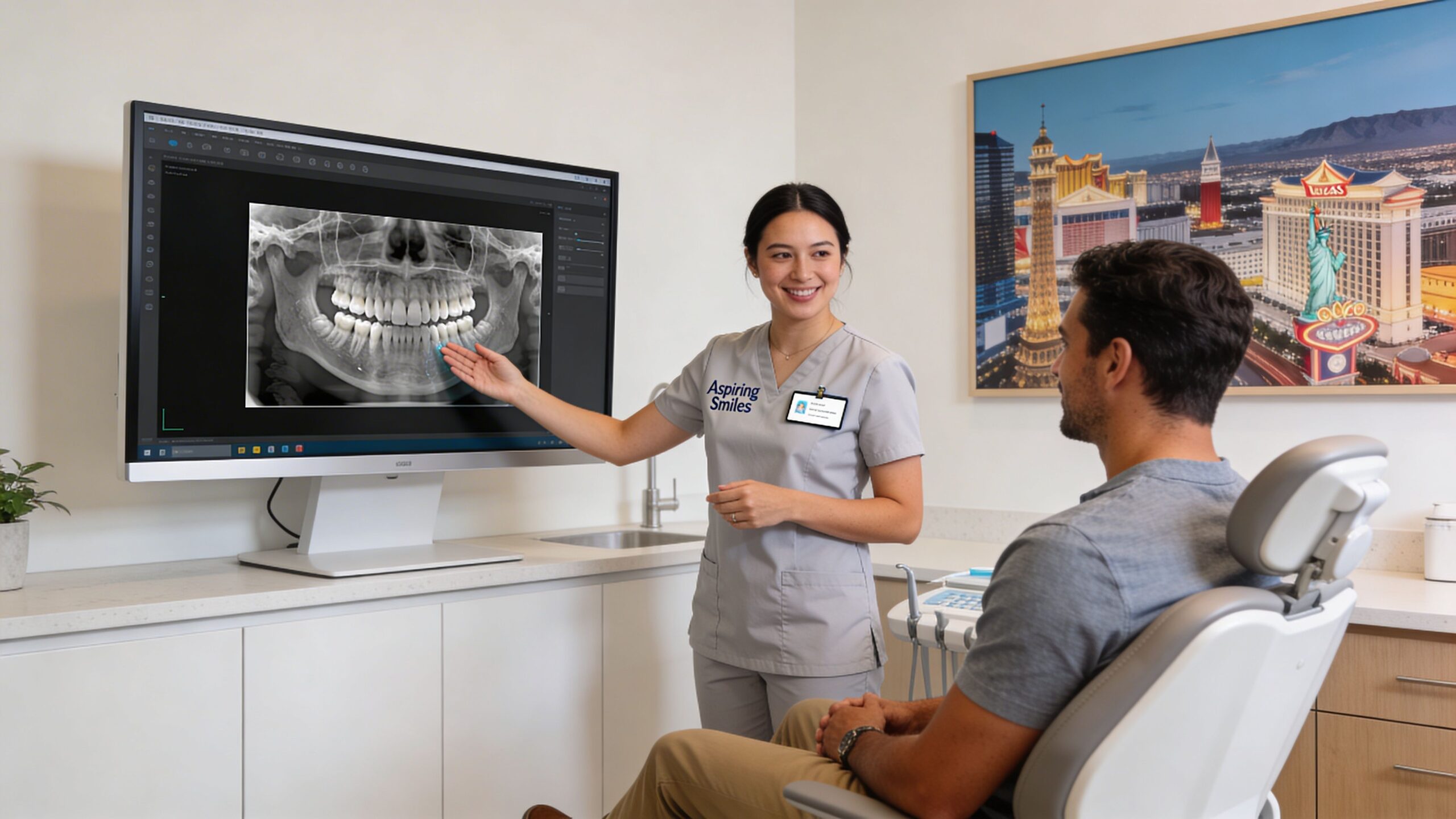
Your first visit
It starts with a consultation at 3211 N Tenaya Wy Suite 122, Las Vegas, NV 89129. We examine the bite, review your goals, and use 3D imaging to see whether the overbite is primarily dental, skeletal, or mixed.
That appointment is also where we discuss the practical side. If attachments are likely, you’ll know. If elastics may be needed, you’ll know. If braces or another approach would be more predictable, that should be said early.
What treatment usually looks like
A typical Invisalign treatment for overbite takes an average of 18 months and involves about 24 sets of aligners, based on the study referenced here (https://pmc.ncbi.nlm.nih.gov/articles/PMC11000900/).
For patients, that usually means:
- A mapped-out start with digital planning rather than messy impressions
- Receiving your aligners with clear instructions for wear and cleaning
- Periodic check-ins to make sure teeth and bite are tracking properly
- Refinements if needed when small adjustments help finish the case well
What day-to-day life is like during treatment
You’ll remove your aligners to eat, brush, and floss. That makes it easier to keep up with oral hygiene than with fixed appliances. Many patients also like being able to continue work, school, and social routines with less visibility.
For families in Lone Mountain, Desert Shores, Monterrey, Mar-A-Lago, Sunhampton, and Painted Desert Estates, the biggest advantage is often predictability. You know what you’re wearing, when you’re changing trays, and what the next checkpoint is.
Overbite treatment can also fit into broader dental care. Some patients are also due for cleaning and exams, dental x-rays, or cosmetic dentistry planning after orthodontic treatment. Others may need restorative dentistry first so the bite is being moved around healthy teeth and gums.
Common Questions About Invisalign and Overbite Correction
Does Invisalign hurt when it starts moving the bite
Most patients describe pressure more than pain. New trays can feel tight for the first few days, especially when the bite is actively changing. Attachments and elastics can add to that adjustment period, but it usually becomes manageable quickly.
Will I need attachments if I only want clear trays
Maybe. Many overbite cases do better with attachments because they help the aligners grip and direct specific tooth movements. If your case needs them, they’re part of making the treatment work, not a sign that something is wrong.
Can adults still fix an overbite with Invisalign
Often, yes. Adults can be excellent candidates when the issue is tooth position or a manageable bite discrepancy. When the overbite is strongly related to jaw position, the recommendation may shift toward a different or combined approach.
How much does Invisalign cost in Las Vegas
The cost depends on the complexity of your bite, how many aligners are needed, whether attachments or elastics are part of the plan, and whether additional refinement is expected. The most accurate way to get an answer is during a consultation after the bite is scanned and evaluated.
Will I need a retainer after treatment
Yes. Retention matters after any orthodontic treatment. Teeth naturally want to drift, and overbite correction should be maintained with the retainer plan you’re given.
Finishing treatment doesn't protect the result. Wearing the retainer does.
What if I also need other dental work
That’s common. Some patients asking about Invisalign also need routine dental care, cosmetic dentistry, or restorative treatment. In other cases, someone may first arrive searching for an emergency dentist, tooth extraction, or even dental implants near me, then later ask about improving bite alignment once urgent issues are handled. The right sequence depends on your oral health, not just your smile goals.
If you’re in Las Vegas, NV and want a clear answer about whether Invisalign can fix your overbite, schedule a consultation with Aspiring Smiles Dental and Braces. We’ll evaluate your bite with 3D imaging, explain what’s realistic, and help you decide on a treatment plan that fits your teeth, your goals, and your daily life.