What Do Dentist Use to Fill a Cavity?
A small zing when you sip something cold. A rough spot you keep finding with your tongue. Maybe a dark area on a back tooth that wasn’t there before. That’s often how people start asking, what do dentist use to fill a cavity, and whether the fix will be simple, noticeable, or painful.
Most cavities are very treatable when caught early. The part that worries people usually isn’t the filling itself. It’s the uncertainty. Patients want to know what material goes in the tooth, how long it lasts, whether it will show when they smile, and if there’s a mercury-free option that feels right for their family.
If you’re looking for a dentist in Las Vegas, NV, it helps to have answers in plain language before you sit in the chair. The goal isn’t just to repair a tooth. It’s to choose a filling that fits your health needs, appearance goals, and budget, while keeping the visit comfortable from start to finish.
Your Trusted Dentist for Cavity Fillings in Las Vegas
A lot of cavity visits begin the same way. Someone in Desert Shores or Sun City Summerlin notices a little sensitivity and hopes it goes away. A parent in Painted Desert Estates spots a mark on a child’s tooth and wonders if it’s urgent. Another patient near Lone Mountain puts off calling because they’re worried the appointment will hurt more than the tooth does.
That hesitation is understandable.
Patients don’t need a lecture when they have a cavity. They need a calm explanation. They want to know what’s happening, what the dentist sees, and what their choices are. That’s especially true if they’re deciding between a tooth-colored filling and a more traditional material.
What patients usually want to know first
Before treatment starts, most questions sound like this:
- Will the filling match my tooth
- Is there a mercury-free option
- Can you save most of my natural tooth
- How long will the appointment take
- What if the cavity is deeper than I thought
Those are the right questions to ask.
Practical rule: The best filling isn’t the same for every person. It depends on where the cavity is, how large it is, how much bite pressure that tooth handles, and what matters most to you.
For families in Sunhampton, Monterrey, and Mar-A-Lago, local dental care should feel personal, not rushed. That matters whether you need a routine exam, an emergency dentist visit for sudden tooth pain, or guidance about restorative dentistry and cosmetic dentistry options.
A dental office that communicates well often earns trust long before treatment begins. If you’re curious how practices think about patient communication and attracting new dental patients, that article gives helpful perspective on what people look for when choosing care. Clear explanations and a comfortable experience are always near the top of the list.
Why Cavities Form and Why Treatment Matters
A cavity usually begins before you can see or feel it. You might be eating, drinking, and brushing as usual while a weak spot is slowly forming in the enamel.
When mouth bacteria break down sugars and starches, they produce acid. That acid softens the outer layer of the tooth. If the area does not get a chance to recover, the enamel loses minerals, the surface breaks down, and a small opening forms. That opening is a cavity.
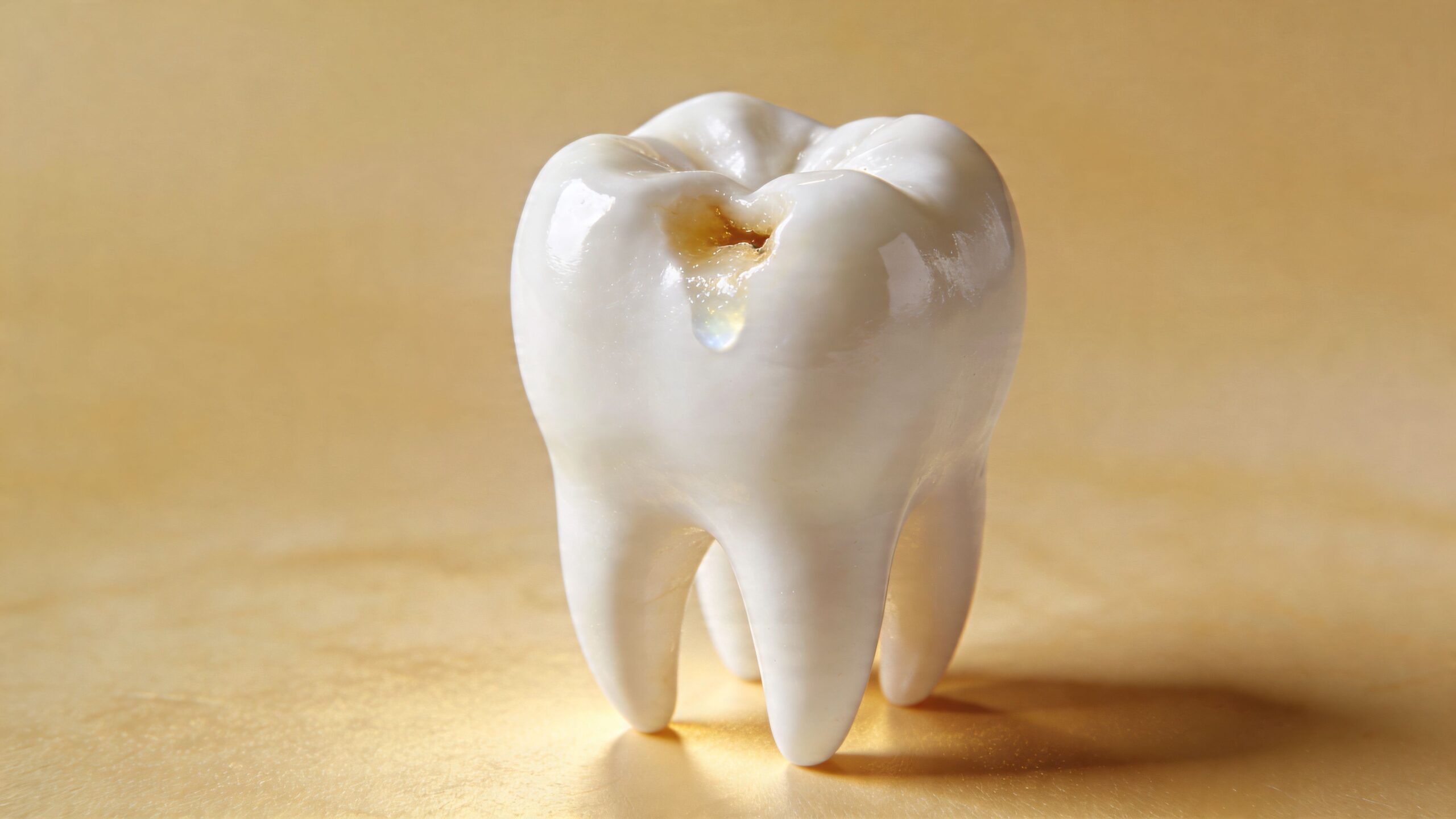
A cavity works much like a pothole in a road
A tiny weak spot can stay easy to miss at first. Then daily pressure makes it worse. Every time you chew, clench, sip something cold, or eat something sweet, that damaged area is asked to do more work than it can handle.
That is why dentists prefer to treat decay early. A small cavity is often a straightforward repair. Once decay reaches deeper layers of the tooth, the problem becomes less about filling a spot and more about protecting the nerve, preserving enough healthy structure, and keeping the tooth comfortable to use.
Why early treatment matters to you
For many Las Vegas families, the biggest question is not only "What do dentists use to fill a cavity?" It is also "How serious is this, and what happens if I wait?"
Here is the practical answer:
- Sensitivity can increase as decay moves closer to the inner part of the tooth
- The filling may need to be larger because more damaged tooth structure must be removed
- The cost and time can go up if the tooth needs a crown or other treatment instead of a simple filling
- Pain can appear suddenly when a cavity gets close to the nerve
- Saving the tooth can become harder if infection or a crack develops
A filling does more than close a hole. It rebuilds the tooth so food does not pack into the area, bacteria do not keep tunneling inward, and the tooth can handle normal chewing again.
Many patients are surprised by one thing. Cavities do not always hurt right away. Enamel has no nerve inside it, so decay can grow unnoticed for a while. By the time pain starts, the cavity may already be deeper than expected.
That is one reason routine exams matter so much. Your dentist can often spot early decay during a checkup or on x-rays, explain what is happening in plain language, and help you choose treatment before the situation turns urgent. If you want a fuller overview of the different types of dental fillings, it helps to review the materials before deciding what fits your health goals, appearance preferences, and budget.
For patients in Las Vegas who prefer mercury-free dentistry, catching a cavity early also creates more flexibility. Smaller areas of decay are often easier to restore with conservative, tooth-colored options, which can be a better fit for families who want a natural look and a metal-free choice.
Comparing Your Dental Filling Options
Dentists use several materials to fill cavities. The right one depends on the tooth, the size of the cavity, your bite, and your priorities. For many patients, the decision comes down to three things: appearance, durability, and cost.
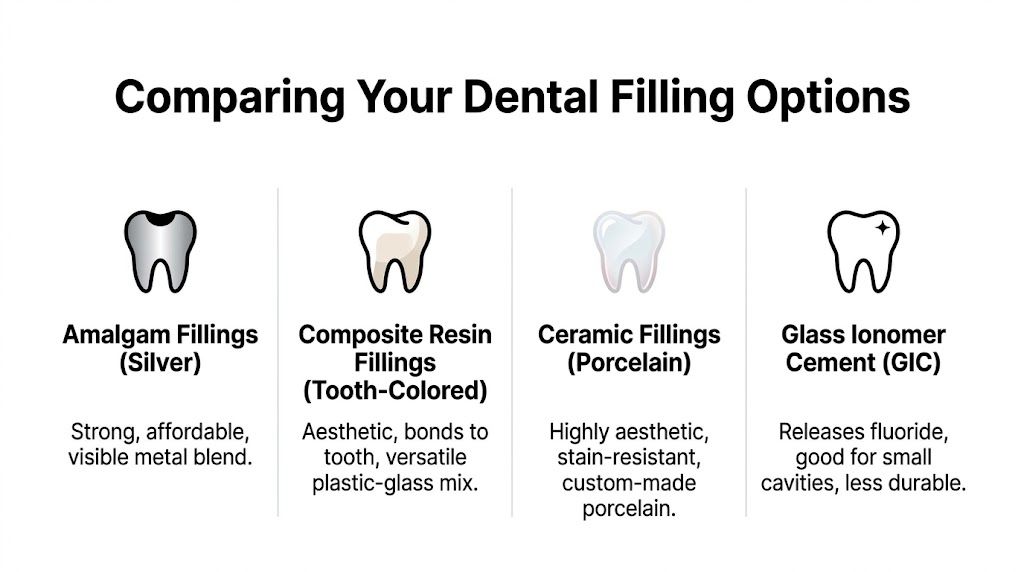
A simple side by side view
| Filling material | How it looks | Where it’s often used | Main tradeoff |
|---|---|---|---|
| Composite resin | Tooth-colored | Front teeth and many back teeth | Strong and natural-looking, but technique matters |
| Silver amalgam | Silver metal | Back teeth under heavy chewing force | Durable and cost-conscious, but visible |
| Ceramic | Very natural-looking | Larger restorations and cosmetic-focused cases | Attractive and stain-resistant, often more involved |
| Glass ionomer | Less polished appearance | Small areas and certain low-stress uses | Can release fluoride, but less durable than stronger options |
What many patients in Las Vegas choose
Tooth-colored fillings have become a common choice for patients who want a natural look. Fact.MR reports that composite fillings hold a 33% market share in 2025, ahead of silver amalgam at 24%, within a market projected to grow from USD 2.7 billion in 2025 to USD 4.2 billion by 2035 according to Fact.MR.
That trend makes sense in everyday practice. Many adults don’t want metal showing when they laugh. Parents often prefer a mercury-free option when appropriate. Patients exploring cosmetic dentist near me searches are usually thinking the same way. They want the repair to blend in.
How each option fits different priorities
Some patients care most about appearance. Others want the longest track record for a back molar. Some want to keep costs manageable. That’s why the conversation matters more than the material list alone.
Here’s a practical way to consider this:
- If appearance matters most, composite or ceramic usually gets the most attention.
- If the tooth takes heavy chewing force, durability becomes a bigger factor.
- If you want mercury-free choices, composite, ceramic, and glass ionomer are the options patients often ask about.
- If the cavity is small or in a specific low-stress area, glass ionomer may come up in the discussion.
For a broader patient guide, this page on the different types of dental fillings can help you compare choices before your appointment.
The best question isn’t “Which filling is best overall?” It’s “Which filling makes the most sense for this tooth?”
Composite Resin The Modern Choice for Cosmetic Dentistry
When patients ask what do dentist use to fill a cavity today, composite resin is often the answer they hear most. It’s tooth-colored, versatile, and designed to bond directly to the tooth.
That bonding matters for more than appearance.
Why many patients prefer composite
Composite resin is a blend designed to match the shade of your tooth closely. When placed well, it can be hard for anyone else to notice. That’s why it’s popular for visible teeth and for adults who want their dental work to look subtle.

It also allows a more conservative approach. According to the NIDCR, composite resin fillings can conserve 20 to 30% more healthy tooth enamel than amalgam because they bond directly to the tooth. The same source notes that modern nanocomposites can achieve flexural strength of 120 to 150 MPa and have shown 85 to 92% survival rates in 10-year studies for certain cavity types when placed correctly as described by the NIDCR.
In plain terms, that means your dentist can often remove less healthy tooth structure than with older approaches that depended more on shape and mechanical hold.
Why bonding is a big advantage
A bonded filling works a bit like a fitted patch that attaches to the tooth rather than resting inside it. That can help support the remaining tooth structure and create a close seal when the tooth is prepared properly.
Patients often like composite for these reasons:
- Natural appearance that blends with nearby teeth
- Conservative treatment because less healthy enamel may need to be removed
- Versatility for both small and moderate repairs in many parts of the mouth
- Mercury-free material for patients who want that option
When composite makes the most sense
Composite is often a strong fit when the cavity is visible in the smile line, when a patient prefers a mercury-free restoration, or when preserving tooth structure is a priority.
A practice such as Aspiring Smiles Dental and Braces offers composite fillings as part of restorative care, alongside exams, cosmetic dentistry, and other treatment options for patients who want a natural-looking result.
If your first concern is “Will anyone see my filling?”, composite is usually where the conversation starts.
That doesn’t mean it’s the right choice for every single tooth. Bite pressure, grinding habits, moisture control during placement, and cavity size all still matter. But for many Las Vegas patients balancing appearance and function, composite is the option that checks the most boxes.
Silver Amalgam Fillings Durability and Health Facts
Silver amalgam has a long history in dentistry. It has been used for over 150 years and is made from a mixture of silver, tin, copper, and mercury. It has remained common because it’s durable and cost-effective, especially for back teeth that take heavy chewing pressure. Grand View Research notes that the global dental fillings market was valued at USD 7.3 billion in 2024 and is projected to grow at a 6.8% CAGR from 2025 to 2030, with silver amalgam remaining widely used because of its proven strength and FDA approval for children aged six and older in Grand View Research’s dental fillings market analysis.
That history matters. So do patient concerns.
Why some dentists still consider it
Amalgam has been known for holding up well in hard-working molars. The material has been valued for practical reasons:
- Durability in posterior teeth
- Long service life, often up to 10 to 15 years or more in the U.S. market description from the same Grand View Research source
- Cost-effectiveness for patients weighing budget along with function
For some people, especially when appearance isn’t the main concern, that can make amalgam part of the conversation.
Why patients ask about mercury
Many families feel uneasy when they hear that amalgam contains mercury. That concern is common, and it deserves a direct answer.
The ADA considers amalgam safe for most patients. At the same time, the FDA’s 2020 guidance advises against its use in high-risk groups such as pregnant patients or children under 6, and one study cited in the patient education summary found 25% of parents prefer mercury-free options for their children as noted in this CareCredit overview of filling types.
A practical way to decide
If you’re choosing between amalgam and a mercury-free option, these are the usual decision points:
- Health priorities if you are pregnant, choosing care for a young child, or prefer to avoid mercury-containing materials
- Visibility because silver fillings are noticeable
- Tooth location since back molars handle more force than front teeth
- Personal comfort because some patients don’t want to worry about the issue at all
You don’t need to guess your way through this decision. A good consultation should include a clear explanation of which materials fit your tooth and which ones fit your preferences.
For many Las Vegas families, mercury-free options are a meaningful part of the conversation, even when amalgam remains a recognized restorative material.
Your Comfortable Cavity Treatment at Aspiring Smiles
Patients feel better once they know how the visit will go.
You arrive, check in, and settle into the chair. If it’s your first time in the office, the team reviews your health history, listens to what you’ve noticed, and takes the concern seriously. If you came in because of pain, the visit starts there.

What the appointment usually feels like
First comes the exam. The dentist checks the tooth, reviews any needed dental x-rays, and explains whether the area is a stain, a worn spot, or active decay. Patients often say this is the moment their stress drops, because they finally know what’s going on.
If a filling is recommended, the next step is simple communication. You’ll hear which material fits the tooth best, whether a tooth-colored option makes sense, and what to expect during numbness and treatment.
Common parts of the visit include:
- A gentle exam to locate the problem and check nearby teeth
- Clear treatment planning so you understand your options before anything starts
- Local numbing to keep the area comfortable
- Decay removal and filling placement with attention to bite and fit
- Final bite check so the tooth feels normal when you close down
Comfort matters during the whole visit
The filling itself is usually straightforward. After the area is numb, the dentist removes the decayed portion, places the chosen material, shapes it, and checks how your teeth meet.
Patients from Desert Shores, Sunhampton, and Lone Mountain often worry most about the shot or the sound of the drill. Those concerns are common. A gentle approach, clear updates, and short pauses when needed can make the visit feel much easier than expected.
If you want a more detailed walkthrough before your appointment, this guide on what to expect during a dental filling procedure answers the questions patients ask most.
Here’s a visual overview that can help make the process feel familiar before you come in.
Most filling appointments are easier than patients expect. Knowing the steps ahead of time takes away much of the fear.
If the cavity turns out to be more advanced, the dentist will explain that too. Some teeth need more than a filling. But when a filling is the right solution, the visit is usually efficient, predictable, and focused on getting you comfortable again.
Caring for Your New Filling and Common Questions
Once the filling is done, patients can typically return to normal daily activities quickly. A little tenderness or temperature sensitivity can happen for a short time, especially if the cavity was deeper.
Smart aftercare at home
A few simple habits help your tooth settle in well:
- Chew carefully at first if your mouth is still numb, so you don’t bite your cheek or tongue
- Keep brushing and flossing around the tooth, because fillings still need a clean environment
- Notice your bite if the tooth feels high or hits first when you close
- Call if sensitivity lingers or if you feel a sharp edge, pressure, or pain when chewing
Common questions patients ask
How long will my filling last?
It depends on the material, the size of the filling, your bite, and your home care. Some last many years with good hygiene and regular exams.
Will insurance cover it?
Many plans help with restorative dental care, but coverage varies. The office can usually help you review benefits before treatment.
What if my bite feels off?
Call the office. A small adjustment can make a big difference.
Can I get a tooth-colored filling on a back tooth?
Often, yes. Your dentist will look at cavity size, tooth position, and chewing pressure before recommending it.
Schedule Your Dental Exam in Las Vegas Today
If you’ve been wondering what do dentist use to fill a cavity, the short answer is that you have options. Today’s fillings can restore strength, protect your tooth, and in many cases blend naturally with your smile.
If you’re in Las Vegas, NV or nearby neighborhoods like Sunhampton, Mar-A-Lago, Painted Desert Estates, or Sun City Summerlin, it’s worth getting that sensitive or suspicious tooth checked before it becomes a bigger problem. Whether you need a routine exam, restorative dentistry, or help from an emergency dentist, early care makes things easier.
If you’re ready to stop guessing and get a clear answer, schedule a visit with Aspiring Smiles Dental and Braces. The office welcomes new patients in Las Vegas and can help with cavity exams, tooth-colored fillings, dental x-rays, emergency concerns, and treatment plans built around your comfort.