Opalescence Teeth Whitening in Office: A Las Vegas Guide
A lot of people start looking into teeth whitening right before something important. A wedding on the Strip. Updated headshots for work. A reunion. Sometimes it's less dramatic than that. You catch your reflection in bright Las Vegas sunlight, notice coffee or wine stains that weren't there before, and decide your smile doesn't match how polished you feel.
That's usually when searches like cosmetic dentist near me or dentist in Las Vegas, NV start. Patients want something that works quickly, looks natural, and feels safe. They also want real guidance, not a one-size-fits-all pitch.
Your Trusted Cosmetic Dentist in Las Vegas for a Brighter Smile
If you live in Las Vegas, you already know how often your smile is on display. Social events, work meetings, family photos, and everyday conversations all feel a little different when you're self-conscious about yellowing or stained teeth. That concern is common for patients from Sun City Summerlin, Painted Desert Estates, Desert Shores, and nearby neighborhoods who want a fresher look without jumping straight into veneers or other major cosmetic treatment.

Why patients look for in-office whitening
Some people have tried whitening strips and felt underwhelmed. Others worry that over-the-counter products will make their teeth sensitive without giving them the brighter smile they want. In-office treatment is appealing because it puts the process in a dental setting, where a clinician can check your teeth, evaluate old dental work, and decide whether whitening is the right cosmetic move.
That matters more than many patients realize. Not every discoloration responds the same way, and not every smile is a good match for the same treatment.
A good whitening plan starts with the reason your teeth changed color, not just the shade you want to reach.
For local patients, the practical part matters too. You may be comparing whitening while also looking for a dental home for cleanings and exams, new patient exams, dental x-rays, or future cosmetic and restorative care. If you've also been searching terms like dentist near me, emergency dentist, or even dental implants near me, it helps to choose an office that can look at the full picture of your oral health.
Trust matters before any cosmetic treatment
Reviews often shape that first call. If you're evaluating any dental office, one helpful tool is this guide for create Google review links, which shows how practices make it easier for patients to leave feedback and for new patients to verify real experiences.
At Aspiring Smiles Dental and Braces, whitening conversations usually begin with the same question: what are you hoping to change, and what would feel like a successful result to you? That's the right place to start if you want a smile that looks brighter, still looks like you, and fits comfortably into your life in Las Vegas, NV.
What Is Opalescence Boost In-Office Whitening
Teeth don't stain for just one reason. Coffee, tea, red wine, tobacco, aging, and the simple wear of everyday life can all dull enamel over time. Some discoloration sits more on the surface. Some settles deeper into the tooth structure. That's why whitening products vary so much in how they perform.
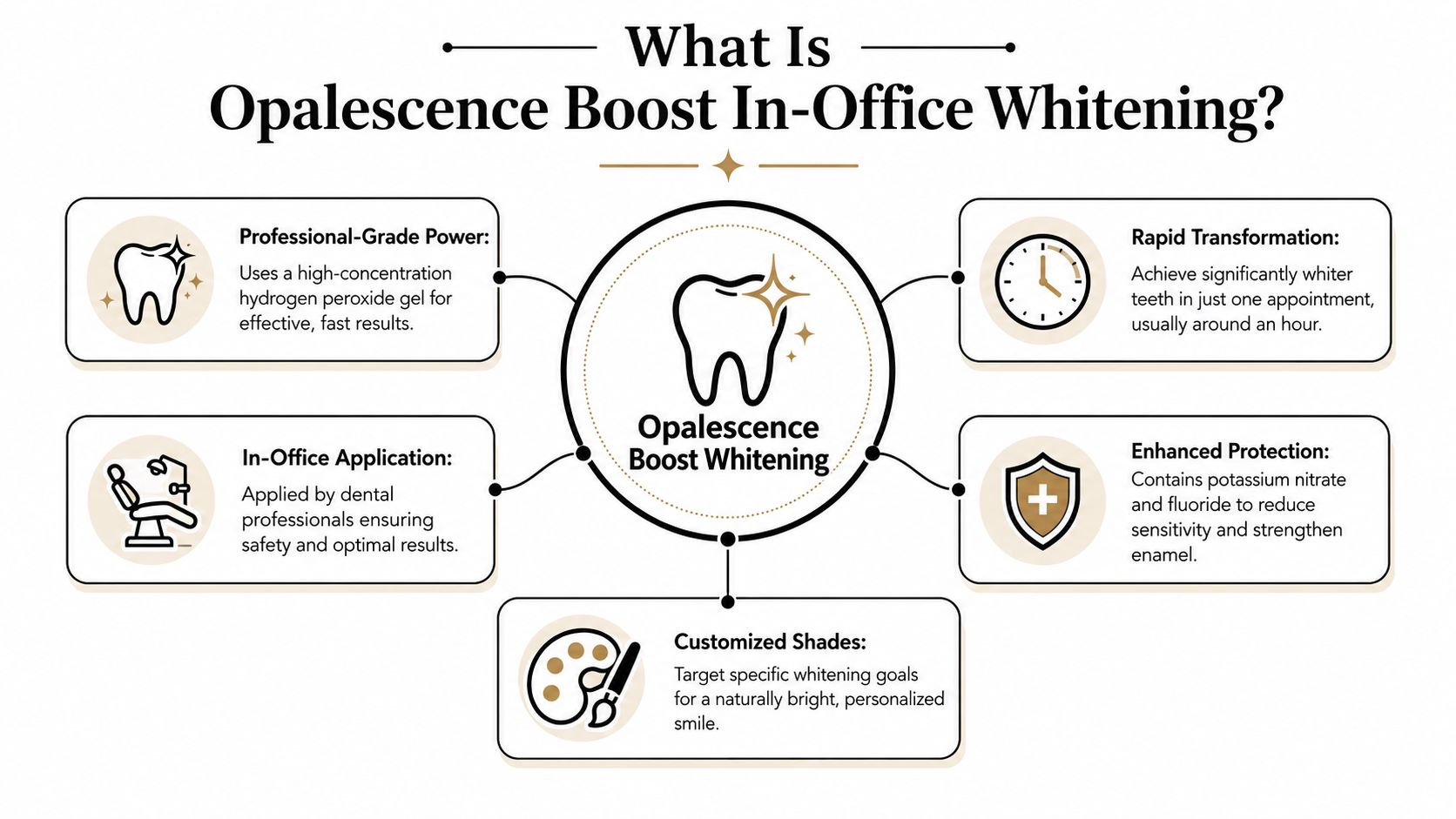
Opalescence Boost is a professional whitening treatment used in the dental office, not a product you apply on your own at home. It's designed for chairside use and relies on a 40% hydrogen peroxide formula, with the manufacturer stating that patients can see results in about one hour on the Opalescence professional whitening product page.
What makes it different from store-bought whitening
The biggest difference is control. With Opalescence teeth whitening in office, your dentist evaluates your teeth before treatment, applies the material precisely, and monitors how your smile responds. That's very different from trying to fit generic strips to every contour of your teeth and hoping for even coverage.
This system is also designed as a chairside, high-concentration peroxide treatment without needing a light or laser. For many patients, that's a practical advantage. The treatment focuses on the chemistry of the whitening gel itself, not on adding another device to the experience.
What patients usually like about it
Patients often choose this option because they want a result they can see quickly and because they want the process professionally supervised.
A few reasons it stands out:
- Professional application means your gums and soft tissues are managed carefully during treatment.
- Fast cosmetic change appeals to patients with upcoming events or a limited schedule.
- A more customized approach helps when one person's staining pattern is very different from another's.
- A clinical setting allows your dentist to decide whether whitening should come before other cosmetic work, after a cleaning, or not yet at all.
Practical rule: Whitening works best when the teeth and gums are healthy first. If there's untreated decay, gum irritation, or leaking dental work, those issues should be addressed before cosmetic whitening.
For patients in Lone Mountain, Sunhampton, or Monterrey who want a straightforward cosmetic upgrade, this treatment often fits well because it's efficient and professionally managed. It's not magic, and it isn't the right answer for every type of discoloration, but it's one of the clearest ways to brighten natural teeth without changing their shape.
Your Whitening Journey at Aspiring Smiles
The easiest whitening appointment is the one that feels predictable. Most patient anxiety fades once they understand what happens from start to finish.
It starts with a candidacy check
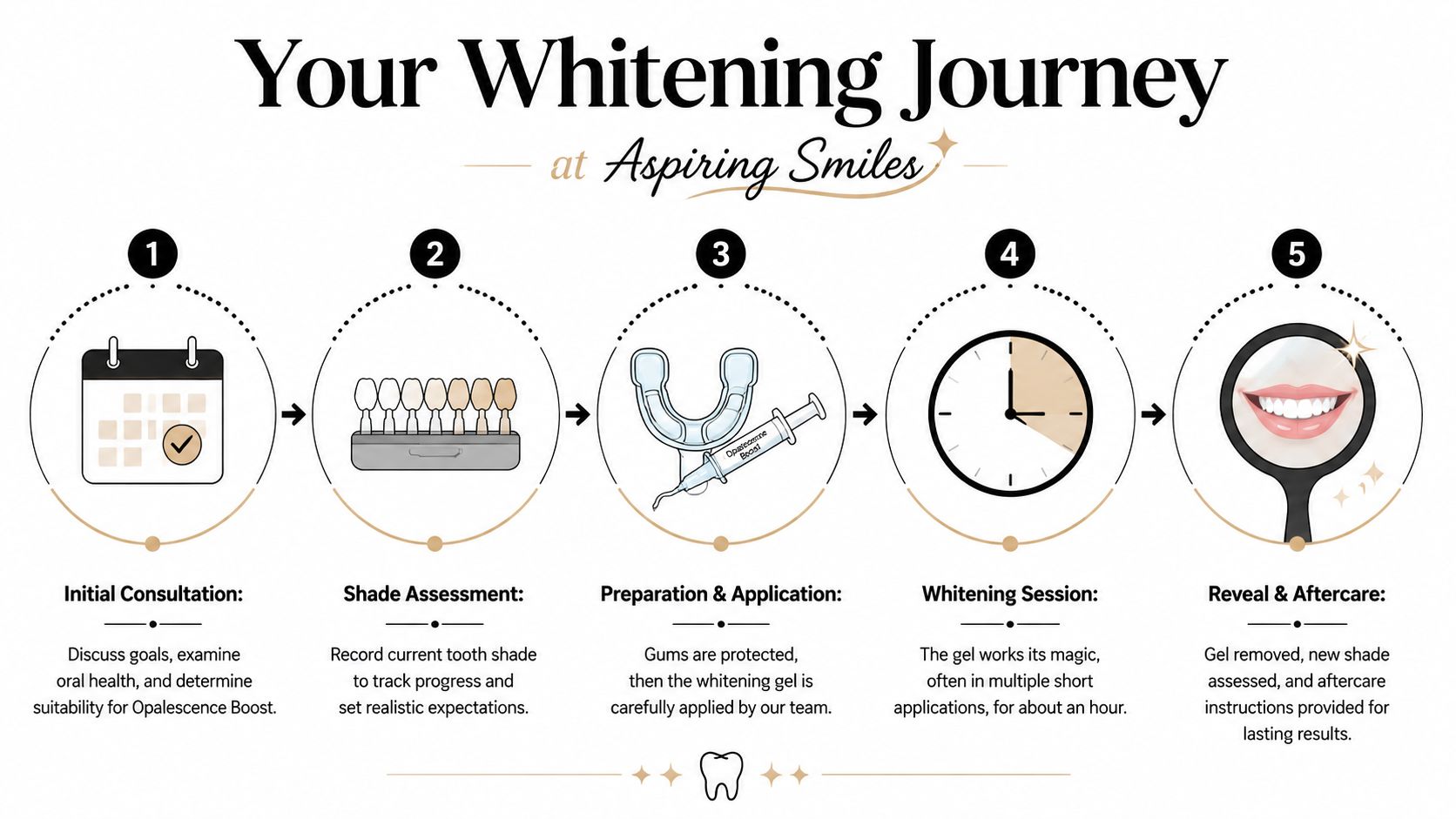
Before any whitening gel comes out, we look at your teeth, gums, and existing dental work. That exam matters because whitening is for natural tooth structure, and some patients have staining that's tied to restorations, enamel changes, or other issues that need a different plan.
We also talk through what you want. Some patients want a brighter version of their current smile. Others want the biggest safe improvement they can get in one visit. Those are different goals, and your treatment should reflect that.
A practical consultation usually includes:
- An oral exam to make sure whitening is appropriate right now.
- A baseline shade record so there's a real point of comparison before treatment.
- A conversation about sensitivity history if cold drinks or previous whitening have bothered you.
- Discussion of timing if you're also considering veneers, crowns, bonding, or other cosmetic dentistry.
What happens in the chair
The manufacturer's instructions for use specify a 0.5–1.0 mm gel layer, 20 minutes per application, and no more than 3 applications per visit in the official Opalescence Boost IFU PDF. That structure is part of why in-office whitening feels more controlled than at-home experimentation.
The appointment itself is usually calm and methodical:
- We examine the mouth and confirm you're ready for whitening.
- We record the starting shade.
- Soft tissues are protected so the gel stays where it belongs.
- The whitening gel is placed on the front surfaces of the teeth.
- After each application, we reassess shade and comfort before deciding whether another cycle makes sense.
The material isn't just painted on casually and left there. Contact time matters. Thickness matters. Isolation matters. Those details affect both whitening performance and comfort.
Later in the visit, many patients like seeing a product demonstration before or after treatment:
Communication makes the experience easier
A lot of whitening anxiety comes from uncertainty, not the procedure itself. Patients do better when they know what they may feel, when they can ask questions easily, and when aftercare is spelled out clearly. That's one reason dental teams pay attention to modern patient communication strategies, especially for elective treatment where expectations shape satisfaction.
If a patient says, “I'm nervous my teeth will feel too sensitive,” that shouldn't be brushed off. It should shape the plan.
For patients from Desert Shores, Mar-A-Lago, or Painted Desert Estates, the visit should feel organized, not rushed. Whitening is cosmetic, but the process is still clinical. When it's handled that way, patients usually leave feeling informed about what happened, what they can expect next, and how to protect the result.
Results and Maintaining Your Bright New Smile
The exciting part of in-office whitening is obvious. You want to leave with a smile that looks cleaner, brighter, and more refreshed. Most patients do see a noticeable change, but the immediate mirror check isn't always the final story.
A useful detail with Opalescence is that the whitening effect may continue for 24–48 hours after treatment, according to the manufacturer information discussed in this Opalescence video resource. That means your shade can continue settling after you leave the office. If you judge the result too quickly, you may miss the full outcome.
What affects how bright your smile gets
Whitening results depend on the starting shade, the type of stain, your enamel, your habits, and whether you have existing restorations in visible areas. Someone with mild surface discoloration may respond differently than someone with long-standing deeper staining.
What works well after treatment is usually simple and consistent:
- Choose lighter foods and drinks at first while your shade settles.
- Drink water often to help rinse away pigments from meals and beverages.
- Brush gently and floss consistently so new surface stains don't build back quickly.
- Keep routine dental care on schedule because cleanings help remove stain accumulation that can dull the result.
How to make the result last longer
Whitening lasts longer when it's supported by good habits, not when it's treated like a one-time cosmetic event. If you drink coffee daily, smoke, or skip regular cleanings, the brightness won't hold the same way it does for someone with fewer staining exposures.
Patients who want specific post-treatment guidance can review our teeth whitening aftercare instructions for practical next steps.
Your new shade is easier to maintain than to rebuild. Small habits after treatment matter more than people think.
If you already stay current with dental care, cleaning and exams, and periodic cosmetic maintenance, whitening tends to fit in nicely. It's one of the simpler ways to refresh your smile without altering healthy tooth structure.
Comparing Professional Whitening Methods
Not every whitening option fits every patient. Some people want speed. Some care more about flexibility. Some have sensitive teeth and would rather lighten gradually. The right choice depends on the trade-offs you're comfortable making.
Where in-office whitening stands out
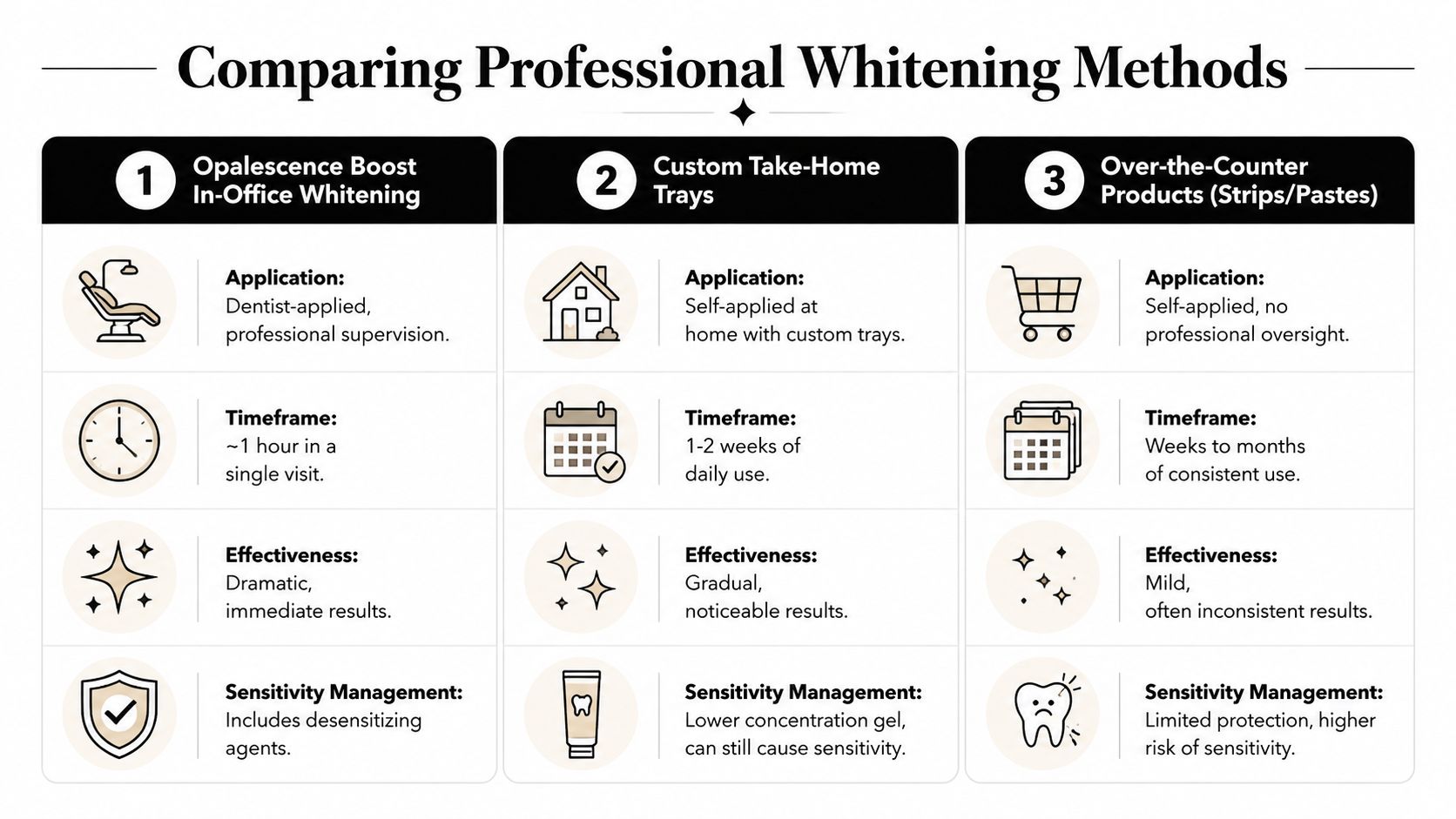
In-office whitening is mainly about speed and supervision. You come in, your dentist applies the material, and the visit is structured around a controlled clinical protocol. That appeals to busy patients who don't want to manage trays or strips at home.
Take-home whitening can be a good option if you prefer a more gradual change. It gives you flexibility, but it also requires consistency. If you know you won't wear trays as directed, the convenience can disappear quickly.
Other in-office brands, including systems some patients may recognize by name, can also produce strong results. The better question isn't which brand sounds more familiar. It's which approach fits your goals, your tolerance for sensitivity, your timeline, and the condition of your teeth.
Professional Whitening Options at a Glance
| Feature | Opalescence In-Office | Opalescence Take-Home | Zoom Whitening |
|---|---|---|---|
| Application | Dentist-applied in the office | Self-applied with dentist-provided trays | In-office professional whitening |
| Speed | Fast, single-visit treatment | Gradual whitening at home | Fast, appointment-based whitening |
| Control | High clinical control during treatment | More patient-managed | High clinical control during treatment |
| Convenience | Good for patients who want one main visit | Good for patients who prefer home use | Good for patients seeking in-office care |
| Sensitivity planning | Monitored chairside | Adjusted through at-home pacing | Monitored chairside |
What usually works best for different patients
Here's how it works:
- Choose in-office whitening if you want visible change quickly and you'd rather have the process handled by a dental team.
- Choose take-home trays if you want a slower pace and more control over when you whiten.
- Be cautious with over-the-counter products if you already have sensitivity, uneven staining, or visible crowns and fillings.
- Ask for a full recommendation if whitening is only one part of a broader cosmetic plan that may also include bonding, veneers, or restorative dentistry.
For patients weighing options, this guide on how to choose the right teeth whitening option for you can help frame the decision.
One practical note for local patients searching cosmetic dentist near me in Las Vegas: if you also need a cleaning, a new patient exam, or evaluation of older dental work first, whitening should be chosen in that larger context. The cosmetic result is better when the foundation is healthy.
Managing Sensitivity and Ensuring a Comfortable Treatment
Sensitivity is the question almost every patient asks about first, and that's fair. Whitening can work well and still cause temporary discomfort for some people.
Clinical reviews summarized in this discussion of whitening effectiveness and sensitivity incidence note that sensitivity is common with in-office peroxide whitening, affecting 30% to over 78% of patients depending on the protocol, with higher peroxide concentrations associated with greater sensitivity risk. That doesn't mean everyone feels the same thing, and it doesn't mean whitening is a bad option. It means sensitivity should be planned for directly.
Why sensitivity happens
Whitening gels work by penetrating the tooth and breaking down stain compounds. During that process, some patients notice short, sharp responses to cold air, cold drinks, or temperature changes. The feeling is usually temporary, but it can be surprising if you weren't expecting it.
Soft tissues can also become irritated if whitening material touches areas it shouldn't. The in-office protocol is designed to reduce that risk through controlled placement and isolation.
What helps most
Comfort usually improves when treatment is personalized instead of pushed. Useful steps include:
- Reviewing your sensitivity history before treatment, especially if past whitening bothered you.
- Monitoring how you feel between applications rather than assuming more treatment is always better.
- Using careful isolation techniques so peroxide stays on teeth, not on gums or other soft tissue.
- Following aftercare instructions closely for the first stretch after your appointment.
The manufacturer instructions also note that if chemical irritation reaches soft tissue, it should be rinsed promptly, and tissue typically returns to normal within 20–30 minutes after the gel is removed from the area. That's one reason professional placement matters.
Whitening should feel managed, not endured. If you're uncomfortable, the treatment plan should respond to that.
If you've been avoiding cosmetic treatment because you think sensitivity automatically means a miserable experience, that's usually too broad a conclusion. The better approach is to tell your dentist exactly what you've felt before so the plan can be adjusted around you.
Opalescence Whitening FAQs and Your Next Step
Most patients are down to a few practical questions by the time they're ready to book. Those questions are important because the right whitening decision depends on timing, existing dental work, and your overall smile goals.
Common questions patients ask
Will my crowns, veneers, or fillings whiten too?
No. Dental restorations such as crowns and veneers won't whiten the way natural teeth do. That's a big reason a pre-whitening evaluation matters.
When should old dental work be replaced if I want it to match my new shade?
Guidance commonly recommends waiting 1–2 weeks after whitening for the tooth color to stabilize before replacing older visible restorations, as noted in this in-office whitening patient information sheet.
Am I a candidate if I also need other dental treatment?
Sometimes yes, sometimes not yet. If you need restorative work, treatment for decay, or gum care first, those issues should be handled before cosmetic whitening. If you're also exploring tooth extraction, dental implants near me, or broader smile improvements, sequencing matters.
Is whitening worth doing if I may want veneers later?
Often, yes, but only if the whitening result will help guide the rest of your cosmetic planning. In other cases, it makes more sense to discuss the complete smile design first.
Your next step in Las Vegas
If you live in Las Vegas, NV, including Sunhampton, Lone Mountain, Monterrey, or Sun City Summerlin, the easiest next move is a consultation focused on your teeth, your existing dental work, and your goals. That visit can also identify whether whitening should happen on its own or as part of a broader plan that includes preventive, restorative, or cosmetic dentistry.
You don't need to guess whether Opalescence teeth whitening in office is the right fit. A clear exam and a direct conversation answer that faster than online comparison shopping ever will.
If you're ready to brighten your smile with a plan customized for your teeth and your goals, schedule a consultation with Aspiring Smiles Dental and Braces. Dr. Patel and the team provide whitening evaluations, routine dental care, cosmetic dentistry, restorative treatment, and emergency dental care for patients across Las Vegas, including Desert Shores, Painted Desert Estates, Sun City Summerlin, Lone Mountain, Monterrey, Mar-A-Lago, and Sunhampton.