
How Much Is Tooth Extraction with Insurance in Las Vegas?
With insurance, a simple tooth extraction in Las Vegas often ends up around $25 to $200 out of pocket, depending on your plan, deductible, and whether the dentist is in network. For those experiencing pain and worrying about the bill, the good news is that the numbers are usually more manageable once benefits are applied.
A lot of people start this search at the same moment. A tooth starts throbbing during dinner. A filling breaks on a Friday. A wisdom tooth flares up before work, and now you're trying to judge two problems at once: how urgent the pain is, and what the visit is going to cost.
That uncertainty is what makes dental problems feel worse. Patients looking for a dentist in Las Vegas, NV, an emergency dentist, or even a dentist near me usually aren't just comparing services. They're trying to avoid a financial surprise while getting out of pain quickly.
For families in Desert Shores, Sunhampton, Sun City Summerlin, Monterrey, Lone Mountain, Mar-A-Lago, and Painted Desert Estates, the most helpful answer isn't a vague national estimate. It's a clear local explanation of what changes the final price, what insurance usually pays, and what to ask before treatment so you can make a confident decision.
Facing Tooth Pain in Las Vegas and Worried About Cost
It often starts with a sharp bite on one side, swelling around a back tooth, or a wisdom tooth that suddenly won't let you sleep. By the time many people search for tooth extraction, they're already uncomfortable and trying to decide whether they can wait until next week or need help now.
The hard part is that online cost guides often make extraction pricing sound fixed. It isn't. In Las Vegas, urgent cases can create extra confusion because insurance may handle the emergency exam and X-rays differently than the extraction itself. One report notes that patients often run into unexpected bills of $150 to $400 for impacted wisdom teeth even with insurance when emergency benefits and routine surgical benefits are treated differently by the plan, according to this overview of emergency tooth extraction cost differences.
Pain makes people want a fast answer. Insurance rules usually make the answer more complicated than it should be.
That mismatch is why many patients hesitate. They know they need care, but they don't know whether the problem is a straightforward removal or a more involved surgical procedure. They also don't know whether their plan will treat it as a basic service, a major service, or an emergency visit with separate rules.
Why delay usually doesn't help
Waiting can feel like a budgeting strategy, but for a painful tooth, it usually creates more uncertainty. A tooth that's loose, badly decayed, or infected doesn't tend to get cheaper to treat by sitting for another week. In practical terms, the cost question becomes easier to answer after an exam, dental X-rays, and a review of your insurance benefits than it is from internet estimates alone.
For someone also comparing cosmetic dentist near me, dental implants near me, or restorative care options, this matters for another reason. If a tooth does need to come out, the next step may involve future replacement planning. That could mean discussing restorative dentistry, a bridge, or dental implants after the extraction site heals.
What local patients usually want to know first
Individuals typically aren't asking for every billing detail right away. They want answers to a few simple questions:
- Is it urgent: Do I need to be seen today, or can this wait briefly?
- Is it simple or surgical: Is the tooth visible and easy to remove, or is it impacted or broken?
- Will insurance help enough: Am I likely looking at a manageable copay or a larger balance?
- Can I plan the next step: If the tooth is removed, what does replacement or follow-up care look like?
Those are the right questions. Once you have those answers, the cost becomes much less mysterious.
Factors That Determine Your Tooth Extraction Cost
The final fee for an extraction is built from a few practical pieces. The biggest one is what kind of extraction you need. A visible tooth that's easy to remove is usually simpler than a tooth that's impacted, broken below the gumline, or difficult to access.
According to CareCredit's 2024 Cost Study, the national average cost for a simple extraction is about $177, with a range of $137 to $335, and the national average for a surgical extraction is about $363, with a range of $281 to $702, before insurance is applied, as outlined in CareCredit's tooth extraction cost and financing guide.
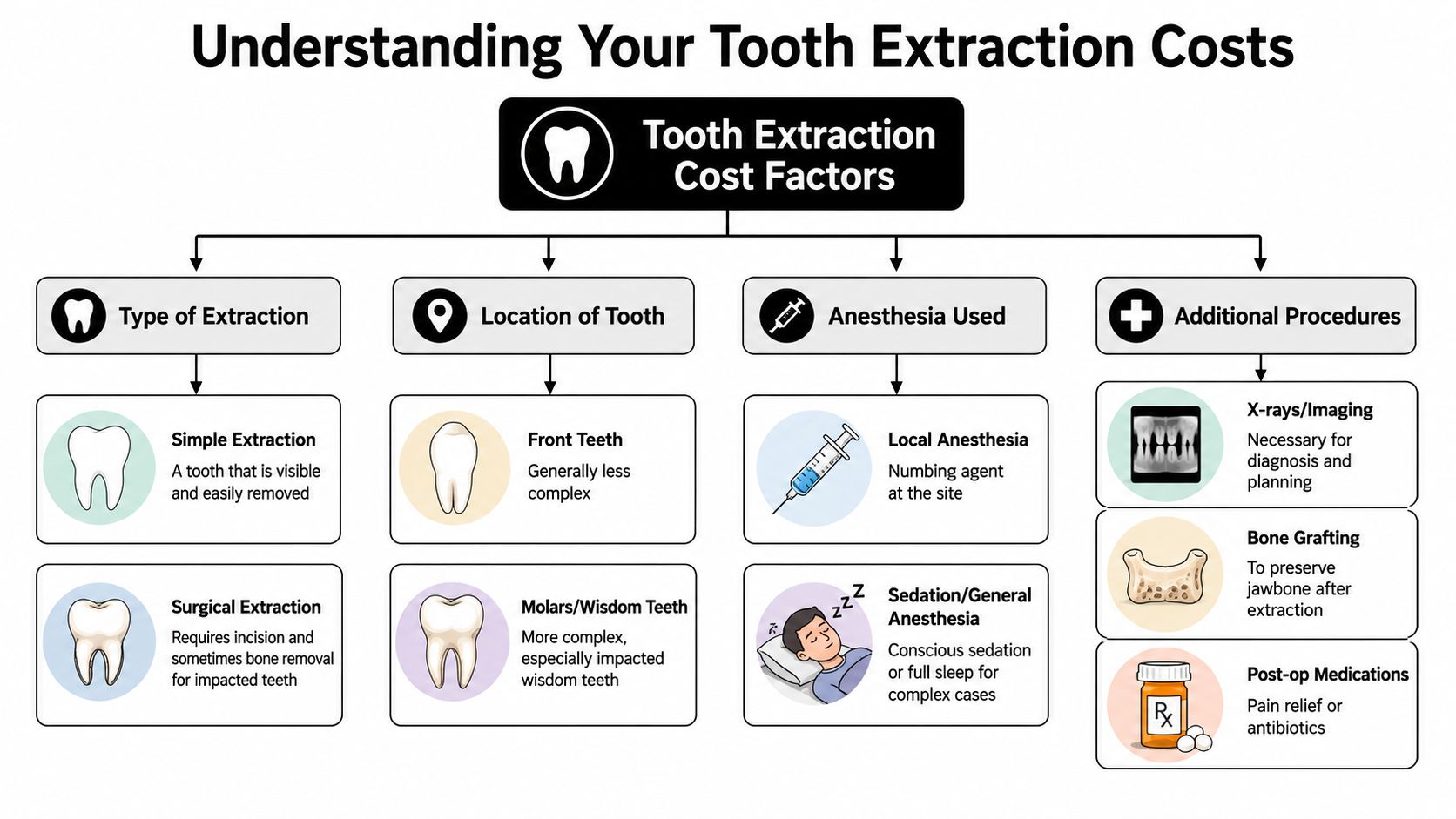
Simple extraction versus surgical extraction
A simple extraction usually means the tooth is fully visible above the gum and can be removed without surgically opening the area. A surgical extraction usually means the dentist needs to work below the gumline, remove a broken piece, or access an impacted tooth.
That difference affects both time and technique. It also changes how insurance may classify the procedure later.
| Extraction type | What it usually means for the visit |
|---|---|
| Simple extraction | Visible tooth, more direct removal, often less complex |
| Surgical extraction | Impacted, broken, or hard-to-reach tooth, often more involved |
| Wisdom tooth removal | May be simple or surgical depending on position and access |
Other charges patients should expect to discuss
The extraction itself isn't always the only line item. The complete treatment plan may also include:
- Exam and diagnosis: A clinical evaluation helps confirm whether the tooth can be saved or needs removal.
- Dental X-rays: Images help show roots, bone level, infection, and the position of nearby teeth.
- Anesthesia choice: Local numbing is common, but some cases need added comfort options.
- Follow-up needs: Some patients need a return visit, site check, or discussion about replacement.
- Future restorative care: If the missing tooth affects chewing or smile balance, restorative dentistry may come next.
Practical rule: The more hidden the tooth is, the more likely the extraction is to become clinically and financially complex.
Why the location of the tooth matters
Front teeth are often more straightforward than molars. Back teeth can have broader roots, more force on them from chewing, and less working room. Wisdom teeth add another layer because they may be partially erupted, fully impacted, or angled in a way that changes the difficulty of removal.
This is why a new patient exam matters so much. Before anyone can give you a useful number, they need to know whether you're dealing with a routine extraction, an urgent infection, or a surgical case that needs more planning. That's also why patients comparing general dental care, cleaning and exams, dental X-rays, and emergency treatment should think of the estimate as part of diagnosis, not separate from it.
How Your Dental Insurance Plan Actually Works
Dental insurance reduces the bill, but it doesn't usually erase it. For extractions, many plans share the cost with you rather than paying the entire amount. In broad terms, dental insurance plans in the United States consistently cover 50% to 80% of tooth extraction costs, and for non-surgical extractions, patients with insurance typically pay only $25 to $150 per tooth, according to this breakdown of tooth extraction costs with Delta Dental and similar plans.
That sounds simple until you look at the actual claim. The easiest way to think about it is as a cost-sharing partnership. The plan may help, but only after it applies its own rules.
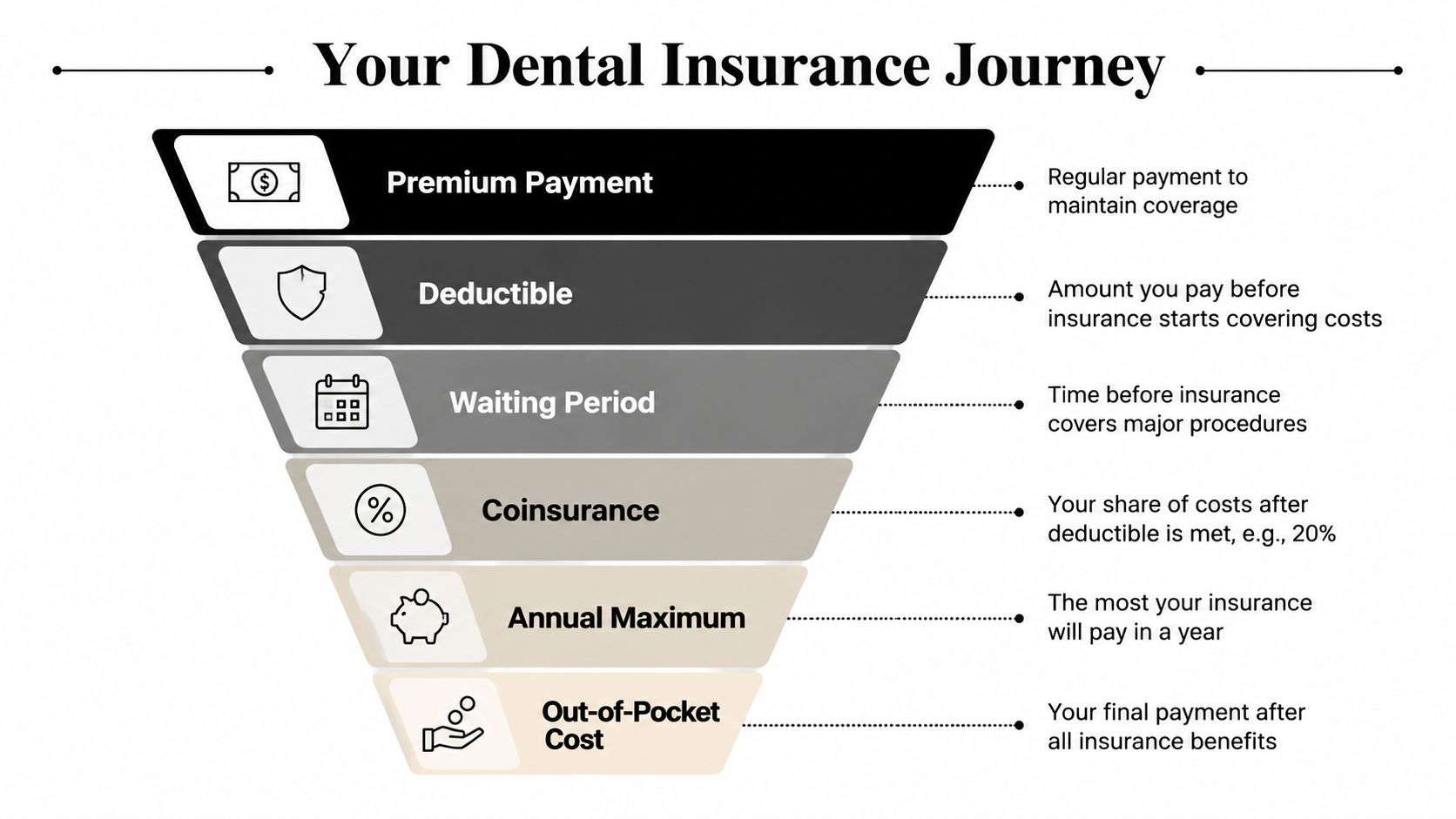
The four insurance terms that matter most
- Deductible: This is the amount you pay first before your insurance starts contributing on covered services.
- Coinsurance: After the deductible, the plan may pay part and leave you responsible for the rest.
- Annual maximum: This is the most your dental plan will pay within the plan year.
- In-network status: If your dentist is in network, the plan may apply a contracted rate before it calculates your share.
That last point matters more than many people realize. A lower allowed amount can reduce what insurance calculates from in the first place, which can bring your out-of-pocket cost down.
Why the paperwork looks more complicated than the treatment
Claims move through a review process where the insurer checks coding, plan limits, frequency rules, and benefit categories before deciding what it will pay. If you've ever wanted a plain-English look at that back-end process, this explanation of healthcare revenue cycle optimization for providers gives useful context on how claim adjudication works.
Patients don't need to master insurance administration, but they do benefit from understanding the sequence. The dentist submits the procedure code. The insurer decides how that code fits your plan. Then the remaining balance becomes your responsibility.
Insurance doesn't just ask, "Was a tooth removed?" It asks, "Which code was used, is the deductible met, and what benefit tier applies?"
What helps patients the most before treatment
The most useful step is a benefits check before the visit or before treatment begins. If you want a clearer picture of deductibles, annual maximums, and covered services, this page on how dental insurance works gives a practical overview from a patient perspective.
For someone searching how much is tooth extraction with insurance, the key point is this: your final number depends less on the phrase "I have insurance" and more on the fine print behind that coverage.
Example Tooth Extraction Costs in Las Vegas With Insurance
Local numbers make this easier to understand. In major U.S. markets like Las Vegas, a simple tooth extraction under ADA code D7140 typically has a cash price of $150 to $350, and when a standard dental insurance plan covers a simple extraction billed at $220, the patient's out-of-pocket cost often drops to $40 to $110, depending on deductible status and coverage tier, according to this local guide to Las Vegas tooth extraction costs.
If you're comparing options for a tooth extraction in Las Vegas, these examples show how the same treatment can land at very different final totals.
Example one with a simple extraction
A patient from Lone Mountain comes in with a cracked tooth that's fully visible and can be removed without surgery. The office fee for the simple extraction is $220.
Here are two common ways that can play out:
| Scenario | What changes | Estimated patient share |
|---|---|---|
| In-network plan with deductible already met | Insurance applies the covered rate and pays its portion | $40 to $110 |
| Insurance active but deductible not yet met | Patient may owe more before benefits fully apply | Still often within the local insured range, but closer to the higher end |
This is why two friends with the "same insurance company" can get different answers. One has met the deductible. The other hasn't. One is seeing an in-network office. The other isn't.
Example two with a more complex removal
Now take a patient in Sun City Summerlin with an impacted wisdom tooth. This is no longer a straightforward visible-tooth extraction. It may be classified differently, and the plan may treat it under a lower benefit tier than a simple extraction.
A practical way to think about the bill is in layers:
Procedure complexity changes the code
The extraction may be billed as surgical rather than simple.Benefit tier changes the plan share
Some plans treat more complex extractions less generously than basic services.Annual maximum can become a problem
If the patient has already used benefits for earlier care, less coverage may remain for the extraction.Emergency timing can affect expectations
The exam and imaging may be covered differently than the extraction itself.
Local estimates are most reliable when they include the code, the network status, and whether your deductible has already been met.
The practical lesson isn't that insurance is unpredictable. It's that the estimate needs enough detail to be real. A useful quote isn't just "extraction with insurance." It's "simple or surgical, in network or out of network, deductible met or unmet, annual maximum available or mostly used."
How to Verify Your Insurance Benefits Before Your Visit
A quick benefits check can spare you a frustrating billing surprise, as dental plans don't treat every extraction the same way. Most PPO plans cover 50% to 70% of costs for basic services like simple extractions, while complex surgical cases may fall under major services with lower coverage, often 30% to 50%, as explained in this review of tooth extraction insurance tiers and PPO coverage.
That means "I have dental insurance" isn't enough information. You need to know how your plan classifies your specific procedure.
Questions worth asking before the appointment
Call the number on your insurance card and ask direct questions. These are the ones that usually matter most:
- Ask about the procedure category: Is a simple extraction covered under basic services, and is a surgical extraction covered under major services?
- Confirm the code review: If the office expects a simple extraction, ask how your plan handles ADA code D7140.
- Check your deductible status: Has it already been met, or will part of today's visit go toward it first?
- Ask about your annual maximum: How much benefit remains for the rest of the year?
- Verify network status: Is the dental office in network under your exact plan?
- Clarify emergency handling: If this is an urgent pain visit, does the plan process the exam, X-rays, and extraction under different benefit rules?
Why this step changes the whole experience
Patients who verify benefits ahead of time usually feel calmer because the conversation shifts from guessing to planning. Even if the extraction turns out to be more involved, you still know the likely payment range, the limits of your plan, and whether a financing conversation may be needed.
A strong front desk team can often help by reviewing your insurance information, checking benefits, and pointing out the exact items that deserve a second look. That's especially useful for new patient exams, emergency dental visits, and situations where you're also considering restorative dentistry after the extraction.
If a tooth may be surgical, don't stop at asking, "Is extraction covered?" Ask, "Under which benefit tier is this code covered?"
What doesn't work
What usually fails is relying on a generic benefits summary, an old explanation of benefits, or a verbal assumption based on a prior visit. Plans change. Employers change plans. Benefit categories shift. One extraction can be basic, while another can be major.
That extra phone call isn't wasted effort. It's often the step that turns cost uncertainty into a workable treatment plan.
Affordable Care Options at Aspiring Smiles
Insurance helps, but some patients still end up with a balance that feels hard to manage. That can happen when a deductible hasn't been met, when a surgical extraction falls into a less favorable category, or when annual benefits are already tied up in other treatment.

For Las Vegas patients, that doesn't mean care has to stop. A practical office gives you more than one path forward. The financial journey should move from uncertainty to a clear plan, especially when you're dealing with pain and need decisions quickly.
Options that make care easier to start
Patients generally do best when they look at payment in layers rather than as one all-or-nothing bill.
- Insurance first: Use in-network benefits when available and confirm how the extraction is categorized.
- Membership savings next: If you don't have insurance, or your plan is limited, an in-house membership can make routine care and needed treatment more predictable.
- Financing when appropriate: Third-party financing such as CareCredit can help spread the cost over time instead of requiring one larger payment at once.
That approach matters for families throughout Desert Shores, Lone Mountain, Painted Desert Estates, Sunhampton, Monterrey, Mar-A-Lago, and Sun City Summerlin who want treatment now without feeling boxed in by timing.
Why membership plans can help
A membership plan can be especially useful for patients who don't have traditional dental insurance or who know their plan won't cover enough. It can also support the bigger picture. If you need an extraction now, you may also need follow-up dental care, cleaning and exams, replacement planning, or future services like crowns, restorative dentistry, or even dental implants near me searches later on.
This overview gives a helpful visual sense of how practices talk patients through financing and care decisions.
The best payment solution is the one that lets you address the dental problem before it gets worse. Delaying treatment because the payment path feels unclear often costs more comfort than it saves.
Schedule Your Tooth Extraction Consultation in Las Vegas Today
The cost of an extraction with insurance isn't random, but it does depend on details that generic articles often skip. The type of extraction, your deductible, your network status, the procedure code, and your annual maximum all shape the final bill. Once those pieces are clear, the numbers usually become much easier to understand.
For patients searching dentist near me, emergency dentist, tooth extraction, or a trusted dentist in Las Vegas, NV, the most useful next step is a real exam with clear treatment recommendations and a benefits review. That's how you move from internet estimates to a plan that fits your mouth, your schedule, and your budget.
What to expect from a visit
A good extraction consultation should feel straightforward. You should leave knowing:
- What the diagnosis is: whether the tooth can be saved or needs removal
- What kind of extraction is needed: simple or surgical
- What your insurance is likely to cover: based on the available information from your plan
- What comes next: healing instructions, follow-up, and whether replacement options should be discussed later
That same visit can also help if you're looking beyond urgent care and want one office for family dentistry, dental X-rays, new patient exams, cosmetic dentistry, teeth whitening, or restorative treatment after an extraction.
Local care should feel clear
Patients across Las Vegas, NV, including Desert Shores, Sunhampton, Sun City Summerlin, Monterrey, Lone Mountain, Mar-A-Lago, and Painted Desert Estates, deserve dental care that explains both the clinical side and the financial side without making either one harder than it needs to be.
If you're in pain, don't wait for the cost question to become another reason to delay care. A clear estimate, an honest exam, and a practical payment conversation can turn a stressful situation into a manageable one.
If you're ready to get answers and relief, contact Aspiring Smiles Dental and Braces to schedule your consultation. The team can help you understand your extraction options, review your insurance benefits, and find a payment approach that works for your family in Las Vegas.