Dentist Near Me Payment Plan in Las Vegas, NV
A lot of people start the same way. They search for a dentist near me, then stop when they worry about the bill. Maybe it's a throbbing tooth, a broken filling, a child who needs an exam, or a smile you've wanted to improve for years. The dental need feels urgent, but the cost feels uncertain.
That uncertainty keeps many patients in Las Vegas from booking the visit they already know they need. The good news is that paying for care isn't limited to one big payment anymore. Today, a dentist near me payment plan search often leads to structured options that can make treatment more manageable, especially for families and adults balancing monthly budgets in Desert Shores, Sunhampton, Sun City Summerlin, Monterrey, Lone Mountain, Mar-A-Lago, and Painted Desert Estates.
Why You Should Not Delay Dental Care Over Cost
A small dental problem rarely stays small. Tooth decay can deepen. A cracked tooth can become painful. Gum irritation can turn into a larger restorative issue. The longer you wait, the more likely it is that a simple visit becomes a more involved one.
That matters whether you're looking for a dentist in Las Vegas, NV, an emergency dentist, help with a tooth extraction, or a long-term plan for cosmetic dentist near me searches. Delaying care over cost can create a cycle where pain gets worse, stress rises, and treatment feels harder to fit into your life.

What changed about paying for dental care
Dental affordability has changed from informal office arrangements to more structured options. Many practices now use in-house memberships or third-party financing, and some plans advertise 20% to 50% discounts on treatments through discount-style programs, according to this overview of a dental discount plan.
That shift matters because many services, from fillings and crowns to dental implants near me searches, often involve out-of-pocket costs that patients want to spread out in a predictable way.
Practical rule: If cost is the reason you're waiting, ask about payment options before you decide you can't move forward.
What works better than waiting
Patients usually do better when they take three simple actions early:
- Book the exam first: You need a clear diagnosis before you can compare real financial options.
- Ask for the treatment sequence: Some care can be phased, which helps many households manage cost.
- Request the payment discussion in writing: Clear numbers and terms reduce surprises.
This approach helps with preventive care, emergency visits, restorative dentistry, and cosmetic planning alike. If you need cleaning and exams, dental x-rays, a new patient exam, teeth whitening, crowns, implants, or an urgent evaluation, the first step isn't guessing. It's getting the facts.
Las Vegas families deserve that kind of clarity. A good financial conversation should lower stress, not add to it.
Your Guide to Dental Payment Plan Options
A Las Vegas patient may hear four different payment terms in one call and assume they all mean the same thing. They do not. A payment plan, a membership program, a financing application, and a credit card payment are separate options with different rules, costs, and limits.
When looking for a dentist near me payment plan, the clearest way to compare choices is to sort them into three buckets first: in-house plans, membership plans, and third-party financing. Once you do that, the conversation gets much easier.
Comparing Dental Payment Options
| Feature | In-House Plan | Membership Plan | Third-Party Financing |
|---|---|---|---|
| Who manages it | The dental office | The dental office | A financing company |
| Best fit | Smaller balances or straightforward arrangements | Patients who want ongoing savings on routine and restorative care | Larger treatment plans or longer repayment timelines |
| Credit involvement | May be limited or handled by the office | Usually not a credit product | Approval depends on the financing provider |
| Common structure | Installments arranged with the practice | Annual or monthly membership with discounts | Monthly payments through a lender |
| What to ask | Down payment, due dates, missed payment policy | Covered services, discount scope, annual cost | Interest terms, approval process, repayment period |
How each option works in practice
In-house plans are usually the simplest to understand. The office reviews your treatment plan, explains what deposit is required, and tells you how the remaining balance would be split. This can work well for a filling, crown, or other treatment where the balance is manageable and the office offers direct payment arrangements.
Membership plans are often confused with financing, but they solve a different problem. They usually lower the cost of care through included preventive visits and reduced fees on other services. For a patient without insurance, that can make the total bill smaller before any financing is even discussed.
Third-party financing is handled by an outside company, not the dental office itself. These plans may offer more time to repay a larger balance, which can help with bigger treatment plans such as multiple crowns, implant work, or combined restorative care. The trade-off is that approval terms, payment schedules, and any interest charges are set by the financing provider.
The right option is the one that fits both your treatment needs and your monthly budget, with terms you understand before care starts.
Where HSAs and FSAs fit
HSA and FSA funds can reduce how much you need to finance. Ask the office to apply those dollars first, then calculate the remaining balance. That step is easy to miss, and it can make a meaningful difference in your monthly payment.
A practical way to compare options at a local office
Patients in Las Vegas usually get the best results by asking the front desk or treatment coordinator the same few questions every time. Is this a true office payment plan, a membership discount program, or financing through another company? Is there a down payment? How long do payments last? What happens if treatment changes after the exam?
Those questions give you real numbers, not vague reassurance.
A clear payment experience also depends on how an office handles billing and follow-up. If you want background on how service businesses organize digital billing, this overview of online payment processing setup offers useful context. For patients, that usually means easier statements, clearer payment links, and fewer billing surprises.
If you want a local starting point before you call, our page on Las Vegas affordable dental care options explains how many patients begin comparing cost-conscious treatment choices in a more practical way.
How to Apply for a Dental Payment Plan in Las Vegas
You leave a dental exam with a treatment plan in hand, and the first question is not always about the procedure. It is often, "How do I fit this into my budget?" That conversation goes better when you handle it in a clear order and get the numbers before treatment begins.
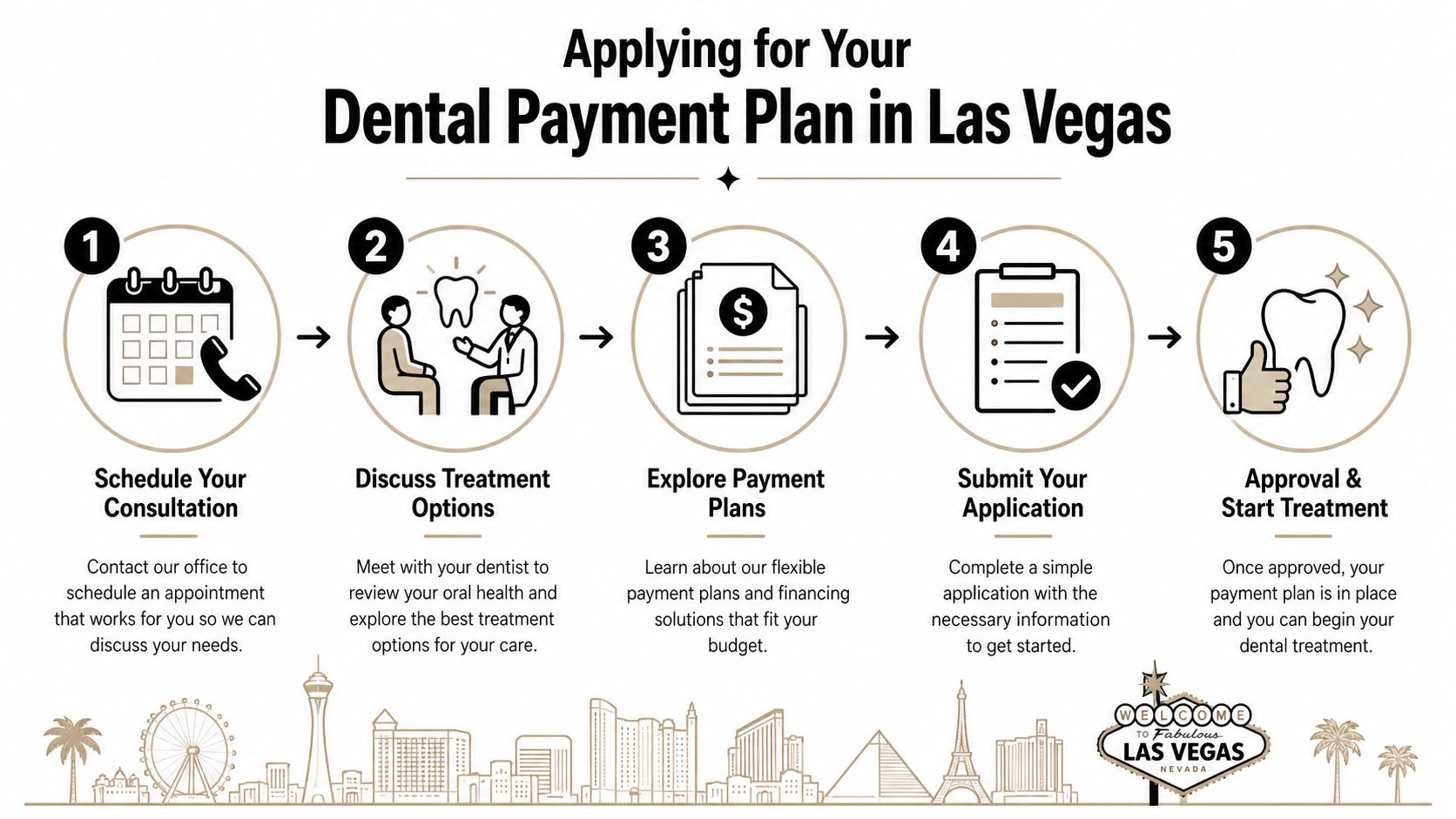
Step one through step three
-
Book the right visit. Start with a new patient exam or a problem-focused appointment, depending on what is happening. If you have pain, swelling, a broken tooth, or a lost filling, say that on the phone so the team can schedule you appropriately and explain what to bring.
-
Gather your information before you arrive. Bring a photo ID, your dental insurance card if you have one, and a list of concerns or symptoms. If another office took recent x-rays, ask for them to be sent over ahead of time. That can save time and keep the financial discussion focused on your actual treatment needs.
-
Ask for the written treatment plan and cost estimate. This is the point where the conversation becomes useful. A payment plan only makes sense once you know what care is recommended, what can be done first, and what the office estimates insurance may cover.
Step four and step five
A short visual can help if you want to see the process in order:
-
Clarify what you are financing. Patients in Las Vegas often assume the full treatment amount goes into monthly payments. Sometimes the office collects part of the balance at the visit, especially estimated insurance portions, deductibles, or services insurance does not cover. Ask the coordinator to show you the breakdown in plain language: total fee, estimated insurance payment, amount due at the appointment, and amount eligible for financing.
-
Complete the application and confirm how treatment will be staged. Once you choose an option, fill out the application and review the approval terms. Then ask three practical follow-up questions. When is the first payment due? Can treatment start right away? If care happens in phases, how does that affect the balance and future payments?
Office insight: Patients make better decisions when they review the payment breakdown before scheduling treatment, not while they are already in the chair.
What patients in Las Vegas should do before saying yes
A good payment plan should match both the treatment timeline and the household budget. In our office, the patients who feel least stressed are usually the ones who slow the conversation down for five extra minutes and verify the details.
Use this checklist before you approve anything:
- Confirm which procedures are included: Emergency treatment, crowns, dentures, implants, orthodontics, and cosmetic work are not always handled the same way.
- Ask whether insurance will be billed first: That affects how much is due now and whether the balance may change after claim processing.
- Check the payment length and total cost: A lower monthly payment can still mean paying more over time.
- Ask what happens if the treatment plan changes: That matters if the dentist finds something new after diagnostics or if care needs to be split across several visits.
- Get the terms in writing: Verbal explanations help, but written figures prevent confusion later.
For Las Vegas patients, the goal is simple. Leave the consultation knowing what starts now, what gets paid at the visit, what goes on the plan, and who to call if anything in the estimate changes.
Flexible Financing at Aspiring Smiles
A common Las Vegas call sounds like this: a patient is ready to fix a painful tooth or start a larger case, but the next question is not about the procedure. It is, "What will this look like month to month?" That is the right question to ask.
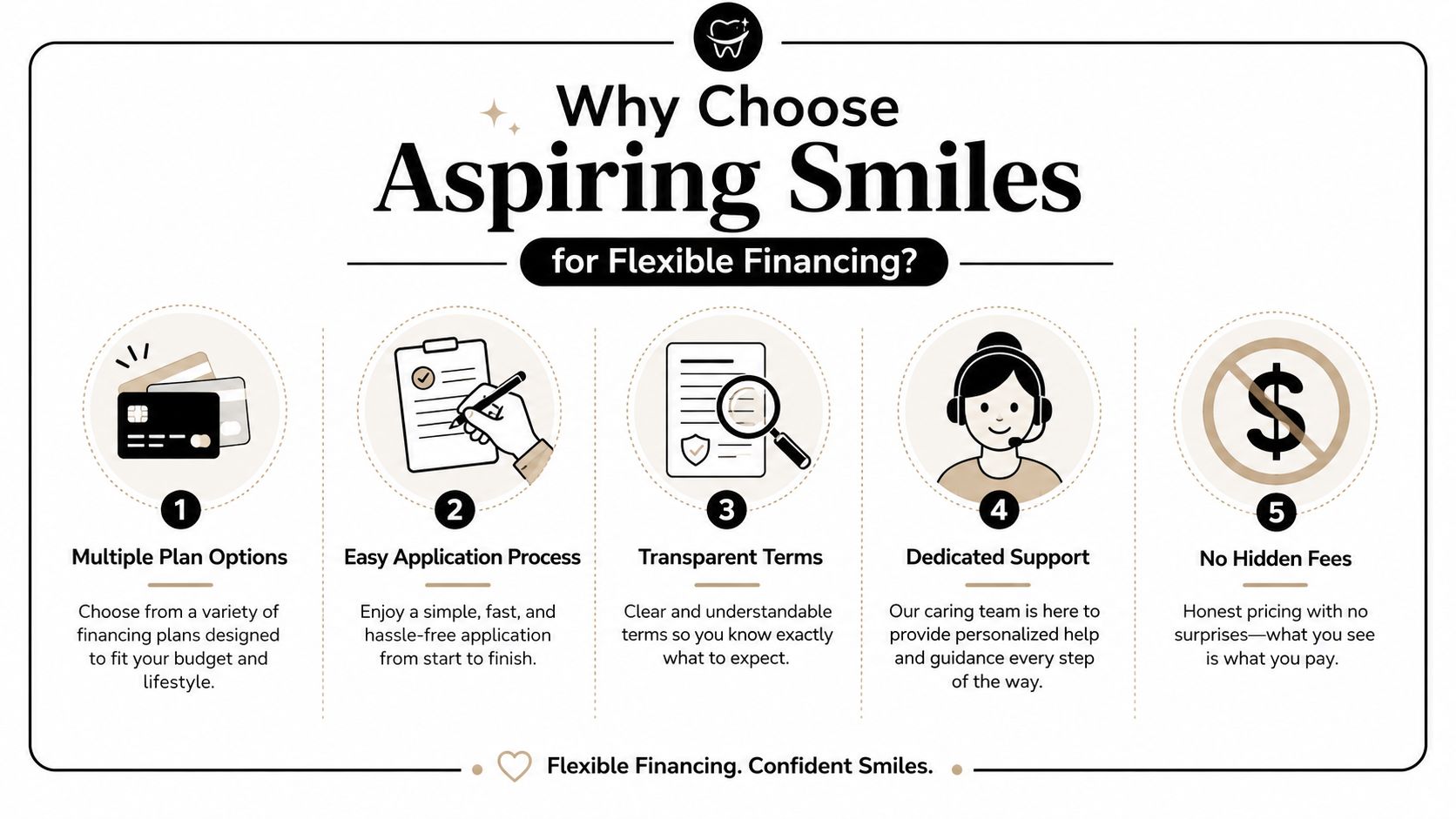
At Aspiring Smiles, we want the financial conversation to feel clear from the start. Patients need to know what can be paid at the visit, what may go through insurance, and what can be spread out over time. That clarity matters for a single crown, a cosmetic case, or full-arch treatment.
How financing works in a real Las Vegas dental office
A useful payment discussion should answer practical questions before treatment begins. Patients usually feel most comfortable when they leave with a written estimate, a clear first payment amount, and a realistic monthly range.
At our office, that conversation usually includes:
- Which treatments can be financed: Restorative, cosmetic, orthodontic, and implant cases may not all be handled the same way.
- How insurance fits into the plan: If you have benefits, the estimate should show whether insurance is expected to reduce the balance before financing is finalized.
- What payment methods are available: Some patients prefer to split costs with a card, some want third-party financing, and some want a shorter office payment arrangement if eligible.
- What the full cost looks like over time: Monthly affordability matters, but total repayment matters too.
Patients who are still sorting out benefits can also review our guide on how to find a dentist that accepts your insurance before committing to a larger treatment plan.
Where term length helps, and where it can cost more
Longer repayment terms can make major care easier to start. They can also increase the total amount paid over time. Both points need to be on the table.
That trade-off matters for treatment such as implants, implant-supported dentures, Invisalign, veneers, or multi-step restorative work. A short term may look better on paper because it ends faster, but the monthly amount can strain a real household budget. A longer term can lower that monthly pressure enough to make treatment possible.
Patients needing larger treatment plans should ask one direct question: "What is the difference between my monthly payment and my total repayment under each option?" That answer usually tells you more than the advertised term length.
What we want patients to leave with
The goal is not fast approval for its own sake. The goal is a payment path you can maintain while covering everyday expenses in Las Vegas.
In practice, that often means matching the financing option to the treatment itself. Smaller cases may work well with a short-term arrangement. Larger cases often work better when insurance, any available savings, and a longer repayment structure are considered together. When patients can see those choices side by side, they tend to make calmer and better decisions.
Important Questions to Ask About Your Payment Plan
A Las Vegas patient might feel ready to schedule treatment, then freeze the moment the financial agreement comes out. That pause usually has one cause. The numbers were presented, but the terms were not made clear enough to compare.
Good questions prevent that problem before it starts.
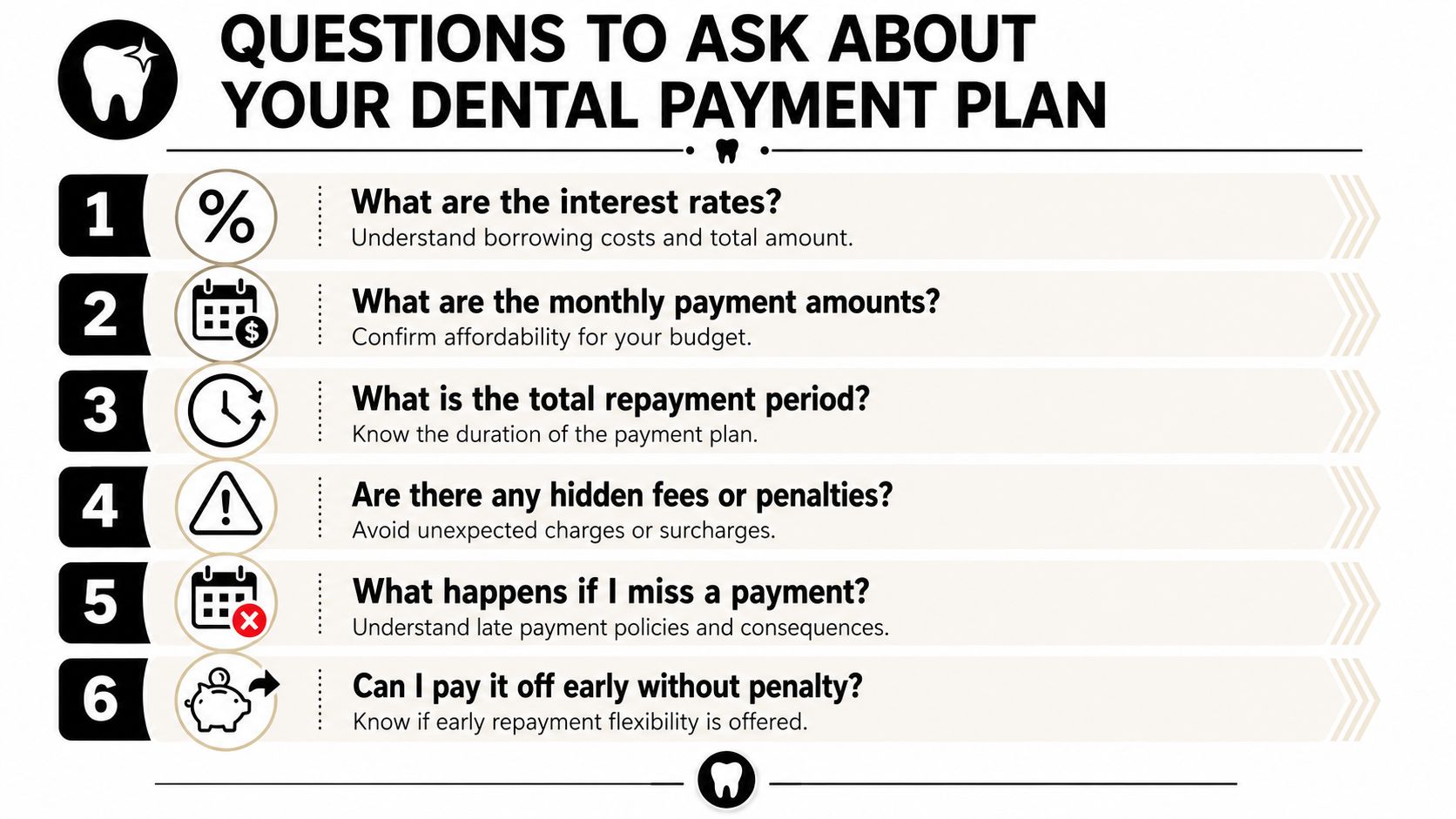
Questions worth asking before you sign
Start with the parts that affect your budget right away and the parts that can change later.
- What amount is due today, and what amount will be financed? Those are not the same number.
- How is my insurance estimate being used in this plan? Many offices collect the expected patient portion first, then adjust after the claim is processed. Ask what happens if insurance pays less or more than expected.
- Is this financing the full case or only one phase of treatment? That matters for crowns, implants, Invisalign, dentures, or any care completed over multiple visits.
- Are these promotional terms or standard terms? If there is a reduced-interest or deferred-interest period, ask for the end date and the regular terms after that.
- Is there a penalty for missing a payment? Late fees, interest changes, or loss of promotional terms can make a manageable plan harder to keep up with.
- Can I pay extra or pay it off early without a fee? That option helps if your budget improves later.
Patients do better when they hear the numbers in plain language, not finance jargon.
What a transparent office should explain clearly
A clear financial conversation should cover the treatment estimate line by line, what insurance is expected to cover, and what remains your responsibility. It should also explain whether future appointments could change the balance. That is especially important for multi-step care, where the final total can depend on how treatment progresses.
At Aspiring Smiles, we encourage patients to slow the conversation down and ask for each figure to be separated. Total fee. Estimated insurance portion. Amount due at the visit. Amount financed. Once those numbers are broken out, decisions usually get easier.
When sorting out benefits before you choose a financing option, this guide on how to find a dentist that accepts my insurance can help you prepare for that discussion.
Ask for the total treatment estimate, the amount due at the visit, and the amount that would be financed. Those are three different numbers.
A simple way to protect yourself
Keep your questions in your phone and check them off during the visit. Then repeat the terms back in your own words. If the coordinator needs to correct anything, you have caught a misunderstanding early, before paperwork is signed.
That habit protects patients.
For local offices, clarity also helps patients feel confident enough to follow through with care. If you want background on how nearby practices become easier to find online, this article explains how dentists improve Google Maps ranking.
Your Healthiest Smile is Within Reach
Dental care should feel approachable, not out of reach. When payment options are explained clearly, patients can make decisions based on health needs instead of fear about a lump-sum bill.
That matters for routine cleanings and exams, dental x-rays, and new patient visits. It also matters when the issue is more urgent, such as pain that may lead to an emergency evaluation or tooth extraction, or when you're ready to invest in cosmetic dentistry, crowns, Invisalign, or implants.
Why taking action now helps
Patients who move forward sooner usually gain more than symptom relief. They get a clearer treatment path, less uncertainty, and a better chance to protect their long-term oral health. They also avoid spending weeks or months wondering what might happen next.
For local practices, trust matters too. If you're interested in how strong local visibility helps patients find a nearby office when they search for care, this guide on how dental practices improve Google Maps ranking offers useful background on local search presence.
A practical next step for Las Vegas patients
If you live near Desert Shores, Sunhampton, Sun City Summerlin, Monterrey, Lone Mountain, Mar-A-Lago, or Painted Desert Estates, the best next move is simple. Schedule the visit, get the diagnosis, and ask for the financial options in plain language.
You don't need to solve the entire cost question alone before calling. A clear treatment plan and a clear payment conversation usually change the picture.
Frequently Asked Questions About Dental Payment Plans
Can I still get a payment plan if my credit is not strong
Sometimes, yes. It depends on the type of plan. An in-house arrangement from a dental office is different from a third-party financing product. Some financing marketplaces advertise amounts up to $75,000 for up to 144 months, with 0% interest plans available on approved credit, but eligibility depends on the lender's approval process, as explained on this dental payment information page.
Are payment plans available for emergency dental services
Often they can be, but you need to ask how the office handles urgent visits. Emergency care may involve an exam, x-rays, and same-day treatment recommendations. Some offices can apply financing to the part of treatment that moves forward after the urgent evaluation.
What is the difference between a payment plan and using a credit card
A credit card is a payment method. A payment plan is a structured arrangement to repay treatment over time. That arrangement might be handled directly by the office or by a financing company. The difference matters because the approval process, terms, and patient protections can vary.
Are payment plans only for big procedures like dental implants
No. They can also be used for moderate restorative treatment or multi-visit care. The right fit depends on the office, the treatment plan, and whether the balance is large enough to warrant financing.
Should I focus on the monthly payment first
Not by itself. A low monthly amount can sound comfortable, but you still need to understand the total expected cost, whether insurance is already accounted for, and which services are included.
What should I bring to my first appointment if I want to discuss financing
Bring your ID, insurance details if you have them, and a list of concerns or symptoms. If you're comparing treatment options, ask for the written estimate and payment terms before you commit.
If you're ready to stop guessing and get clear answers about treatment, insurance, and monthly payment options, contact Aspiring Smiles Dental and Braces to request an appointment. The team can help you review your dental needs, explain your options in plain language, and take the next step toward comfortable, confident care in Las Vegas.