Aspiring Smiles: Cosmetic Dental Payment Plans
A lot of people in Las Vegas start cosmetic dentistry the same way. They've been thinking about whitening, veneers, Invisalign, or dental implants for months, sometimes longer, but they keep putting off the consultation because they're worried the conversation will end with a number that feels out of reach.
That hesitation is understandable. A confident smile matters in daily life, whether you're heading to work, meeting friends in Desert Shores, spending time with family in Sun City Summerlin, or taking photos at a special event. But wanting to improve your smile and feeling unsure about the cost can exist at the same time.
Your Dream Smile Is Within Reach in Las Vegas
A patient may want straighter front teeth, a brighter smile, or a plan to replace a missing tooth, but still feel nervous about saying yes to treatment. That doesn't mean the treatment is unrealistic. It usually means the payment structure hasn't been made clear yet.

In the United States, dental spending reached $189 billion in 2024, and much of that spending was paid out of pocket, which is one reason payment plans matter so much in cosmetic care. The ADA also reports that affordability is a top reason adults avoid treatment, which helps explain why financing has become a standard part of care for procedures like veneers, whitening, and implants, as noted by the ADA Health Policy Institute dental care market overview.
Why cost feels like the biggest obstacle
Cosmetic dentistry is different from a routine cleaning and exam. Many smile improvements are elective, partially covered, or not covered by insurance at all. That means patients often have to think like consumers and make a real budget decision.
For many people in Las Vegas neighborhoods like Lone Mountain, Monterrey, and Painted Desert Estates, the concern isn't whether treatment would help. It's whether they can begin without draining savings all at once.
Cost concerns don't always mean treatment is unaffordable. Often, they mean the payment path hasn't been matched to the patient yet.
Why payment plans are now part of normal dental care
Years ago, many people assumed cosmetic work required one large payment up front. That's no longer how many practices handle treatment planning. Monthly payment options are now part of the conversation because they remove the biggest immediate barrier.
That matters if you're searching for a cosmetic dentist near me, a dentist in Las Vegas, NV, or even dental implants near me and trying to compare offices. A good treatment plan should address both the clinical side and the practical side. If a crown, aligner case, veneer treatment, or implant can be broken into manageable payments, more patients can move forward with care they've already decided they want.
What patients usually need most
Most new patients aren't asking for something complicated. They want clarity.
They want to know:
- What treatment is needed so they're not paying for extras they don't want
- What the monthly payment could look like instead of hearing only the full fee
- What choices exist if they don't want to use traditional credit
- How to protect their budget while still improving their smile
That's why cosmetic dental payment plans matter. They turn a stressful yes-or-no decision into a practical discussion about timing, priorities, and fit.
Understanding How Payment Plans Make Your Smile Possible
The easiest way to think about cosmetic dental payment plans is to compare them to other large personal purchases. Consumers don't expect to pay the full cost of a car or a phone all at once. They choose a structure that spreads the cost over time. Dental financing works in a similar way.
Instead of delaying veneers, clear aligners, or dental implants until the entire amount is available in one payment, a plan can divide treatment into monthly installments. That changes the conversation from “Can I afford all of this today?” to “Can I manage this responsibly each month?”
What payment plans actually do
A payment plan doesn't reduce the importance of treatment. It changes the timing of how you pay for it.
That can make a real difference for procedures such as:
- Teeth whitening when you want a fast cosmetic refresh
- Veneers or crowns when shape, color, or wear is affecting your smile
- Invisalign or clear aligners when spacing or crowding is visible
- Dental implants when replacing a missing tooth is both cosmetic and restorative
Modern financing options moved dentistry away from lump-sum billing and toward monthly payments. Industry guidance describes common terms of 12 to 24 months for simpler procedures and as long as 60 months for larger cases like implants, and one industry source says some lenders report approval rates as high as 99% for patients at trusted providers, according to CareCredit's overview of dental patient financing.
The two main paths patients usually choose
Most cosmetic dental payment plans fall into two broad categories.
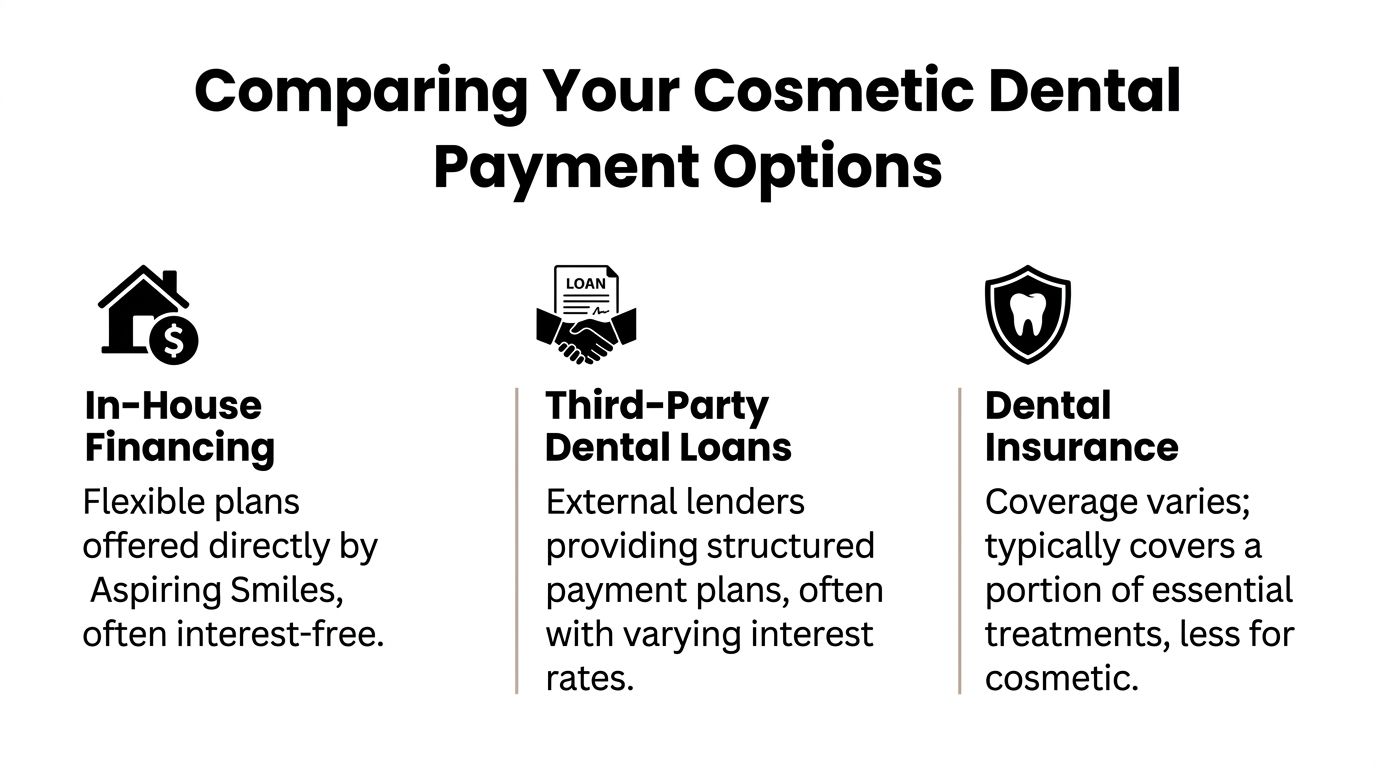
The first is in-house financing, where the dental office manages the arrangement directly. The second is third-party financing, where an outside healthcare lender handles the application, approval, and repayment terms.
Here's the simple difference:
- In-house plans can feel more personal and straightforward.
- Third-party financing can offer more structured lending options and longer terms in some cases.
Neither path is automatically better. The right fit depends on your treatment size, your credit comfort level, and how much flexibility you want.
A good financing option should make treatment easier to start, not harder to understand.
Think beyond the monthly number
It's natural to focus on the payment amount first. But a smart decision also looks at the full picture. A lower monthly payment may come with a longer term. A shorter term may feel tighter each month but cost less overall if interest applies.
If you're already organizing other household expenses, a simple budgeting framework can help you decide what's realistic before you commit. Some patients like using Velzee's debt payoff method as a planning reference because it helps them think through how an added monthly payment fits alongside existing obligations.
That kind of planning is useful whether you're scheduling cosmetic dentistry, restorative dentistry, or combining treatment with cleaning and exams, dental x-rays, or a new patient exam. The clearer the budget, the less stressful the decision tends to feel.
Comparing Your Cosmetic Dental Payment Options in Las Vegas
Patients looking for cosmetic dental payment plans in Las Vegas usually want a side-by-side answer, not a vague list. The ultimate choice often comes down to how much flexibility you want, how quickly you want to start, and whether you prefer dealing directly with the office or with a lender.
Third-party financing
Third-party financing usually works like healthcare credit. You apply through a financing company, review available terms, and repay according to the lender's structure. This option can be useful when treatment is more extensive or when a patient wants a longer repayment timeline than a practice may offer internally.
One practical point matters here. The distinction between in-house and third-party financing is significant because third-party credit generally involves an application and credit review, while many providers now offer soft credit checks during prequalification so patients can review options without affecting their credit score, as explained in Rectangle Health's guide to cosmetic dentistry payment options.
What tends to work well
- Structured approvals that give a clear lending decision
- Potentially broader term options for larger treatment plans
- Familiar payment systems for patients who prefer outside financing
What can be frustrating
- Applications can feel formal if you hoped for a simpler process
- Terms vary by lender so the offer you receive may not match what another patient receives
- Interest may apply depending on the plan
In-house payment options
An in-house plan keeps the financial arrangement closer to the practice. For many patients, that feels easier. Questions are handled by the office team, and the plan may be built around the specific treatment timeline rather than a generic lending product.
This can be especially appealing for patients in Mar-A-Lago, Sunhampton, or Painted Desert Estates who want less complexity. If the treatment is moderate in size and the monthly amount is workable, in-house financing often feels more direct.
At Aspiring Smiles payment plan options, patients can review financing information in the same setting where they're discussing treatment. That tends to make the conversation more practical because the clinical and financial pieces stay connected.
The best financing setup is usually the one the patient can understand easily and maintain consistently.
Membership plans as a different kind of cost strategy
A membership plan isn't the same as a loan. It doesn't replace financing for large cosmetic cases, but it can still lower the overall burden for patients who don't have traditional dental insurance.
That's useful when a smile plan includes more than one type of visit. A patient might need preventive care, x-rays, or restorative work before moving into cosmetic treatment. A membership structure can support the routine side of care and help reduce the total amount that needs separate financing later.
This option often makes sense for uninsured patients who want continuity. Instead of using financing for everything, they reserve financing for the larger elective portion and use the membership plan for ongoing care and eligible discounts.
Cosmetic Dental Payment Options at Aspiring Smiles
| Feature | Third-Party Financing (e.g., CareCredit) | Aspiring Smiles In-House Plan | Aspiring Smiles Membership Plan |
|---|---|---|---|
| How it works | Outside lender manages approval and payments | Practice-managed payment arrangement | Ongoing membership for routine care and certain savings |
| Application | Usually requires an application | Usually discussed directly with the office | Enrollment rather than a lending application |
| Credit review | Common with lender-based financing | May differ based on the arrangement | Not framed as credit-based financing |
| Best fit | Larger cases or patients who want lender options | Patients who prefer a simpler office-based process | Patients without insurance who want ongoing value |
| Main advantage | Can offer structured repayment choices | More direct communication with the practice | Helps reduce overall out-of-pocket burden for regular care |
| Main trade-off | Terms and interest can vary | May not fit every treatment size or situation | Doesn't replace financing for major cosmetic cases |
For patients searching online for a dentist near me, cosmetic dentist near me, or dental implants near me, this comparison matters more than marketing language. The right option is the one that fits your treatment plan without pushing your budget into a place that feels uncomfortable.
Applying for Dental Financing Step by Step
Most patients feel better once they know what happens. Financing sounds intimidating when it's abstract. It becomes manageable when you can see the steps in order.
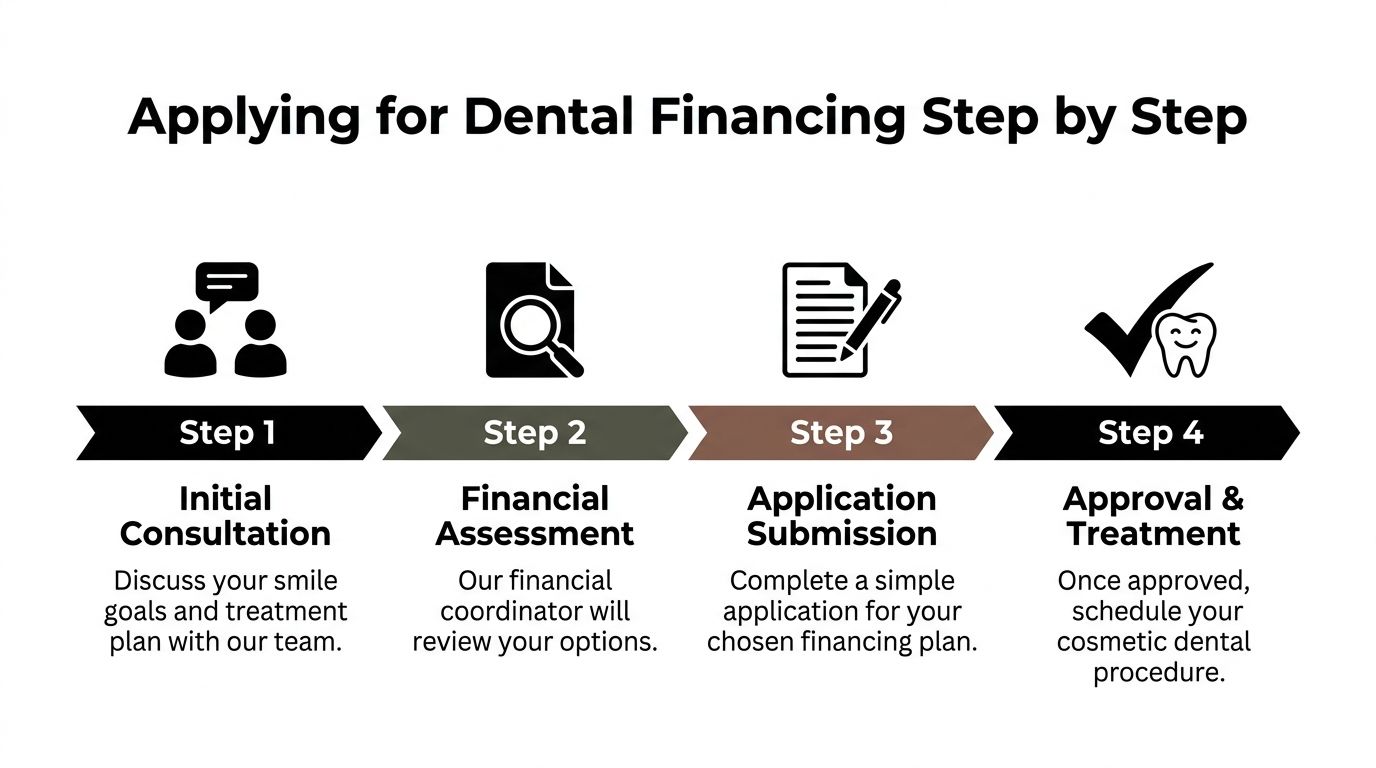
Step 1 starts with the treatment plan
The first visit isn't about pushing financing. It's about understanding what you want to change and what your mouth needs first.
If you come in for veneers, teeth whitening, Invisalign, crowns, or dental implants, the clinical team has to determine whether any underlying issue should be addressed before cosmetic treatment begins. Sometimes the answer is straightforward. Other times a patient also needs restorative dentistry, a replacement for a damaged tooth, or care that supports long-term stability.
Step 2 is reviewing the numbers clearly
Once the treatment recommendation is in place, the next step is cost breakdown. Through this breakdown, many patients finally feel the issue become manageable, because they can compare the full fee with possible payment paths.
You should expect a plain-language discussion about:
- What is included in the proposed treatment
- What may be phased if you prefer to spread care over time
- Which financing options apply to your case
- What monthly budgeting range feels reasonable for your household
A useful financial conversation should never feel rushed. If a patient needs time to think, compare, or talk it over at home, that's normal.
Step 3 may involve prequalification or application
If you choose third-party financing, the office may help you complete a prequalification or formal application. If soft credit prequalification is available, that allows you to explore options before moving deeper into the process.
If you choose an in-house route, the office will usually explain the practice-specific terms and what is needed to begin. The important thing is that you understand the obligation before treatment starts.
Approval is only one part of the decision. Comfort with the repayment terms matters just as much.
A short video can make the process feel even more familiar before your appointment.
Step 4 is scheduling treatment with confidence
After approval or enrollment, the final piece is timing. Some patients start right away. Others schedule in phases to coordinate with work, family obligations, or monthly cash flow.
That flexibility is especially helpful if you're also looking for other services from a dentist in Las Vegas, NV, such as cleaning and exams, dental x-rays, a new patient exam, or even urgent treatment from an emergency dentist before cosmetic work begins. Sometimes the smartest financial move is sequencing care in the right order.
What patients should have ready
To keep things simple, it helps to come prepared with a few basics:
- A clear list of your smile goals, even if it's short
- Questions about payment comfort, not just treatment results
- Any insurance details if part of your care may involve covered services
- An honest monthly budget range so the conversation stays realistic
The process works best when patients don't feel pressured to pretend everything is fine financially. A candid conversation usually leads to a better plan.
Practical Tips to Reduce Your Out-of-Pocket Dental Costs
Even when financing is available, most patients still want to lower the total amount they pay. That's the right instinct. A smart cosmetic plan isn't only about finding a monthly payment. It's also about reducing avoidable costs before financing even begins.

Choose the right timing, not just the right treatment
Many cosmetic cases don't have to be completed all at once. If your smile goals include multiple improvements, it may make sense to phase them.
That can help in two ways. First, you give priority to the treatment that matters most right now. Second, you avoid stacking every expense into one financing agreement.
Cosmetic dental payment plans commonly use fixed installments over 12 to 24 months for standard treatments or 36 to 60 months for more complex cases such as implants, and longer terms can raise the total cost if interest is applied, according to this overview of cosmetic dental surgery payment plans.
Look for savings outside the financing contract
Financing is one tool. It shouldn't be the only one.
A few practical ways to reduce out-of-pocket cost include:
- Use covered services first if your plan helps with exams, cleanings, or x-rays tied to broader treatment
- Ask about phased treatment so you finance only the portion you want to start now
- Compare treatment approaches if more than one cosmetic solution could meet your goal
- Consider a membership plan if you don't have insurance and want routine care plus ongoing savings
If you want a simple way to sketch out monthly spending before committing, some patients find a tool like the ReceiptsAI budget generator helpful for mapping fixed expenses against a proposed dental payment.
Focus on total value, not just monthly convenience
A low monthly number can feel comforting, but it's not always the strongest deal. Longer repayment can increase the overall amount paid when interest is involved. Shorter repayment can be more efficient if the payment still fits your budget.
That's why it helps to ask two separate questions:
| Question | Why it matters |
|---|---|
| What can I afford each month comfortably? | This keeps the plan sustainable |
| What will I pay in total by the end? | This shows the real financial impact |
For patients comparing options, reviewing what cosmetic dental care can cost can make the conversation more grounded before choosing a payment path.
The lowest monthly payment isn't automatically the lowest-cost decision.
Small planning choices can prevent bigger expenses
Good planning can also reduce the chance of paying twice. If a patient needs restorative work first, skipping that step to rush into cosmetic treatment can create problems later. The same is true when someone delays a damaged tooth too long and turns a smaller issue into a larger one.
That's why this topic connects to more than smile makeovers alone. Patients often come in searching for tooth extraction, dental implants near me, or a new dentist near me, then realize their financial strategy matters just as much as the procedure choice. When treatment sequencing is thoughtful, the budget usually holds up better.
Begin Your Smile Journey at Aspiring Smiles in Las Vegas
The hardest part for many patients isn't deciding they want a better smile. It's deciding whether they can realistically begin.
The good news is that cosmetic dentistry doesn't have to be approached as one overwhelming bill. With the right structure, patients can move forward in a way that respects both their goals and their budget. That may mean using in-house options, applying for third-party financing, combining treatment with a membership plan, or phasing care over time.
A practical next step for local patients
If you live in Las Vegas or nearby neighborhoods like Desert Shores, Sunhampton, Sun City Summerlin, Monterrey, Lone Mountain, Mar-A-Lago, or Painted Desert Estates, the most useful first step is a consultation that looks at both treatment and affordability together.
That matters whether you're searching for a cosmetic dentist near me, a dentist in Las Vegas, NV, or care that overlaps with restorative and emergency needs. Some patients come in focused on whitening or veneers. Others need crowns, implant planning, or support after a broken tooth. The right payment conversation depends on the actual clinical plan.
What patients can expect at the office
A visit should feel clear, respectful, and pressure-free. You should expect an explanation of your options in plain language, a review of what's urgent versus optional, and a realistic discussion about payment routes.
The office is located at 3211 N Tenaya Wy Suite 122, making it convenient for patients across this part of Las Vegas who want one place for cosmetic dentistry, restorative dentistry, dental implants, family dental care, and emergency visits.
Financial concerns shouldn't be the reason someone gives up on a healthy, confident smile.
When patients understand the path, they usually feel more comfortable taking the next step. That's true whether the goal is a brighter smile, a straighter smile, or replacing a missing tooth with a treatment plan that fits everyday life.
If you're ready to talk through cosmetic treatment and a realistic payment approach, schedule a consultation with Aspiring Smiles Dental and Braces. The team can help you review your smile goals, explain available financing and membership options, and build a personalized plan for care at 3211 N Tenaya Wy Suite 122 in Las Vegas.