Invisalign for Crowded Teeth: Las Vegas Guide
You catch your reflection at the wrong angle, and the same thought keeps coming back. Your teeth look crowded, the smile feels uneven, and you're left wondering whether Invisalign for crowded teeth can really fix the problem without putting metal braces back on your list.
At Aspiring Smiles Dental and Braces in Las Vegas, NV, that question comes up all the time from patients in Desert Shores, Sunhampton, Sun City Summerlin, Monterrey, Lone Mountain, Mar-A-Lago, and Painted Desert Estates. The good news is that crowded teeth are common in adult orthodontics, and clear aligners have become a mainstream way to treat many mild to moderate cases. Invisalign's crowded-teeth resource describes crowding as one of the most common adult orthodontic problems, and adult orthodontics literature cited there places crowding at about 24% of women and 14% of men in the adult population (Invisalign crowded teeth resource).
That matters because the problem is not rare, and it's not just about looks. For many people, the main worry is simpler and more personal. Will this need braces? Will it need extractions? Or can a clear, removable approach handle it in a way that still feels realistic for work, family, and daily life in Las Vegas?
Do You Keep Hiding Your Smile
A lot of patients describe the same moment. They're in the bathroom, in the car mirror, or looking at a phone photo, and they notice the same front teeth that never quite settled into place. They smile anyway, but the question stays with them, whether Invisalign can handle crowded teeth or whether the case is already too complicated.

What happens when that concern becomes treatment planning
At a consultation, the evaluation usually starts with a close look at how the teeth fit together, how much space is available, and whether the crowding is mostly dental or tied to a deeper bite issue. That distinction matters because two smiles can look similar from the outside and still need very different treatment plans.
At Aspiring Smiles Dental and Braces, the practical question is not, “Can clear aligners move teeth at all?” It's, “Can this case be treated safely and predictably with aligners alone, or should the plan include braces, extra space creation, or another step?” That's the kind of answer nervous patients usually want, because it replaces guesswork with a path forward.
Practical rule: a crowded smile doesn't automatically mean braces are your only option. It means you need a careful exam, digital records, and a plan that matches the kind of crowding you actually have.
Patients often feel better once the process is explained in plain language. If you want a more detailed look at candidacy before your visit, the practice's guide on whether you're a good candidate for Invisalign can help frame the same questions you'd ask in the chair.
Understanding What Crowded Teeth Are and Why They Matter
Crowded teeth happen when the jaw doesn't have enough room for each tooth to sit where it should. The result can be overlap, rotation, one tooth sitting behind another, or a smile that looks narrow and uneven. In plain terms, the teeth are competing for space.
Why crowding develops
Crowding can show up for several reasons. Some people inherit a smaller jaw or a natural tendency toward tight spacing. Others lose baby teeth too early, lose permanent teeth later, or develop a bite that doesn't leave enough room for the full arch.
The important part is that crowding is more than a cosmetic concern. When teeth sit too close together, brushing and flossing become harder, and areas that are difficult to clean can collect plaque more easily. That's why crowded teeth can become a long-term oral health issue, not just a photo problem.
Why patients shouldn't ignore it
Crowding can also change how your bite feels. Chewing may feel less smooth, and some patients notice uneven wear over time because certain teeth take more force than others. The more compressed the arch is, the harder it can be to keep the gums and enamel healthy with everyday care.
That's where treatment planning matters. If the crowding is mild, the goal may be simple alignment. If it's moderate or tied to a narrower arch, the plan may need space creation and careful movement. If the issue is severe or skeletal, aligners alone may not solve everything.
Crowding isn't only about straightening teeth for appearance. It's about making the mouth easier to clean, easier to use, and easier to keep healthy over time.
How Invisalign Straightens Crowded Teeth
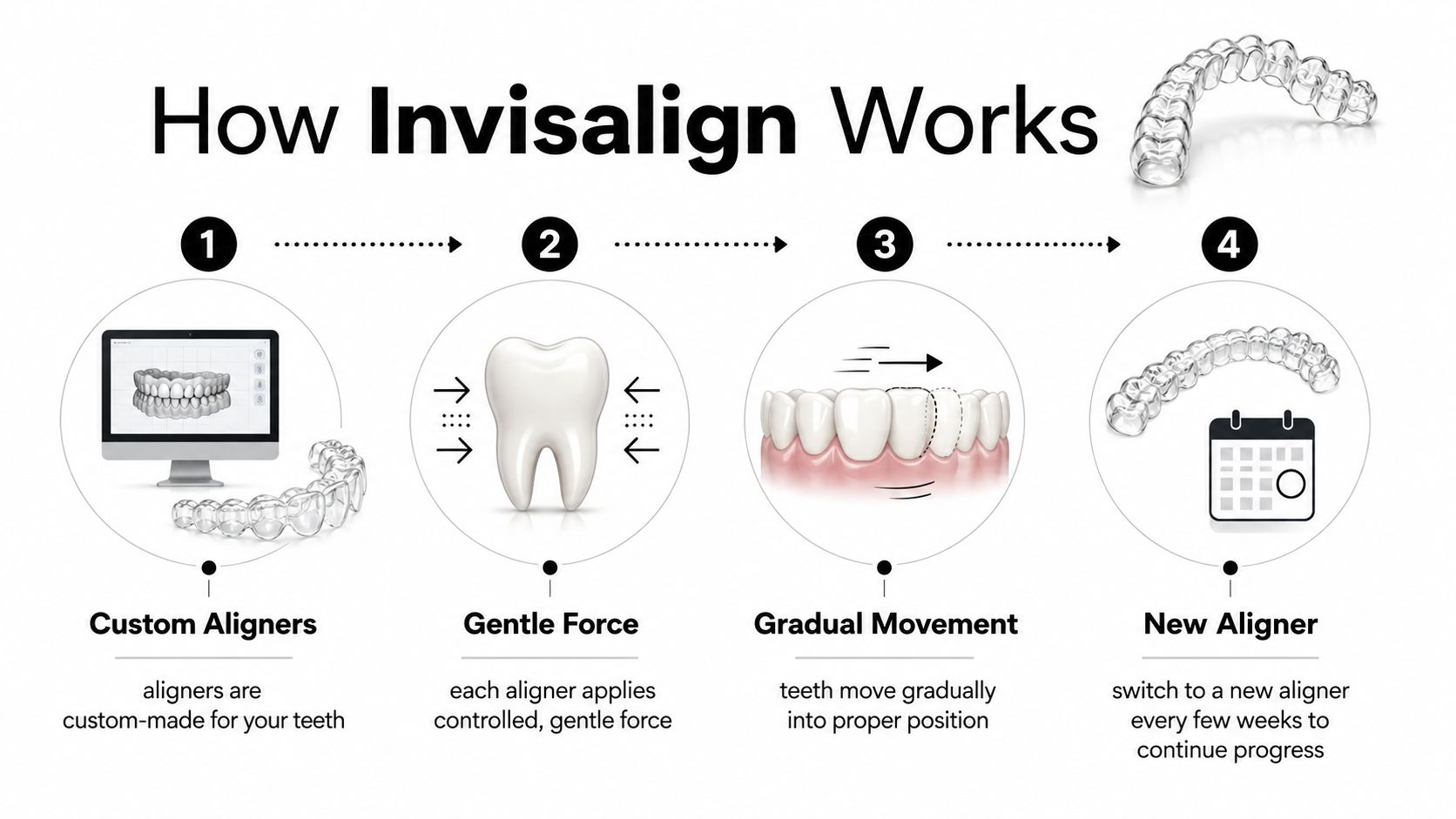
A crowded smile does not always need braces right away. In many mild to moderate cases, Invisalign can create enough space and guide teeth into better positions with a series of custom clear aligners. Each tray makes a small change, so the movement feels gradual. Patients usually notice little by little progress rather than a dramatic shift from one day to the next.
The three ways aligners make room
For crowded teeth, aligners usually create space in a few different ways. Interproximal reduction, or IPR, removes a tiny amount of enamel between selected teeth so they can fit more comfortably. Controlled tipping and leveling help teeth move into a more even arch shape. Limited arch expansion can also help in some cases, although it has clear biomechanical limits.
That is why Invisalign is better understood as a space-management treatment than as a simple straightening system. A systematic review on clear aligners found that aligners can predictably level, tip, and derotate teeth in non-extraction cases, while bodily arch expansion becomes less reliable when skeletal discrepancy or stronger rotation problems are present.
What the research says about crowding resolution
Clinical studies show that Invisalign can work well in the right crowding cases. One peer-reviewed report found that up to 91.4% of mandibular incisor crowding can be resolved with Invisalign treatment (PMC study). A separate crowding-resolution study reported predictability of 87% in the upper arch and 81% in the lower arch (PMC crowding-resolution study).
Refinements are still part of the process. The same PMC study notes that many patients needed a mid-course adjustment before treatment was finished, which reflects how aligner therapy often depends on careful monitoring and small corrections along the way. That does not mean Invisalign failed. It means the trays are designed to guide movement step by step, and the plan sometimes has to be adjusted so the teeth keep tracking the way the doctor intended.
For patients who want a more personal look at whether aligners make sense for their crowding, the Invisalign candidacy guide at Aspiring Smiles explains how doctors evaluate space, tooth movement, and bite fit before recommending treatment.
Who Is a Good Candidate for Invisalign with Crowded Teeth
The simplest answer is that Invisalign tends to work best for mild to moderate crowding. If there's enough room to create space with IPR, small changes in tooth position, and limited expansion, clear aligners can often do the job well.
Where Invisalign usually fits well
Cases with front-tooth overlap, moderate bunching, or teeth that need gradual alignment are often good fits. These are the patients who may be able to avoid fixed braces, especially if their bite isn't heavily complex and they can commit to wearing aligners as directed.
Where aligners become less predictable
Severe crowding is a different story. If the arch is very narrow, the bite is significantly off, or the teeth need larger movements, aligners can lose predictability. In those cases, treatment may require braces, extra space creation, or a hybrid plan. Independent orthodontic guidance notes that severe crowding and complex bite problems may need another orthodontic approach, not aligners alone (Las Vegas orthodontic guidance on Invisalign questions).
What a Las Vegas exam looks for
A clinician has to decide whether the crowding is mainly dental or whether the jaw relationship is part of the problem. That's where digital scans and x-rays help. At Aspiring Smiles Dental and Braces, Dr. Patel uses that kind of evaluation to decide whether Invisalign is enough or whether other treatment steps belong in the plan.
Good candidacy is about fit, not hope. The right case can move beautifully with aligners. The wrong case needs a different tool.
What to Expect During Your Invisalign Treatment Journey
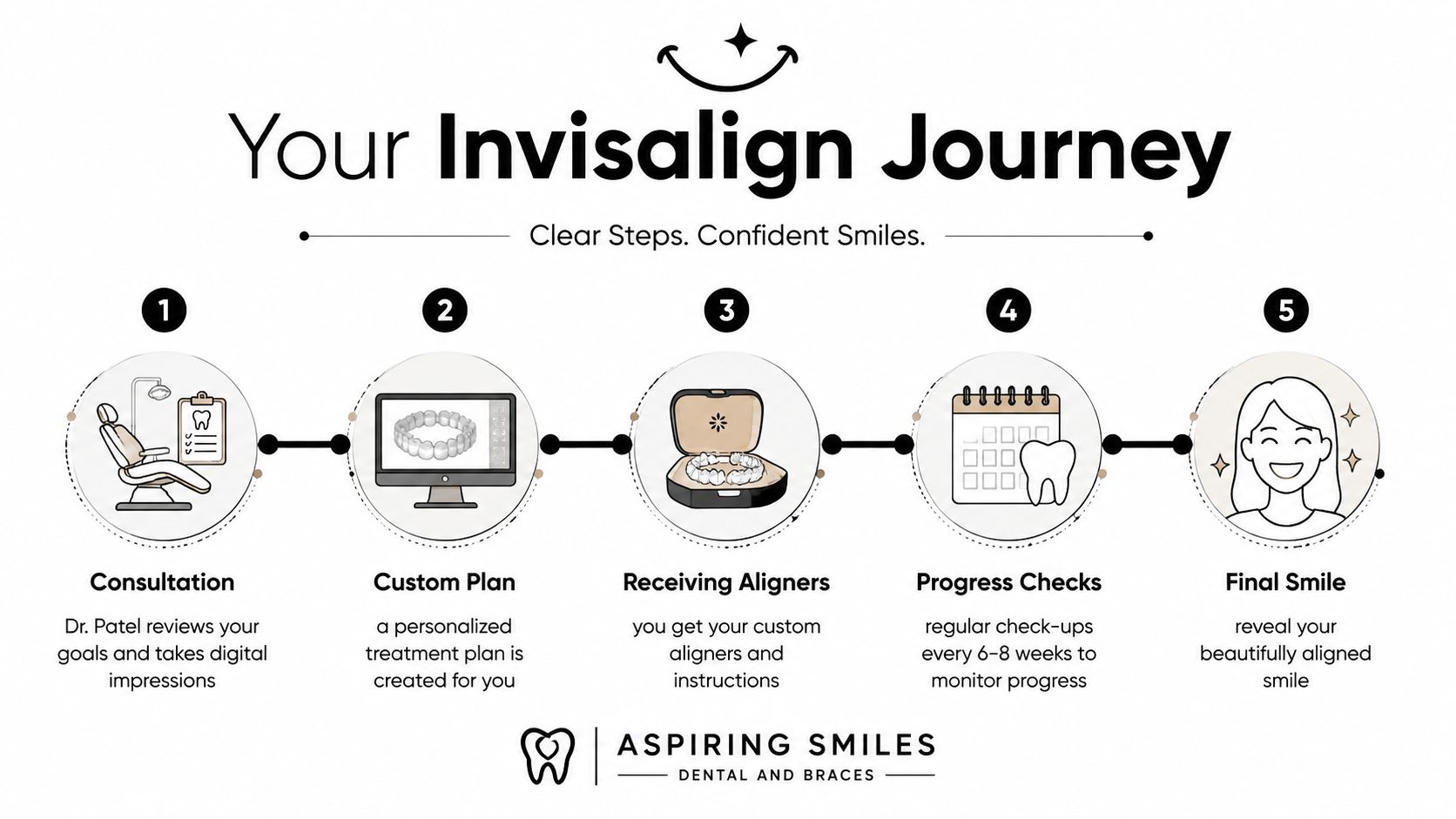
The experience usually starts with a consultation, digital impressions, and a discussion about what bothers you most about your smile. From there, a custom plan is mapped out so you can see where the teeth are expected to move and how the crowding should change over time.
The day-to-day rhythm
You'll wear each aligner set for a stretch of time, then move to the next one as directed. The aligners are removable, so you can take them out for meals and cleaning, which makes oral hygiene easier than with fixed brackets and wires. That convenience matters for patients who are balancing work, family, and daily routines around Las Vegas.
What follow-up care adds
Crowded teeth don't always track perfectly from the first plan, so checkups are part of the process. Some patients need refinement rounds, which means additional aligners are made to fine-tune the result. That's normal in modern aligner therapy, especially when the goal is not only straight teeth but a stable, healthy bite.
What comes at the end
After the aligners finish their job, retainers help keep the teeth from drifting back. That part is just as important as the active treatment, because crowding can gradually return if the teeth aren't held in place.
For patients who want a local office that can coordinate treatment, monitoring, and long-term retention in one place, Aspiring Smiles Dental and Braces offers that continuity of care alongside general dental services like cleanings, exams, and x-rays.
Invisalign vs Traditional Braces for Crowded Teeth
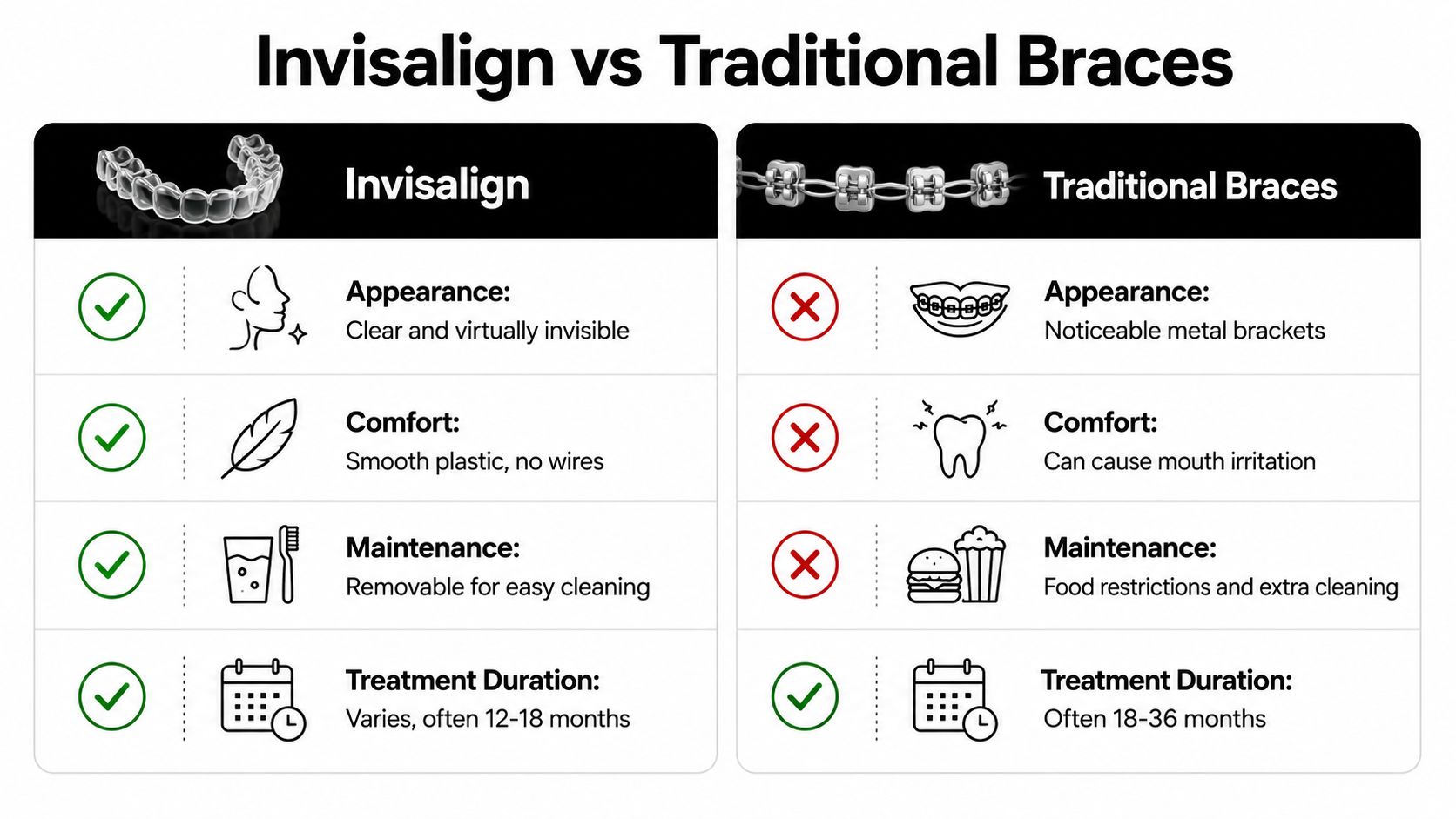
Both treatments can straighten crowded teeth, but they don't do it the same way. Braces use fixed brackets and wires, which can be especially useful for severe crowding and more complex bite correction. Invisalign uses removable clear trays, which usually appeal to adults who want a more discreet option and easier daily cleaning.
The practical differences patients feel
With Invisalign, appearance is the first thing many people notice. The aligners are clear, so they're less visible in meetings, family photos, and everyday conversations. They're also easier to clean around because you can remove them before brushing and flossing.
Braces are fixed, so compliance is simpler in one sense, because you can't forget to put them back in. But they also bring more dietary caution and more cleaning effort around wires and brackets.
Why effectiveness depends on the case
For mild to moderate crowding, Invisalign is a strong option, and the predictability figures in the earlier section reflect that. For severe crowding or stubborn rotations, braces often provide more direct control. The orthodontist's job is to match the tool to the problem, not force every smile into the same category.
The best question to ask yourself
The most useful question isn't “Which is better in general?” It's “Which is better for my teeth, my bite, and my life right now?” That's where a consultation helps, because the answer depends on whether your crowding is mainly front-tooth overlap, arch tightness, or a more complex orthodontic issue.
Cost, Insurance, and Financing for Invisalign in Las Vegas
The financial side matters, and patients deserve a clear answer before they start. At Aspiring Smiles Dental and Braces, Invisalign treatment for crowded teeth typically ranges between three thousand and eight thousand dollars, depending on case complexity, the number of aligners needed, and whether added steps like IPR or attachments are part of the plan.
What changes the price
A simpler crowding case generally needs fewer aligners and less chair time. A more involved case may need refinement aligners or extra treatment steps, which can increase the overall cost. That's why a same-day estimate is helpful, because it turns a general price range into a case-specific plan.
What insurance and payment options can do
Many dental insurance plans cover part of orthodontic treatment, and some have separate orthodontic benefits that can lower your out-of-pocket cost. The practice also accepts major dental insurance plans, offers flexible payment options, and provides a membership program for patients without insurance that includes preventive care and discounts on additional services.
Why the estimate matters before you begin
A good treatment plan should include the clinical steps and the financial steps. If you're trying to compare Invisalign with braces, or if you're also thinking about other services like cosmetic dentistry, restorative dentistry, dental implants, or even a future tooth extraction if space needs to be created, you want the full picture up front.
For a closer look at pricing details, the practice's page on Invisalign cost in Las Vegas gives a useful starting point before your consultation.
| Invisalign Treatment Cost Estimates | Case Type | Estimated Cost Range | Typical Duration |
|---|---|---|---|
| Invisalign Treatment Cost Estimates | Simple crowded-teeth case | Lower end of the treatment range | Shorter treatment plan |
| Invisalign Treatment Cost Estimates | Moderate crowded-teeth case | Middle of the treatment range | Moderate treatment plan |
| Invisalign Treatment Cost Estimates | More complex crowded-teeth case | Higher end of the treatment range | Longer treatment plan |
If you're dealing with crowded teeth and wondering whether Invisalign can handle them without braces or extractions, the next step is a real exam, not more guessing. Aspiring Smiles Dental and Braces in Las Vegas can evaluate your crowding, explain your options clearly, and map out a plan that fits your smile and your schedule. Visit Aspiring Smiles Dental and Braces to request your consultation and get a straightforward answer about your treatment options.