Dental Crowns in One Day in Las Vegas, NV
You chip a molar on a Friday evening in Las Vegas, and by the next morning you're searching for a dentist near me, wondering whether you'll need weeks of temporary repairs before the tooth is finally restored. A damaged tooth can make eating uncomfortable, disrupt work, and turn a busy schedule into a treatment-planning problem.
Dental crowns in one day can provide a faster path for patients whose teeth are suitable for chairside treatment. Instead of preparing the tooth during one appointment and waiting for an outside laboratory to complete the restoration, a dentist can scan, design, mill, adjust, and bond a ceramic crown in the office. The important question, however, isn't just whether a crown can be made quickly. It's whether that workflow is appropriate for your tooth, bite, esthetic goals, and long-term oral health.
At Aspiring Smiles Dental and Braces, patients from Las Vegas, NV, and nearby communities such as Desert Shores, Sunhampton, Sun City Summerlin, Monterrey, Lone Mountain, Mar-A-Lago, and Painted Desert Estates can discuss same-day crowns alongside traditional restorative options. This guide explains what the process involves, where the evidence is reassuring, where caution is needed, and what you can expect when choosing a local dentist.
A Faster Way to Restore a Damaged Tooth in Las Vegas
By Saturday morning, the Las Vegas patient with the chipped molar may be worried about every bite. The tooth could have broken while eating, cracked around an old filling, or lost a cusp that had already been weakened by decay. The usual crown process often means preparing the tooth, taking an impression, placing a temporary crown, and returning later for the permanent restoration. For someone working long shifts, traveling across the valley, or trying to fit care around family responsibilities, that schedule can feel difficult.
A dental crown is a tooth-shaped covering that protects and rebuilds a tooth when a filling can't provide enough strength. Dentists may recommend one for:
- Large decay: Extensive damage may leave too little healthy tooth for a conventional filling.
- A cracked tooth: A crown can hold the remaining structure together when the crack hasn't extended into the root.
- Root-canal protection: A treated tooth can need full-coverage protection after infection has been addressed.
- A broken cusp: A fractured chewing point may leave the tooth vulnerable to further breakdown.
The same-day alternative aims for the same clinical goal, protecting and restoring the tooth, but uses a connected digital workflow. CEREC means Chairside Economical Restoration of Esthetic Ceramics, and the system was developed at the University of Zurich in 1980 by Werner Mörmann and Marco Brandestini. The first patient was treated in 1985, Siemens licensed the technology in 1986, and CEREC 1 launched in 1987 as dentistry's first CAD/CAM system. By 2002, the platform had more than 2,500 users in the United States and more than 5,000,000 restorations placed worldwide, according to the CEREC history document.
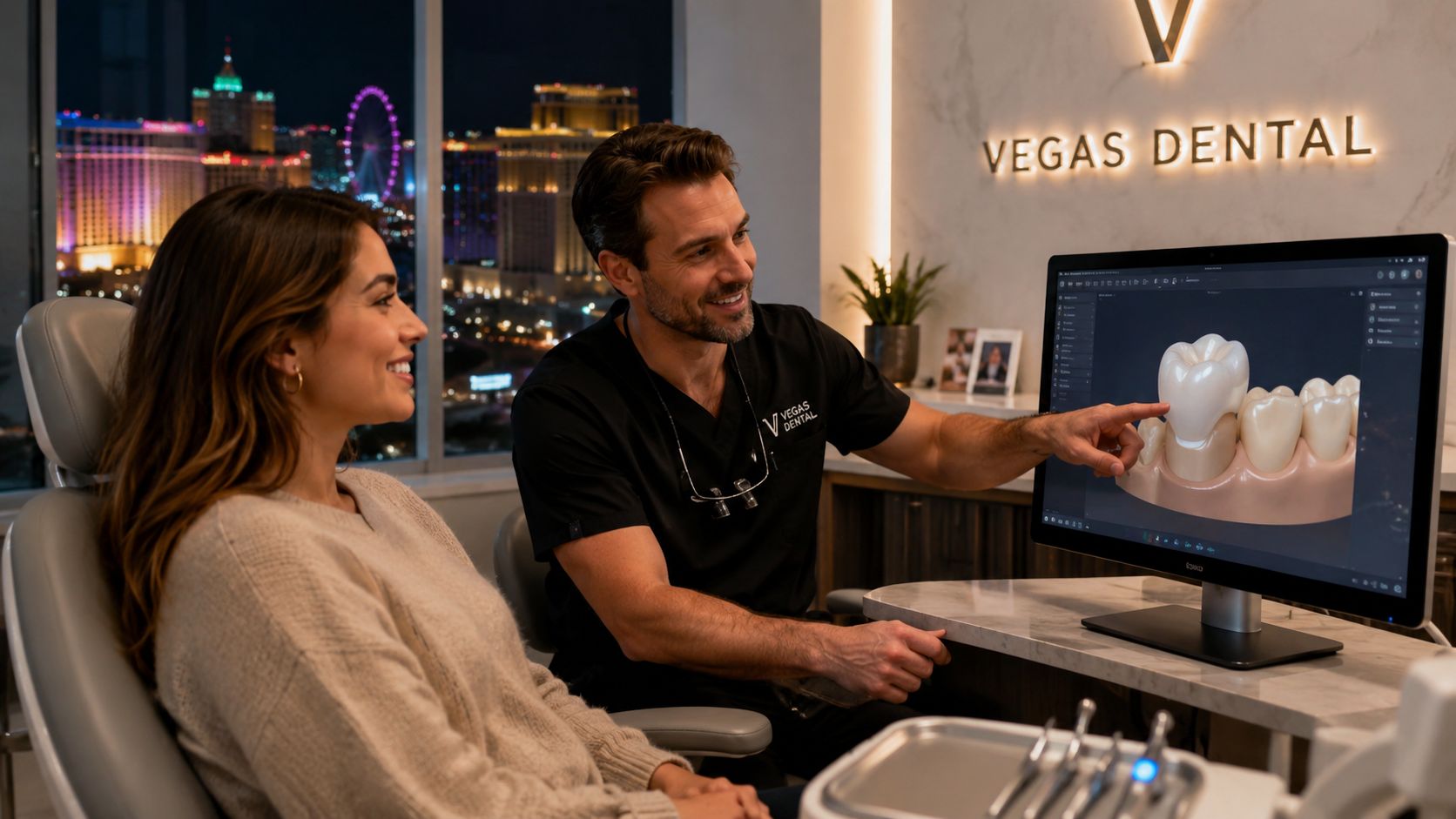
The promise isn't that speed makes every crown better. The practical benefit is that a suitable tooth may be restored without a temporary crown or a separate placement visit. A clinical study reported that a chairside process could be completed in under 60 minutes, with mean impression times of 12:41 minutes for conventional methods and 7:29 minutes for a CEREC intraoral scan, supporting the feasibility of a lithium disilicate crown in one visit according to this clinical overview of chairside CAD/CAM crown delivery.
How Same-Day Crowns and the CAD/CAM Workflow Actually Work
The visit begins much like any other restorative appointment. The dentist examines the tooth, reviews dental x-rays when needed, discusses symptoms and goals, and uses local anesthetic before removing decay or reshaping the damaged structure. The crown still needs a stable, healthy foundation. Digital equipment doesn't replace diagnosis or careful preparation.
From the prepared tooth to a digital design
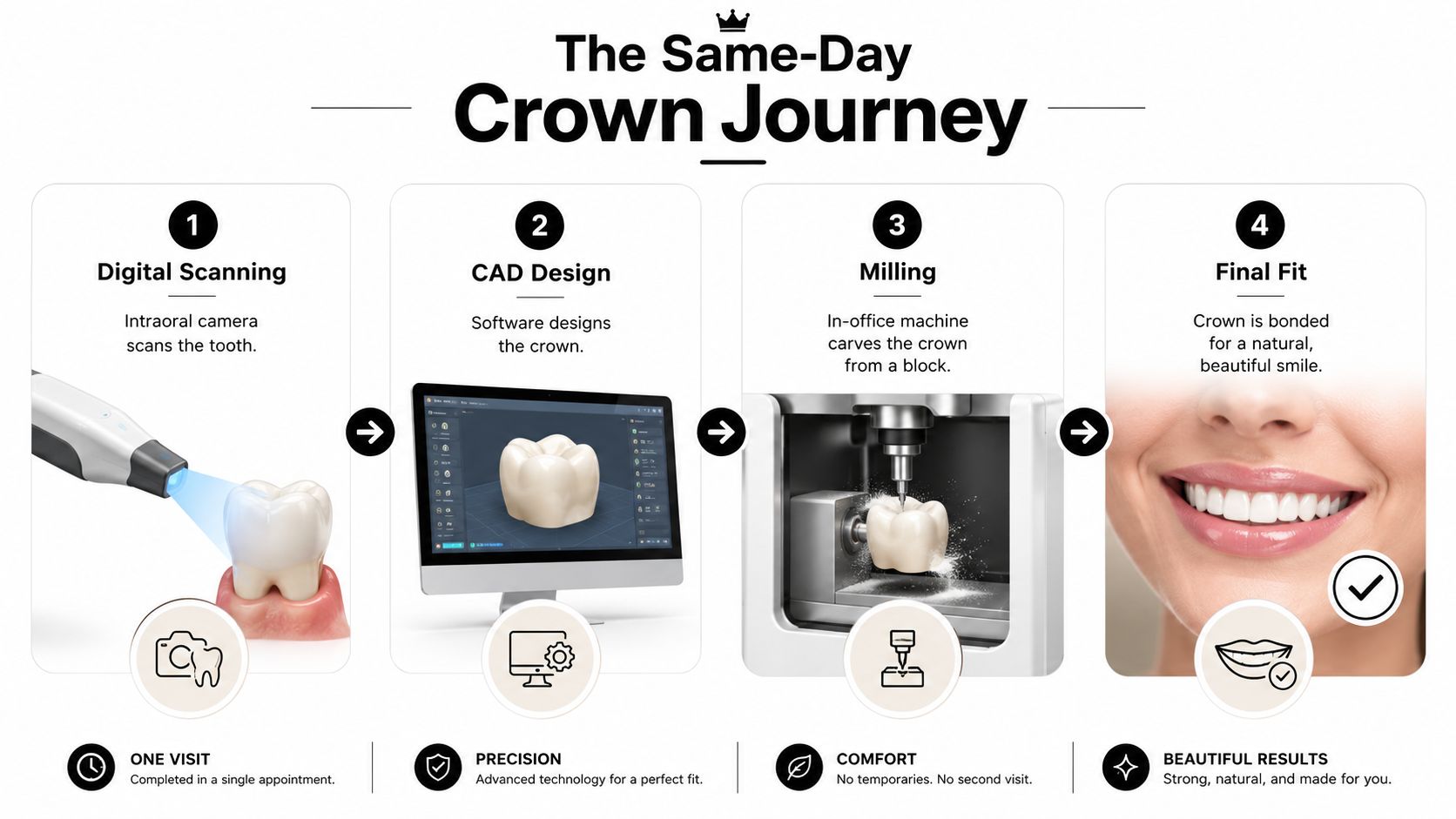
After preparation, an intraoral scanner captures the tooth and the surrounding bite. The scanner uses a small camera rather than a tray filled with impression material, creating a three-dimensional model that the dentist can inspect on a screen. That model shows the preparation margins, neighboring teeth, and the opposing bite.
The CAD software then helps create the crown design. The dentist controls the contour, contacts, chewing surface, and relationship with the teeth above and beside it. Some systems can suggest a starting design, but the dentist remains responsible for evaluating whether the proposal fits the patient's anatomy and functional needs.
Milling, finishing, and bonding
Once the design is approved, the file goes to an in-office milling unit. The machine carves the crown from a manufactured ceramic block, often lithium disilicate or a zirconia-reinforced glass ceramic, depending on the tooth and the dentist's material selection. One dental-industry explanation reports that some materials can be milled for immediate delivery in less than 40 minutes, while some blocks used for inlays, onlays, and crowns can be milled in 18 minutes or less. The exact time depends on the material, machine, design, and milling strategy, as described by this overview of scanning and milling for one-visit crowns.
After milling, the dentist checks the crown, refines its surface, and may stain or glaze it to match the surrounding teeth. The final steps include checking the contacts and bite, making any necessary adjustments, and bonding the crown to the prepared tooth. A full appointment can vary because examination, anesthesia, preparation, scanning, design, milling, finishing, and placement all take time. Patients should ask the office for a personalized estimate rather than assuming every case follows the same schedule.
If you're interested in how dental teams keep patient communication organized while clinicians are busy with procedures, this resource on SkipCalls dental call handling offers useful background.
Why Same-Day Crowns Can Be Just as Precise as Lab-Made Ones
Fast treatment doesn't automatically mean careless treatment. Chairside systems mill a restoration from a pre-manufactured ceramic block under controlled conditions, while the dentist can inspect the digital model and the finished crown during the same visit. That combination can support a consistent result, but it doesn't eliminate the variables that affect crown fit.
A systematic review found that 94.9% of measured marginal gaps for ceramic crowns fell within clinical acceptability, according to the PubMed-indexed review of CAD/CAM crown adaptation. The same evidence also showed that results vary by system and technique. One CAD/CAM comparison found a chairside system had a significantly higher absolute marginal discrepancy, 132 ± 12 µm, than alternative milling workflows measuring 71 ± 6.9 µm and 78 ± 7.7 µm. Those findings don't prove that same-day crowns are inferior. They show why scanner quality, preparation geometry, software settings, milling calibration, and operator judgment matter.
Milling speed can also affect the edge where the crown meets the tooth. In one comparative study, the finest milling strategy produced mean marginal deviations of 87 µm and 111 µm for the materials tested. Faster strategies increased deviations to 146 µm and 118 µm, and the faster approach was statistically worse. For one material, the result could cross the commonly cited 150 µm clinical acceptability threshold, as reported in this comparative study of milling strategies and marginal accuracy.
Factors Affecting Crown Fit Accuracy
| Factor | Same-Day CAD/CAM | Traditional Lab |
|---|---|---|
| Impression method | Digital scan, with the dentist able to review the model immediately | Physical or digital impression sent through a laboratory workflow |
| Design control | Dentist can evaluate the virtual design chairside | Dentist and laboratory technician share design responsibilities |
| Milling or fabrication | In-office machine uses a selected milling strategy and block | Laboratory equipment and technician-specific fabrication process |
| Adjustment timing | Fit and bite can be evaluated during the same visit | Fit is evaluated when the restoration returns |
| Main quality variable | Scan quality, preparation, software, machine, and operator control | Impression, laboratory process, material, communication, and clinical adjustment |
The practical takeaway is simple: precision is a system outcome, not a miracle of speed. A skilled Las Vegas dentist should explain how the tooth will be prepared, which material is being considered, and why the proposed workflow suits the case.
Same-Day Crowns Compared to Traditional Lab-Made Crowns
A same-day crown and a traditional laboratory crown both aim to protect a weakened tooth and restore its shape, function, and appearance. The difference is where the restoration is designed and fabricated, how many appointments are needed, and how much material and artistic customization the case requires.
Traditional crowns may take up to about two weeks for fabrication, while a same-day CEREC crown can be completed and placed during the same day, according to this patient overview of CEREC crowns and traditional timelines. The traditional process can be valuable when the case benefits from a laboratory technician's layered porcelain work, a more involved design, or several try-in stages.
Same-Day vs. Traditional Crowns at a Glance
| Factor | Same-Day Crown | Traditional Crown |
|---|---|---|
| Visits | Often completed in one appointment when the tooth qualifies | Usually includes preparation and a later placement visit |
| Temporary crown | Often not needed | Commonly used while the laboratory makes the permanent crown |
| Impression experience | Digital scan may be more comfortable for patients who dislike impression trays | May involve a physical impression, depending on the office and case |
| Common materials | Lithium disilicate or zirconia-reinforced ceramic blocks | Lithium disilicate, zirconia, porcelain-fused-to-metal, gold, or layered porcelain, depending on the case |
| Design control | Dentist designs and mills the restoration in the office | Dentist works with a dental laboratory |
| Esthetic customization | Strong for many single-tooth restorations, with chairside staining and glazing | Useful for complex shade, translucency, and layered porcelain demands |
| Best fit | A suitable single damaged tooth and a patient who values one-visit care | Complex cases, demanding esthetic work, extensive rehabilitation, or specialized implant designs |
The evidence supports a conditional conclusion. Recent systematic reviews generally report smaller marginal discrepancies and better internal adaptation for CAD/CAM crowns, but differences are often not statistically significant and vary with material and fabrication method. A 2025 review reported about 90% five-year survival for CAD/CAM restorations, broadly comparable to conventional crowns, according to this systematic review of CAD/CAM crown outcomes.
Clinical perspective: The better choice is the restoration that matches the tooth, the bite, the material requirements, and the dentist's ability to control the workflow.
A traditional crown may serve better for an implant crown on a custom abutment, a full-mouth rehabilitation, a long bridge, or a front tooth requiring highly individualized layered porcelain. Same-day dentistry is a useful option, not a rule that every crown should be made in the office.
Who Makes a Good Candidate for a One-Day Crown
Candidacy starts with the tooth, not the calendar. A Las Vegas dentist first needs to determine whether the tooth can be saved, whether the root is healthy, and whether enough sound structure remains to support a crown. Dental x-rays, a clinical examination, gum evaluation, and bite assessment help answer those questions.
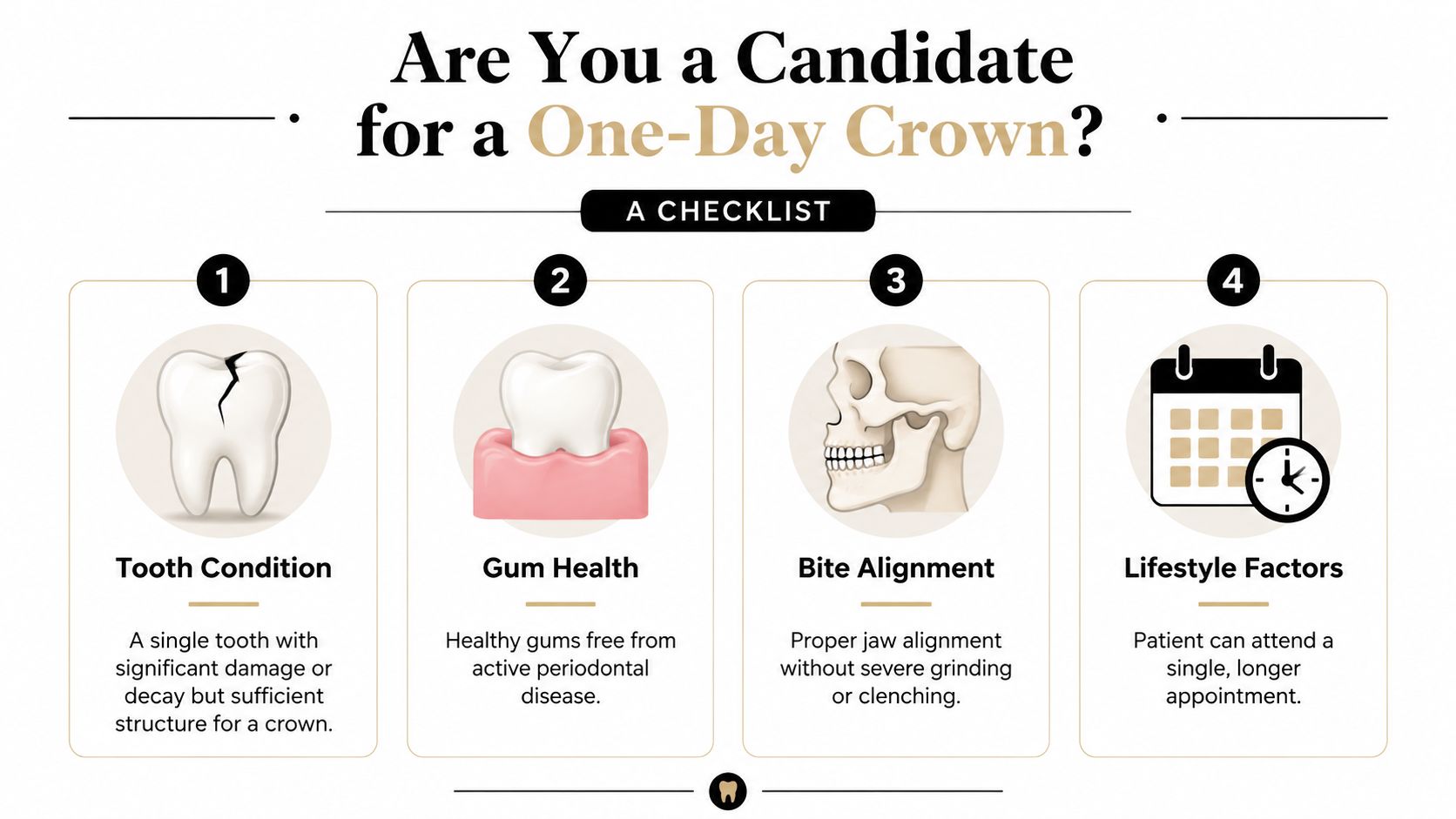
A patient may be a strong candidate when the case involves one structurally damaged but salvageable tooth. The remaining tooth should provide a stable foundation, the margins should be accessible, and the tooth shouldn't require an unusually complex post-and-core reconstruction. Healthy gums also matter because inflammation or bleeding can make scanning and bonding less predictable.
The decision points behind the recommendation
- Tooth condition: A large filling, broken cusp, extensive decay, or a tooth that has completed root-canal treatment may be appropriate if the remaining structure and root support a crown.
- Gum health: Active periodontal disease or swollen tissue may need attention before definitive restorative treatment.
- Bite forces: Severe clenching or grinding can increase the risk of damage to any crown, especially when the tooth carries heavy chewing pressure.
- Esthetic demands: A molar and a highly visible front tooth may require different materials and design approaches.
- Appointment practicalities: A single longer visit can help patients who work long shifts on the Strip, travel for work, or have difficulty arranging multiple appointments.
When a traditional approach may be wiser
A one-day crown may be the wrong choice when a crack extends into the root, the preparation margin sits far below the gum, or the tooth needs a complicated buildup. Patients with uncontrolled bruxism may need bite protection and a broader treatment plan before a crown is placed. Implant crowns on custom abutments can require laboratory coordination, while full-arch cases often benefit from laboratory artistry, multiple try-ins, and staged verification.
Patients from Sun City Summerlin, Desert Shores, Lone Mountain, and surrounding Las Vegas neighborhoods shouldn't try to decide based only on a treatment advertisement. A consultation should connect the scan, x-rays, gum condition, bite, and esthetic expectations to the restoration choice. The same-day option is most valuable when it improves the overall plan, not merely when it shortens the appointment sequence.
How AI and Digital Dentistry Are Changing Chairside Crowns
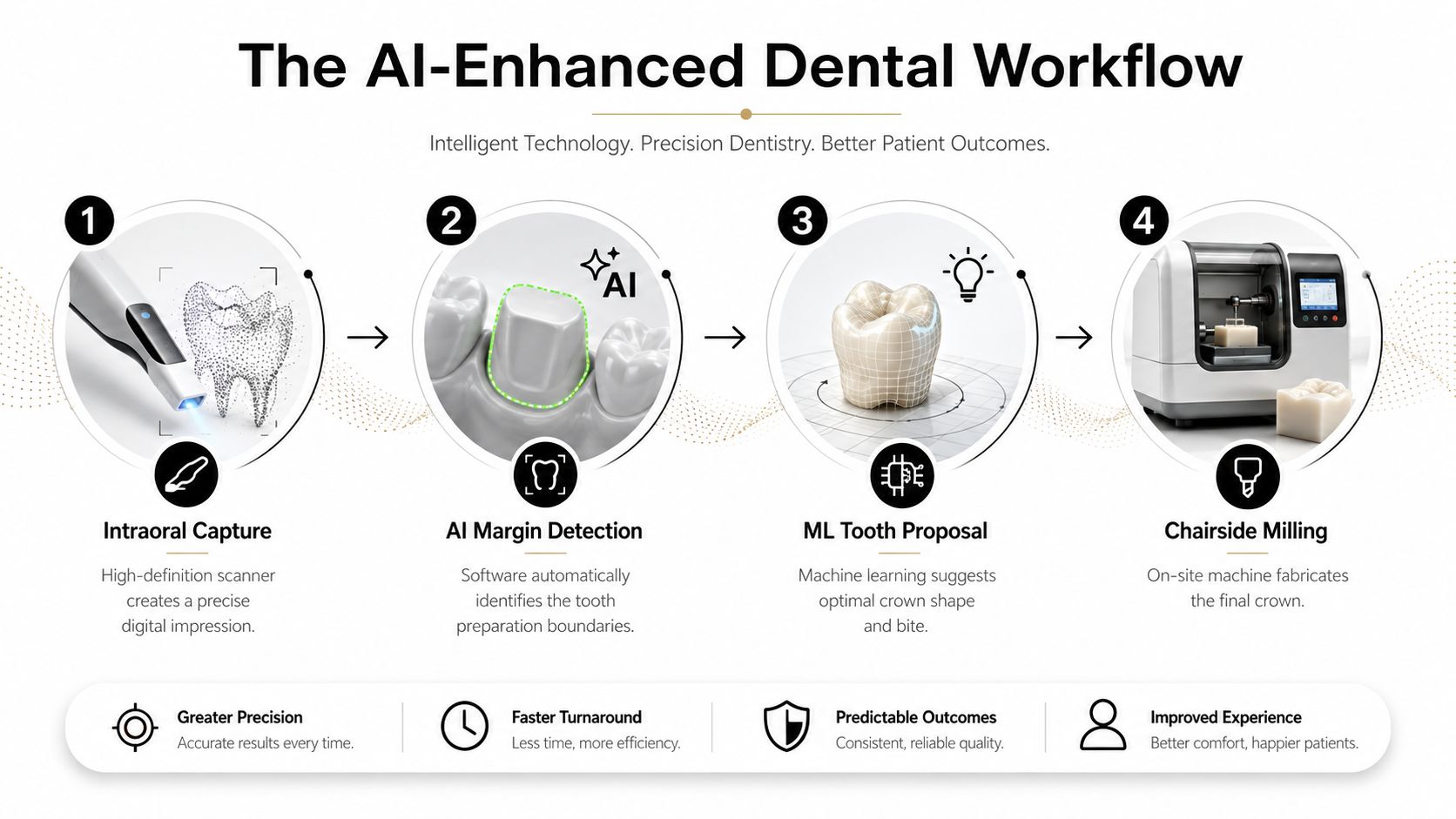
Digital dentistry is becoming more connected. The intraoral scanner captures the tooth, software identifies preparation boundaries, design tools suggest a crown shape, and an in-office mill turns the approved file into a restoration. Artificial intelligence can support parts of that chain, but it doesn't replace the dentist's examination, diagnosis, material selection, shade evaluation, or final bite check.
Emerging evidence is encouraging. A 2026 systematic review found that AI-based crown design produced clinically acceptable accuracy, with internal fit and marginal adaptation comparable to, and sometimes better than, conventional CAD/CAM workflows. Another review reported that digital workflows can reduce chairside time by 30% to 45% and may be preferred by patients because procedures can be less uncomfortable and involve less gagging, according to this review of AI and digital dental workflows.
What patients may notice
The patient experience can include a more comfortable digital scan, fewer repeated impressions, clearer on-screen explanations, and easier review of the proposed crown shape. Automated margin detection can help the dentist locate the crown boundary, while machine-learning tools can suggest contours based on existing tooth anatomy and bite relationships.
Those suggestions still need clinical review. A software proposal can't feel a patient's bite, diagnose a crack, evaluate gum tissue, or decide whether a tooth should receive a crown instead of a filling, root-canal treatment, tooth extraction, or another option. At Aspiring Smiles, digital tools are intended to support chairside decision-making while the dentist focuses on the parts of care that require clinical judgment. Patients can learn more about the practice's advanced dental technology.
The most useful way to view AI is as a refinement of the workflow. It can reduce repetitive design work and help organize information, while the dentist remains accountable for whether the restoration is appropriate, functional, comfortable, and maintainable.
Cost, Insurance, and Value for Las Vegas Patients
The cost of a same-day crown in Las Vegas depends on more than the ceramic block. The practice must maintain a scanner, milling unit, furnace or finishing equipment, software, calibration protocols, and trained staff. The selected material also affects planning, since lithium disilicate and zirconia-reinforced ceramic blocks have different handling and performance characteristics.
Insurance is another variable. Crowns are generally classified as major restorative treatment, and many plans cover a portion after the deductible, but exact benefits depend on the policy. Same-day and laboratory-made crowns may be submitted under the same CDT procedure code when the clinical service is equivalent, so the digital workflow doesn't automatically create a different insurance benefit. Patients should confirm the plan's annual maximum, waiting rules, replacement limitations, deductible, coinsurance, and network status before treatment.
What changes the amount you pay
PPO and HMO plans can handle provider participation and reimbursement differently. An in-network office may have contracted fees, while an out-of-network office may leave the patient responsible for a larger balance. HSA and FSA funds may also be available for eligible dental expenses, but patients should confirm eligibility with the plan administrator.
The practical value includes more than the fee on the estimate. A same-day restoration may reduce the need for a temporary crown, eliminate a return visit, and reduce the chance that a scheduling gap extends treatment. For a patient working downtown or on the Strip, avoiding another trip and another period of temporary-crown precautions can have meaningful personal and work value.
| Factor | Same-Day Crown | Traditional Crown |
|---|---|---|
| Equipment investment | Office maintains CAD/CAM scanning and milling equipment | Office coordinates with an outside or affiliated laboratory |
| Laboratory time | Design and fabrication happen chairside | Laboratory fabricates the restoration after receiving the case |
| Temporary restoration | Often avoided when the crown is placed the same day | Commonly used during the laboratory period |
| Insurance classification | Often billed as a crown under the applicable restorative code | Often billed under the same type of crown code |
| Patient cost | Depends on material, exam needs, insurance, and office fees | Depends on material, laboratory process, insurance, and office fees |
| Time value | Fewer appointments may mean less time away from work | Multiple visits may be necessary |
| Planning question | Is the tooth suitable for in-office fabrication? | Does the case benefit from laboratory customization? |
For a broader look at how service businesses explain costs and value to local customers, this Transactional LLC electrician marketing guide provides an example from a different industry. For crown-specific planning, review the practice's information about how much crowns cost and ask for a written estimate based on your examination.
Aftercare and Your Next Step at Aspiring Smiles Dental and Braces
After the crown is bonded, your mouth may remain numb for a while. Avoid chewing until normal sensation returns so you don't accidentally bite your cheek, tongue, or lip. Mild temperature sensitivity can occur after treatment and may fade, but persistent discomfort, sharp pain when biting, or a feeling that the crown hits first deserves a call to the dental office.
The dentist should check the bite before you leave, and a follow-up bite check can be useful if the tooth feels high once the anesthetic wears off. A small adjustment may relieve pressure and protect the tooth and restoration from unnecessary stress. Don't try to reshape the crown yourself.
Protecting the restoration every day
Brush along the gumline and floss carefully around the crown margin. A crown can't develop decay, but the natural tooth underneath and beside it remains vulnerable if plaque collects at the edges. Regular cleaning and exams also help the dentist monitor the crown, gums, neighboring teeth, and bite.
If you grind or clench, ask whether a nightguard would help. Avoid using the crown to open packages, chewing ice, or biting hard non-food objects. These habits can damage natural teeth and restorations alike.
Aftercare rule: A same-day crown removes the temporary-crown waiting period, but it still needs the same daily hygiene and bite protection as any other permanent restoration.
For Las Vegas patients, one-visit care can simplify scheduling around work, school, and family responsibilities. It also avoids the inconvenience of a fragile temporary crown dislodging between appointments. Still, convenience should follow diagnosis. If the tooth needs a root canal, periodontal treatment, a tooth extraction, dental implants, or another form of restorative dentistry, those needs must be addressed before or instead of a crown.
When choosing a new dentist near me, patients often look for clear communication as well as technical services. Questions about patient experience and practice communication can be informed by resources such as this guide to reputation management for dental clinics, but your own consultation remains the best way to understand your treatment options.
Aspiring Smiles Dental and Braces provides general, cosmetic, restorative, and emergency dental care in Las Vegas, including crowns and chairside CAD/CAM evaluation. During a consultation, the team can determine whether a one-day crown is appropriate or whether a traditional crown, cosmetic dentist near me service, dental implants near me consultation, tooth extraction, or emergency dentist visit better fits your needs.
Schedule a consultation with Aspiring Smiles Dental and Braces in Las Vegas, NV, to have your damaged tooth examined and learn whether chairside CAD/CAM can provide a dental crown in one day. Contact the practice to discuss your symptoms, insurance questions, and preferred appointment timing, including care that fits your schedule in Desert Shores, Sunhampton, Sun City Summerlin, Monterrey, Lone Mountain, Mar-A-Lago, or Painted Desert Estates.