How Does Clear Aligners Work in Las Vegas, NV
Standing in front of the mirror before a wedding, reunion, or big night on the Strip, a lot of people in Las Vegas notice the same thing. The teeth that used to seem “fine” now look crowded, a little crooked, or not as straight as they want in photos. At that point, the big question usually sounds simple, how does clear aligners work, and is it really different from braces?
Clear aligners feel different because they don't rely on brackets and wires. They're custom-made trays that fit over the teeth and move them in planned steps, which is why many adults and teens like the discreet look. The honest part is that not every tooth movement responds the same way, so the best treatment plan depends on the case, not just the preference.
If you're comparing Invisalign with braces, or you've been searching for a dentist near me or a dentist in Las Vegas, NV, the details matter more than the marketing. A helpful outside resource on jaw alignment and bite balance is the SleepHabits jaw misalignment guide, which gives a useful overview of how bite issues can affect the way people think about smile treatment.
What follows is a plain-language walkthrough of the mechanics, the appointment flow, the lifestyle rules, and the limits that matter in everyday life at a Las Vegas practice.
A Las Vegas Patient's First Question About Clear Aligners
A common scene goes like this. Someone in Las Vegas is getting ready for a work trip, a family event, or a night out in Summerlin, and they keep noticing one crowded front tooth in every selfie. They want a straighter smile, but they don't want metal showing in photos, and they're wondering if Invisalign can do the job without turning daily life upside down.
That question makes sense. Clear aligners are designed to be discreet and removable, and that combination is exactly why many adults start looking at them before they ever consider braces. The aligners are custom-made plastic shells that fit over the teeth, and the American Association of Orthodontists says they're typically worn 1 week at a time, at least 22 hours a day, and removed for eating and oral hygiene (AAO summary).
The first thing most patients want to know is whether the treatment is doing work or just “covering” the teeth. It's doing real orthodontic work. Clear aligner therapy dates back to 1946, when Kesling first introduced the concept, and the modern commercial breakthrough came in 1998–1999 with Invisalign from Align Technology (systematic review). That same review found 79% of published clear-aligner outcome studies were published in the last 5 years, which shows how quickly the evidence base has grown (systematic review).
Practical rule: if the change you want is mainly about alignment and appearance, aligners may be a strong fit. If the bite problem is complex, the answer can be different.
At Aspiring Smiles Dental and Braces in Las Vegas, the conversation usually starts with the smile you want and the bite you have. That's the part that keeps the plan realistic, whether you live near Desert Shores, Sunhampton, Sun City Summerlin, Monterrey, Lone Mountain, Mar-A-Lago, or Painted Desert Estates. The rest of this guide walks from scan to retainer in plain language, so the process feels less mysterious and a lot more manageable.
The Biomechanics Behind How Clear Aligners Move Teeth
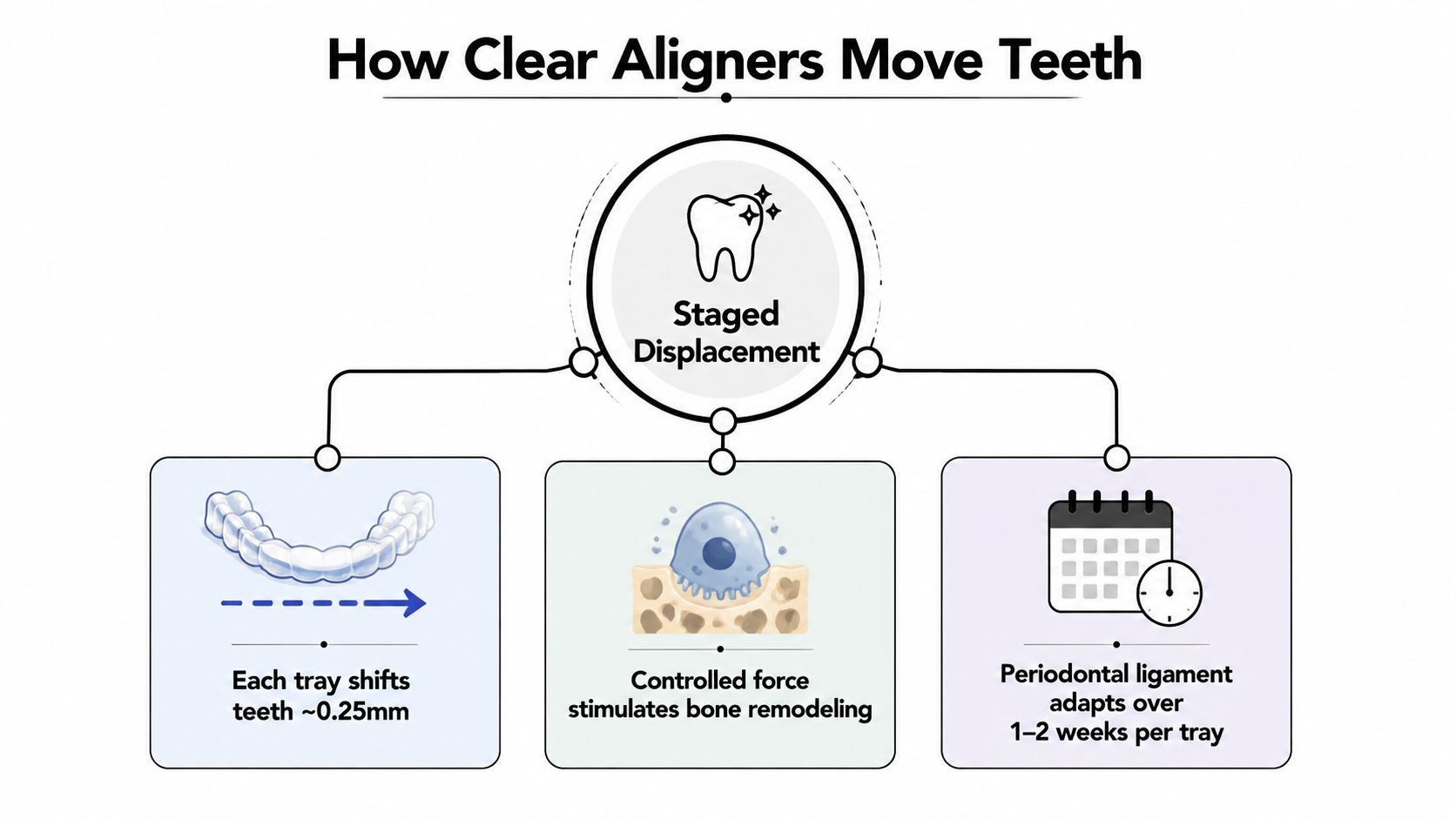
Think of aligner treatment as a snowplow moving along a route one small section at a time. Each tray is shaped a little differently from the last one, so when you wear the series in order, the teeth keep moving toward the final position rather than jumping there all at once. That staged approach matters because the appliance is fabricated for the intended tooth position, and the fit creates controlled force and moment systems on the teeth and periodontal ligament (biomechanics review).
Why the trays need time
The teeth don't move because plastic “pushes” in a simple way. The periodontal ligament and surrounding bone respond to steady pressure, then remodel gradually, which is why clinical protocols rely on short wear intervals and staged movement instead of expecting one tray to do everything (biomechanics review). In simple terms, the aligner nudges the tooth, the supporting tissues adapt, and the next tray continues the process.
A review article also describes the mechanism as both displacement-driven and force-driven, and notes that simple movements such as tipping and minor rotation are the easiest to achieve (review article). That's where the “how does clear aligners work” answer becomes very practical. They work best when the movement is controlled, predictable, and broken into steps the tissues can tolerate.
What helps aligners do more
Not every case is simple. Reviews note that more complex movements, such as bodily translation and root torque, often need engineered features like attachments, pressure points, and power ridges to create the couple needed for root control (biomechanics review). In practice, dentists may also use interproximal reduction, which means carefully shaping tiny amounts of enamel between select teeth to make room for alignment without extra bulk.
Clinical takeaway: aligners don't “straighten everything” by themselves, they work as part of a staged system that depends on design, wear time, and the type of tooth movement involved.
Your Step-by-Step Invisalign Journey at Aspiring Smiles
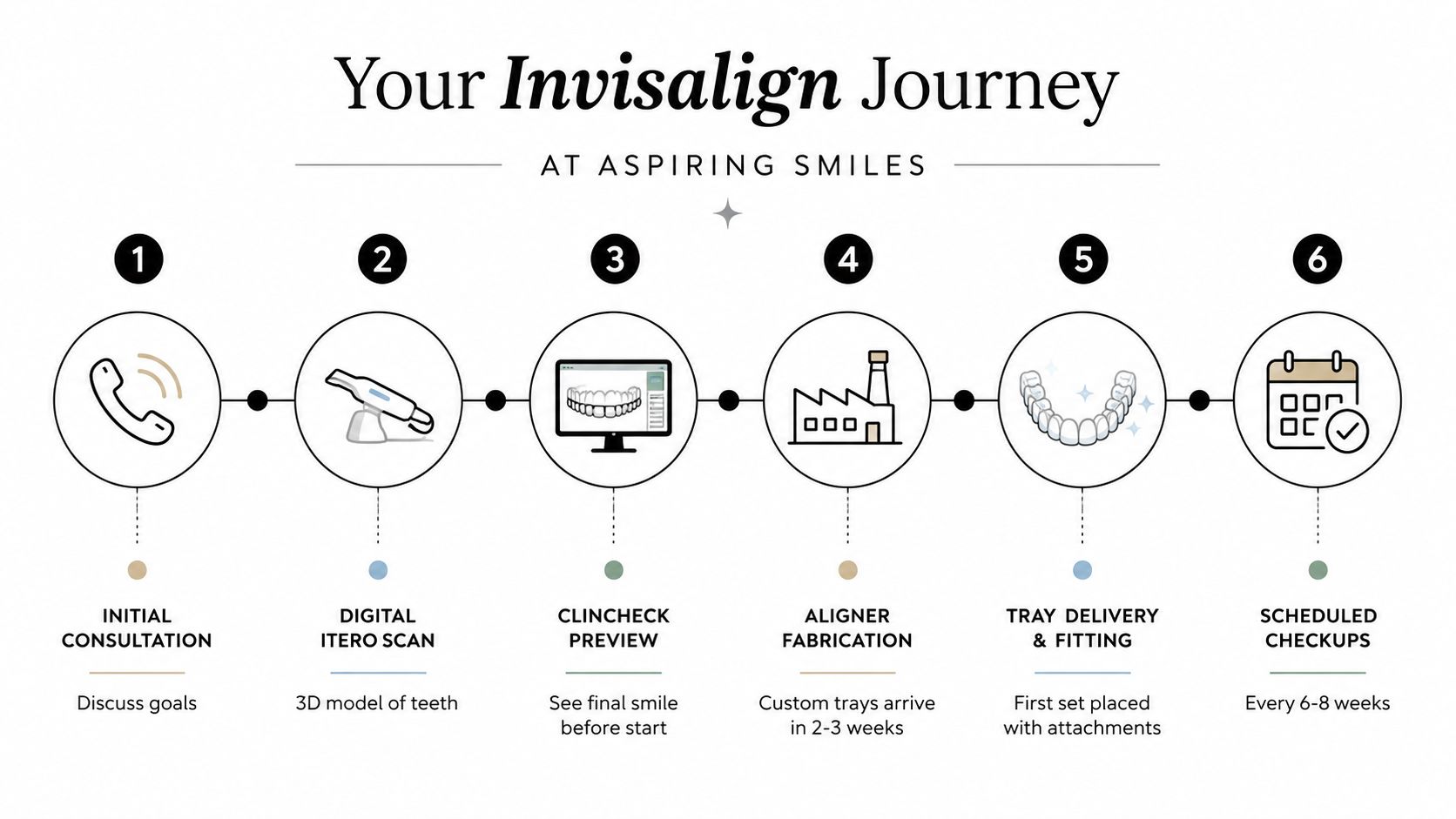
The first visit is usually straightforward. A patient comes in, talks through goals, and gets a digital scan so the office can map the teeth in three dimensions instead of relying on messy impressions. In many cases, the scan leads to a visual preview of how the teeth are expected to move, which helps people understand the plan before they commit.
For mild cases, treatment can feel relatively quick, while moderate cases usually take longer. A broad clinical comparison found average treatment duration of 14.5 months for aligners versus 16.2 months for braces, and patient satisfaction was 85% with aligners versus 65% with braces (comparative research). The same comparison reported discomfort scores of 2.3 out of 10 for aligners and 5.6 for braces, along with a 75% reduction in the PAR index after 12 months for aligners versus 80% for conventional braces (comparative research).
What the visits usually cover
A typical Invisalign path at Aspiring Smiles Dental and Braces includes:
- Consultation and exam, to look at the bite, crowding, spacing, and gum health.
- Digital scan, to build a model of the teeth.
- Treatment preview, so the patient can understand the proposed movement.
- Aligner delivery, with attachments placed if needed.
- Progress checks, usually spaced through treatment.
- Retention, because teeth need support after active movement ends.
The clinic can also coordinate cleaning and exams, dental x-rays, new patient exams, teeth whitening, cosmetic dentistry, restorative dentistry, dental implants, and even tooth extraction or emergency dentist care when that becomes part of the overall plan.
The most useful question at the first visit is not “Can I get aligners?” It's “What movements do my teeth need, and is aligner treatment the right tool for those movements?”
For patients who want a local Invisalign overview, a practice comparison like Invisalign vs traditional braces can also help frame the decision before the consultation.
Who Is a Good Candidate for Clear Aligners in Las Vegas
Some people are a fit because of lifestyle. They want a discreet option for work, travel, or public-facing jobs, and they'd rather not deal with brackets. That matters, but the decision comes down to tooth movement, because aligners are not equally good at every kind of correction.
What aligners usually handle well
Clear aligners are most comfortable when the problem is mild to moderate and the patient is consistent. Recent reviews note stronger performance for some movements and weaker performance for others, with better predictability in molar distalization and expansion, and weaker control for torque and extrusion (2025 consensus). Another review found aligners effective for anterior intrusion and posterior buccolingual inclination, but not for anterior extrusion or anterior buccolingual inclination (scientific review).
| Clear Aligner Candidacy by Tooth Movement Type | Aligner Accuracy | Good Candidate? | Notes |
|---|---|---|---|
| Mild crowding | Better | Often | Works best when movement is small and staged |
| Minor spacing | Better | Often | Usually predictable when the bite is otherwise stable |
| Distal tipping | Better | Often | One of the more reliable movements |
| Torque or extrusion | Weaker | Sometimes | Often needs attachments or another approach |
| Severe extraction-based movement | Less predictable | Often not ideal | Control can be harder than with braces |
Where candidacy gets limited
A major reason Las Vegas patients get honest recommendations is that movement-specific accuracy can be lower than people expect. Recent reviews highlight that some movements, like upper incisor intrusion, can be far less predictable than others, while distal tipping tends to be more reliable (2026 3D comparison). Another review reported stronger outcomes for molar distalization at 86% and expansion at 80%, but weaker control for torque at 52% and extrusion at 30% (2025 consensus).
Las Vegas schedules matter too. Hospitality workers, frequent travelers, and people with active social calendars need a plan they can follow. That's why candidacy at Aspiring Smiles is judged on the tooth movement, the bite, and the patient's ability to wear the trays consistently, not just on whether they want a lighter-colored option.
Clear Aligners vs Traditional Braces Compared Honestly
A lot of patients start with the appearance question and end with the function question. Clear aligners look discreet and feel easier in day-to-day life, but braces still do some jobs better, especially when the movements are complex or the bite needs stronger control.
| Factor | Clear Aligners | Traditional Braces |
|---|---|---|
| Comfort | No brackets or wire tightening, but new trays can feel tight for a couple of days | Can rub cheeks and need adjustment visits |
| Appearance | Nearly invisible in normal conversation | More noticeable, especially metal braces |
| Hygiene | Removable, so brushing and flossing are simpler | Food can catch around brackets and wires |
| Treatment Time | Often efficient for mild to moderate cases (comparative research) | Often better for complex movement control |
| Complexity | Best for simpler to moderate movements (biomechanics review) | Better for severe rotations, vertical changes, and tougher bite problems |
The comfort difference is real, but so is the trade-off. Aligners avoid the bracket cuts and wire tightening that some patients dislike, while braces can be more efficient when the case calls for stronger mechanical control. The comparison is not about one system being “better” in every situation, it's about matching the tool to the task.
A concise patient guide like Invisalign vs traditional braces can help make that choice easier before you book, but the final recommendation should still come from the clinical exam.
The verdict is simple. Aligners win when the case is appearance-conscious, mild to moderate, and the patient will wear them faithfully. Braces win when the movement is complex, the bite is challenging, or the tooth positions need tighter control than trays can deliver.
Daily Wear, Eating, and Care Habits That Keep Treatment on Track
A clear aligner plan only works when the trays are in the mouth long enough. The American Association of Orthodontists says aligners are typically worn at least 22 hours a day (AAO summary), and that rule is what keeps the teeth moving on schedule instead of drifting behind.
How the day usually looks
Morning coffee in Las Vegas is fine, but the trays should come out first if you're drinking anything besides water. After eating or drinking, brush and floss, then put the aligners back in right away. That rhythm matters because extended tray-free time slows the plan, and a few skipped hours here and there add up fast.
Practical rule: if you're about to eat, drink something other than water, or brush your teeth, take the aligners out. If none of those are happening, the trays should be in.
Cleaning is simple when it stays consistent. Use a soft toothbrush, lukewarm water, and a non-abrasive cleanser. Hot water can warp the plastic, and whitening toothpaste can scratch or stain the trays, so gentler products are a better choice. Daily care routines like these are also explained in the practice guide on how to clean Invisalign aligners.
A few habits make a big difference:
- Store trays in the case, not a napkin, especially at restaurants.
- Wear them while sleeping, because overnight hours count.
- Avoid smoking or vaping with trays in, since that can stain the plastic.
- Use chewies if recommended, so the aligners seat fully against the teeth.
Check-ins usually happen on schedule so progress stays on track, and aligner changes are timed by the treatment plan rather than by guesswork. If you're traveling for work or spending long days on the move, the case and the routine matter even more. Consistent wear is what keeps treatment close to the original timeline instead of stretching it out.
Invisalign Cost, Insurance, and Financing in Las Vegas
Cost varies because treatment is customized. In Las Vegas, what you pay depends on the case complexity, the number of aligner stages, the treatment length, and whether refinement trays are needed after the first sequence. That's why two people can both ask for Invisalign and still receive very different plans.
What usually affects the final fee
The more movement a case needs, the more planning it takes. Longer treatment, more aligner sets, and extra refinements usually mean a higher investment, while minor alignment problems tend to be simpler. Insurance can help, especially when the plan includes an orthodontic benefit, and many patients also use HSA or FSA funds if their plan allows it.
| Invisalign Cost Factors and Payment Options in Las Vegas | Typical Range or Detail |
|---|---|
| Case complexity | Simpler cases usually cost less than more involved correction |
| Treatment length | Longer treatment generally means more aligner stages |
| Refinement trays | May add cost if extra finishing work is needed |
| Dental insurance | Often applies an orthodontic lifetime maximum |
| HSA or FSA | May be used for eligible treatment costs |
| Financing | Monthly payment plans can spread out the investment |
The practical question is what fits the budget without delaying care. Monthly financing can make treatment easier to start, and a membership program can also reduce out-of-pocket costs through bundled preventive care or discounted services. At Aspiring Smiles Dental and Braces, those options are discussed alongside the clinical plan so the decision stays grounded in value, not just price.
A realistic way to think about cost is to ask what the smile is worth over time. Better alignment can make cleaning easier, support healthier gums, and reduce the need for repeated short-term fixes later. The specific monthly payment depends on the treatment plan, but the office can map that out before you commit so there are no surprises.
Getting Started With Invisalign at Aspiring Smiles Dental and Braces
The easiest first step is a phone call or online booking for a consultation in Las Vegas. Bring your insurance card, any recent x-rays you have, and a short list of questions about alignment, comfort, and timeline. That keeps the visit focused on your goals, not on paperwork.
During the consultation, the dentist does a clinical exam, reviews the bite, and uses a digital scan to build the treatment model. The scan helps show how the teeth may move, how many aligner stages may be needed, and whether attachments, refinements, or another approach make more sense. If the case is a fit, the plan is explained in plain language before anything starts.
What usually comes next
Once the treatment plan is approved, the aligners are made, and the next visit covers the first set, wearing instructions, and any attachment placement. After that, progress checks are scheduled so the office can confirm that the teeth are tracking the way the plan expects. If refinements are needed later, they're handled as part of the same process rather than treated like a surprise problem.
Many patients worry that they have to commit before they understand the details. They don't. A good consultation answers the candidacy question first, then the timeline, then the cost, then the day-to-day rules. That order matters because it keeps the decision grounded in what your teeth need.
Aspiring Smiles Dental and Braces also offers other care that often matters around orthodontic treatment, including cleaning and exams, teeth whitening, restorative dentistry, dental implants, tooth extraction, and emergency dentist services when needed. That kind of continuity helps Las Vegas patients keep the rest of their oral health in order while they straighten their smile.
If you're ready to find out whether clear aligners make sense for your smile, schedule a visit with Aspiring Smiles Dental and Braces. The consultation is a straightforward way to get real answers, see your options, and decide on treatment with confidence.