Digital Smile Design in Las Vegas: A Complete Patient Guide
You're smiling for a group photo in Las Vegas, but your lips stay carefully closed. Maybe you're a hospitality professional who spends every shift under bright lights, a bride-to-be planning a wedding, or someone who wants to stop hiding worn, uneven, chipped, or discolored teeth. If you've searched for a cosmetic dentist near me, you may have wondered whether you can see the likely result before treatment begins.
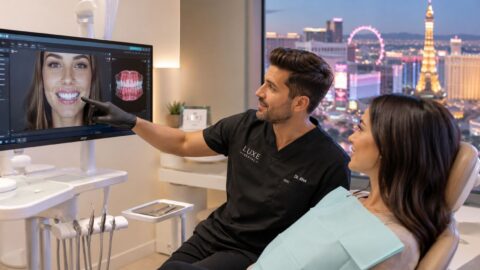
Digital Smile Design gives patients a visual planning process for cosmetic and restorative dentistry. Instead of relying only on verbal descriptions or a traditional wax model, the dental team can use photographs, videos, scans, and design software to create a smile proposal based on your face, teeth, lips, and goals. At Aspiring Smiles Dental and Braces in Las Vegas, Dr. Patel can use this type of planning to help patients understand their options before deciding whether veneers, bonding, Invisalign, crowns, whitening, or implant treatment is appropriate.
What Digital Smile Design Means for Las Vegas Patients
A patient working in a Las Vegas hotel may feel especially aware of a smile. Conversations happen under strong lighting, photographs are part of daily life, and guests often remember a warm, confident expression. A future bride may have a different reason, such as wanting her teeth to look balanced in close-up photographs. The concern is personal, but the question is similar: What could my smile look like, and would the result suit my face?
Digital Smile Design, often shortened to DSD, is a digitally planned approach to cosmetic dentistry. It uses pre-treatment and post-treatment photographs to design a smile around facial features and patient preferences. The method is widely traced to Brazilian dentist Christian Coachman, who introduced it in 2007 as a digital treatment-planning method. A 2020 review of Digital Smile Design describes the field's development from hand-drawn smile sketches on printed photographs toward facial integration, digital workflows, and connections between two-dimensional concepts and three-dimensional planning.

The important idea is simple. Your smile isn't designed in isolation from the rest of your face. The planning process considers tooth proportions, the gum line, lip movement, facial symmetry, and the way your smile appears when you speak or laugh. A screen preview can't predict every biological detail, but it can make a previously abstract conversation much easier to understand.
Modern reviews show that DSD has moved beyond a single pioneer's concept and into a broader digital dentistry workflow. A 2025 systematic review and meta-analysis on AI-based smile design searched research published from 2004 through 2024, while a separate 2024 narrative review examined studies published from 2013 through 2023. This research has focused on communication, patient satisfaction, workflow, and aesthetic outcomes.
At Aspiring Smiles, the value for a Las Vegas patient is clarity. You can discuss what you like, what you don't like, and what feels natural before a final treatment plan is approved.
How the Digital Smile Design Process Actually Works
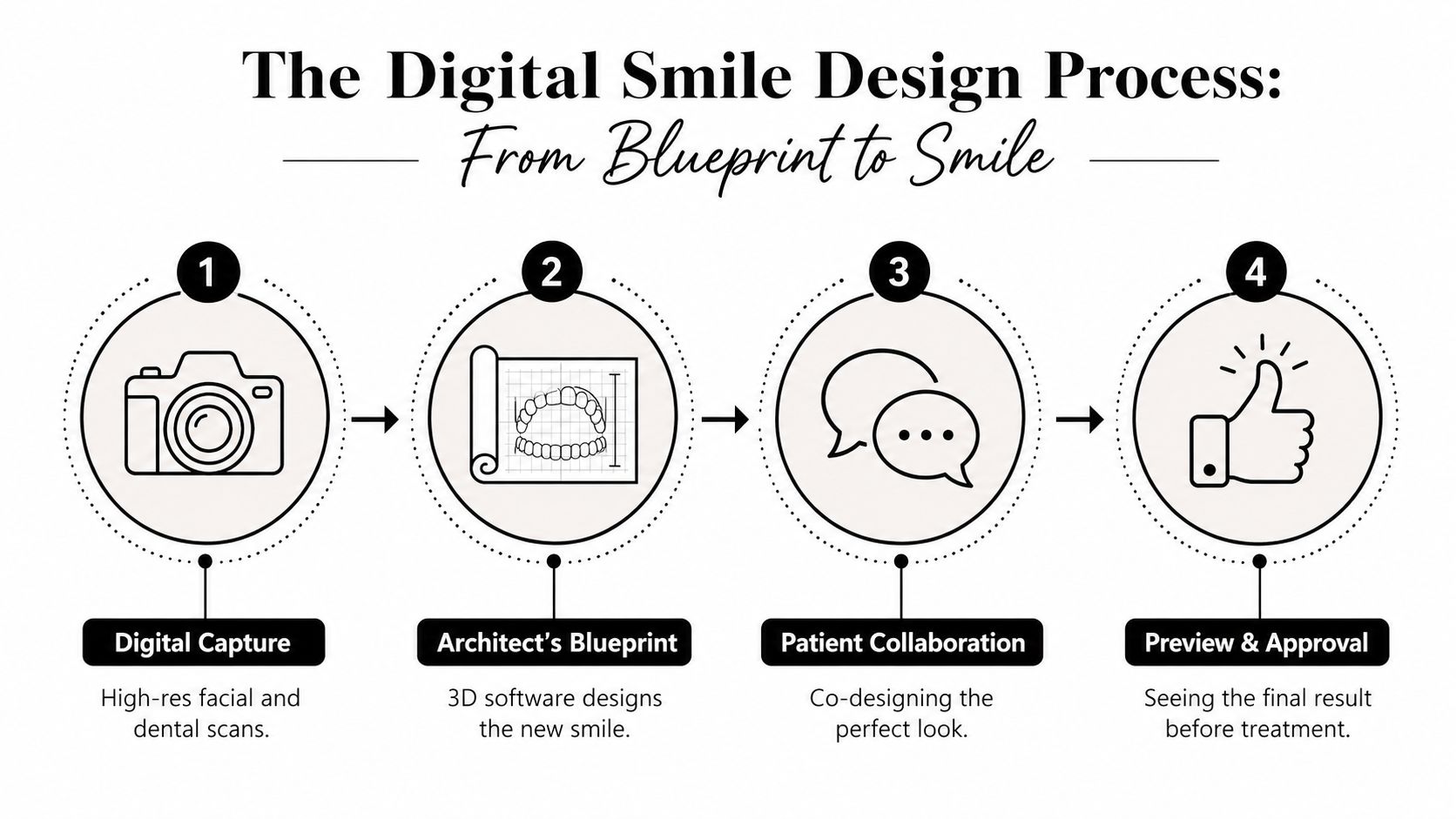
Think of DSD as an architect's rendering before a house is built. The rendering helps everyone discuss proportions, layout, and changes before construction begins. It doesn't replace the builder's judgment, and a smile simulation doesn't replace Dr. Patel's clinical examination, but it gives the patient and dental team a shared plan.
Step one captures the starting point
The process begins with detailed records. These may include:
- Facial photographs: Standardized images show your face, smile line, tooth display, and facial midline.
- Smile video: Short recordings capture natural lip movement, speech, and how your teeth appear when you smile normally.
- Intraoral scans: A digital scanner records the teeth and bite without the discomfort of traditional impression material.
- Dental imaging: Dental X-rays or CBCT imaging may be used when the case requires additional information about roots, bone, or implant planning.
A clinical workflow review describes DSD as combining photographic calibration, intraoral scanning, optional CBCT imaging for complex cases, virtual planning of tooth length, width, contours, and contacts, plus fabrication of mock-ups, preparation guides, and temporaries in line with the plan. You can learn more about the technology used in modern planning through advanced dental technology at Aspiring Smiles.
Step two turns records into a visual proposal
The dental team brings the photographs, scans, and other records into design software. The proposed tooth shapes are positioned against your own face, using references such as the facial midline, lip framing, tooth display, and proportional relationships. “Golden proportion” ideas may be considered, but they shouldn't override your anatomy, bite, speech, or preferences.
Step three checks function, not just appearance
A smile can look attractive on a still image and still feel wrong in the mouth. The design is therefore checked against speech sounds such as F, V, and S, bite relationships, tooth contacts, and gum symmetry. These checks help the team identify changes before permanent restorations are made.
Step four creates a temporary preview
A printed or milled mock-up can be placed over the existing teeth. You may see it in a mirror, speak, smile, and assess how it feels. This stage is collaborative and reversible until you approve the final direction.
Practical rule: A digital preview is most useful when you treat it as a conversation starter, not a promise that every detail will remain identical after healing and long-term use.
Your First Visit and Digital Planning at Aspiring Smiles
Your first appointment at Aspiring Smiles in Las Vegas should begin with a conversation, not a sales pitch. Dr. Patel and the team need to understand what you want to change, what you want to preserve, and how your smile fits into your life. A public-facing career, an upcoming event, a history of dental anxiety, or a preference for a subtle result can all influence the planning discussion.
The consultation focuses on your priorities
You may explain that you dislike uneven edges, spaces, discoloration, worn teeth, or a smile that looks narrow in photographs. You may also ask whether whitening, bonding, Invisalign, porcelain veneers, crowns, or dental implants near me would make sense. The dentist will evaluate your teeth, gums, bite, existing restorations, and general oral health before recommending cosmetic treatment.
A patient who needs a cleaning and exam, dental X-rays, gum treatment, or urgent care may need those concerns addressed before cosmetic planning. DSD works best when the underlying mouth is healthy enough to support the proposed treatment.
The records appointment gathers the details
During a focused diagnostic visit, the team may capture standardized facial photographs, a short smile video, intraoral scans, and any required radiographs. These records allow the digital plan to reflect your actual teeth and facial movement rather than a generic model.
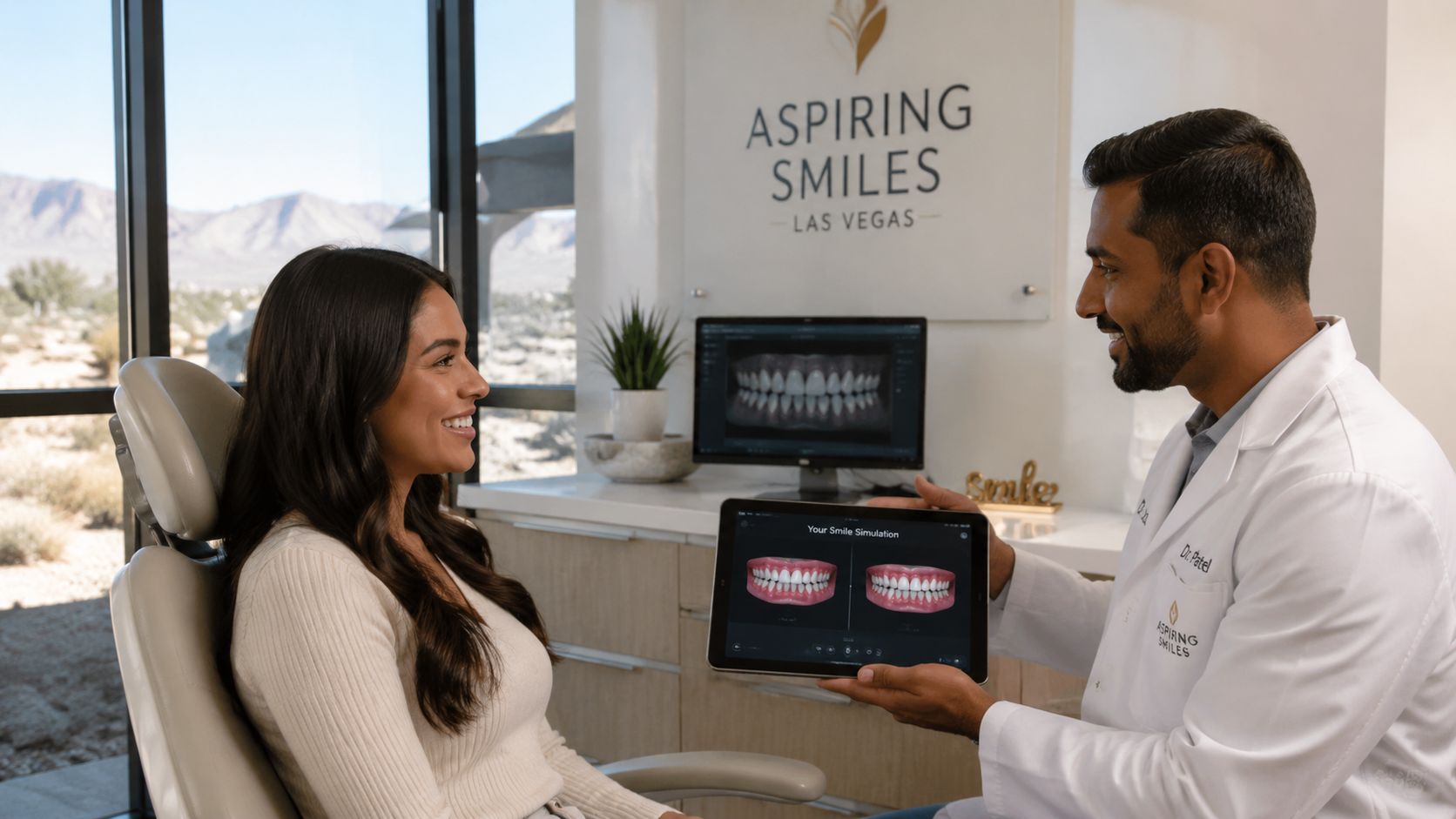
The next stage is the digital wax-up. Dr. Patel reviews the records, develops a proposed design, and discusses it with you at a follow-up appointment. Instead of trying to remember a verbal description, you can review the proposed tooth length, width, contours, and overall smile line on screen.
The mock-up makes the proposal tangible
At the in-mouth mock-up visit, the proposed design is temporarily placed over your existing teeth. You can look in the mirror, speak, smile for a video, and consider how the teeth appear in different lighting. That matters in Las Vegas, where a smile may be seen in bright daylight, restaurant lighting, professional photography, and phone cameras.
Refinements can be made before consent forms and treatment appointments are finalized. The number of visits depends on the complexity of your case and whether you need preparation, orthodontics, gum treatment, restorative work, or implant planning. The purpose of each appointment remains clear, collect information, review the design, test the proposal, and approve a treatment sequence.
Treatments Guided by Your Digital Smile Design Plan
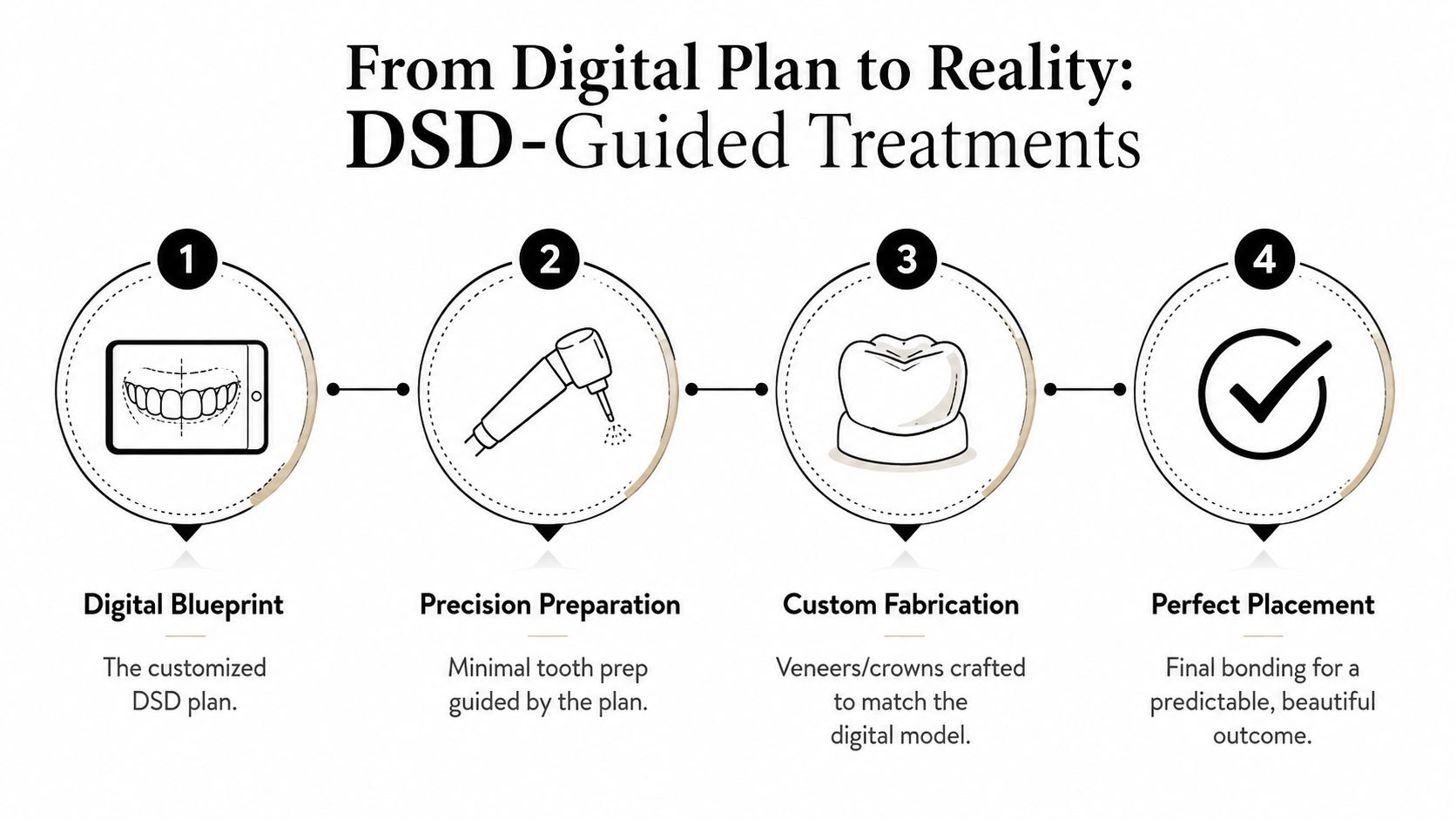
A digital plan matters only when it improves decisions in the dental chair and laboratory. For example, a veneer plan can specify the intended tooth length, width, edge position, and relationship to the gum line before enamel preparation begins. You can review the direction first, while Dr. Patel checks whether the design is compatible with tooth structure, bite forces, speech, and gum health.
Veneers, bonding, and tooth reshaping
For porcelain veneers, the DSD model can guide the preparation and temporary design. The laboratory receives a defined reference for tooth proportions and contours rather than working from a general description. You can review porcelain veneers near me at Aspiring Smiles as one possible cosmetic option, although veneers aren't appropriate for every patient.
Dental bonding may be useful when a patient needs a smaller change, such as repairing a chip or adjusting a contour. Teeth whitening can also be included in a broader plan, especially when the shade of natural teeth needs to coordinate with proposed restorations.
Invisalign and alignment planning
Some patients need tooth movement before cosmetic restorations. A digital setup can show intended positions for Invisalign clear aligners and help the team plan how alignment may affect tooth display, spacing, and the final smile line. Refinements may still be needed because teeth respond biologically, but the setup gives the patient a visual explanation of the proposed pathway.
Implants and gum contours
For dental implants, the restorative goal should guide surgical planning. DSD can help the team plan the future crown shape first, then use that information when considering implant position and any surgical guide. This approach is especially relevant when missing teeth affect the visible smile zone.
Gum contouring, crowns, bonding, orthodontics, whitening, and veneers may be combined when one treatment alone won't address the complete concern. A temporary mock-up can let you experience the design during ordinary activities before permanent work is completed.
This video offers another visual way to understand how digital planning can connect with treatment decisions.
Digital Smile Design Compared to Traditional Methods
Traditional smile design can work well, particularly when the changes are straightforward. The dentist may use clinical photographs, physical models, wax-ups, and professional judgment to plan the result. The challenge is that many patients find it difficult to understand a wax model or imagine how a proposed tooth shape will look against their own face.
DSD adds a patient-facing visual layer. The dentist can show a digital proposal, adjust it during discussion, and use the approved direction to guide mock-ups, temporaries, laboratory communication, and preparation. That doesn't make traditional dentistry obsolete. It gives the team another way to coordinate complex decisions.
A systematic review of 10 DSD studies found consistent improvements in patient satisfaction and treatment acceptance, with visual communication identified as the main mechanism. The review included randomized, non-randomized, and observational studies published from 2013 through 2023, so the findings weren't limited to individual anecdotal cases. A separate retrospective comparison reported mean satisfaction scores of 85.4 for the DSD group and 79.8 for conventional smile design. Read the published comparison of digital and conventional smile design.
| Criteria | Digital Smile Design | Traditional Methods |
|---|---|---|
| Patient preview | Digital simulation and temporary mock-up can make the proposed direction easier to visualize. | Patients may rely more heavily on verbal explanations, photographs, or physical models. |
| Communication | Digital records can give the dentist and laboratory a shared reference for proportions and contours. | Communication may depend more on written notes, physical models, and professional interpretation. |
| Patient participation | Patients can comment on a proposed design before final treatment decisions. | Patients may have fewer opportunities to preview the intended result in their own mouth. |
| Clinical judgment | The dentist still evaluates health, bite, function, and feasibility. | Clinical judgment remains central from diagnosis through restoration. |
| Equipment | Requires compatible photography, scanning, imaging, software, and trained staff. | Can be completed with conventional records and laboratory methods. |
The balanced conclusion is that DSD enhances clinical judgment rather than replacing it. It can improve understanding and coordination, but the dentist remains responsible for deciding whether a proposed result is healthy, functional, and realistic.
Benefits, Limitations, and Who Is a Good Candidate
The strongest reason to consider DSD is participation. You aren't asked to approve a smile based only on technical language. You can discuss the design, try a temporary version, and identify what feels too long, too bright, too wide, or unlike you before permanent treatment.
Useful advantages include:
- Clearer expectations: A visual proposal can make the conversation about shape, tooth display, and facial balance more concrete.
- Better coordination: Digital records can help the clinical team and laboratory work from the same reference.
- More controlled preparation: A defined design can guide how much tooth structure needs to be adjusted, although the amount depends on your anatomy and treatment.
- Shared decisions: Patients can respond to a proposed smile before the final plan is approved.
- Support for complex care: Veneers, crowns, Invisalign, gum contouring, and implant restorations may be coordinated around one restorative objective.
Evidence supports the communication benefit, but it doesn't justify unlimited promises. A 2025 review of DSD outcomes found only 12 eligible studies and emphasized the need for more long-term, standardized research. Current evidence focuses mainly on planning, aesthetics, and patient satisfaction, not proof that DSD alone predicts lasting stability or function.
What the simulation can't guarantee
A screen image is a guide. Gum healing, tooth wear, bite forces, oral hygiene, material behavior, speech, and natural aging can affect the final result and its longevity. AI and software can assist with design, but they can't independently evaluate your complete health history or reproduce the individualized judgment of an experienced clinician.
A 2025 scoping review on AI in smile design reported that AI-generated designs weren't significantly different from manually created designs in esthetic perception, while three-dimensional designs were more accurate than two-dimensional designs. Another comparative study of AI-enabled smile design described improvements in symmetry and efficiency while noting that individualized artistic judgment remains beyond what AI can replicate.
Who may benefit
Good candidates often include people with defined cosmetic goals, worn or uneven teeth, multiple restorations, or plans for veneers and full smile makeovers. Someone who wants only minor whitening may not need a full DSD workflow. Significant untreated gum disease, active decay, or a request for an instant same-day transformation may require a different sequence.
Candidacy should be determined during a consultation. A dentist near me in Las Vegas, NV can assess your oral health before discussing whether digital planning adds value.
Costs, Timelines, and Booking Your Consultation
Patients often search dentist in Las Vegas, NV or cosmetic dentist near me because they want a clear financial and scheduling picture. The honest answer is that DSD doesn't have one universal price. The planning fee, if applicable, is separate from the treatment selected, and the final investment depends on the number of teeth, materials, laboratory work, preparatory care, and complexity of the case.
The available information for this guide doesn't establish verified dollar ranges for DSD planning, veneers, Invisalign, or implants, so a responsible practice shouldn't publish invented estimates. Ask for an individualized written plan after examination and records. The same applies to timelines. A simple bonding case may require a shorter treatment path than a combined orthodontic, gum, restorative, or implant case.
| Treatment | Estimated Cost Range (USD) | Typical Timeline |
|---|---|---|
| Digital smile planning | Determined during consultation | Based on records, design, and review |
| Dental bonding | Determined after examination | Depends on the number of teeth and planned changes |
| Porcelain veneers | Determined after design and laboratory planning | Includes design approval, preparation, temporaries, and placement |
| Invisalign | Determined after digital orthodontic assessment | Depends on tooth movement and refinements |
| Dental implants | Determined after examination and imaging | Depends on bone, healing, restoration, and case complexity |
Cosmetic services are commonly handled differently from medically necessary dental care, and insurance benefits vary by plan. Ask whether the proposed service is covered, whether the office is in or out of network for your plan, and whether payment plans or third-party financing are available. Aspiring Smiles Dental and Braces provides flexible payment options and accepts insurance, but your specific responsibility should be confirmed before treatment begins.
Booking can be straightforward:
- Call the Las Vegas office and request a cosmetic consultation with Dr. Patel.
- Complete new-patient paperwork online before your visit when available.
- Bring useful context, including photos of smiles you like, prior dental records, and a list of questions about veneers, Invisalign, implants, whitening, or restorative care.
Patients from Desert Shores, Sunhampton, Sun City Summerlin, Monterrey, Lone Mountain, Mar-A-Lago, and Painted Desert Estates can ask about in-person or virtual pre-consultation options and the office location near Summerlin. If you need urgent care instead of cosmetic planning, ask about emergency dental services, tooth extraction, pain relief, and the next safe treatment step.
Aspiring Smiles Dental and Braces offers digital smile planning alongside cosmetic, restorative, implant, Invisalign, preventive, and emergency dental care in Las Vegas, NV. Visit Aspiring Smiles Dental and Braces to request a consultation, discuss your smile goals with Dr. Patel, and take the first step toward a plan you can understand before treatment begins.