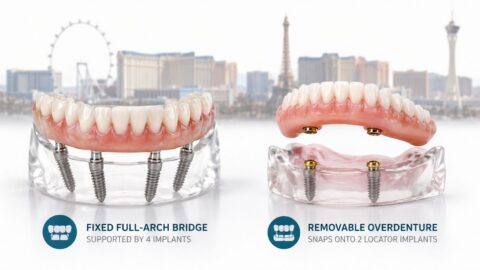
All on 4 vs Snap on Dentures in Las Vegas
You're sitting in a Las Vegas dental office with a loose denture, sore gums, and a practical question: should you choose a fixed full-arch bridge or a removable implant denture? The decision between All-on-4 and snap-on dentures isn't about which treatment costs less on surgery day. It's about how you want to eat, speak, clean your teeth, travel, schedule appointments, and manage repairs over the years.
For patients searching for a dentist near me, dental implants near me, or an experienced dentist in Las Vegas, NV, the right answer depends on bone health, medical history, comfort with removable hardware, budget, and daily priorities. Aspiring Smiles Dental and Braces provides general, restorative, cosmetic, emergency, and implant care for patients throughout Las Vegas, including Desert Shores, Sunhampton, Sun City Summerlin, Monterrey, Lone Mountain, Mar-A-Lago, and Painted Desert Estates.
| Factor | All-on-4 | Snap-on dentures |
|---|---|---|
| Basic design | Fixed full-arch prosthesis supported by four implants | Removable overdenture attached to implants |
| Daily removal | No, only a dentist removes it | Yes, typically removed for cleaning and sleep |
| Cleaning approach | Brush and clean underneath the bridge | Remove, brush, and clean the denture and attachments |
| Main appeal | Fixed teeth and a more bridge-like experience | Stability with easier removal and repair |
| Main trade-off | Higher entry cost and more involved treatment | Ongoing maintenance and removable components |
Why Las Vegas Patients Are Comparing These Two Options
A patient who works late shifts on the Strip may need a solution that fits around changing hours and a demanding recovery window. A retiree in Sun City Summerlin may be tired of adhesive, rocking dentures, and avoiding certain foods. A small-business owner near Lone Mountain may want teeth that stay in place during meetings without committing to a fixed bridge before understanding the long-term maintenance.
Those patients are asking the same basic question: Do I want teeth that stay fixed in my mouth, or do I want a denture that snaps onto implants and comes out? That's the core of the All-on-4 versus snap-on dentures decision.
Traditional dentures rest mainly on the gums. They can move while chewing, irritate soft tissue, affect speech, and make meals feel like a daily negotiation. Implant-supported options add stability, but they don't all create the same experience. All-on-4 uses four implants in the front portion of an edentulous jaw to support a fixed bridge, while snap-on dentures use implant attachments to hold a removable prosthesis in place. The difference affects hygiene, comfort, repairs, appearance, and how much independence you want over your appliance.
Patients often first hear about both choices at local seminars, online searches, or Las Vegas community groups. Before booking a consultation, it helps to review a practical guide on choosing between dental implants and dentures so you can arrive with focused questions rather than marketing promises.
Local scheduling changes the practical decision
Las Vegas patients also have unusual scheduling pressures. Resort employees may have limited healing windows between shifts. Retirees may travel frequently. Families in Desert Shores or Painted Desert Estates may need Saturday appointments because weekday visits conflict with work, school, or caregiving.
A treatment that looks convenient on paper may become difficult if you can't attend implant checks, hygiene visits, or denture adjustment appointments. Ask about Saturday availability, the number of planned visits, emergency access, and what happens if a temporary prosthesis needs attention while you're working or traveling.
Price is only the first question
Full-fee offices and value-focused clinics serve different patients, but a lower quote doesn't automatically mean lower lifetime expense. You need to know what the fee includes, whether the temporary and final teeth are covered, how repairs are handled, and whether replacement attachments or relines are billed separately.
The rest of the decision comes down to mechanics, candidacy, recovery, lifecycle cost, and lifestyle. Those details will tell you whether fixed All-on-4 or removable snap-on dentures make more sense for your life in Las Vegas.
How All-on-4 and Snap-on Dentures Actually Work
All-on-4 and snap-on dentures both rely on dental implants becoming stable within the jawbone through osseointegration. They differ in what sits on top of those implants and how you live with it.
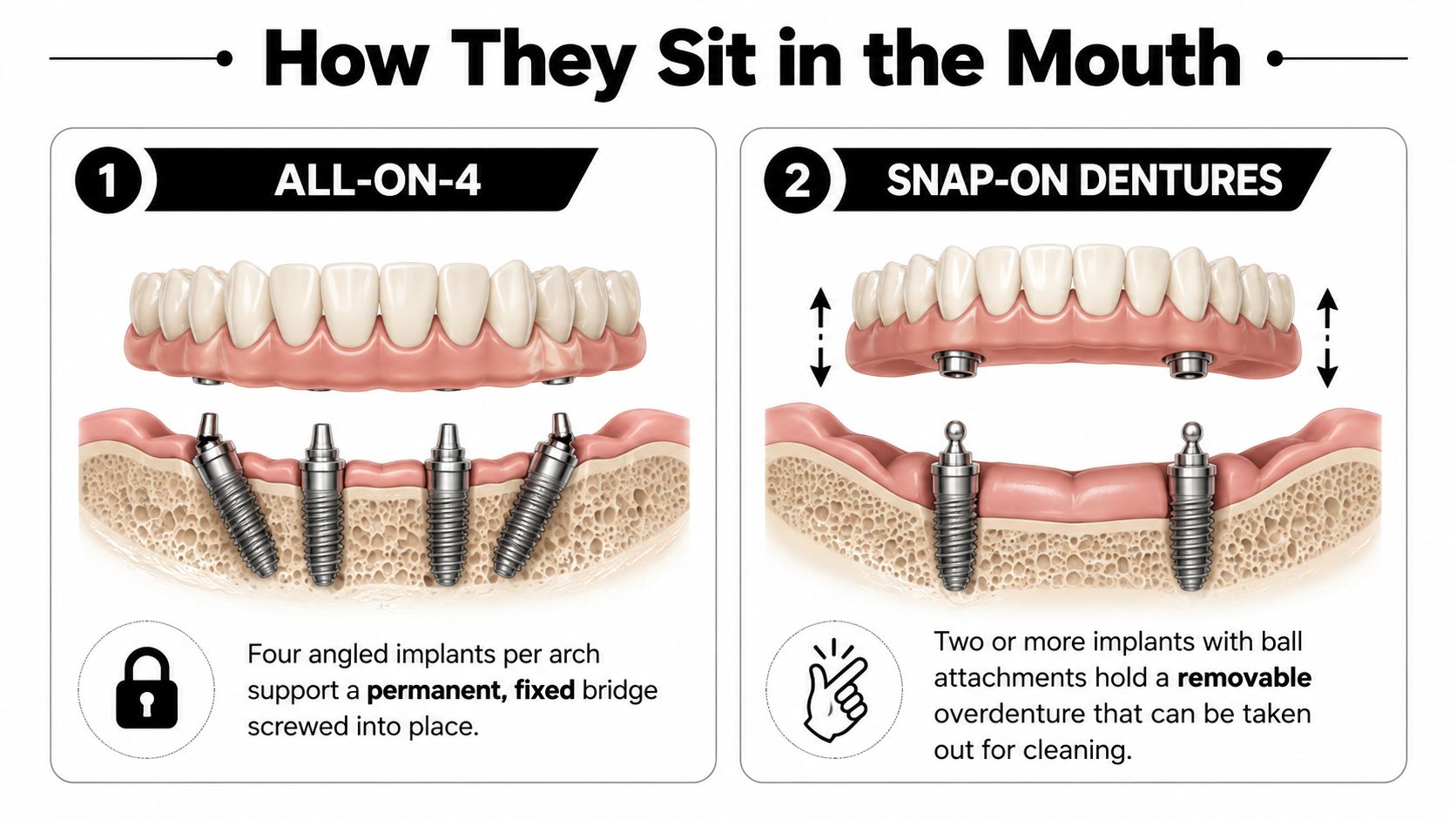
With All-on-4, a dentist places four implants in the anterior part of an edentulous jaw. The implants may be strategically angled to use available bone and support a full-arch provisional prosthesis. This approach can reduce the need to place implants in the back portion of the upper jaw, where bone availability may be limited and grafting may otherwise be considered.
The temporary teeth are often attached during the surgical visit, depending on candidacy, surgical stability, and the treatment plan. After healing and tissue changes settle, the temporary is replaced with the final fixed prosthesis. The bridge is screw-retained, so you won't remove it at home. A dentist removes it when professional access is needed.
Learn how the All-on-4 dental procedure works before your consultation, especially if you want to understand the difference between temporary teeth, final teeth, and maintenance visits.
Snap-on dentures use removable attachments
Snap-on dentures, formally called implant overdentures, attach to two to four implants. A lower overdenture often uses two implants for stability, while an upper overdenture commonly uses four because the upper jaw usually has softer bone and a broader area to support.
The denture contains a male attachment cap. A female abutment is secured to the implant, and the two pieces connect when you seat the denture. Locator-style attachments, ball attachments, or a connecting bar can provide the retention. You can remove the prosthesis for cleaning and usually take it out at night.
The acrylic denture rests partly against the soft tissue. That soft-tissue contact is the key anatomical difference from a fixed bridge. Snap-on dentures can feel much more secure than traditional dentures, but they still have a removable base, attachment parts, and areas that need regular cleaning.
Materials affect feel and service
Both solutions can use acrylic, hybrid designs, zirconia, or combinations of materials. The dentist and laboratory select materials based on bite forces, appearance, repairability, available space, and your goals. Material choice doesn't change the central distinction: All-on-4 is fixed, while snap-on dentures are removable.
Candidacy Timeline and Recovery Compared
A good implant consultation starts with the same foundation for either treatment. The dentist reviews your medical history, gum health, bone volume, smoking status, diabetes control, existing teeth, bite, and expectations. Dental X-rays and three-dimensional CBCT imaging help identify implant sites, sinus anatomy, nerve locations, infection, and the need for extractions or grafting.
Some patients need tooth extraction before implants. Others require gum treatment or medical coordination before surgery. Smoking and poorly controlled diabetes can interfere with healing, so a responsible provider addresses those issues before promising a final result.
All-on-4 requires concentrated planning
All-on-4 often suits patients with substantial bone loss because tilted posterior implants can use available bone in the front of the jaw. That doesn't mean every patient with bone loss qualifies. The CBCT scan, implant stability, bite, health history, and prosthetic plan determine candidacy.
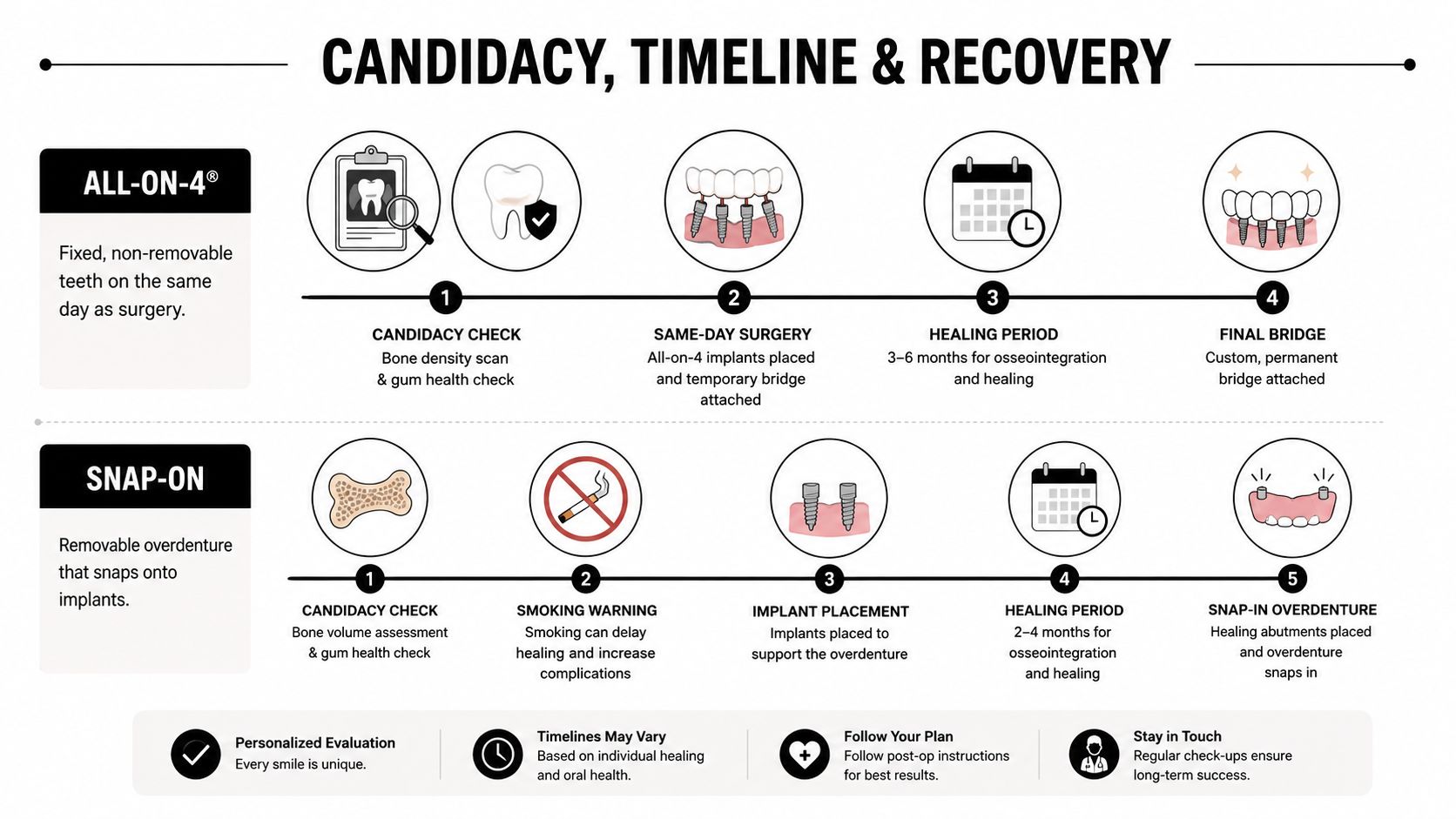
A common treatment sequence looks like this:
- Consultation and records: The team reviews goals, health history, photographs, scans, and existing dentures or failing teeth.
- Preparation: Necessary extractions, infection control, gum treatment, or medical clearance happen before implant surgery.
- Surgery: Four implants are placed per arch when the plan calls for a full-arch All-on-4 restoration.
- Temporary teeth: A provisional fixed prosthesis may be delivered on the surgery day when conditions support immediate loading.
- Healing and protection: Patients commonly follow a soft diet for 8 to 12 weeks, as described in clinical guidance from Quiet Corner Dental.
- Final restoration: After healing and bite refinement, the final bridge is fitted and secured.
- Maintenance: Follow-up visits check implants, tissues, hygiene access, bite, and prosthetic wear.
The recovery is front-loaded. Swelling, soreness, fatigue, and dietary limits can be more noticeable after full-arch surgery, even though the temporary teeth can provide a rapid change in appearance and function.
Snap-on treatment is staged
Snap-on dentures usually begin with evaluation and implant placement. The implants then need time to integrate with the bone before the attachment components are connected and the overdenture is fabricated or modified. Patients should expect a staged process rather than a single definitive visit.
The implant overdenture literature includes a long-term follow-up of 147 patients and 314 implants, with recall attendance above 90% and more than 80% of dentures remaining in continuous service, as reported in this implant overdenture review. The same review reported maxillary and mandibular implant overdenture success rates of 86.6% and 95.8%, respectively. Those figures describe study outcomes, not a personal guarantee.
Scheduling rule: Choose a treatment plan you can realistically support with follow-up visits, hygiene appointments, and adjustments. A theoretically convenient procedure becomes inconvenient if your work schedule leaves no room for maintenance.
Snap-on recovery is often divided into smaller appointments, but the total treatment period can feel longer because the denture and attachments need adjustment. That may suit a retiree with flexible time, but it may frustrate a patient who wants one concentrated recovery window between resort shifts or extended travel.
Cost Longevity and Day to Day Trade Offs
The lowest initial quote isn't always the lowest lifetime cost. Fixed All-on-4 generally asks for a larger investment at the beginning, while snap-on dentures may be easier to repair, modify, or replace in stages. The smarter comparison asks what you'll pay for maintenance, adjustments, replacement parts, and prosthetic service over the years.
Neutral guidance identifies implant overdentures as a recommended option for edentulous patients when two to four implants provide stability and function. Cost guidance also places All-on-4 pricing in major markets at roughly $11,640 to $27,500 nationally on average, while other estimates place per-arch pricing around $15,000 to $35,000. These figures come from the discussion in this peer-reviewed cost and treatment overview, and Las Vegas quotes can differ based on the arch, materials, extractions, sedation, imaging, laboratory work, and included follow-up.
| Factor | All-on-4 | Snap-on Dentures |
|---|---|---|
| Initial financial profile | Usually higher because it includes a fixed full-arch prosthetic plan | Usually lower entry cost than a fixed full-arch restoration |
| Long-term service | Fewer removable components, but fixed prosthetic repairs can be substantial | Relines, attachment service, and denture repairs are easier to stage but recur |
| Daily cleaning | Brush the bridge and use floss threaders, water irrigation, or specialized under-bridge tools | Remove the overdenture, clean the attachments, brush the base, and follow soaking guidance |
| Eating | Fixed design generally supports a more natural chewing routine after healing | Improved stability over traditional dentures, but the removable base still affects chewing |
| Speech | Requires adaptation to the fixed bridge and its contours | Requires adaptation to denture thickness and movement |
| Bone considerations | Implants stimulate the supporting bone around implant sites | Provides implant stability, though the removable prosthesis still rests on tissue |
| Repair philosophy | A problem may involve the fixed bridge or implant components | Denture bases and attachment parts can often be serviced separately |
The clinical picture also requires more than survival rates. A review of All-on-4 literature reported long-term implant and prosthetic success rates ranging from 91.9% to 99.6%, while biologic complications ranged from 18.9% to 25.5% and mechanical complications from 7.3% to 36.7%. The clinical review on true All-on-4 success makes the important point that survival alone doesn't capture every repair, hygiene challenge, or biological concern.
Insurance may contribute differently to extractions, dentures, implants, sedation, or prosthetic components. Nevada Medicaid dental exclusions can limit coverage for adult implant treatment, so ask for a written benefits review rather than assuming insurance will cover the implant portion. Third-party financing, including CareCredit or LendingClub, may help divide payments, but financing terms should be compared by total repayment, not only the monthly figure.
A removable overdenture also creates a maintenance rhythm. Attachment parts can wear, the fit can change, and the base may need service. If you're still using a conventional denture during planning, a practical guide to buy denture adhesive online can help you manage temporary stability needs, but adhesive isn't a substitute for diagnosing a failing fit or planning implant treatment.
Which Option Fits Your Lifestyle Best
The clearest recommendation comes from your routine, not from the treatment name. Start with how you want to live after healing, then confirm that your bone, gums, health history, and budget support that choice.
The active adult who wants fixed teeth
If you're under sixty-five, work in a public-facing role, travel frequently, or want to enjoy a meal at a Summerlin restaurant without thinking about denture movement, All-on-4 is usually the stronger lifestyle match. A fixed bridge doesn't come out for dinner, doesn't need a nightly soaking routine, and generally feels more like a permanent replacement once you adapt.
That convenience comes with more concentrated surgery and a higher initial commitment. You should also be willing to learn specialized hygiene under the bridge and attend maintenance visits.
The long-time denture wearer who wants stability
If you've worn dentures for years and want better retention without committing to a fixed prosthesis, snap-on dentures may be the better first step. You can remove them, clean them directly, inspect the attachments, and make adjustments without replacing an entire fixed arch.
This option suits patients who value control and repairability. It may also appeal to someone who wants implant stability but isn't ready for a permanently attached prosthesis. Expect the overdenture to contact the gums and require ongoing attention to fit.
The budget-conscious retiree
If your budget ceiling is firm, start with a full written estimate for both options. Snap-on dentures often provide a more accessible entry point, but you must reserve money and time for future adjustments and attachment service. A retiree in Sun City Summerlin may prefer that staged financial responsibility over the larger upfront commitment of fixed treatment.
Don't choose based on the advertised starting price. Ask what happens if the denture needs adjustment, if an attachment wears, or if an implant needs treatment. The more clearly the provider explains those events, the easier it is to compare financing responsibly.
The patient with significant bone loss
If another dentist has told you that you need bone grafting, don't assume snap-on dentures are automatically easier or that All-on-4 automatically solves the problem. All-on-4 may use tilted implants and available anterior bone, but your CBCT scan determines whether that approach is safe and prosthetically sound.
My direct advice: Patients with significant bone loss should get a second implant opinion before choosing a removable or fixed solution. The scan matters more than the sales presentation.
For patients in a gray zone, book two consultations. Compare the proposed implant positions, prosthetic design, maintenance plan, total fee, and backup plan if an implant fails. A cosmetic dentist near me may help with appearance goals, but full-arch implant planning also requires surgical and restorative coordination.
Choosing a Provider in Las Vegas and Next Steps
Make the decision with four questions in front of you:
- What is my maximum realistic budget? Include treatment, temporary teeth, final teeth, imaging, sedation, follow-ups, repairs, and maintenance.
- Can I tolerate a removable appliance? If removing and cleaning a denture every night already feels unacceptable, fixed treatment may fit your routine better.
- What does my bone and gum health allow? Request an explanation of the CBCT findings, not just a treatment label.
- How long will I stay in Las Vegas? Implant care requires continuity. If you may relocate, ask how records, warranties, and emergency care work elsewhere.
Look for a provider who can coordinate surgical and restorative care, offers in-house CBCT imaging, explains the laboratory process, and provides transparent all-inclusive pricing. Ask whether an oral surgeon or periodontist participates in complex cases, how quickly temporary or final prostheses can be fabricated, and whether the office can show appropriately consented before-and-after cases.
Saturday consultations matter for patients working in hospitality, healthcare, retail, and other demanding schedules. Practices serving Summerlin, Henderson, and North Las Vegas may offer Saturday appointments, and some offices provide free first-implant consultations. Confirm availability directly because scheduling policies change.
Questions to bring to your consultation
Ask both providers the same questions:
- What is the total cost per arch, and what exactly is included?
- Which temporary, final, and repair services are covered?
- What warranty applies to the implants and prosthesis?
- What is the expected timeline from records to final teeth?
- What happens financially and clinically if an implant fails?
A systematic review reported All-on-4 survival beyond 24 months at 99.8%, with 95.6% of patients rating results as excellent, supporting its predictability as a fixed full-arch option. The systematic review of the All-on-4 treatment concept still shouldn't replace an individualized examination. Strong research outcomes don't remove the need to assess your bite, hygiene ability, medical history, and maintenance commitment.
Frequently asked questions
Are snap-on dentures permanent?
No. They're implant-retained but removable. You take the overdenture out for cleaning and typically remove it while sleeping.
Can All-on-4 teeth be removed at home?
No. The fixed bridge is screw-retained and should be removed only by a dental professional.
Which option is easier to clean?
Snap-on dentures are easier to remove and clean directly. All-on-4 requires careful cleaning around and beneath a fixed bridge.
Do I need a tooth extraction before either treatment?
Possibly. A dentist must evaluate failing teeth, infection, gum health, and bone before building the treatment plan.
If you're also dealing with sudden swelling, severe tooth pain, a broken tooth, or dental trauma, contact an emergency dentist promptly. Tooth extraction, infection treatment, and implant planning should be sequenced safely rather than rushed into a cosmetic decision.
Aspiring Smiles Dental and Braces offers consultations for All-on-4, dental implants, and implant-supported dentures, along with restorative, cosmetic, preventive, and emergency dental care in Las Vegas. Visit Aspiring Smiles Dental and Braces to request a consultation, discuss your CBCT findings and lifestyle priorities, and compare a fixed or removable full-arch plan with a local dental team.