
Invisalign Insurance Coverage: What Plans Pay in 2026
You've picked Invisalign, you've seen the treatment fee, and now you're staring at an insurance card wondering what your plan will pay. That's where most families get stuck, because Invisalign insurance coverage rarely works like coverage for a cleaning or filling.
Most plans treat clear aligners as orthodontic treatment, not as routine dental care. This means there are separate rules, a different cap, and often a smaller payment than the headline percentage indicates. When looking for a dentist in Las Vegas, NV, or a cosmetic dentist near me, understanding that gap before you start helps you budget with confidence and avoid a surprise balance later.
Estimate What Your Plan Will Actually Pay
A plan's percentage isn't the same as its payment. That's the answer most families need first, and it's the point where estimates often go wrong.
A typical U.S. PPO dental plan treats Invisalign as an orthodontic benefit rather than routine preventive or restorative care, and the American Dental Association introduction to dental benefits describes a representative design with 50% orthodontic coverage subject to a separate lifetime maximum of $1,000. The percentage is generally applied to the insurer's maximum allowable fee, not necessarily the dental practice's full charge.
So you can't estimate reimbursement by multiplying the office fee by 50%. You need the allowed fee, the percentage, and the cap, in that order.
The Three Step Formula
Use these steps on any written estimate you receive:
- Start with the allowed fee: Use the insurer's allowed amount, not the office's full charge.
- Multiply by the percentage: Apply 50%, or whatever your plan states, to that allowed fee.
- Stop at the lifetime maximum: Pay the lower of the percentage amount and the remaining cap.
Say your insurer allows $4,000 but imposes a $1,000 orthodontic lifetime maximum. Half of $4,000 is $2,000, yet the payable amount is still capped at $1,000. The cap wins.
Estimated plan payment at 50 percent orthodontic coverage
| Insurer allowed fee | 50% orthodontic share | Lifetime maximum | Likely plan payment |
|---|---|---|---|
| $1,500 | $750 | $1,000 | $750 |
| $2,000 | $1,000 | $1,000 | $1,000 |
| $3,000 | $1,500 | $1,000 | $1,000 |
| $4,000 | $2,000 | $1,000 | $1,000 |
| $4,000 | $2,000 | $2,000 | $2,000 |
At a $1,500 allowed fee, the 50% share of $750 sits below the $1,000 maximum, so the cap doesn't yet apply. From $2,000 upward under that same cap, the payment stays flat.
These figures ignore deductibles, benefits already used, and out-of-network reductions, so treat them as a starting calculation, not a final promise.
Practical rule: If 50% of the allowed fee is higher than your remaining lifetime maximum, the maximum is your expected payment.
That orthodontic lifetime maximum is also different from the general annual dental maximum, which may apply to other services but commonly excludes orthodontics. Mixing the two up is a common reason families overestimate what they'll receive.
Ask our Las Vegas office for a written pre-treatment estimate that lists the CDT-coded orthodontic service, allowed fee, coinsurance percentage, and lifetime maximum remaining. Then run the same formula on that document. You can also review our guide to Invisalign cost in Las Vegas to see how the treatment fee itself is built. A benefits verification call alone isn't a guarantee of payment, because the plan certificate and the carrier's adjudication control the final result.
Plan Terms That Change What You Pay
The same Invisalign fee can produce very different payments depending on your plan's terms. Copy each term below from your plan summary, and you'll have the numbers needed for an honest estimate.
Plan terms that set your Invisalign payment
| Plan term | Typical range | What it means for your payment |
|---|---|---|
| Orthodontic coverage percentage | Often 50% of allowed fee | Applied to the insurer's allowed fee, not the office's full charge |
| Orthodontic lifetime maximum | Often $1,000 to $2,000 | One-time ceiling that does not renew each year |
| Annual dental maximum | Commonly $1,000 to $1,500; some plans $2,000 to $3,000 | Usually does not pay orthodontic treatment |
| Waiting period | Six months to one year | Treatment started early may go unpaid |
| Age limit | Set by your specific plan certificate | Adult coverage is less common than child coverage |
| Network status | In-network or out-of-network | Out-of-network care may be paid at a lower rate |
The Lifetime Maximum Is Not Annual
Many people expect orthodontic benefits to reset each January like benefits for cleaning and exams or dental x-rays. They don't. An orthodontic lifetime maximum is a one-time ceiling for eligible treatment, so once it's used for braces or aligners, that same person doesn't get a fresh amount next year.
A waiting period creates a different timing risk. If you start treatment before that period ends, the plan may pay nothing for treatment it would otherwise recognize. Starting a few months too early can cost more than waiting costs you in time.
Adult coverage deserves an early check, too. According to Invisalign guidance on orthodontic insurance, adult Invisalign coverage is generally less common than orthodontic coverage for children, and an eligible plan may still impose a lifetime maximum or other restrictions. Supplemental orthodontic policies may cover as much as 50% of treatment, but they commonly include a waiting period and a lifetime maximum benefit.
PPO Versus Dental HMO Rules
Network rules also change your share. PPO plans commonly permit visits to out-of-network orthodontic providers but may pay less outside the network, whereas dental HMO-style plans generally require in-network care and use scheduled copayments or set rates.
Having dental insurance doesn't automatically mean an adult's Invisalign treatment will be covered. Ask about adult eligibility first.
Before you schedule with a cosmetic dentist near me or any dentist near me, ask whether adult orthodontics and clear aligners are covered, whether a lifetime maximum applies, and whether the plan pays the same amount for Invisalign as for braces. Write each answer on one page before your consultation.
Verify Your Invisalign Benefits Step by Step
Start with a difference that changes your options. A benefit can be blocked for now, or it can be excluded. Those two words lead to very different budgets.
ADA guidance on noncovered services states that a service may be recognized by the plan but produce no payment because the annual maximum has been exhausted, a frequency limit has been exceeded, a deductible remains unpaid, or a waiting period is active. By contrast, an expressly excluded orthodontic procedure is not recognized as a benefit at all.
If aligners are blocked by a waiting period or an exhausted maximum, you can find the reset date or eligibility milestone and time your start around it. If orthodontics is excluded, waiting longer won't create coverage under that contract.
This short conversation at the desk is where most of those questions get answered in writing.

Seven Steps Before You Start
- Gather your current details: Bring the plan name, member ID, and group number from your current card, plus the plan summary showing orthodontic terms.
- Request a pre-treatment estimate: Ask the Las Vegas office to submit it using CDT orthodontic codes so the allowed fee appears in writing.
- Confirm the math inputs: Check the coinsurance percentage, the orthodontic lifetime maximum, and the amount remaining.
- Check aligner eligibility: Ask whether clear aligners are handled like braces, whether adults are eligible, and whether an age limit applies.
- Check timing rules: Ask whether a waiting period is running, whether your deductible is met, and whether treatment begun before enrollment is paid.
- Check how payment is made: Confirm whether the benefit is paid as an initial lump sum or in installments, and whether your treating dentist is in network.
- Keep the paperwork together: File the written estimate with your signed treatment plan so you can compare it with later claim statements.
These fields matter even more when you're changing employers or insurers. A new plan may coordinate benefits differently and may not reimburse treatment begun before enrollment, even if your old plan would have paid part of it.
What a Finished Estimate Should Show
Don't rely on a verbal benefits call. A phone representative can describe your plan in general terms, but that conversation isn't a guarantee of payment.
A finished estimate shows four things you can check yourself:
- Written allowed fee: The dollar amount your percentage is based on.
- Coverage percentage: The share the plan applies to that fee.
- Remaining lifetime maximum: The cap that may limit the percentage amount.
- Estimated out-of-pocket balance: The amount left for you after the plan payment.
If the estimate doesn't name the allowed fee and the remaining maximum, you don't yet have enough information to budget.
Bring that document to your new patient exams or consultation, and ask the team to walk through it line by line. If the numbers don't match your own calculation, ask which term explains the difference. Usually it's the allowed fee, a deductible, or benefit already used for earlier orthodontic care.
What Coverage Averages Look Like in Real Cases
Averages help you set expectations, as long as you don't treat them as a promise. This overview puts the national benchmark in visual form before you look at individual situations.
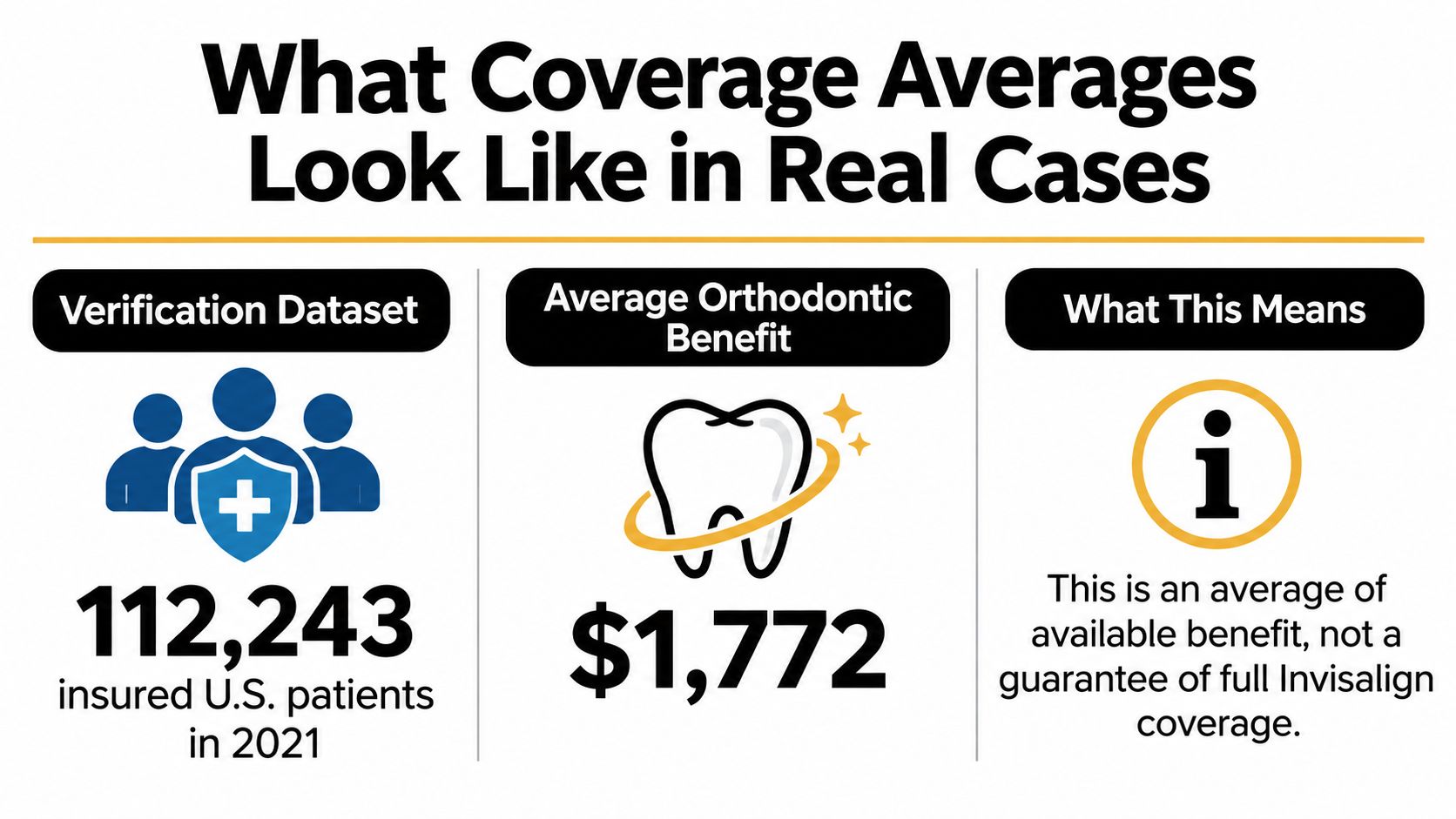
Among 112,243 U.S. patients with dental insurance who used OrthoFi's insurance-verification tool in calendar year 2021, the Invisalign comparison of aligner and braces cost reports the average orthodontic coverage amount was $1,772. Align Technology reported the figure in data on file dated January 19, 2023.
That's an average of available benefit across many different plans. Your plan could offer more, less, or no orthodontic benefit at all.
Three Illustrative Situations
Illustrative out-of-pocket estimates for a $5,000 treatment fee
| Patient situation | Plan payment | Estimated out-of-pocket |
|---|---|---|
| Adult with no orthodontic benefit | $0 | $5,000 |
| Teen with $1,000 maximum at 50% | $1,000 | $4,000 |
| Adult with $2,000 maximum at 50% | $2,000 | $3,000 |
These examples assume the full fee is allowed and no deductible applies, which won't be true for every plan. They show the usual pattern clearly, though. Insurance often reduces the balance in a meaningful way, but it rarely removes it.
This short video walks through how clear aligner treatment works, which helps when you're weighing the balance against the treatment itself.
Place your own situation beside the closest row. Then compare that expected balance with payment options, including tax-advantaged accounts. If your row is the first one, don't assume treatment is out of reach. It means your planning should focus on account funds and monthly payment choices rather than an insurance payment that won't arrive.
Using FSA and HSA Funds With Your Plan
Your plan pays up to its lifetime maximum. Leftover costs come from pretax accounts or direct payment. Think of it as three buckets poured in order. Insurance first, then FSA or HSA funds, then the rest out of pocket.
| Account | How funding works | How it helps with aligners |
|---|---|---|
| Flexible Spending Account (FSA) | Funded through your employer plan | Pays eligible orthodontic costs with pretax dollars |
| Health Savings Account (HSA), individual | Funded when you have an eligible health plan | Pays eligible costs with pretax dollars if the account is available |
| Health Savings Account (HSA), family | Funded under family coverage | Covers eligible costs for family members with pretax dollars |
Limits change by year and by employer. Confirm current figures and rollover rules with your account administrator before you set contributions. A contribution limit is not a payment promise. Your reimbursement still depends on eligibility rules and receipts.
How to Stack Your Payment Sources
Start with the expected plan payment from your allowed fee and lifetime maximum. Apply available FSA or HSA money next toward the remaining eligible balance. Cover what is left directly or through financing plans, cash, and credit card payment options.
Keep your treatment estimate, invoices, and receipts together. Check eligibility before the first payment so the account charge matches a qualifying orthodontic expense. Our overview of flexible spending accounts in Las Vegas explains account basics to review before you schedule.
Rules can confuse shoppers in other categories too. This guide for runners using HSA funds shows how buyers check eligibility for shoes and gear.
Invisalign Insurance Questions Answered
Some costs sit beside the aligners themselves, and they aren't always paid from the same benefit. These are the questions families often ask after the main estimate makes sense.
Do Plans Pay for Retainers
Many orthodontic benefits bundle retainers into the overall treatment fee. Other plans bill them separately or exclude them.
Ask whether retainers fall under the same lifetime maximum. If they do, and your maximum is already used by active treatment, you may pay for retainers yourself even though they're part of keeping your result.
Are Records and Scans Covered
Diagnostic dental x-rays, photos, and digital scans taken before treatment are often paid under the general diagnostic benefit. That usually draws on the annual maximum, not the orthodontic one.
That distinction can work in your favor, because records may be payable even when orthodontic benefits are limited. It can also reduce what's left for other dental care that year, including restorative dentistry, so ask how records will be coded.
Predetermination Versus Pre-Authorization
Predetermination means the insurer reviews planned treatment and states in writing what it expects to pay. Some offices use pre-authorization to mean that same review, while others mean a simple coverage check.
Ask which one your estimate reflects. You want the written review, not a general statement that orthodontics is included.
Are Cosmetic Add-Ons Covered
Teeth whitening is usually treated as cosmetic and excluded, even when it's planned alongside aligners as part of cosmetic dentistry. Plan to pay for it separately.
Confirm each answer against your plan certificate before treatment begins. When office language and plan language differ, the plan language controls what gets paid.
Book Your Invisalign Consultation in Las Vegas
You have the numbers. The last step is putting them in front of a dentist who can confirm how the claim will be filed and what your balance will be before treatment starts.
Call 702-508-6699 or request an appointment with Aspiring Smiles Dental and Braces. The office welcomes new patients and has same-day appointments available. Families across Las Vegas can book at 3211 N Tenaya Wy Suite 122.
Bring your plan summary and your questions: the allowed fee, the remaining lifetime maximum, and any waiting period. Use the visit to ask how the office will file the claim and what your estimated balance will be. Aspiring Smiles accepts a variety of major dental insurance providers and offers financing plans, cash, and credit card payment options for the remaining balance.
If you want a Las Vegas dentist who will explain Invisalign insurance coverage in real dollars before you commit, visit Aspiring Smiles Dental and Braces to request your consultation. The practice provides Invisalign, cosmetic dentistry, dental implants, and emergency dentist care for families in Las Vegas, NV.