
Affordable Clear Aligners: Las Vegas Guide
You've probably seen clear aligner prices online that seem almost too good to be true. One offer promises a low starting price, another includes monthly payments, and a third appears to cover everything until you read the fine print about retainers, replacement trays, or refinements. If you're searching for affordable clear aligners, a dentist near me, or a dentist in Las Vegas, NV, the important question isn't just what you'll pay at the beginning. It's whether the plan can move your teeth safely, predictably, and completely.
Understanding Affordable Clear Aligners in Las Vegas
A Las Vegas patient may begin by comparing aligner prices on a phone during a lunch break. The advertised number looks manageable, but the patient still needs answers. Who checks the roots and bone supporting the teeth? What happens if a tooth doesn't track with the plan? Are follow-up visits and retainers included?
Those questions define genuine affordability. A low entry price can be helpful, but it doesn't automatically represent the lowest total cost. A predictable plan includes an appropriate examination, diagnosis, monitoring, and a clear explanation of what happens if treatment needs adjustment.
At Aspiring Smiles Dental and Braces, clear aligner treatment belongs within complete dental care, not outside it. A consultation should consider cavities, gum health, existing restorations, tooth wear, and the way the upper and lower teeth meet. Moving teeth before addressing active dental problems can create avoidable complications and may delay the smile result you want.
Affordable should also mean appropriate
Clear aligners can offer a discreet way to address selected crowding, spacing, and bite concerns. They're removable for eating and cleaning, which can make daily hygiene more convenient than with fixed brackets. They also support cosmetic goals, but a straighter smile should be built on healthy teeth and gums.
That's why a local evaluation matters. A dentist serving Las Vegas, including Desert Shores, Sunhampton, Sun City Summerlin, Monterrey, Lone Mountain, Mar-A-Lago, and Painted Desert Estates, can assess your mouth in person and explain whether aligners are suitable for your case.
Practical rule: Compare the complete treatment plan, not just the lowest number displayed in an advertisement.
A responsible plan may include dental x-rays, digital records, progress checks, and a retention strategy. If you also need cleaning and exams, restorative dentistry, or cosmetic services such as teeth whitening, those needs should be discussed before aligner treatment begins. That approach may not always produce the lowest initial quote, but it gives you a clearer path toward a healthy, bright smile.
The True Cost of Budget Aligner Treatments
The advertised starting price tells you only one part of the financial story. Independent coverage reports that at-home plans may start around $649 to $1,499, while office-based treatment averages about $5,108 in the United States. The same source identifies possible additional costs of $300 to $800 for retainers, $500 to $1,500 for refinements, and replacement trays when an aligner is lost or damaged. These figures are summarized in this clear aligner cost guide.
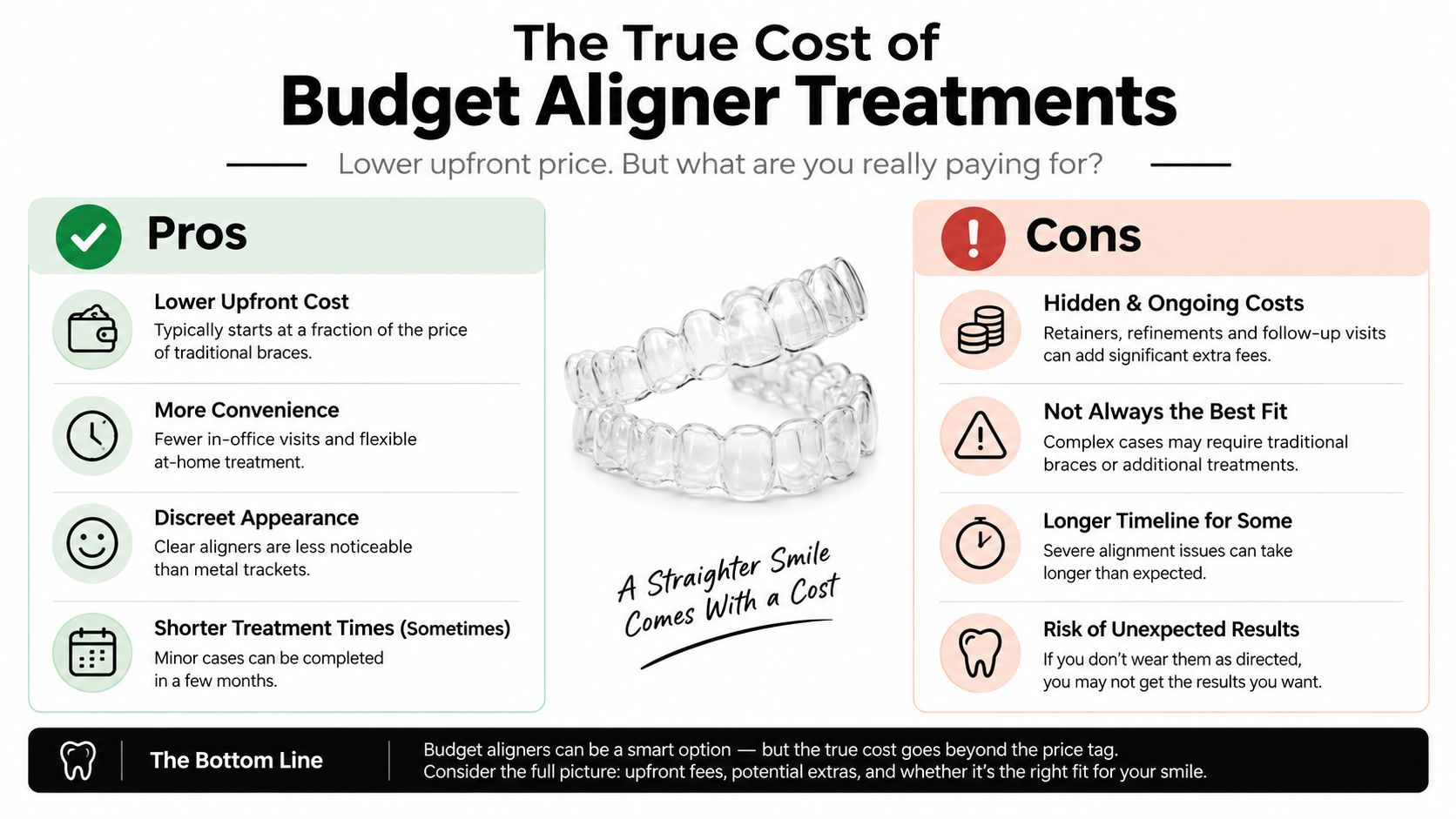
A budget plan can therefore become less affordable if it doesn't include the services you need to finish treatment. A patient may pay an appealing initial amount, then discover that a poorly tracking tooth requires additional scans and trays, or that the final retainer is a separate purchase. If treatment stops before the bite is properly settled, the financial cost is only part of the concern.
Questions to ask before accepting a quote
Request a written breakdown before you commit. Ask whether the treatment fee includes:
- Diagnostic records: Confirm whether the examination, digital scans, and necessary dental x-rays are included.
- Monitoring: Find out who reviews your progress and how you'll contact the clinical team if a problem develops.
- Refinements: Ask what happens if your teeth don't follow the original digital plan.
- Replacement trays: Clarify the charge for a lost or broken aligner.
- Retention: Check whether your first retainers are included and what replacement retainers cost later.
- Additional dental care: Determine whether cavities, gum treatment, fillings, or other restorative needs are billed separately.
The treatment plan also affects the price. A mild cosmetic adjustment may require a different level of care than a case involving significant crowding, bite changes, or movements that need attachments. Recent clinical literature notes that clear aligner effectiveness varies by malocclusion type, and some cases may need mid-course corrections or conventional braces instead of a low-cost aligner plan. Clinical review evidence on suitability and outcomes supports evaluating the case rather than choosing by price alone.
For a Las Vegas patient comparing options, the useful question is, “What is my expected total cost if everything goes normally, and what costs apply if treatment needs correction?” You can also review the practice's information about clear aligner costs in Las Vegas and bring specific questions to your consultation.
The least expensive plan can become the most expensive if it leaves you needing unfinished treatment, repeated corrections, or additional dental work. True affordability means knowing the likely total, understanding the clinical safeguards, and protecting the health of your teeth while they move.
Comparing At-Home Kits and In-Office Professional Care
At-home mail-order kits can appeal to patients who want convenience and a low starting price. In-office care takes more time and requires clinical appointments, but it gives a dentist the opportunity to examine your teeth, evaluate supporting tissues, and respond when movement differs from the plan.
The diagnostic difference is significant. Dental x-rays can help assess root position, bone support, unerupted teeth, and problems that aren't visible from a home impression or a photograph. A digital scan shows the tooth surfaces, but it doesn't replace a complete dental evaluation.
Two approaches, different safeguards
| Feature | At-Home Mail-Order Kits | In-Office Professional Care |
|---|---|---|
| Initial assessment | Often based on remote records or home impressions | Examination with clinical records and appropriate imaging |
| Progress monitoring | Remote communication may be available | Local visits allow direct evaluation of tooth movement and gum health |
| Treatment suitability | Usually focused on the correction described in the remote plan | Dentist evaluates whether aligners, braces, or another option fits the case |
| Attachments and additional procedures | May not be available in the same way | Can be planned and placed when specific movements require them |
| Dental conditions | Existing cavities or gum problems may be harder to identify remotely | Cleaning, restorative dentistry, and other needs can be addressed in sequence |
| Follow-up care | Policies vary by provider | A local team can manage refinements, retainers, and related concerns |
Unsupervised tooth movement can create problems when the planned movement exceeds what the supporting bone and gums can safely accommodate. A tray may appear to fit while a tooth moves in an undesirable direction, a bite becomes uncomfortable, or gum recession develops. That doesn't mean every remote option fails, but it does mean patients should understand what clinical access they're giving up.
An in-office plan can also coordinate orthodontic and cosmetic goals. For example, a dentist may recommend treating a cavity before aligners, improving gum health through professional cleaning, or discussing teeth whitening after alignment rather than trying to solve every concern at once.
You can review local options for teeth aligners near Las Vegas before scheduling a consultation. The right comparison isn't remote versus local in the abstract. It's whether the plan provides the diagnosis, supervision, correction process, and retention care your particular smile needs.
A local cosmetic dentist near me can also identify when clear aligners aren't the best first step. If a tooth has a large filling, infection, advanced gum concerns, or inadequate support, moving it without addressing that condition can compromise the result. Professional oversight protects more than appearance. It protects the mouth the smile depends on.
The Science of Safe and Effective Tooth Movement
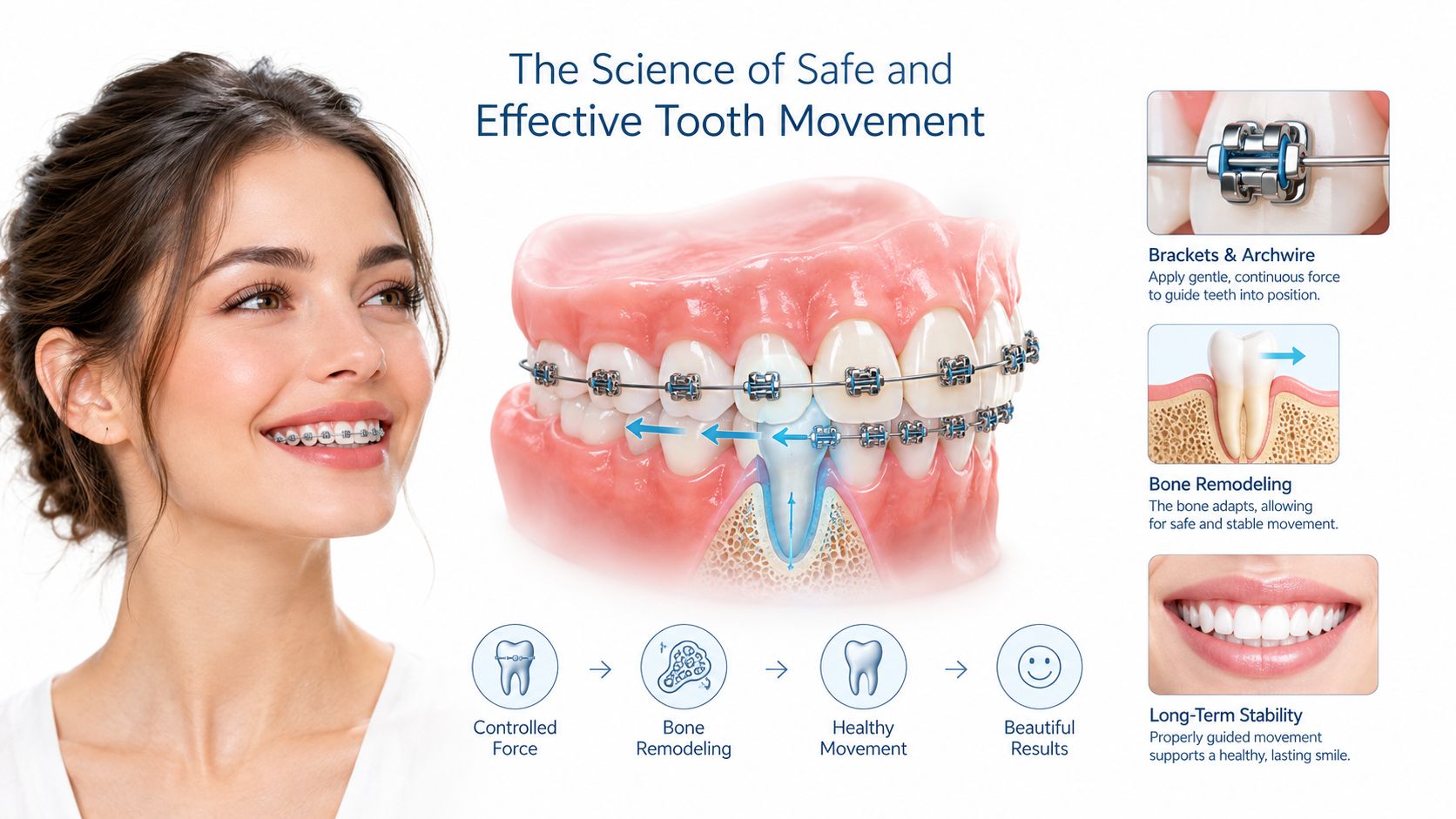
Clear aligners work by applying planned pressure to teeth, but teeth don't move like objects on a shelf. The surrounding bone and periodontal tissues must remodel gradually, and the aligner must deliver the intended force in the intended direction. Treatment planning therefore combines biology, material behavior, tooth anatomy, and patient consistency.
The first requirement is wear time. Clear aligners generally need to be worn for at least 22 hours per day to work effectively, and inconsistent wear can lengthen treatment or reduce success, as described in this clinical review of aligner compliance. Remove them for meals and oral hygiene, then put them back in promptly.
Why the material and design matter
Different aligner materials don't deliver force in exactly the same way. In vitro testing found that single-layer thermoformed sheets, including Duran and Zendura, transmitted the highest initial orthodontic forces, while multilayer materials such as CA Pro, Zendura FLX, and Zendura Viva transmitted significantly lower forces. The reported active force values ranged from 83.1 to 149.7 N, passive forces from 50.5 to 89.8 N, and absolute forces from 24.0 to 60.1 N in that testing. These findings are detailed in research on clear aligner material biomechanics.
Those laboratory results don't determine the correct material for every patient. They do show why a treatment plan should account for aligner architecture, the movement being attempted, and the way the tray fits. A cheaper tray isn't automatically equivalent to another tray just because both look clear.
Attachments are another important part of the design. These small composite bumps are bonded to teeth to improve aligner retention and help produce movements such as rotation or extrusion. They're not merely cosmetic add-ons. Clinical literature on aligner attachments describes their mechanical role in helping the tray control tooth movement.
Your responsibilities during treatment
Successful treatment depends on a partnership between the dental team and the patient:
- Wear each aligner as directed. Switching trays early or leaving them out for long periods can interfere with tracking.
- Keep teeth and trays clean. Brush and floss before replacing the aligners whenever possible.
- Report problems promptly. Persistent sharp edges, severe discomfort, a loose attachment, or a tray that no longer fits should be evaluated.
- Complete retention care. Teeth can shift after active treatment, so retainers are part of the treatment result, not an optional final accessory.
Affordable clear aligners work best when affordability never removes the clinical decisions that make movement safe.
Market Growth and Expanding Access to Clear Aligners
A Las Vegas patient comparing several clear aligner offers may see different monthly payments, treatment lengths, and levels of professional follow-up. That variety reflects a growing market, but the advertised starting fee does not show the full cost of reaching a stable result.
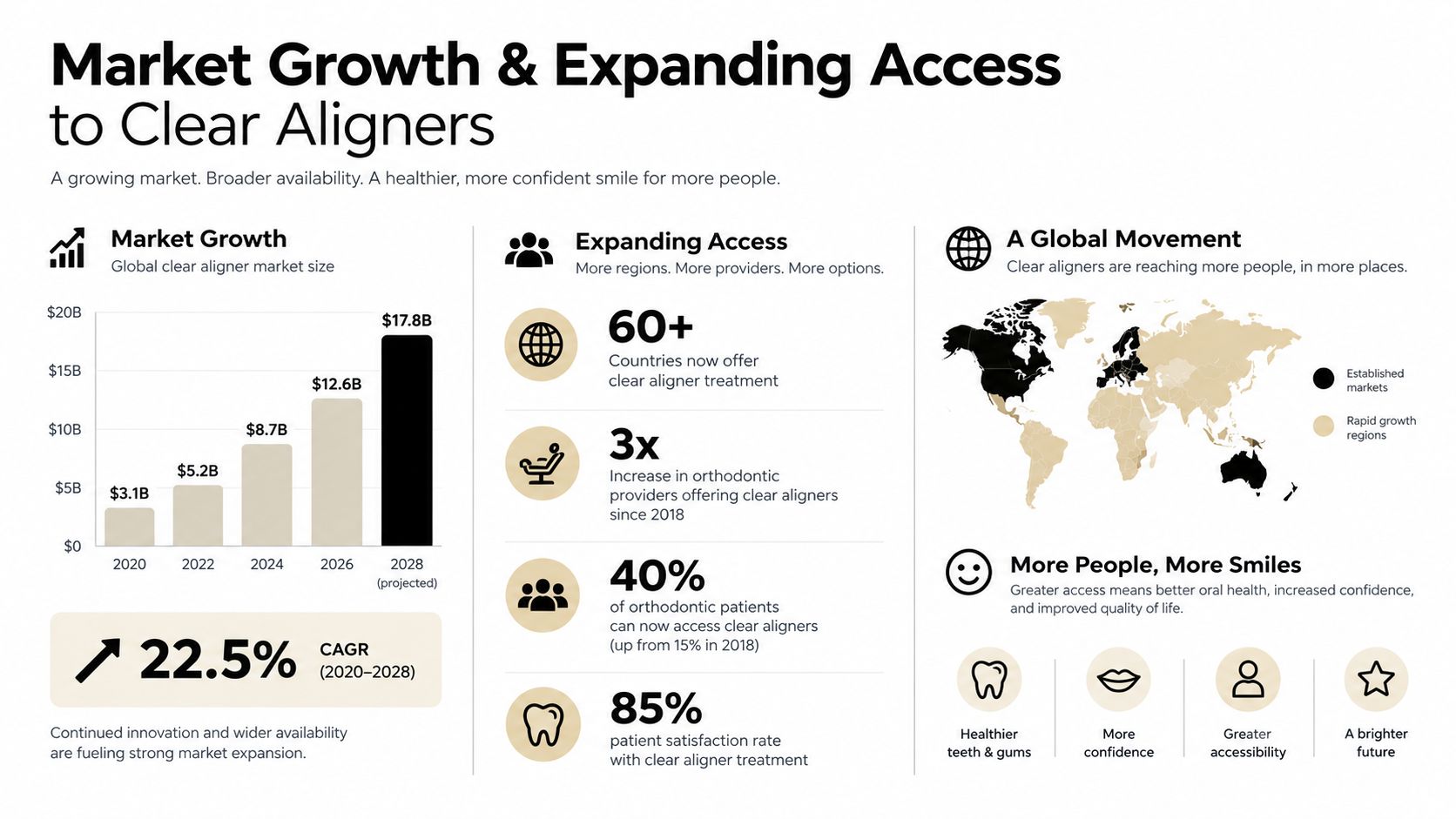
Consumer reporting summarized by Grand View Research's clear aligner market analysis states that the number of people treated grew from 5 million in 2018 to 10.9 million in 2020 and 17 million by 2023, including 4.5 million teens. Wider use has brought more providers and product choices to patients in Las Vegas.
What growth means for patients
One forecast values the global clear aligners market at USD 8.3 billion in 2025, with growth to USD 10.7 billion in 2026 and USD 56.8 billion by 2033, implying a 27.0% CAGR from 2026 to 2033. The same MarketsandMarkets clear aligners report also lists a lower USD 5.58 billion in 2026 figure and a projection of USD 13.65 billion by 2031, with a 19.59% CAGR. These figures use different market definitions or forecasting scopes, so they should not be compared as one continuous series. Both are projections, not guaranteed results.
In a fast-growing market, Las Vegas patients may encounter more discount offers than before. Ask each provider for a written total-cost breakdown before comparing monthly payments. The breakdown should identify the number of trays, scans or examinations, refinements, replacement trays, attachments when indicated, retainers, and follow-up visits. A lower starting price can become more expensive if limited supervision or poor fit leads to additional treatment.
Market growth expands access, but it does not change tooth biology. The right choice still depends on diagnosis, gum health, oral hygiene, expected wear time, the movements required, and retention after active treatment. Professional oversight and suitable materials can reduce avoidable refinements while protecting the teeth and supporting tissues.
Access must remain clinically grounded
The market analysis reports that clear aligners represented 33.1% of orthodontic case starts in the United States, compared with 11% in China. Those figures show different adoption levels, not that every patient or correction is suitable for aligners.
For Las Vegas families, expanded access is valuable when the financial plan remains connected to the clinical plan. Compare total treatment obligations, not only the first payment, so convenience and price competition do not remove the follow-up care needed for a healthy, lasting result.
Financing and Insurance Options at Aspiring Smiles
Affordability depends on more than the treatment fee. It also depends on whether a practice explains insurance benefits clearly, offers manageable payment arrangements, and helps patients plan for care beyond the first appointment.
At Aspiring Smiles Dental and Braces, Dr. Patel's team discusses treatment goals, lifestyle, and financial priorities before recommending a path. The practice accepts dental insurance, offers flexible payment plans, and maintains an in-house membership program for patients who want a structured approach to ongoing care. These options can make cosmetic dentistry and orthodontic care easier to budget without treating safety as a feature to remove.
Building a plan around the patient
A patient who needs only limited alignment may have different priorities from someone who also needs fillings, gum treatment, crowns, or replacement teeth. A family may need to coordinate care for a teen and an adult, while another patient may be comparing clear aligners with traditional braces. A thorough consultation gives the dental team context for recommending care that fits the person rather than forcing every smile into the same package.
The office also provides general, cosmetic, restorative, and emergency dental services. That can be useful when an aligner consultation identifies an issue that needs attention first. Dental cleaning and exams, dental x-rays, teeth whitening, crowns, veneers, dental implants, and emergency dental services can all form part of a broader oral health conversation when clinically appropriate.
Patients comparing dental costs should also understand that insurance rules differ by plan. Ask whether orthodontic treatment is covered, whether clear aligners qualify, what portion applies, and whether there are exclusions or limits. For questions involving surgical dental benefits or oral surgery coverage, the Pain and Sleep Therapy Center oral surgery insurance resource may provide useful background, though your own insurer and treatment provider should confirm the details of your case.
Payment planning should include the whole journey
Before beginning, ask for the total expected fee and a list of included services. Confirm the policy for refinements, replacement trays, progress visits, and retainers. If you may need tooth extraction, restorative dentistry, or dental implants instead of aligners, request a separate explanation of how those services affect the overall plan.
The goal isn't to make every treatment identical in price. It's to make the financial commitment understandable. A trusted dentist in Las Vegas, NV should explain what you're paying for, which options are available, and how the plan protects your long-term oral health.
Next Steps for Las Vegas Patients Ready to Start
Start with an examination rather than an online price comparison. A new patient exam allows the dental team to review your medical and dental history, examine your teeth and gums, and order dental x-rays when needed. If you're overdue for a cleaning, that may be addressed before or alongside a clear aligner consultation.
Patients visiting from Desert Shores, Sun City Summerlin, Lone Mountain, Painted Desert Estates, Sunhampton, Monterrey, and Mar-A-Lago can request an appointment at the Las Vegas office at 3211 N Tenaya Wy, Suite 122, Las Vegas, NV 89129.
What your first visits may include
- Health and smile discussion: Tell the team what you want to change, what concerns you have about cost, and whether you're looking for cosmetic or functional improvement.
- Clinical examination: The dentist evaluates cavities, gum health, tooth wear, existing restorations, and your bite.
- Records and imaging: Digital records and appropriate dental x-rays help determine whether tooth movement is suitable.
- Treatment consultation: You'll review clear aligners, Invisalign, braces, or other options when relevant.
- Financial planning: The team explains insurance, payment plans, membership options, included services, and possible additional fees.
- Treatment start: If aligners are appropriate and your mouth is ready, the practice can outline the next steps for records, attachments, trays, monitoring, and retention.
This process also gives you a chance to decide whether you feel comfortable with the office and the communication style. Good treatment includes knowing who to contact when a tray feels wrong, an attachment loosens, or you have a dental emergency.
If you're searching for an emergency dentist, a cosmetic dentist near me, dental implants near me, or a local practice for preventive and restorative care, choose an office that can look beyond one isolated service. A healthy smile transformation starts with healthy foundations and continues with maintenance after the final aligner.
Aspiring Smiles Dental and Braces offers clear aligner and Invisalign consultations alongside preventive, cosmetic, restorative, implant, and emergency dental care in Las Vegas. Schedule your evaluation with Aspiring Smiles Dental and Braces to discuss a safe, transparent, and manageable plan for your smile.