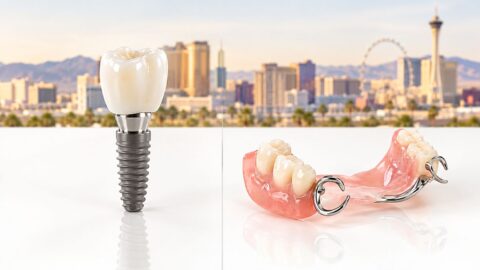
Dental Implants vs Partials in Las Vegas
You've just left a dental appointment in Las Vegas with two treatment plans for the same problem. Two upper-left teeth can't be saved, and now you're comparing dental implants vs partials while wondering which option will feel secure at dinner, stay comfortable during a workout, and fit around work, travel, and your budget.
Patients from Desert Shores, Sun City Summerlin, Painted Desert Estates, and nearby Las Vegas communities often ask the same questions. Will a partial slip while speaking or eating? Is implant surgery worth the longer timeline? What happens to the surrounding teeth and jawbone? The right decision usually isn't about choosing the most expensive option. It's about matching treatment to your health, priorities, maintenance tolerance, and long-term plans.
Choosing Between Dental Implants and Partials in Las Vegas
A patient from Desert Shores recently described the decision in practical terms. She wanted to enjoy dinner along Lake Mead Boulevard without worrying about a removable appliance moving when she chewed. She also exercised regularly and didn't want to think about whether a partial denture might feel loose during a workout. At the same time, her work schedule and upcoming travel made a multi-month implant process feel difficult.
Those concerns are more useful than a glossy treatment brochure. A partial denture may be faster and less invasive, while an implant may provide a more fixed, natural-tooth-like experience. Neither option is automatically right for every patient.
The first question is whether the remaining teeth, gums, jawbone, and medical history support implant treatment. The second is whether you're comfortable with surgery and a longer treatment arc. The third is how much daily maintenance you're willing to accept after treatment is complete.
Practical rule: Choose the restoration you can maintain comfortably for years, not only the one that looks attractive on an initial estimate.
Partial dentures remain relevant because they replace missing teeth without placing implants into the jawbone. They're commonly used for partial tooth loss because they're generally less invasive and typically lower cost than implants, as described in this historical overview of implant dentistry and removable partial dentures. Dental implants, by contrast, have a comparatively modern history. Commercially pure titanium implants were first used in a human in 1965, and a major two-stage threaded implant milestone followed in 1978, helping establish osseointegration as a foundation of modern implant dentistry.
If you're researching the broader question of implants vs dentures for Vancouver patients, you'll find similar themes around stability, surgery, comfort, and long-term care. For a Las Vegas patient, though, the decision should be personalized to your teeth, bone, schedule, and goals.
What Dental Implants and Partials Actually Are
A dental implant replaces the role of a missing tooth root. A dentist or oral surgeon places a small titanium post into the jawbone, then allows the surrounding bone to bond with the implant through a process called osseointegration. After healing, an abutment connects the implant to a custom crown, which is shaped to resemble a natural tooth.
Because the implant is anchored in bone, it can support a standalone crown without relying on neighboring teeth for support. In other cases, several implants can support a bridge or an implant-supported removable partial denture. The design depends on how many teeth are missing, where they're located, and how much support the mouth can provide.
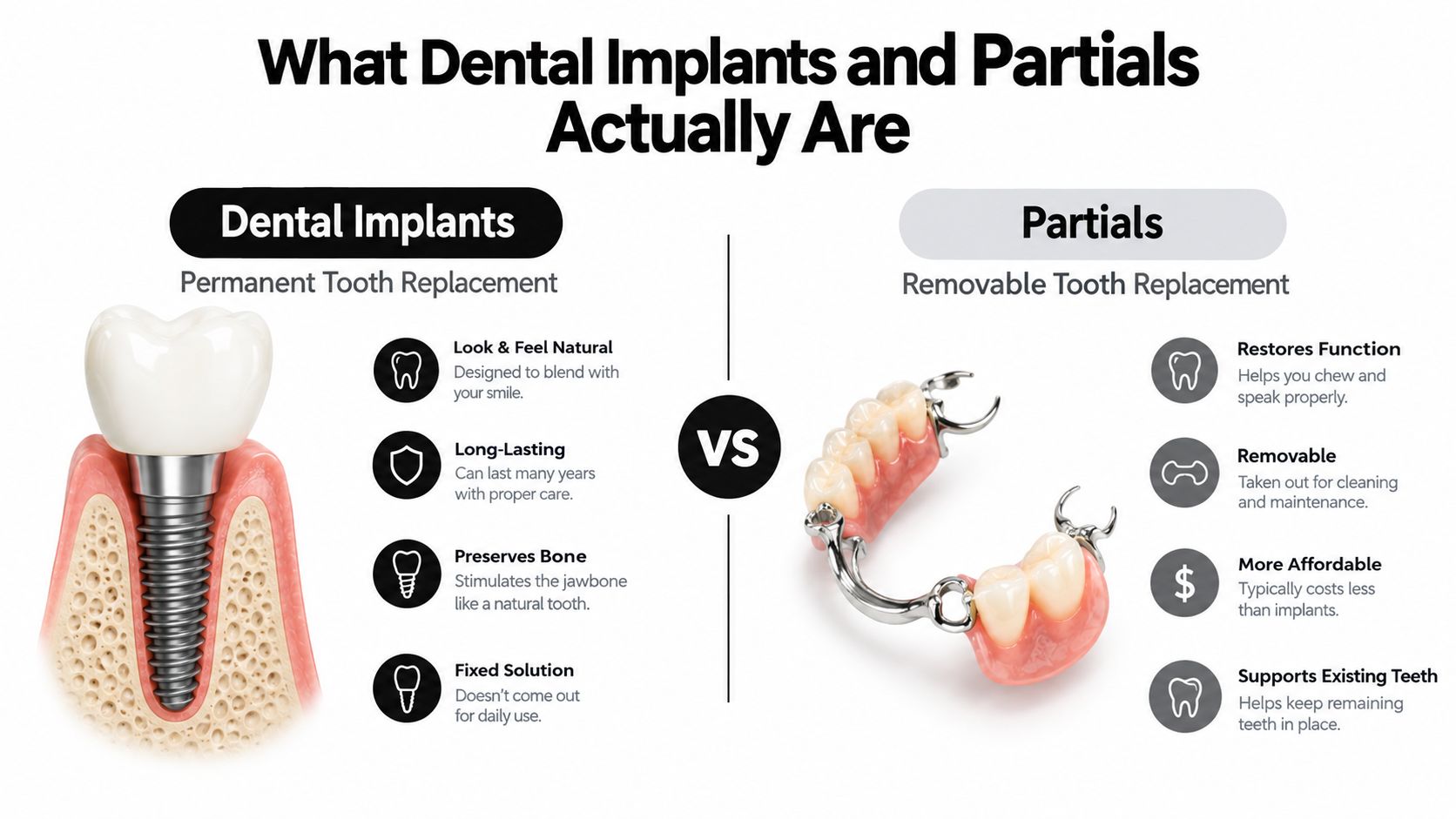
A partial denture replaces one or more missing teeth with artificial teeth attached to a gum-colored base. The base usually connects to remaining natural teeth with clasps or precision attachments. Unlike a fixed implant crown, a partial is designed to be removed for cleaning and often taken out while sleeping.
A partial may use an acrylic base, a metal framework, or another design selected for the number and position of missing teeth. It can span several spaces, making it useful when multiple teeth are missing in different areas. Its stability depends on the condition and location of the remaining teeth, the fit of the appliance, and the shape of the gums and supporting ridge.
The key distinction is anatomical. Implants replace a tooth from root to crown, while partials replace visible teeth and use remaining teeth and oral tissues for support. Patients considering removable options can review the different partial denture options available for replacing missing teeth before discussing which design may fit their mouth.
Side-by-Side Comparison That Matters for Real Patients
The practical difference between implants and partials becomes clearer when you compare daily experiences instead of looking only at the initial treatment fee.
| Comparison Criterion | Dental Implants | Partial Dentures |
|---|---|---|
| Stability | Fixed in the jaw after healing | Removable and supported by remaining teeth and oral tissues |
| Chewing | Strong load transfer through the implant foundation | Functional, but stability varies with fit and support |
| Comfort and speech | Often feels more like a natural tooth once healed | Requires adaptation to the appliance and its movement |
| Neighboring teeth | A standalone implant crown generally doesn't require clasp support from adjacent teeth | Usually depends on remaining teeth for retention |
| Bone considerations | Transfers chewing forces to the jawbone | Doesn't replace the function of a tooth root |
| Maintenance | Brushing, flossing, hygiene visits, and restoration checks | Daily removal, cleaning, adjustments, and possible relines |
| Future tooth loss | Additional implants or revised planning may be possible | Can often be modified if another tooth is lost |
| Visible hardware | No removable clasp is needed for a single implant crown | Clasps or attachments may be visible, depending on design |
| Timeline | Surgical treatment and healing are required | Usually completed more quickly without surgery |
| Recovery | Includes surgical recovery | Usually involves pressure spots and speech adaptation rather than surgery |
Implants generally offer the stronger fixed feel. That matters if you're biting into firmer foods, speaking in a meeting, or traveling without wanting to pack and clean a removable appliance. Clinical evidence also shows measurable functional advantages in implant-based restorations. One study reported higher masticatory performance for implant-supported crowns at 3, 6, and 12 months, with results of 28.4% versus 22.6%, 32.1% versus 25.4%, and 35.7% versus 28.3%, respectively, with p = 0.001 for each comparison, as reported in this clinical study of implant-supported masticatory performance.
Partials have their own important advantages. They're generally faster to deliver, can replace several teeth in one appliance, and can be adjusted or repaired without another surgical procedure. They may be the sensible choice when you need treatment completed before travel, when surgery isn't appropriate, or when the available budget makes an implant plan unrealistic.
Long-term outcomes vary by restoration and patient. A prosthodontic evidence review found restorative survival rates ranging from 89.2% to 95.5% at five years and 65% to 89.4% at ten years, while implant-supported fixed partial dentures showed 94.1% survival at five years and 77.8% at ten years in the same evidence base (prosthodontic survival analysis). Those figures describe groups, not a guarantee for your mouth.
Who Is a Good Candidate for Each Option
Implant candidacy begins with the jawbone. An implant needs adequate bone volume and healthy surrounding tissue to remain stable. The dentist also evaluates the ridge and, for upper back teeth, the relationship between the proposed implant site and the sinus.
Age alone isn't a cutoff. Older adults in Desert Shores and Sun City Summerlin may do well with implants when their general health is controlled and their gums are stable. The more important questions involve healing capacity, oral hygiene, periodontal health, medications, and whether the patient can follow the care plan.
Certain issues may delay or rule out immediate implant placement:
- Uncontrolled diabetes: Healing and infection risk need careful medical review.
- Heavy smoking: Tobacco can compromise gum health and implant healing.
- Active periodontal disease: Infection must be treated before implant surgery.
- Bisphosphonate use: The dentist and prescribing physician may need to assess medication-related risks.
- Recent extraction: The socket may need time to heal or may require preservation treatment.
- Bone loss: Grafting may be needed before an implant can be placed.
Partials may be a better fit when several teeth are missing but the remaining teeth can support clasps or attachments. They can also suit patients who want a nonsurgical approach, need a quicker restoration, have limited bone, or prefer a lower initial commitment. That doesn't mean a partial is a compromise in every case. A carefully designed partial can restore appearance and function, particularly when the supporting teeth and tissues are healthy.
| Factor | Implants | Partials |
|---|---|---|
| Jawbone | Requires adequate bone or possible grafting | Can often be used with less bone volume |
| Remaining teeth | May avoid using adjacent teeth for a single missing tooth | Needs suitable teeth for support and retention |
| Gum health | Active periodontal disease should be treated first | Gum disease still needs treatment for a stable result |
| Medical history | Surgery and healing require medical review | May suit patients who shouldn't undergo implant surgery |
| Smoking and healing | Requires careful risk discussion | Still affects oral health, but doesn't involve implant integration |
| Number of missing teeth | Useful for one or multiple teeth, depending on the plan | Particularly useful for multiple spaced missing teeth |
| Patient preference | Fixed feel and longer treatment process | Removable design and quicker delivery |
A Las Vegas dentist should review your dental chart, take appropriate dental X-rays or three-dimensional imaging, examine your gums, and discuss your medical history before recommending either path. For an additional explanation of dental implant candidacy criteria, patients can compare the health and anatomy questions that commonly guide evaluation.
Treatment Timeline and Recovery for Both Choices
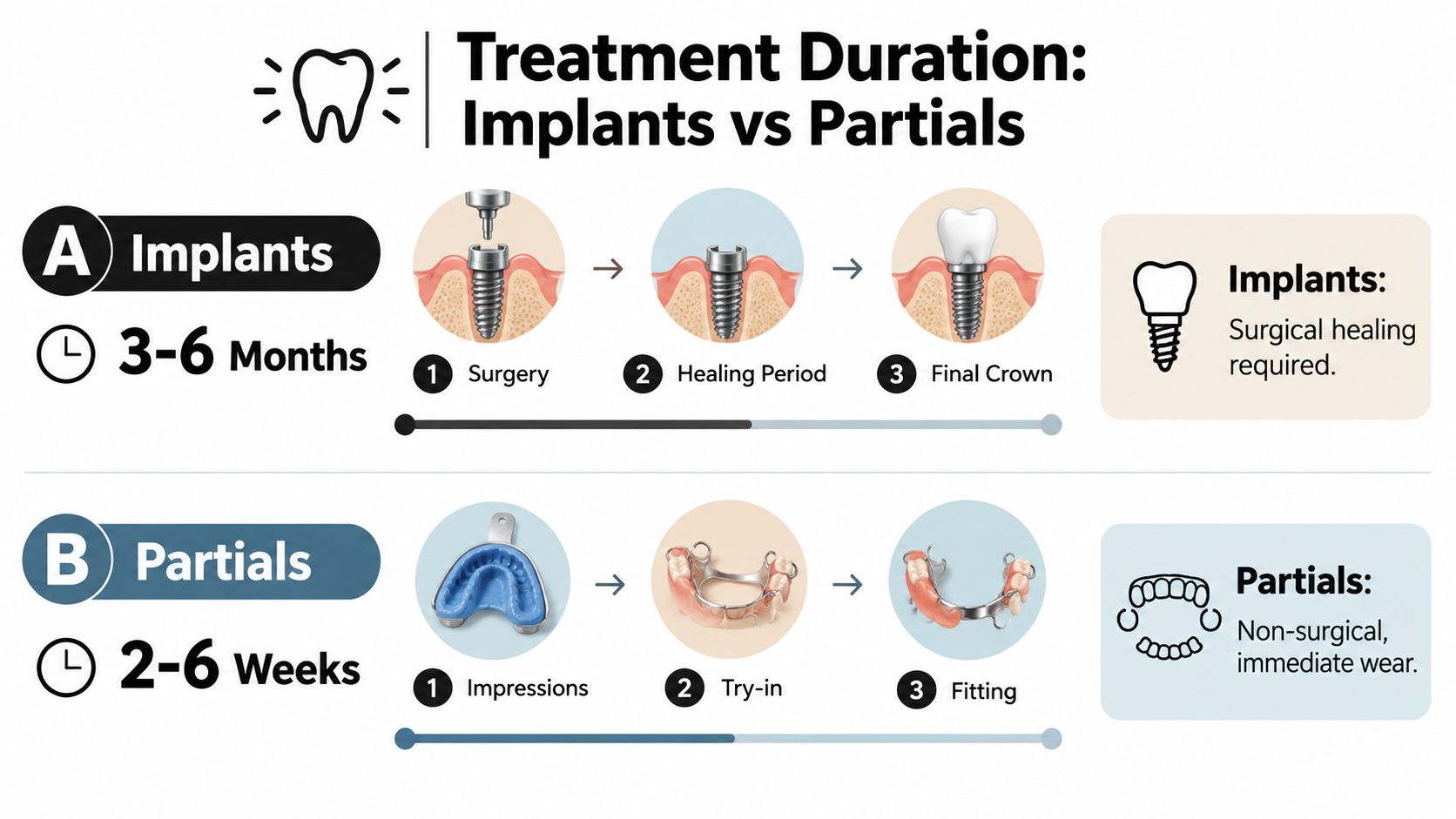
Partials usually follow a shorter, nonsurgical path. Your dentist examines the remaining teeth, takes impressions or digital records, designs the appliance, and may schedule a try-in before the final fitting. Follow-up visits address pressure points, speech changes, bite contacts, and retention.
The first days may involve gum soreness or a feeling that the appliance is larger than expected. Speaking often improves with practice, and eating usually becomes easier as you learn how to place food and control the partial. You'll also need to learn how to remove it, clean it, and store it properly.
Implant treatment follows more stages:
- Evaluation and imaging: The dentist assesses the missing-tooth space, bone, gums, bite, and overall health.
- Preparatory treatment: Tooth extraction, periodontal care, or bone grafting may be needed.
- Implant placement: The titanium post is placed surgically into the jaw.
- Healing: Osseointegration commonly takes three to six months, depending on the site and individual healing, as outlined in this dental implant timeline.
- Abutment and restoration: After healing, the abutment and final crown or prosthesis are delivered.
Swelling, bruising, tenderness, and a temporary soft-food diet can occur after implant surgery. Some patients take limited time away from work, while others schedule treatment around professional obligations, social events, or travel. Your specific recovery depends on the number of implants, whether grafting is necessary, and your medical history.
If an upper implant requires sinus-related treatment, ask for detailed aftercare instructions. These sinus lift recovery tips from Periodontal Associates can help you understand the type of precautions clinicians may discuss after sinus augmentation, although your treating provider's instructions should always take priority.
During implant healing, a temporary partial or healing denture may fill the visible space. That means your smile doesn't have to remain incomplete while the implant integrates. The trade-off is that implant care stretches across a longer calendar period, while a partial often restores appearance and function sooner.
Costs, Insurance, and the Maintenance Trade-Offs
Cost matters, but the first estimate doesn't tell the whole financial story. For Las Vegas patients, a single implant with a crown often falls between $3,500 and $6,500, while a partial denture commonly falls between $700 and $2,500, depending on materials and the number of teeth involved. These are planning ranges, not a quote for your treatment.
Insurance policies differ sharply. Many plans place limits on implant coverage or exclude implants, while partial dentures may receive partial coverage. Waiting periods, annual maximums, missing-tooth clauses, and replacement restrictions can change what you pay. Ask the office to submit a pre-authorization request and provide an itemized estimate before treatment begins.
Financing may include third-party lenders, an in-house payment arrangement, or an eligible health savings account. Ask how each option handles surgery, grafting, the abutment, the crown, temporary teeth, and follow-up care. A low initial estimate can become incomplete if those parts aren't listed separately.
| Category | Dental Implants | Partials |
|---|---|---|
| Initial expense | Higher upfront investment | Lower initial expense in many cases |
| Routine care | Brushing, flossing, professional hygiene, and restoration checks | Daily removal and cleaning, plus dental visits |
| Adjustments | May involve crown, implant, or abutment maintenance | Relines, clasp adjustments, and pressure-point corrections |
| Repair approach | Prosthetic complications can require laboratory or clinical care | Repairs and modifications are often more straightforward |
| Long-term planning | Fixed restoration with ongoing preventive care | Recurring maintenance and eventual replacement planning |
The maintenance question deserves honest attention. A review of removable partial dentures found that most metal partials may last at least five years, while one primary study reported a mean survival time of eight years for 33 removable partial metal dentures. Across studies with follow-up of five years or more, observed survival ranged from 13 of 33 dentures to 100%, showing how strongly design, patient factors, and maintenance affect longevity (National Library of Medicine evidence review).
Implants aren't maintenance-free. A systematic review of implant-supported cantilever fixed partial dentures reported a 1% failure rate, but prosthesis and abutment complications occurred in 14% of cases and loss of retention in 13%, demonstrating that survival doesn't eliminate follow-up or repairs (systematic review of complications). The financially responsible question is not which option costs less today. It's which pattern of surgery, cleaning, adjustments, repairs, and future replacement fits your life.
Which Option Fits Your Life and Where to Start
A busy professional in Sun City Summerlin who travels, eats out frequently, and speaks with clients may value a fixed restoration. An implant can reduce the daily logistics of removing an appliance, but the patient must be prepared for surgery and a longer treatment timeline.
A retiree in Desert Shores with several missing back teeth and a fixed budget may find a well-designed partial more practical. It can restore a larger area without surgery and may be easier to repair or modify if the mouth changes. The remaining teeth still need regular examinations, cleaning, and protection because they support the appliance.
A younger patient in Painted Desert Estates who lost one front tooth in an accident may prefer an implant crown if bone and gum conditions are favorable. A standalone restoration can avoid clasp visibility and provide a fixed replacement, though the dentist must evaluate the injury, the extraction site, and the surrounding tissues first.
A long-time removable-appliance wearer from Lone Mountain, Monterrey, Mar-A-Lago, or nearby communities may have reduced ridge volume after years of tooth loss. A partial may remain the appropriate solution, while implant-assisted removable treatment could be worth discussing if conventional retention is poor and health permits surgery. Reviews report improved satisfaction and oral-health quality of life with implant-supported removable partial dentures, but the evidence remains low-certainty and heterogeneous. In one review, mean marginal bone loss was 0.98 mm, with a 95% confidence interval of 0.61 to 1.36 mm, so this hybrid option deserves individualized discussion rather than a blanket promise (review of implant-supported removable partial dentures).
Start with a consultation and ask for:
- Diagnostic imaging: Discuss panoramic X-rays and whether a CBCT scan is appropriate.
- Bone planning: Ask whether grafting or sinus-related treatment could be necessary.
- Written treatment options: Request itemized costs for each stage, including temporary and final restorations.
- Insurance review: Confirm benefits and seek pre-authorization before committing.
- Maintenance expectations: Ask how often each option needs professional review, adjustment, repair, or replacement.
Implant-supported fixed partial dentures have shown strong long-term benchmarks in clinical evidence. An Italian Academy of Osseointegration consensus reported cumulative survival of 95.4% after five years and 92.8% after ten years for oral implants supporting fixed partial dentures, while another implant-supported fixed partial denture analysis reported 94.525% survival at five years (consensus statement on implant survival and complications, systematic review of implant-supported prostheses). Those results support careful planning, not an automatic recommendation.
Aspiring Smiles Dental and Braces offers dental implants, implant-supported dentures, partial denture options, restorative dentistry, tooth extraction, dental exams, and emergency dental services for patients in Las Vegas, NV. Schedule a consultation at Aspiring Smiles Dental and Braces to review your imaging, compare an implant and partial plan, and choose a replacement that fits your health, schedule, and long-term maintenance goals.