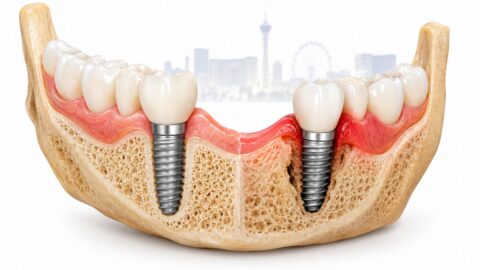
What Causes Dental Implant Failure in Las Vegas
A tender implant can make an ordinary evening feel urgent. You may be eating dinner after a long day in Las Vegas when a molar implant suddenly feels sore, or brushing your teeth in Sun City Summerlin when the crown seems to move under your toothbrush. A little discomfort can quickly turn into a worrying question: what causes dental implant failure, and can anything be done to save it?
Dental implants are designed to provide a stable foundation for a replacement tooth, but problems can develop during healing or after the implant has functioned successfully. Pain, swelling, bleeding, a metallic taste, or movement deserves attention, especially when symptoms are getting worse.
The cause may be biological, surgical, mechanical, or related to health and lifestyle. The timing matters, too. This guide walks through the difference between early and late failure, the warning signs to watch for, and the practical steps a dentist in Las Vegas, NV can take to diagnose and manage the problem.
A Common Scenario for Las Vegas Implant Patients
A patient in Painted Desert Estates notices tenderness around a molar implant while finishing dinner. The implant was placed months earlier, and the area had seemed comfortable. Now chewing on that side sends a dull pulse through the jaw, and the gum feels puffy when the patient touches it with the tongue.
Another patient, a retiree near Sun City Summerlin, notices something different. The implant itself doesn't hurt, but the crown feels wobbly while brushing. The patient plans to call the dentist in the morning, then wonders whether waiting a few days could make the situation worse.
Those sensations don't automatically mean the implant has completely failed. A loose crown may involve a prosthetic screw or cement issue, while movement of the implant post can indicate that the bone never bonded properly or has lost support. Only an examination, dental X-rays, and sometimes three-dimensional imaging can separate these possibilities.
Practical rule: A stable implant should not move. Pain that persists, swelling that increases, or a crown that shifts should prompt a call rather than a wait-and-see approach.
Patients searching for dental implants near me, an emergency dentist, or a dentist near me in Las Vegas often want one clear answer. The answer is that implant failure usually comes from a chain of factors, not one isolated mistake. A dentist will consider healing, infection, bite forces, bone condition, surgical placement, medications, and daily cleaning before recommending treatment.
That same evaluation is useful before treatment. Whether you're in Desert Shores, Sunhampton, Monterrey, Lone Mountain, Mar-A-Lago, or nearby Las Vegas neighborhoods, a careful consultation can identify risks that are manageable before an implant is placed.
How Dentists Define Dental Implant Failure
A dental implant fails when it can no longer provide a stable, healthy foundation for the replacement tooth. That might mean the implant becomes mobile, loses too much supporting bone, develops persistent disease around it, or cannot safely support a crown, bridge, or denture.
Dentists generally divide failure into early failure and late failure. Early failure occurs during healing, before the implant has successfully bonded with the jawbone. In plain language, the implant never becomes firmly anchored. Late failure occurs after the implant has integrated and functioned, sometimes long after placement.
Think of the difference between two fence posts. One post never sets in concrete because the ground is loose or the concrete was disturbed. That resembles early failure. Another post sits firmly for years, but water, rot, or repeated stress damages the base. That resembles late failure.
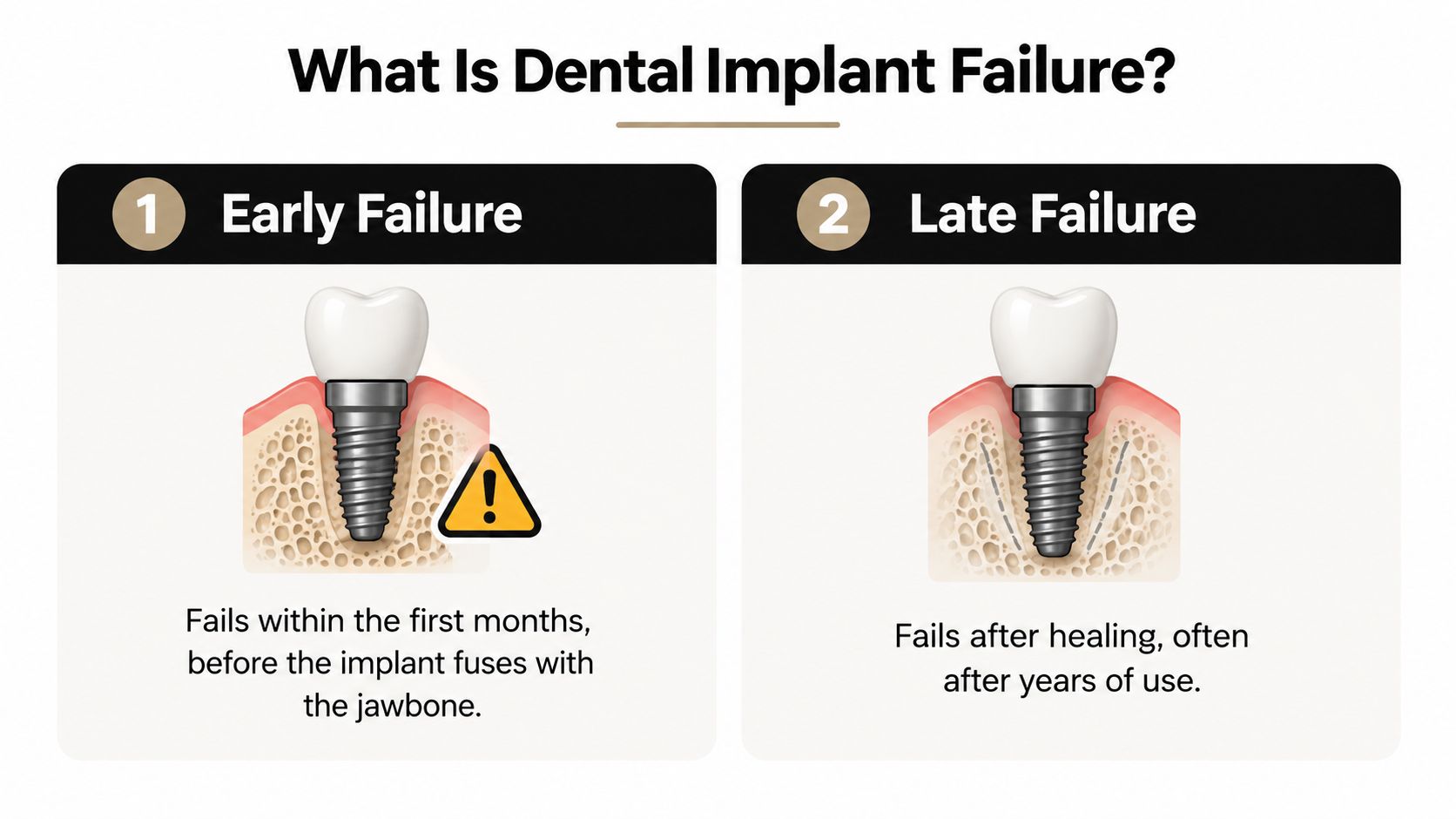
A 2025 review found that lack of osseointegration accounted for 36.4% of implant removals, while absent primary stability accounted for 22.4%. It also listed peri-implantitis at 14.0%, positioning errors at 14.0%, and infection at 7.5%. These findings support a practical conclusion: failure can begin with healing or placement problems, then progress through biological and mechanical complications. The review of implant failure causes explains this timing-based pattern in detail.
Patients who want broader background on treatment categories can also review this dentistry specialties overview, which places implant care within the larger field of restorative and preventive dentistry.
The early-versus-late framework matters because treatment differs. A mobile implant soon after surgery may need evaluation for removal and future replacement, while a later problem may involve peri-implantitis, a loose component, or excessive bite force that can sometimes be treated without removing the implant.
Biological and Medical Causes of Implant Failure
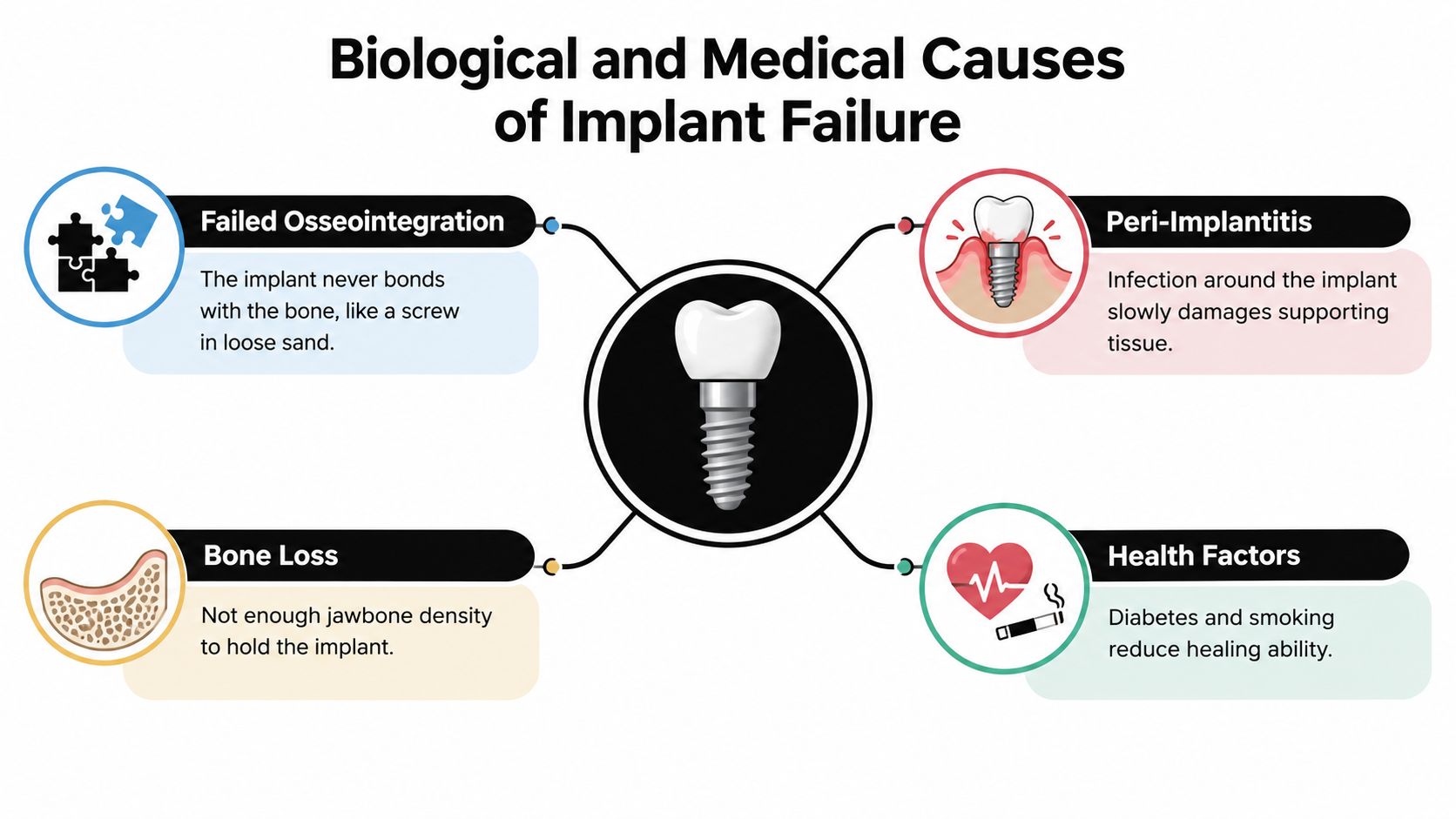
The jawbone must accept the implant and gradually hold it as living tissue. This process, called osseointegration, is similar to a screw setting firmly in concrete. If the surrounding material is unstable, contaminated, overheated, or repeatedly disturbed, the screw won't become secure.
Early failure commonly involves poor osseointegration, infection, surgical trauma, inadequate primary stability, or insufficient bone quality. Earlier reviews have associated early failure with overheating during drilling, contamination, trauma, poor bone quantity or quality, and movement during healing. A dentist may respond by reviewing dental X-rays, checking mobility, controlling infection, or planning bone reconstruction before another implant is considered.
Peri-implantitis and progressive bone loss
Peri-implantitis is a plaque-associated inflammatory disease around an implant that has already integrated. It resembles gum disease around a natural tooth, but the inflammation can cause bleeding, pus, deeper probing measurements, and progressive bone loss around the implant. The European Federation of Periodontology describes peri-implantitis as affecting more than 10% of patients with implants and notes that it can appear within only a few years of function. Its evidence overview of peri-implant treatments shows why cleaning and maintenance matter from the beginning.
A practical prevention step is to ask your dentist to demonstrate how to clean beneath and around the crown. If inflammation is present, professional debridement, antimicrobial care, and closer monitoring may limit further damage.
Health conditions that change healing
Diabetes doesn't automatically mean an implant will fail. One systematic review found 49 failures among 1,260 implants in diabetic patients, compared with 555 failures among 11,476 implants in non-diabetic patients, and the pooled comparison wasn't statistically significant. Another meta-analysis found a higher overall risk in diabetic patients, with an odds ratio of 1.777, showing that disease control, severity, patient selection, and study design influence results. The systematic review of diabetes and implants supports an individualized discussion rather than a blanket warning.
Osteoporosis and changes to bone after radiation treatment also require careful planning. Osteoporosis alone may not prevent successful treatment, but the dentist needs a complete medical history, medication list, and imaging before deciding whether the bone can support an implant.
Surgical and Mechanical Causes You Should Know
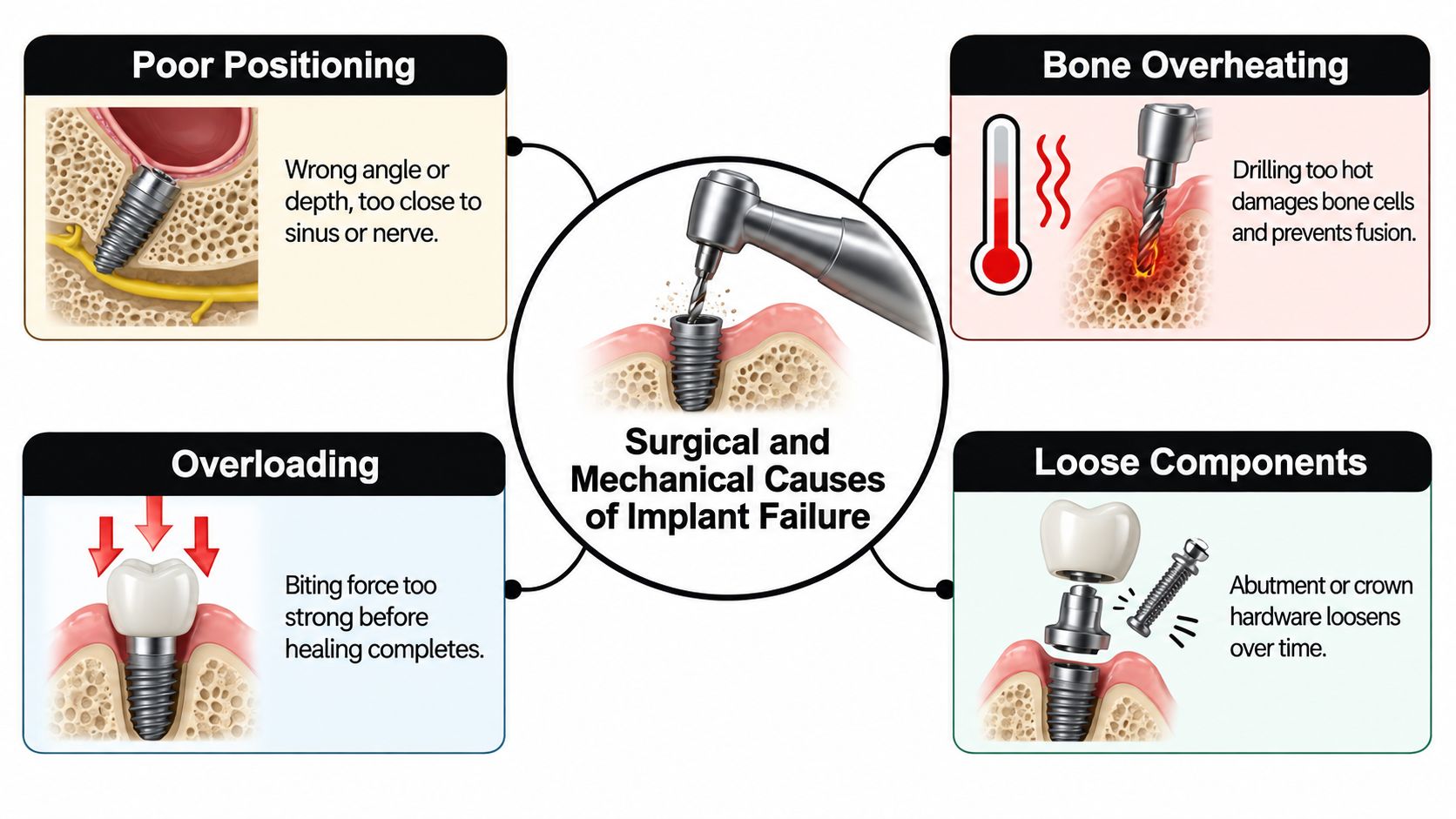
Some failures begin in the operatory. The implant must be placed at the right angle and depth, with adequate space from neighboring teeth, nerves, and the sinus. Three-dimensional planning can help the dentist evaluate the available bone and select a position that supports both healing and the final crown.
Overheating during drilling can damage bone cells and interfere with osseointegration. Inadequate irrigation, excessive pressure, or an unsuitable drilling sequence can contribute to this problem. Contamination of the implant surface during placement can also introduce bacteria before healing is complete.
Primary stability is another early checkpoint. The implant needs enough initial grip in the bone to remain still while integration develops. Bone that is too soft, an undersized or poorly prepared site, or movement during healing can leave the implant feeling mobile within the early healing period.
Problems with the restoration and bite
A crown can loosen even when the implant post remains firmly integrated. An abutment screw may loosen or fracture, a crown may chip, or the connection between the implant and abutment may allow bacterial leakage. These problems often appear months or years after placement rather than immediately after surgery.
Bite forces matter just as much. A crown that contacts too heavily, a cantilever bridge, an uneven bite, or nighttime grinding can apply repeated stress to the implant and restoration. That stress may cause screw loosening, crown fracture, bone strain, or fatigue damage over time.
A 2022 review reported that connection-related mechanical problems rose from 4.3% after five years to 26.4% after 10 years. The same review found implant failure more often among patients with bruxism, 41% compared with 12% among those without parafunction. The review of late implant failure factors reinforces why a loose crown needs examination, even when the gum looks normal.
A Las Vegas implant dentist can evaluate the bite, retighten or replace a component when appropriate, and use guided placement and properly torqued parts to reduce preventable mechanical stress.
Patient Risk Factors That Raise Implant Failure Rates
Your health history doesn't decide the outcome by itself, but it helps the dentist plan safely. Smoking, blood sugar control, bone condition, medications, radiation exposure, immune function, and grinding habits can all change how the jaw heals or how much force reaches the implant.
Smoking has some of the clearest evidence. A 2013 meta-analysis found nearly twice the failure risk among smokers, with a relative risk of 1.92 and a 95% confidence interval of 1.67 to 2.21. A separate 2021 meta-analysis reported an odds ratio of 2.402, with a 95% confidence interval of 2.176 to 2.652. The smoking and dental implant meta-analysis supports discussing nicotine use openly before surgery.
| Risk Factor | Impact on Implant Success | Evidence Strength |
|---|---|---|
| Smoking and heavy nicotine use | Restricts healing support and raises failure risk | Strong |
| Poorly controlled diabetes | Can slow healing and increase infection concerns | Conditional, supported but mixed |
| Osteoporosis alone | May not independently increase implant failure | Conditional |
| Radiation to the jaw | Can alter bone healing and tissue quality | Clinically important |
| Bruxism | Adds repeated mechanical load | Supported |
| Certain medications | May affect bone or soft-tissue response | Variable |
Evidence about systemic disease isn't uniform. A 2025 review found peri-implantitis prevalence around 22% in patients with osteoporosis but concluded that osteoporosis didn't increase implant failure, while another 2025 review associated diabetes, smoking, and certain medications with two- to threefold higher early-failure risk and reported that prophylactic antibiotics may reduce that risk by about 60%. The 2025 review of systemic factors and implant outcomes illustrates why your dentist should assess your specific condition rather than rely on a generic risk label.
Before a consultation, bring a complete medication list, information about diabetes control, any history of osteoporosis treatment, past radiation involving the jaw, immune-system conditions, tobacco use, and whether you clench or grind. If nighttime grinding is a concern, review this guide on how to stop grinding teeth at night and discuss a protective night guard with your dentist.
Warning Signs and When to Call an Emergency Dentist
Some soreness is expected after oral surgery, but symptoms that persist, intensify, or return after comfort has been restored deserve attention. The type of symptom can offer a clue, although only a clinical evaluation can identify the actual cause.
- Throbbing pain or swelling: Within the early healing period, this may point to infection, surgical trauma, or poor integration.
- A loose crown or implant: A shifting crown can indicate a loose screw or abutment, while movement of the implant itself may indicate loss of bone support.
- Bleeding, pus, or a metallic taste: These signs can occur with inflammation and peri-implantitis.
- A receding gumline: Exposed implant surfaces can collect plaque and may signal soft-tissue or bone changes.
- Numbness or tingling: These symptoms require prompt assessment for possible nerve involvement.
- Sinus pressure: An upper-jaw implant problem can require evaluation of the nearby sinus.
- A changing bite: Difficulty chewing, a crown that hits first, or new pressure can suggest overload.
Don't test a loose implant at home. Avoid wiggling it with your fingers or tongue, and don't chew hard foods on that side while arranging care.
Any of these symptoms during the first year warrants a same-week call to your dental office. Severe pain, facial swelling, or an obviously loose implant calls for a same-day emergency dental visit in Las Vegas, because prompt treatment may protect the surrounding bone and improve the chance of preserving the restoration.
A dentist may use an examination, probing, mobility testing, and dental X-rays to determine whether the problem involves the crown, the supporting tissues, or the implant itself. An emergency dentist can also address pain and swelling while arranging the more detailed implant evaluation you may need.
How Implant Failure Is Treated and What to Expect
Treatment depends on whether the implant is stable, how much bone has been affected, and whether the problem is biological or mechanical. The first appointment should answer those questions rather than rush you into a procedure.
For inflammation around a stable implant, care may begin with non-surgical debridement, which is a careful deep cleaning around the implant. Your dentist may add antimicrobial rinses and reinforce home-care techniques. If disease has progressed, surface decontamination, laser therapy, or regenerative grafting may be considered to address contaminated surfaces and lost supporting tissue.
Mechanical problems can require a different response. A dentist may tighten or replace a loose abutment, re-cement a detached prosthesis, replace a damaged crown, or adjust the bite when excessive contact is overloading the implant. These solutions are designed to correct the source of stress while preserving an implant that still has healthy bone support.
When integration has failed or bone loss is advanced, explantation, or removal of the implant, may be necessary. The dentist cleans the site and determines whether bone grafting is needed before revision surgery. A replacement implant isn't placed until the site can provide a stable foundation.
At a consultation with the practice, expect diagnostic work rather than an immediate commitment to surgery. The evaluation may include CBCT imaging, probing depths, mobility grading, an examination of the crown and bite, and a written plan that explains the findings and options. This process is also appropriate for someone seeking a second opinion after tooth extraction, implant placement, or restorative dental care.
Prevention Habits and Scheduling a Las Vegas Implant Consultation
Implant protection becomes easier when each habit has a clear purpose.
Daily cleaning
Use a soft-bristle toothbrush and clean along the gumline. A water flosser or interdental brush may help remove plaque beneath and around an implant crown, but your dentist should show you the correct size and pressure. This routine targets the plaque that can contribute to peri-implant inflammation.
Professional monitoring
Regular dental cleaning and exams allow the team to inspect the gum tissue, assess the bite, check for component movement, and monitor bone levels with dental X-rays when appropriate. Implant-specific checks are especially useful when you have a history of gum disease, smoking, diabetes, grinding, or a previous implant problem.
Lifestyle and bite protection
Stopping smoking supports healing and reduces a major modifiable risk. Work with your medical team to manage diabetes, disclose every medication, and ask about a night guard if you clench or grind. These steps address blood flow, infection risk, bone response, and repeated mechanical force rather than treating prevention as a generic checklist.
For more detailed home-care guidance, read how to properly care for dental implants. Most implant problems can be addressed more effectively when patients report changes early and keep consistent maintenance appointments.
If you're looking for a dentist in Las Vegas, NV, dental implants near me, a cosmetic dentist near me, help with tooth extraction, or prompt emergency dental services, a consultation can clarify whether your implant is healthy, needs maintenance, or requires treatment. Aspiring Smiles Dental and Braces provides implant placement and restoration, CBCT-based evaluation, restorative care, cosmetic dentistry, teeth whitening, cleanings, exams, and emergency appointments for patients in Las Vegas and surrounding neighborhoods.
Schedule an implant evaluation or second-opinion visit with Aspiring Smiles Dental and Braces if your implant hurts, bleeds, feels loose, or has changed your bite. The team can examine the implant, identify the likely cause, and explain a personalized plan before a manageable concern becomes a larger problem.