Dental Crowns vs Implants Near Me in Las Vegas
A cracked molar after dinner, a crown that no longer feels secure, or a missing front tooth can turn an ordinary week into a difficult decision. If you're searching for a dentist near me, dental implants near me, or a dentist in Las Vegas, NV, you may be comparing two treatments that serve very different purposes: preserving a tooth with a crown or replacing a tooth with an implant.
At Aspiring Smiles Dental and Braces, Dr. Patel and the team help Las Vegas patients make that decision through an examination, dental X-rays, gum evaluation, and a careful discussion of prognosis, appearance, comfort, timing, and maintenance. The right treatment isn't determined by the label that sounds more durable. It starts with whether the natural tooth can be predictably saved.
| Factor | Dental crown | Dental implant |
|---|---|---|
| What it restores | An existing natural tooth | A missing tooth and its root |
| Surgery | Usually not required | Required for implant placement |
| Supporting structure | Natural tooth root and surrounding tissues | Titanium implant integrated with jawbone |
| Typical treatment path | Preparation, temporary restoration, final crown | Placement, healing, abutment, final crown |
| Main biological concern | Recurrent decay, fracture, gum disease, root problems | Gum inflammation, bone loss, technical complications |
| Best starting question | Is the tooth restorable and maintainable? | Is the tooth missing or beyond predictable repair? |
Why Las Vegas Families Choose Between Crowns and Implants
A patient from Desert Shores recently arrives after biting something hard and discovering a fracture in a back tooth. Another patient from Sun City Summerlin has lived with a missing premolar for months and is now tired of avoiding that side of the mouth. Both may ask the same question, “Would an implant last longer than a crown?” Clinically, that question comes too early.
The first question is whether there's a healthy, maintainable tooth left to restore. A crown can protect and reinforce a damaged natural tooth, but it can't rescue a tooth with an unfavorable root fracture, extensive decay below the gumline, or insufficient supporting tissue. An implant is designed for a missing or non-restorable tooth, so choosing one may require tooth extraction before replacement can begin.
The practical rule: Save a predictable natural tooth when it can be restored and maintained. Replace a tooth when keeping it would only postpone a more complex problem.
That distinction matters for families in Las Vegas, including patients near Sunhampton, Monterrey, Lone Mountain, Mar-A-Lago, and Painted Desert Estates. A quick quote may not reveal whether the proposed treatment addresses the cause of the problem or only the visible damage. A new patient exam, dental cleaning, periodontal assessment, and dental X-rays can show whether infection, bone loss, bite stress, or neighboring teeth will affect the result.
A calm decision starts with diagnosis
At Aspiring Smiles Dental and Braces, a consultation is an opportunity to ask direct questions. What healthy tooth structure remains? Can the gumline be cleaned around the restoration? Is there enough bone for an implant? Would a bridge involve adjacent teeth that are otherwise healthy? What happens if the patient grinds at night?
Understanding both options before committing to care can reduce anxiety and prevent unnecessary procedures. It also gives patients a more useful financial question than “Which treatment costs less?” The better question is, “Which option offers the most dependable lifetime value for this particular tooth and this particular mouth?”
Crowns and Implants: Two Different Foundations
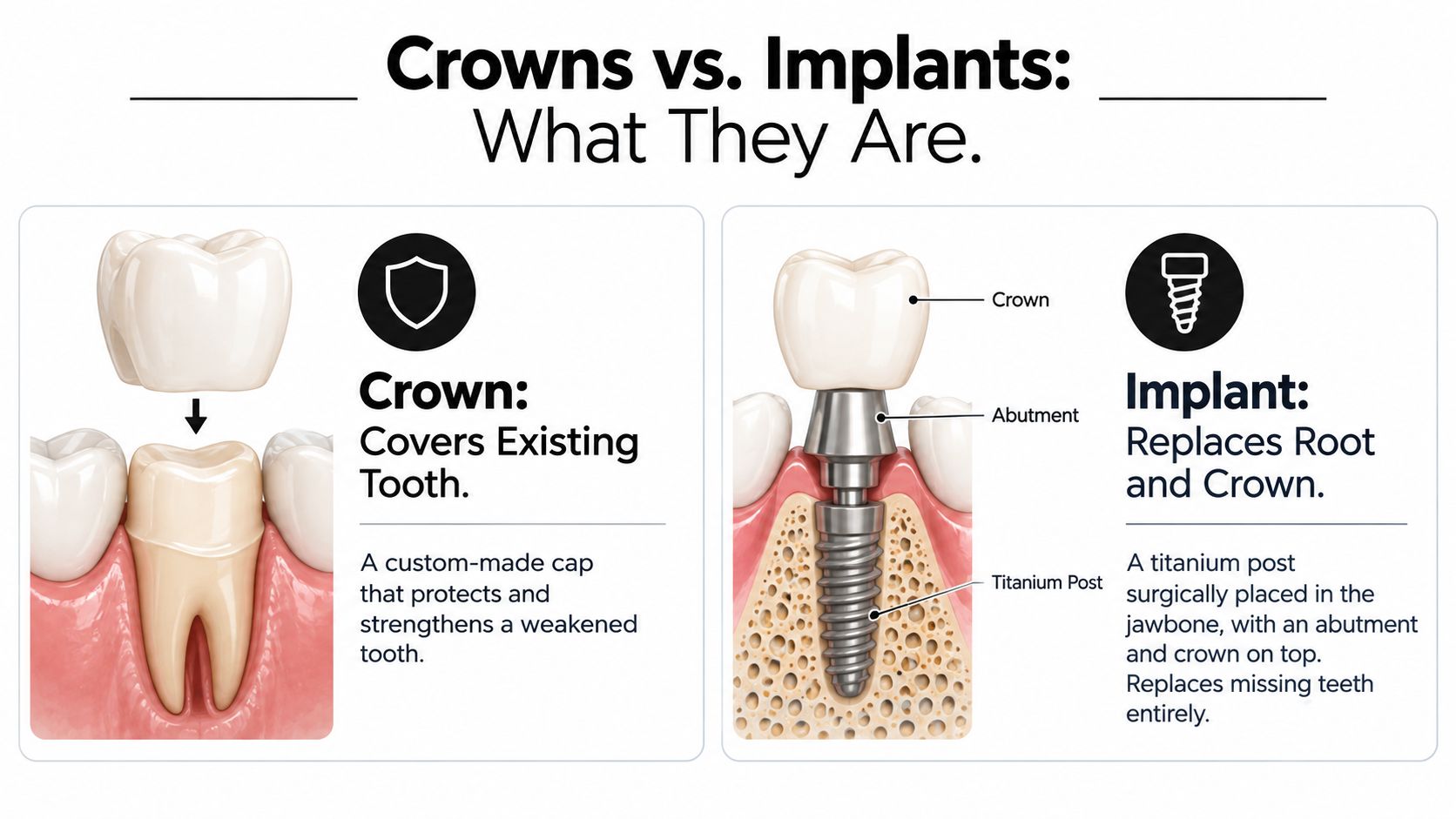
A dental crown covers a prepared natural tooth. Dentists use crowns when decay, a fracture, a large filling, or root canal therapy has weakened the visible structure. The restoration rebuilds the tooth's shape and chewing function while the natural root stays in the jaw.
Preserving that root can protect existing tooth tissues, but the crown cannot eliminate problems beneath or around it. Recurrent decay at the margin, fracture of the remaining tooth, gum disease, and root-related infection can still threaten the result. Crown longevity depends on the material, fit, and health of the tooth and its surrounding tissues.
A dental implant replaces the root of a missing tooth. A dentist places a titanium post in the jawbone, allows bone to attach functionally to its surface, and then connects an abutment and prosthetic crown. The visible crown may resemble one placed on a natural tooth, but the support underneath is entirely different.
This bone-to-titanium connection is called osseointegration. It made implants a clinically established option for replacing missing teeth. Modern evidence supports strong, though not unlimited, implant durability over many years, as reported in this systematic review of implant survival.
Why the foundation matters
A crown keeps the natural root, periodontal attachment, and surrounding tissues when they remain healthy enough to support restoration. An implant can avoid preparing adjacent teeth, which matters when neighboring teeth are sound. It also requires surgery, healing, radiographic planning, and cleaning around an artificial root.
For Las Vegas families, the lifetime-value question starts with this structural difference. A crown restores a tooth that may remain functional for years. An implant replaces a lost or non-restorable root and still needs a crown above it. Material choice, remaining tooth structure, bone, gum health, bite forces, and maintenance all affect the long-term decision.
Neither option is automatically superior. A lower initial commitment can carry future repair or replacement needs, while implant treatment involves more stages before the final tooth is in service. The sound choice is the one that matches the condition of the tooth, the supporting tissues, and the patient's ability to maintain the result.
Clinical Comparison of Crowns and Implants
A crown and an implant can both restore chewing function, but they solve different problems. Survival means the restoration or implant remains in service. It does not mean the patient has avoided repairs, gum problems, bite adjustments, or replacement of the visible crown. That distinction matters when Las Vegas families compare lifetime value rather than choosing by the initial fee alone.
For natural-tooth crowns, population-level evidence reported survival of approximately 77% at 5 years, 63% at 10 years, and 53% at 15 years in an analysis of restorations in England and Wales. Other evidence summarized in the review reported 5-year survival of 93% for all-ceramic crowns and 96% for metal-ceramic crowns. These are estimates, not promises. Age, treatment needs, tooth condition, maintenance, and restoration material all influence the result.
A crown preserves a salvageable tooth and its natural root, provided enough healthy structure remains. An implant replaces a tooth that is missing or cannot be predictably restored. That choice can avoid preparing adjacent teeth, but the implant still requires a crown and ongoing care around an artificial root.
Single-tooth implant outcomes were estimated at 97.2% survival after 5 years and 95.2% after 10 years. Implant-supported single crowns showed 96.3% survival after 5 years and 89.4% after 10 years. The review also reported soft-tissue complications in 7.1%, implant-associated bone loss exceeding 2 millimeters in 5.2%, screw loosening in 8.8%, loss of retention in 4.1%, and veneering-material fracture in 3.5% at 5 years. These figures come from the systematic review of single-tooth implant restorations.
Crowns and implants side by side
| Factor | Dental crown | Dental implant |
|---|---|---|
| Biological foundation | A natural tooth and its root | Jawbone-integrated titanium post |
| Main vulnerability | Decay, fracture, gum disease, or root failure | Peri-implant tissue problems and bone loss |
| Neighboring teeth | May be used as bridge supports when applicable | Usually avoids preparing adjacent teeth |
| Treatment burden | Generally less surgical | Surgery and healing are required |
| Maintenance | Cleaning around the crown and gumline | Specialized cleaning around the implant and crown |
| Restoration reality | The tooth under the crown remains biologically active | The implant may remain stable while the crown needs repair |
For multi-unit treatment, a meta-analysis estimated 5-year survival of 93.8% for conventional tooth-supported fixed prostheses and 95.2% for solely implant-supported fixed prostheses. At 10 years, the estimates were 89.2% and 86.7%. Complications affected about 15.7% of patients with conventional prostheses compared with 38.7% of patients with implant-supported prostheses after 5 years. The meta-analysis of fixed dental prostheses identified technical problems with implant-supported restorations, including ceramic veneer fracture and screw loosening.
Material selection, laboratory communication, cement control, and chairside technique can affect how an implant crown performs. Review lab and chairside best practices for cementation when discussing retention, fit, and maintenance with your dentist.
Treatment Procedures and Recovery Timelines
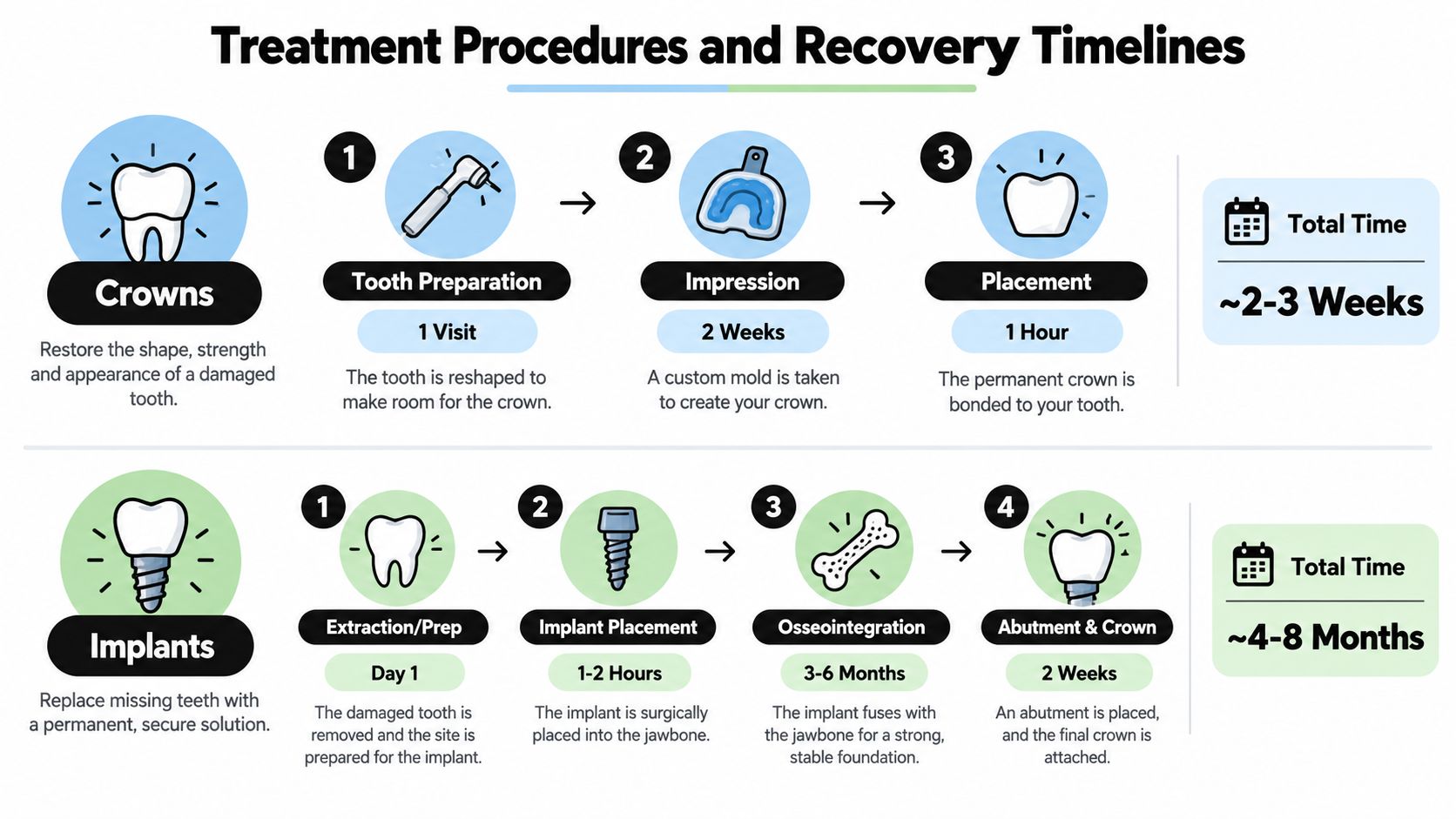
For a Las Vegas patient with a salvageable tooth, crown treatment usually involves fewer surgical steps. The dentist examines the tooth, removes decay or unsupported structure, reshapes it, and records its form with an impression or digital scan. A temporary restoration protects the tooth while the laboratory makes the final crown. At the placement visit, the dentist checks fit, contacts, appearance, and bite before cementing it.
The schedule varies with the tooth's condition, laboratory workflow, and any need for gum treatment or root canal therapy. Crown preparation usually allows a quick return to daily activities, although sensitivity or an unfamiliar bite can persist until the permanent restoration is fitted. Preserving a tooth still makes sense only when its remaining structure and supporting tissues offer a reasonable prognosis.
An implant follows a longer sequence because bone must heal around the fixture. If the tooth cannot be restored, extraction and site preparation may come first. Implant placement is followed by osseointegration, abutment placement, and fabrication of the final crown. Bone grafting, active gum disease, limited bone volume, or bite correction can add visits and extend healing.
Planning around work and family
After implant surgery, plan for soft foods, careful brushing around the surgical area, and several days of lighter activity according to the dentist's instructions. Routine activities may resume soon after placement, but internal healing continues while the mouth feels comfortable.
Ask for a written sequence showing surgical, restorative, observation, and maintenance visits. The dental implant procedure guide can help families prepare practical questions before consultation.
Cost planning also requires a realistic timeline that reflects prognosis, bone needs, and maintenance, not just the crown-versus-implant label.
Costs, Financing, and Lifetime Value Considerations
A Las Vegas family comparing a crown with an implant should start with prognosis, then examine the full financial timeline. Preserving a salvageable tooth may require a crown and future maintenance. Replacing a lost or unrestorable tooth may involve extraction, imaging, the implant fixture, an abutment, and the final crown. Bone grafting or gum treatment can add separate charges, so request an itemized plan before accepting a quote.
A bridge creates another financial comparison. It may require preparing neighboring teeth, while an implant-supported crown can avoid that preparation for a suitable candidate. The decision depends on the missing-tooth site, adjacent teeth, hygiene access, bite forces, healing requirements, and the patient's ability to attend follow-up visits.
Look beyond the first invoice
Lifetime value should include:
- Natural-tooth prognosis: A crown makes financial sense when enough sound structure remains and the gum foundation can be maintained.
- Future maintenance: Either restoration may need professional care, repairs, adjustments, or replacement of the visible crown.
- Surgical needs: Extraction, bone grafting, imaging, and healing can change the total implant plan.
- Insurance details: Benefits vary by plan, procedure, and medical or dental exclusions.
- Payment timing: Financing, flexible payment options, and membership arrangements can affect access without changing the clinical recommendation.
Patients reviewing benefits can compare Original Medicare and Advantage dental coverage, then confirm exclusions and annual limits in their own policy. Coverage information supports better questions, but it does not replace a treatment estimate from the dental office.
A 2024 economic analysis reported average costs of US$3,432 for single-tooth implant-and-crown treatment and US$3,323 for a three-unit fixed bridge, a difference of about US$110 in that study. Implant treatment was more effective but also more expensive, and the authors concluded that willingness to pay should influence the decision. The comparison is different for a crown on a salvageable tooth versus extraction and replacement, so a personalized estimate remains important. Patients can review crown versus implant cost considerations before discussing the options.
At the consultation, ask what happens if the tooth fails, which components are included, and how repairs or replacement would be handled. A lower starting bill may carry different future risks, while a higher initial plan may reduce repeated treatment when its prognosis is favorable. The sound choice is the one that matches clinical durability, maintenance demands, and the family's budget over time.
Who Should Choose a Crown and Who Should Choose an Implant
A crown is generally the more conservative direction when the natural tooth can be restored predictably. That usually means enough sound tooth structure remains, the root isn't fractured beyond repair, the gums can be maintained, and the patient wants to avoid surgery or a lengthy healing process.
A crown may also make sense when adjacent teeth already need restorations. In that situation, a tooth-supported bridge or other restorative design may be considered, although the dentist still has to evaluate the supporting teeth and hygiene access.
An implant becomes more relevant when the tooth is missing or cannot be predictably repaired. It can replace the root and support a crown without preparing neighboring teeth. The patient must still have suitable bone and gum conditions, or be willing to consider additional treatment when clinically appropriate.
Factors that can change candidacy
- Gum disease: Active periodontal disease can threaten either a natural-tooth crown or an implant-supported restoration.
- Smoking: Smoking can interfere with healing and increase implant risk.
- Uncontrolled diabetes: Healing and infection control require careful medical and dental coordination.
- Bruxism: Clenching or grinding can overload crowns, implant components, and natural teeth.
- Bone volume: An implant needs a stable foundation, confirmed through examination and dental X-rays.
- Age and priorities: A younger patient may value preserving tooth structure, while another patient may prioritize avoiding preparation of healthy adjacent teeth.
A systematic review of patients aged 13 to 94 included 26 cohort studies involving 1,558 implants. It estimated 5-year survival of 96.8% for implants and 94.5% for implant-supported single crowns, while conventional metal-ceramic crowns showed 95.4% survival and all-ceramic crowns showed 91.2% survival. The review also reported soft-tissue problems near 9.7% of implant-supported crowns and implant bone loss greater than 2 millimeters in 6.3% of cases. These are survival and complication estimates, not guarantees, and the findings are detailed in the systematic review of crowns and implant-supported crowns.
Your priorities matter, but the examination remains decisive. A dentist in Las Vegas, NV should assess restorability, periodontal health, bone condition, bite, esthetic demands, and how reliably you can clean around the proposed restoration before recommending tooth extraction, a crown, or dental implants.
Aftercare, Maintenance, and Long-Term Success Strategies
Daily maintenance protects both treatments, but the cleaning strategy must match the restoration. Brush gently along the gumline, clean between teeth with floss or an interdental device, and follow the instructions provided for the crown or implant. A night guard may be appropriate for patients who clench or grind, but it should be selected after a professional evaluation.
Crowns require attention to the edge where the restoration meets the natural tooth. Implants require attention to the soft tissues around the implant and to areas beneath or beside the crown that may trap plaque. Regular dental cleanings, exams, and dental X-rays help identify changes before a loose component, worn crown, gum problem, or bone change becomes urgent.
A long-term study followed single dental implants for 38 to 40 years and reported cumulative survival of 95.6% for implants but 60.9% for implant-supported crowns. The finding reinforces an important distinction: the titanium implant may remain integrated while the visible crown eventually needs adjustment, repair, or replacement, as described in the long-term implant and crown study.
For additional visual guidance on routine care, this patient-focused video can complement the instructions provided during an appointment:
Contact the office promptly if you notice
- Persistent pain or swelling: These symptoms can indicate infection, inflammation, or a bite problem.
- Movement: A loose crown, implant crown, or component requires assessment rather than continued chewing.
- A changing bite: New pressure or uneven contact can contribute to fracture or component stress.
- Bleeding or drainage: Tissue changes around an implant or natural tooth shouldn't be ignored.
- Sensitivity or a rough edge: Early evaluation may prevent a small defect from becoming a larger repair.
Long-term success is a partnership between sound diagnosis, precise restorative work, and consistent home care. If you're looking for an emergency dentist after sudden damage, a cosmetic dentist near me for appearance-focused treatment, or a restorative consultation for a missing tooth, prompt evaluation can clarify whether preserving the tooth or replacing it is safer.
Aspiring Smiles Dental and Braces provides examinations, dental X-rays, crowns, dental implants, tooth extraction, cosmetic dentistry, and emergency dental services for patients in Las Vegas, NV and nearby neighborhoods. Schedule a consultation through Aspiring Smiles Dental and Braces to discuss your tooth's prognosis, treatment timeline, maintenance needs, and the option that best supports your long-term smile.