
Dental Insurance That Covers Invisalign for Adults
You're an adult in Las Vegas comparing Invisalign costs, perhaps before a wedding, a career change, or because you're ready to address a bite or alignment concern you've postponed for years. The monthly payment matters, but the more useful first question is whether your dental plan includes adult orthodontic benefits and how it treats Invisalign.
Finding dental insurance that covers Invisalign for adults isn't always a simple yes-or-no search. A plan may cover orthodontics while excluding adults, apply a separate lifetime maximum, require a waiting period, or pay for conventional braces while assigning clear aligners an alternative benefit. A careful benefits check before your scan can prevent an unexpected balance and help you compare treatment options with confidence.
Why Adults in Las Vegas Are Asking About Invisalign Coverage
A working adult looking for a dentist in Las Vegas, NV may be balancing treatment with rent, family expenses, and a busy schedule. Clear aligners can appeal to someone who wants a more discreet way to improve alignment, prepare for an important event, or correct a long-standing bite concern without choosing traditional braces. The question often becomes practical very quickly: what will insurance pay, and what will remain out of pocket?
Adult coverage is generally less common than orthodontic coverage for patients under 18. Some plans include adult orthodontics, while others limit benefits by age or cover adults only when treatment relates to a specified condition. That difference matters to patients who can't rely on a parent's plan and need to evaluate their own employer or individual dental policy.
The product itself usually isn't the gatekeeper. Dental insurance generally evaluates Invisalign under the orthodontic benefit, the same broad category used for traditional braces, when the plan permits clear-aligner treatment. Invisalign's regulatory history also doesn't obligate insurers to pay. Align Technology was founded in March 1997, received U.S. Food and Drug Administration 510(k) clearance in 1998, and began commercial sales in the United States in July 1999, but payment still depends on the contract purchased by an employer or individual. Invisalign's FDA clearance timeline explains why market authorization and insurance reimbursement are separate questions.
Practical rule: Treat insurance as a verification task, not as a barrier or a promise.
Whether you live near Desert Shores, Sunhampton, Sun City Summerlin, Monterrey, Lone Mountain, Mar-A-Lago, or Painted Desert Estates, ask for written confirmation before starting treatment. A local practice can help you understand the estimate, but your member certificate and plan-specific benefits schedule control what the carrier pays.
How Adult Invisalign Coverage Works
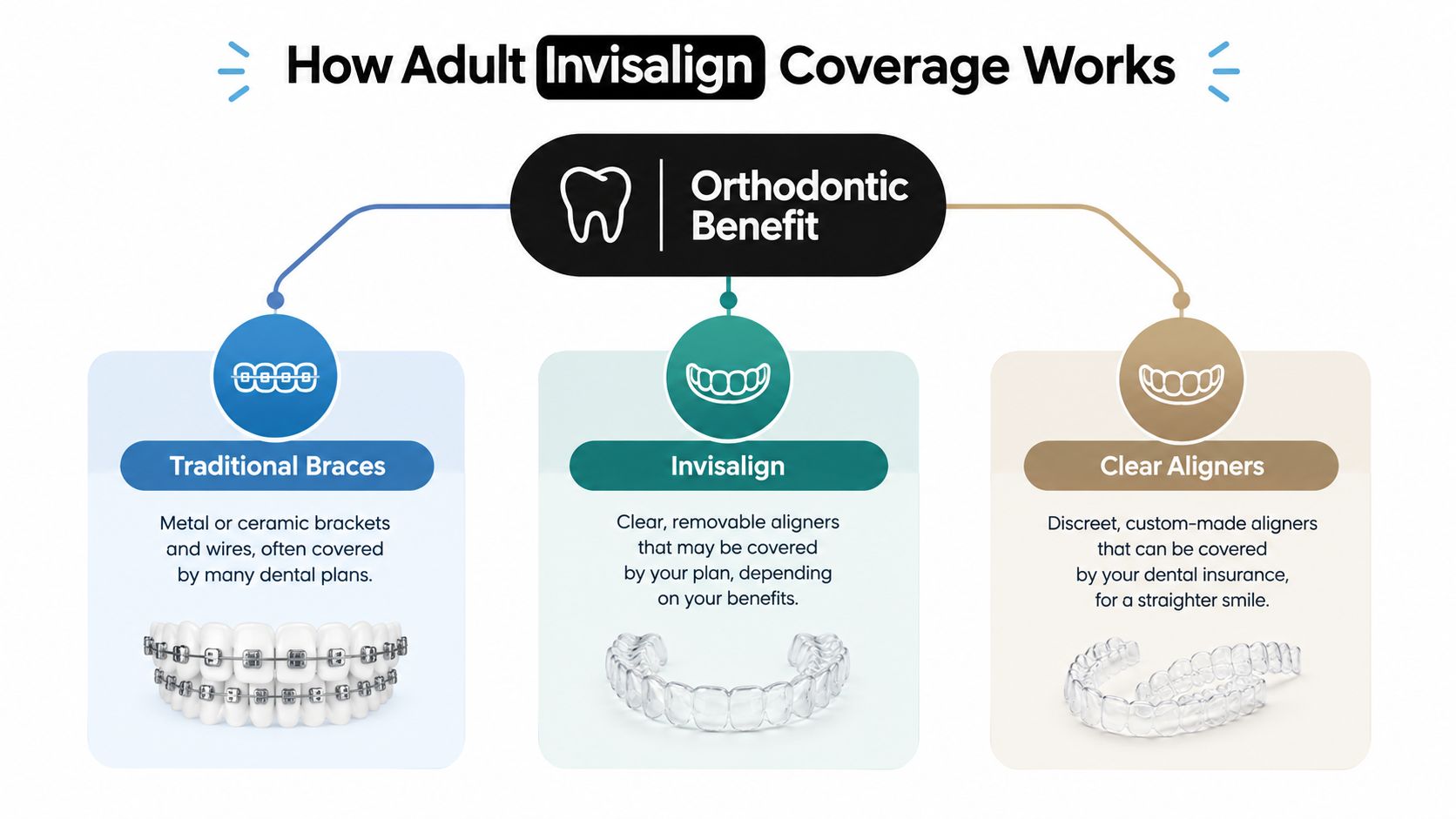
An adult patient may receive a “yes” from an insurer and still face an unexpected bill. The reason is that two separate questions control payment: whether the adult qualifies for the orthodontic benefit, and whether the plan pays for Invisalign rather than only a conventional-braces allowance.
The orthodontic benefit works like a designated drawer in a filing cabinet. Traditional braces, Invisalign, and other clear aligners may fit within it, but the drawer can have different access rules and payment limits. A plan might cover orthodontics for dependent children while excluding adults. Another might cover adult treatment but calculate its contribution using the insurer's allowance for conventional braces. The patient would then pay the difference between that allowance and the Invisalign fee.
The document that matters
A carrier's marketing page can mention orthodontic coverage, but the member certificate or plan-specific benefits schedule controls the claim. Review its age limits, orthodontic exclusions, waiting period, deductible, coinsurance, network requirements, preauthorization rules, and orthodontic lifetime maximum.
A dental plan's annual maximum and orthodontic lifetime maximum apply to different buckets. The annual maximum covers eligible dental services during a plan year. The orthodontic maximum applies to orthodontic treatment under the policy. Ask whether earlier braces treatment reduced the remaining lifetime benefit.
The history of clear aligners explains why insurers classify treatment by benefit category rather than appearance. By February 28, 2002, approximately 44,000 patients had entered Invisalign treatment, as noted in Align Technology's public information. That adoption history does not alter the contract. The plan still determines whether adult orthodontics and clear aligners qualify.
The Five Rules That Decide What Your Plan Pays
A “yes” from a benefits representative may answer only whether the plan includes orthodontics. It may not confirm adult eligibility, Invisalign processing, or the amount the insurer will contribute. Before scheduling treatment, check these five rules and request the details in writing.
| Rule | What It Controls | Question to Ask | Typical Adult Reality |
|---|---|---|---|
| Adult eligibility | Whether an adult can use the orthodontic benefit | “Does this plan cover orthodontic treatment for adults?” | Adult benefits are less common than dependent-child benefits. |
| Clear-aligner inclusion | Whether Invisalign is included or subject to an alternative benefit | “Is Invisalign covered, or will payment be based on conventional braces?” | Some plans process Invisalign under orthodontics, while others limit the covered allowance. |
| Reimbursement percentage | The share the plan calculates before limits and exclusions | “What percentage applies, and is the treatment coded as comprehensive orthodontic treatment (D8080/D8090)?” | The stated percentage does not guarantee that percentage of the full office fee. |
| Orthodontic lifetime maximum | The most the plan will pay toward orthodontic treatment | “What is the remaining lifetime orthodontic maximum?” | The cap can matter more than the coinsurance percentage. |
| Effective date and waiting period | When the benefit becomes usable | “Is there a waiting period, and does it apply when treatment starts?” | A policy may exist today but remain unavailable for immediate treatment. |
Adult eligibility deserves separate attention because a plan can cover orthodontics while excluding adults from that benefit. A 2025 government-sponsored dental plan covers orthodontics for members under 19, while adults qualify only when treatment relates to TMJ/TMD. Most orthodontic benefits in that plan carry a 12-month waiting period. The 2025 Federal Employees Dental and Vision Insurance Program includes adult orthodontic coverage in some options, with 50% benefits and lifetime maximums ranging from $1,500 to $3,000. These examples come from the 2025 dental handbook and the 2025 FEDVIP dental plan summary.
Product eligibility is a separate question. Invisalign may fit the plan's orthodontic category, yet the carrier may calculate its contribution from the allowance for conventional braces. That alternative-benefit clause can leave you responsible for the difference between the covered allowance and the Invisalign fee.
Ask whether the provider must be in network, and confirm how the plan handles refinements, replacement trays, and retainers. These details can change your expected balance even after the main orthodontic benefit appears eligible.
How to Verify Your Benefits Before You Sit Down for a Scan
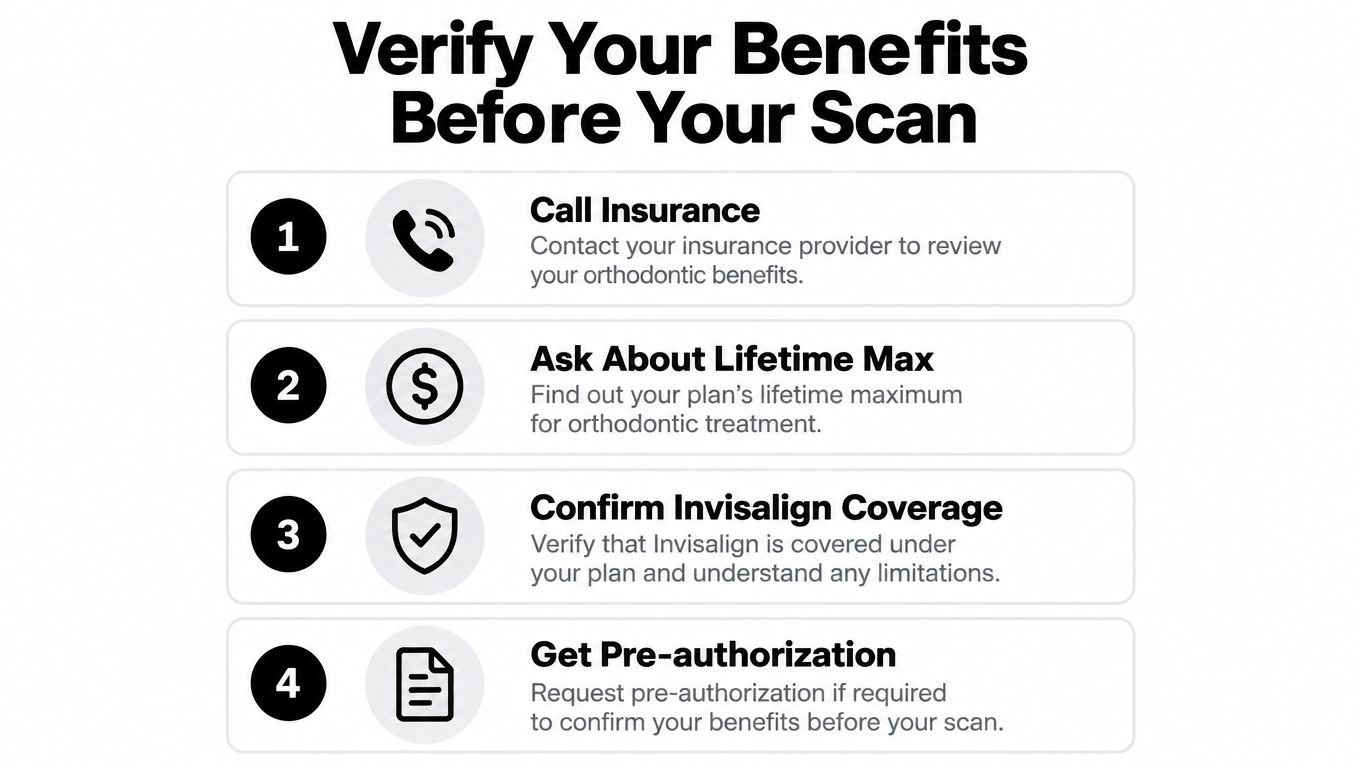
Start with your full benefits summary, not only the short insurance card. Search for “orthodontics,” “adult orthodontics,” “orthodontic treatment,” “clear aligners,” “waiting period,” and “lifetime maximum.” If the language is unclear, call the member services number and keep a written record of the representative's name, call date, and reference number.
Use these questions:
- “Is adult orthodontic treatment covered under my specific plan?”
- “Does the benefit include Invisalign and other clear aligners?”
- “Is there an alternative-benefit clause based on conventional braces?”
- “What percentage applies, and is it calculated from the provider's fee or the plan's allowed fee?”
- “What is my orthodontic lifetime maximum, and have I used any of it?”
- “Is there a waiting period or effective-date restriction?”
- “Does the provider need to be in network?”
- “Are preauthorization, retainers, refinements, or replacement trays handled separately?”
A phone verification is useful, but it isn't the same as a written predetermination. Ask the insurer to review the proposed treatment under the procedure category for orthodontic treatment and send a written estimate. The document should show eligibility, exclusions, the estimated insurer contribution, the lifetime maximum, and your expected responsibility.
Bring your insurance card, member certificate, benefits summary, and any previous orthodontic records to your consultation. If you're still searching for a local office, this guide to finding a dentist who accepts your insurance can help you prepare for that conversation.
A predetermination isn't a final promise of payment, but it gives you a much clearer basis for deciding whether to begin.
Covering the Gap With FSA, HSA, and Practice Financing
Insurance rarely answers the entire affordability question. Once you know the carrier's estimated contribution, compare the remaining balance with several payment tools rather than assuming one option must carry the full cost.
An FSA or HSA may help you pay eligible patient expenses with pre-tax funds, subject to the account rules and your eligibility. An HSA is generally tied to qualifying health coverage, so confirm your own account requirements before using it for orthodontic care. For a plain-language explanation of how these accounts work, review this Fintrack guide to HSA accounts.
Match the tool to the gap
| Payment tool | Most useful for | What it doesn't change |
|---|---|---|
| FSA | Paying eligible portions with available pre-tax funds | It doesn't remove an insurance waiting period or raise a plan maximum. |
| HSA | Using eligible account funds for qualified care | Account rules still apply, and it doesn't alter the carrier's benefit calculation. |
| In-house membership plan | Combining routine-care savings with practice-based benefits | Membership terms aren't the same as insurance, and exclusions may apply. |
| Third-party financing | Spreading a larger remaining balance into scheduled payments | Approval terms and borrowing costs depend on the financing arrangement. |
| Office payment plan | Creating predictable installments directly with the practice | The plan may require a down payment or scheduled payments before treatment stages. |
A practice membership program may help with preventive services and other eligible practice benefits, but it won't automatically replace an orthodontic lifetime maximum. Likewise, financing can spread the balance, but it doesn't make an excluded adult benefit eligible. The best plan often combines insurance with available FSA or HSA funds and a payment arrangement for the rest.
Before agreeing to a schedule, ask for the full fee, the expected insurance payment, deductible, down payment, refinement policy, retainer charges, and post-treatment visits in writing. You can also review dental payment plan options while comparing the total cost rather than only the monthly figure.

A $5,000 Invisalign Case, Line by Line
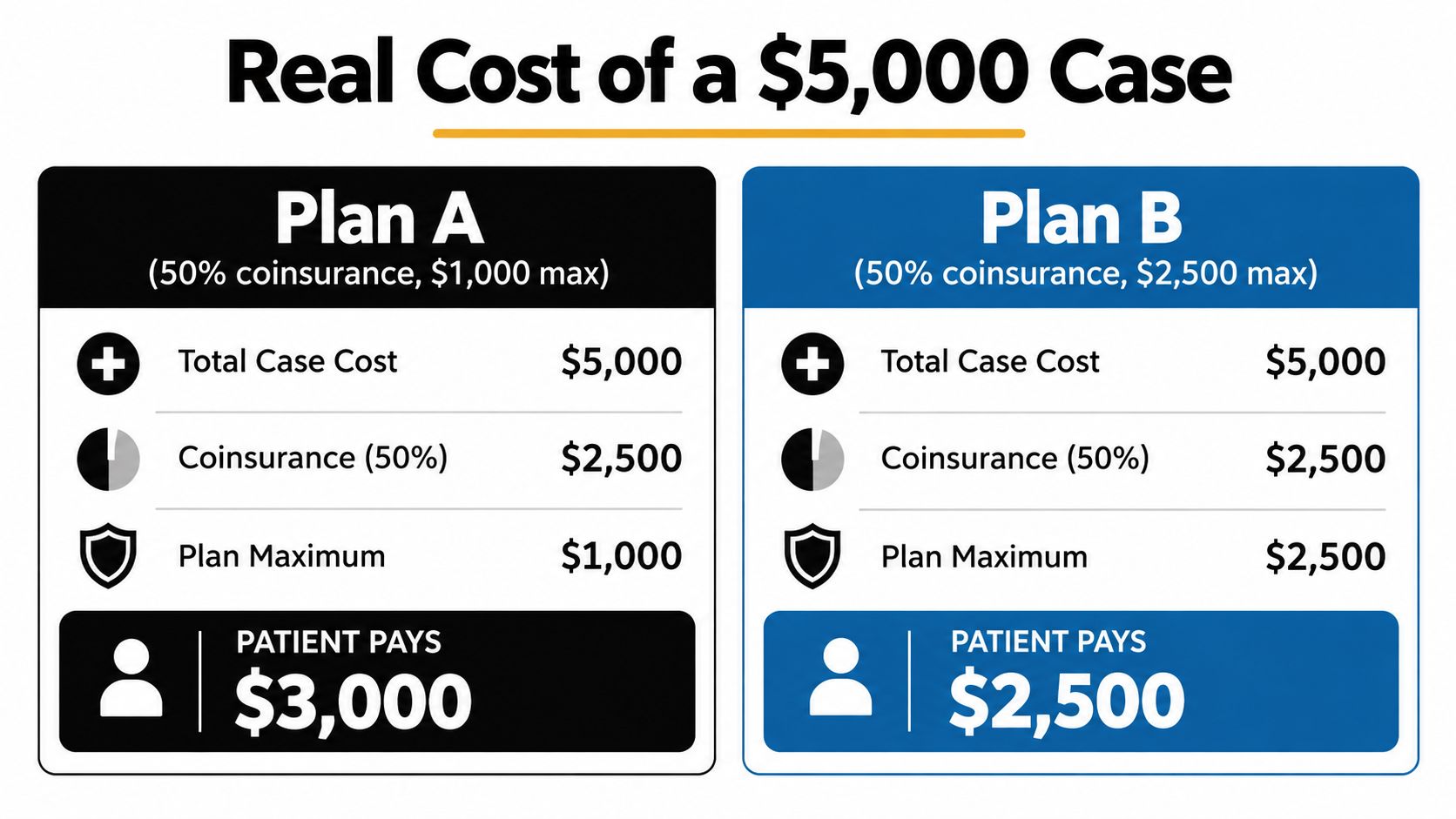
A plan's percentage can look generous until its dollar limit is applied. Start with the treatment fee, then work through the allowed fee, deductible, coinsurance, and orthodontic lifetime maximum. This worksheet separates the percentage from the amount the plan can contribute.
Use a hypothetical treatment fee of $5,000. Under Plan A, the carrier lists 50% coinsurance and a $1,000 orthodontic lifetime maximum. Half of the fee equals $2,500, but the lifetime maximum caps the estimated insurance contribution at $1,000 before deductibles or exclusions. The estimated patient responsibility is therefore $4,000, not $2,500.
Plan B keeps the same $5,000 fee and 50% coinsurance, but raises the orthodontic lifetime maximum to $2,500. The percentage calculation reaches $2,500, and the maximum does not reduce that amount, producing an estimated patient responsibility of $2,500, before other plan adjustments.
Why the worksheet needs more lines
These examples isolate the lifetime maximum so its effect is easy to see. Your estimate may change if the carrier uses an allowed fee, applies the deductible first, requires an in-network provider, or pays benefits in installments during active treatment. A waiting period can also delay eligibility even when the policy lists orthodontic coverage.
A cited analysis reports that orthodontic coverage often pays approximately 25% to 50% of treatment costs, with separate lifetime limits frequently ranging from $1,000 to $2,500. This braces insurance guide also explains that previously used orthodontic benefits can reduce what remains available.
Independent market reporting places clear-aligner treatment broadly around $2,000 to $8,000. Complexity, treatment duration, retainers, and follow-up care can affect the fee. Invisalign's affordability guidance reports an average orthodontic coverage amount of $1,772 from a 2021 analysis of 112,243 U.S. patients who used the OrthoFi insurance-verification system. The analysis found 92% of participating plans qualified for coverage of up to $3,000, while 77% qualified for coverage of up to $2,000. These figures describe available benefit limits, not guaranteed reimbursements.
Smart Habits That Maximize Whatever Coverage You Have
A verification-first approach protects more than your budget. It also helps you avoid using time, appointments, and a lifetime benefit on assumptions that the plan never supported.
- Check the waiting period before choosing a start date: A policy may not pay immediately after enrollment, even when adult orthodontics is included.
- Ask about network status: An in-network provider may use a negotiated fee, while an out-of-network estimate can produce a larger balance.
- Confirm the remaining lifetime maximum: Previous braces or orthodontic treatment may have used part of the benefit.
- Keep medical-necessity records: If adult coverage is restricted to a condition such as TMJ/TMD, retain the documentation and ask how the carrier defines qualifying treatment.
- Clarify the alternative benefit: Find out whether the carrier pays for Invisalign directly or calculates payment using a conventional-braces allowance.
- Ask about the complete treatment package: Confirm whether retainers, refinements, replacement trays, and follow-up care are included in the quoted fee or handled separately.
Cigna notes that orthodontic benefits can involve both spending limits and waiting periods, while Invisalign's guidance stresses individual plan verification. The orthodontic insurance overview from Invisalign supports the practical approach of checking the member-level rules instead of relying on the carrier's general product message.
A Las Vegas practice that helps prepare predeterminations can make this process easier. You'll still want to read the written response yourself, because the insurer's contract remains the controlling document.
Starting the Conversation With a Las Vegas Invisalign Practice
Bring your questions to a consultation before committing to a scan or treatment start. A well-organized appointment should give you space to discuss your alignment goals, bite concerns, schedule, estimated fee, and insurance assumptions without pressure.
At Aspiring Smiles Dental and Braces, located at 3211 N Tenaya Wy Suite 122, Las Vegas, NV 89129, the team can review benefit information for adult Invisalign, help sequence a predetermination with the carrier, and discuss how the remaining balance could fit with FSA, HSA, financing, or an office payment arrangement. Ask the office to confirm what it can verify directly and what you must obtain from your insurer.
Bring these items to the appointment
- Your insurance card and member information
- The plan's orthodontic benefits summary or member certificate
- Any written response from the carrier
- Records of previous orthodontic treatment
- Your preferred treatment timing and budget
- Questions about retainers, refinements, replacement trays, and follow-up visits
The office can also help you separate Invisalign planning from other dental needs. A new patient exam, dental x-rays, cleaning and exams, or restorative evaluation may be appropriate before orthodontic treatment. If you're also researching a cosmetic dentist near me, teeth whitening, veneers, crowns, dental implants, or dental implants near me, mention those goals so the care sequence reflects your wider oral-health priorities.
Patients with urgent pain, swelling, a damaged tooth, or another sudden concern should ask about emergency dental services and whether a tooth extraction or restorative treatment needs attention before aligners. Resolving active dental problems first can make the orthodontic consultation more focused.
The next step is simple. Contact the Las Vegas office, provide your plan details, and request a benefits review and consultation. Whether you're near Desert Shores, Sunhampton, Sun City Summerlin, Monterrey, Lone Mountain, Mar-A-Lago, or Painted Desert Estates, written clarity is more useful than a general promise that insurance “covers Invisalign.”
Aspiring Smiles Dental and Braces offers adult Invisalign consultations, insurance benefit reviews, predetermination support, and flexible ways to plan the balance left after coverage. Visit Aspiring Smiles Dental and Braces to request a Las Vegas consultation and start with a clear estimate before treatment begins.