
Clear Aligners for Teens in Las Vegas: Is It Right?
What if the hardest part of clear aligners for teens isn't whether the trays can move teeth, but whether your teen wears them as long as everyone thinks? Many families searching for a dentist near me or a trusted dentist in Las Vegas, NV focus first on how invisible the trays look. That's understandable. School photos, sports and social confidence matter. But removable treatment only works when it's in the mouth, and honest planning about school days, meals, forgetfulness and follow up makes the difference between steady progress and delays.
At Aspiring Smiles Dental and Braces, we walk parents through that decision step by step, including when braces may be more predictable. You'll find plain language below on how aligners work, what care looks like each day, what to watch for, and what to ask before you commit. If you're also looking for routine dental care, cleaning and exams, dental x rays or a new patient exam, a consultation is a good place to bring all of those questions together.
How Clear Aligners Work and Who Qualifies
Say a 14 year old has crowded lower front teeth. She wants straighter teeth, but she doesn't want brackets showing in every photo. Her clinician checks her bite, her remaining permanent teeth and her growth stage, then maps a series of small movements from where her teeth are now to where they should finish.
Think of clear aligners like a stack of fitted mouthguards. Each clear tray is shaped to hold the teeth in the next small position. She wears one set, then swaps to the next set every one to two weeks as directed. No single tray does all the work. The sequence does, one gentle step at a time.

What a normal day looks like
She puts her trays in after breakfast and brushing, wears them through school, and takes them out for lunch. After lunch, she brushes or rinses, puts the trays back in, and keeps them in through homework and sleep. For sports practice, she follows her clinician's guidance about removing trays and using a mouthguard.
Some teeth also get attachments. These are small, tooth coloured bumps bonded to certain teeth so the tray can grip and push at the right points. They aren't braces, and they don't stay forever. They give the smooth plastic something to hold, which helps with movements like rotating or tipping a tooth.
Who usually qualifies
Aligners often suit teens with mild to moderate crowding, spacing or overbite that a clinician has assessed in person. Maturity matters as much as tooth position. A teen who can keep a case in a school bag, remember to reinsert trays after meals, and speak up when a tray feels wrong is in a stronger position than a teen who regularly loses retainers, homework or water bottles.
Professional judgment varies, and that's a useful reminder not to treat aligners as an automatic yes. In a 2024 survey of orthodontists published in the Journal of Clinical Medicine, 36.1% reported using clear aligners for adolescent patients "sometimes," 26.5% "rarely," and 26.5% "never." The right answer depends on the individual mouth and the clinician planning the case.
Aspiring Smiles Dental and Braces treats patients of all ages, so a teen consultation sits within broader family care. If you're weighing candidacy at home, start with our guide on who makes a good candidate for Invisalign treatment and talk through three questions together.
- Daily ownership: Does your teen already manage a routine without constant reminders?
- Bite complexity: Has a clinician confirmed the problem is mild to moderate and suited to trays?
- Follow through: Can your family commit to regular check ins until treatment and retention are complete?
If the answer to any of those is shaky, it doesn't end the conversation. It tells you what support needs to be in place first.
Teen Clear Aligners Compared With Braces
Clear aligners are removable trays, while braces are brackets and wires bonded to the teeth until treatment ends. That one difference changes eating, cleaning, appearance and daily responsibility. Neither option is automatically better. Each shifts the work to a different place.
Clear aligners and braces side by side for teens
| Factor | Clear aligners | Traditional braces |
|---|---|---|
| Removable | Yes, for eating, drinking anything other than water, and brushing | No, brackets and wires stay on until treatment ends |
| Eating | Eat normally with aligners out | Sticky and hard foods can damage brackets and wires |
| Daily cleaning | Brush and floss as usual after removing trays | Extra tools needed to clean around brackets and wires |
| Visibility | Tooth-coloured, nearly invisible trays | Visible metal or tooth-coloured brackets |
| Wear requirement | About 20 to 22 hours a day | Full-time, with no daily removal |
| Best suited to | Mild to moderate crowding, spacing or bite issues the clinician approves | Complex movements, severe bites and cases needing fixed control |
| Supervision needed | Yes, licensed dentist or orthodontist | Yes, licensed dentist or orthodontist |
Why each row matters at home
The removable row matters most at school and at meals. Trays come out, food isn't trapped around brackets, and your teen can eat lunch without a long list of restrictions. The trade off is simple. Every removal is a chance to forget, lose or delay putting trays back in.
The cleaning row matters every morning and night. With trays out, brushing and flossing stay familiar. There's no threading floss around wires. But trays add a second cleaning job, because a dirty tray placed over clean teeth defeats the purpose.
Visibility explains why many teens ask for aligners first. Trays are hard to notice at conversational distance, which can ease self consciousness. That benefit is real, but it shouldn't outrank bite correction. A discreet treatment that doesn't finish the needed movement isn't a bargain.
The wear requirement row is the decision point most families underestimate. Braces work while a teen sleeps, studies, forgets and gets distracted. Aligners only apply force while they're seated on the teeth. If daily wear can't be relied on, fixed treatment removes that variable.
The best suited row keeps expectations honest. Mild to moderate crowding and spacing often fit aligner planning well. Complex movements, severe bites and cases needing tight fixed control may need braces, sometimes alone and sometimes in combination with other orthodontic steps.
A simple verdict: Aligners suit teens who can wear them consistently. Braces suit cases where daily wear can't be relied on, or where the bite needs fixed control.
Both paths need professional supervision, regular review and a retainer phase afterward. Parents who search for a cosmetic dentist near me sometimes focus only on appearance, but a healthy bite, cleanable teeth and stable results matter longer than how treatment looks in month one.
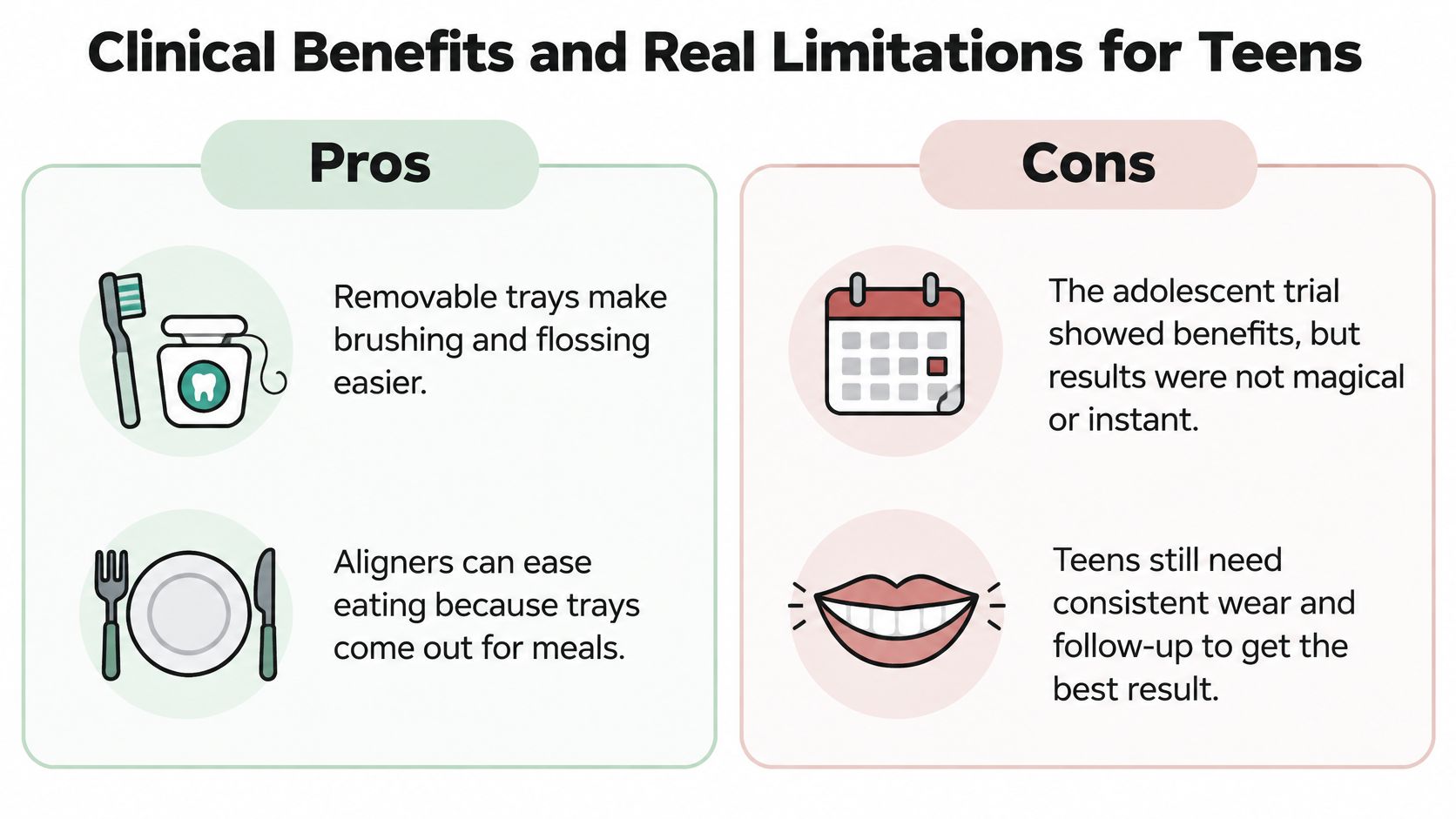
Clinical Benefits and Real Limitations for Teens
It's easy to assume removable trays are healthier in every way because brushing looks simpler. The evidence supports some benefits, but it also shows limits that families should hear before starting. A balanced view helps you protect both the smile and the teeth underneath it.
Removable trays make brushing and flossing easier because there are no brackets in the way. Meals can also feel more normal, since trays come out to eat. For teens who already clean well, that convenience can support better habits during treatment.
What comparative studies found
In a systematic review of clear aligner treatment for teenagers, a 2015 randomized controlled trial included 50 patients aged 10 to 18 years, with 25 receiving Invisalign aligners and 25 receiving traditional fixed braces over 12 months. The aligner group demonstrated better reported oral hygiene compliance, a lower plaque index, and less gingival inflammation than the fixed brace group.
The same review described a 2020 case control study of 72 13 year old patients, with 47 treated with clear aligners and 25 with fixed appliances. Average treatment duration was approximately 24 ± 6 months for aligners compared with 27 ± 5 months for fixed appliances, and the aligner group also showed lower incisor proclination. Those are encouraging findings, but they're not a guarantee for any one teen.
Results depend on the complexity of the malocclusion, adherence to prescribed wear and the clinician's treatment design. Small studies can't prove aligners are superior for every teenager or every orthodontic problem. Selective, professionally supervised use is the safer conclusion.
This short video gives families a visual sense of how aligner treatment is planned and worn day to day.
Where the limits show up
Quality of life findings are less certain. In a systematic review of oral health related quality of life, researchers identified 1,112 initial records but included only two eligible studies, and overall differences between aligners and fixed appliances were inconclusive. There was weak evidence that clear aligner patients may experience less eating disturbance.
Aligners also aren't risk free. In a 2024 study in Orthodontics & Craniofacial Research, approximately 35.5% of adolescents receiving clear aligner treatment in Xi'an, Shaanxi, China, developed white spot lesions during treatment. White spots are early areas of mineral loss on enamel. They are a warning to clean carefully, limit sugary drinks, and keep regular dental visits, not a reason to panic.
Complex bites add another limit. Some rotations, vertical movements and severe bite problems need braces or a combined approach for predictable control. Choosing aligners because they're less visible, when the bite needs fixed mechanics, can lengthen treatment instead of shortening it.
Aligners reduce some risks for motivated teens, but the risks shift toward cleaning and wear rather than disappearing.
Treatment Steps and Timeline From Consultation to Retainer
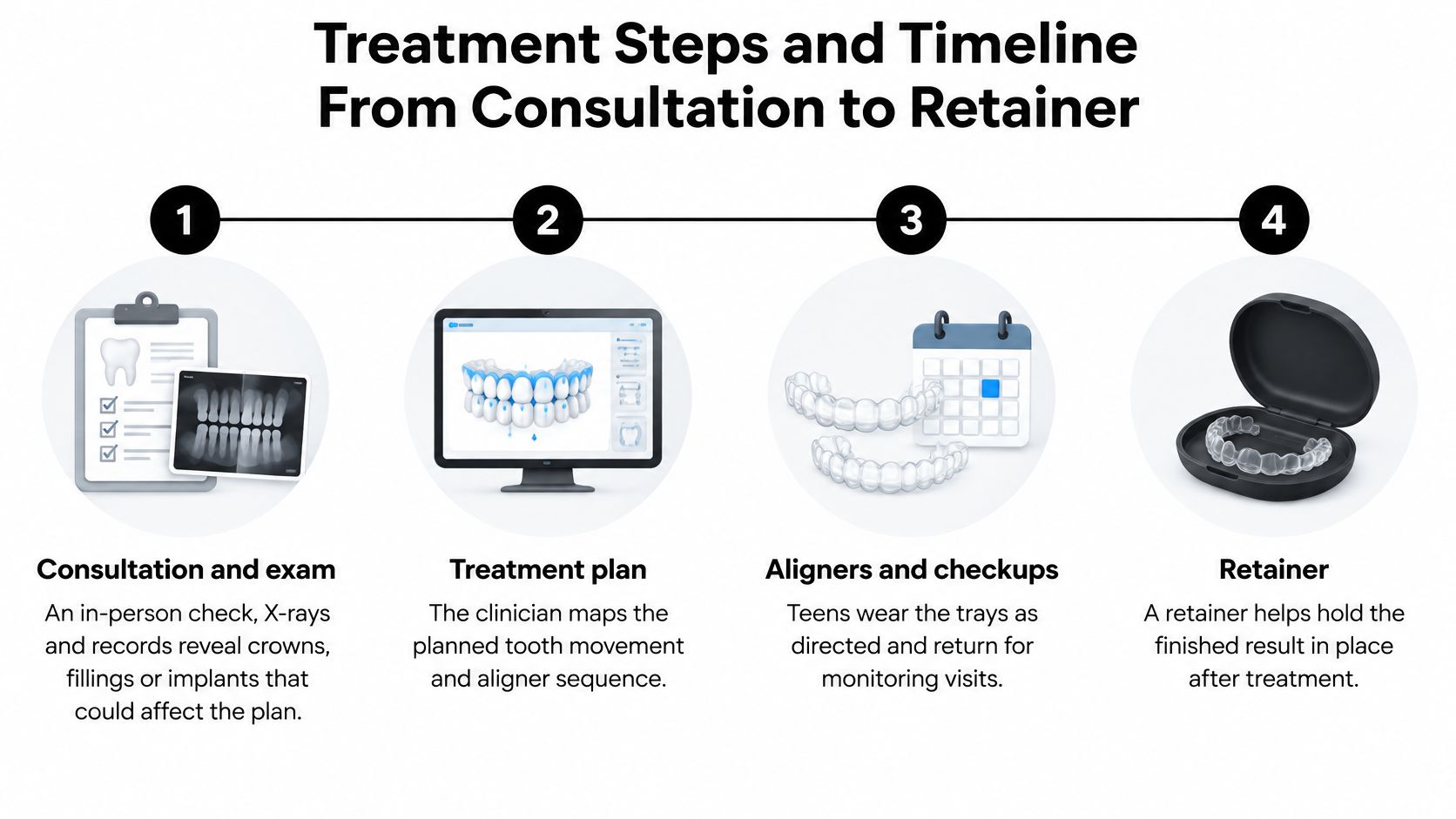
Families often feel calmer once they can see the full path, not just the first tray. The steps below follow a typical supervised course of clear aligners for teens. Your teen's plan may add or reorder parts based on the exam.
The eight stages
- Consultation and exam: We check teeth, gums and bite in person, take dental x rays and records where needed, and look for crowns, fillings or implants that could affect movement. Your teen should expect questions about health history, habits, sports and prior orthodontic care.
- Treatment plan: The clinician maps planned tooth movements, decides where attachments may go, and explains expected duration and limits. This is the time to ask what aligners can correct well and what they may not correct fully.
- Digital scans or impressions: We capture the shape of the teeth so trays can be made to fit. Most teens find scanning quick. The records become the starting point for the tray sequence.
- Fitting and first trays: The clinician checks seating, places attachments if planned, and teaches your teen how to remove and insert trays without bending them. Practice in the chair matters. A tray that isn't fully seated can't deliver the planned force.
- Wear and change: Trays are worn as directed through the day and night and swapped on schedule. Mild pressure during the first days with a new set is common, then it usually eases as teeth settle into that tray.
- Check ins: Regular visits let the clinician confirm teeth are tracking with the plan, review cleaning, and check attachments and gum health. Bring the current trays, the previous set if advised, and any notes about missed hours or discomfort.
- Refinements: If movement drifts from the plan, extra trays may be ordered. Refinements aren't failure. They're a course correction, especially when a tooth lags or wear has been inconsistent.
- Retainers: After active movement ends, retainers hold the result while surrounding tissues stabilize. Skipping retainers can allow teeth to shift back, even after months of good aligner wear.
What a good first month feels like
Trays should feel snug at first, with pressure that's noticeable but manageable. Speech may sound slightly different for a few days. Your teen should be able to remove and reinsert trays for meals and brushing without forcing them, and the edges shouldn't cut the cheeks or gums.
Total time varies with case complexity, growth, wear and whether refinements are needed. Longer cases can extend across many months, so families should plan around school terms, sports seasons and travel rather than expecting a quick cosmetic fix. That same long view applies to other care, from restorative dentistry to dental implants for adults. For searches like dental implants near me, the principle is identical. A staged plan with review visits protects the result.
Report problems early instead of waiting for the next tray. Call if a tray cracks, an attachment feels loose, a tray won't seat, pain sharpens instead of easing, or gums stay swollen. Early review often prevents a small fit issue from becoming a longer delay.
Daily Wear Time and Care Habits That Keep Teens on Track
The daily target is where good intentions meet real life. Pediatric literature summarized in a review of clear aligner adherence in teenagers commonly specifies approximately 20 to 22 hours of daily wear, with removal limited mainly to eating, drinking anything other than water, and oral hygiene. Insufficient wear reduces cumulative force and can cause tracking loss, prolonged treatment or the need for refinement aligners.
That review also notes that reported wear frequently exceeds objectively measured wear, and one cited study found that only 36% of patients achieved the recommended daily wear time. This isn't mainly a character issue. School, sports, meals, social events and simple forgetfulness all eat into the day, and teens can overestimate wear without meaning to mislead anyone.
Missed hours matter because teeth can rebound toward previous positions. A tray that no longer seats properly may also apply forces that differ from the programmed movement. The fix starts with a routine tied to events your teen already does, not willpower alone.
Build the routine around meals and brushing
Use the same sequence every time. Remove trays, place them straight in a case, eat, brush teeth, rinse and gently clean trays as directed, then reinsert. Our step by step guide on how to clean Invisalign aligners safely can help your teen avoid harsh products or hot water that may distort plastic.
Never wrap trays in a napkin or tissue. That's how they get thrown away in cafeterias. A hard case in the lunch area, and a spare case in the school bag, removes the most common excuse for leaving trays out.
Wear and removal rules for common teen situations
| Situation | Wear or removal rule | What to do |
|---|---|---|
| Meals and snacks | Remove aligners to eat | Store in the case and brush before reinserting |
| Plain water | Drinking water is fine with aligners in | Keep wear time unbroken |
| Sugary or acidic drinks | Remove aligners first | Brush or rinse, then reinsert |
| Brushing and flossing | Remove aligners for brushing and flossing | Clean trays as directed and never wrap them in tissue |
| Sports and contact activities | Trays usually come out for practice and games | Ask the clinician whether a mouthguard is needed |
| Missed wear hours | Reported wear often runs higher than measured wear | Put trays back in, log the gap and tell the clinician |
| Lost or cracked tray | Wear the previous tray if it is still usable | Call the provider the same day for a replacement |
Make honesty easier than guessing
A phone reminder after lunch helps during the highest risk gap in the school day. A simple wear log, even a notes app entry with out and in times, gives the clinician useful information at each visit. Parents can help most by checking the routine, not interrogating the teen. Ask whether the case, toothbrush and reminder are in place.
Sugary or acidic drinks deserve special care. Liquid trapped beneath a tray sits against enamel, which can increase caries risk. Water with trays in is fine. Soda, sports drinks and juice call for removal, then brushing or rinsing before trays go back in.
If hours are missed, reinsert trays as soon as your teen notices and write down the gap. Don't jump ahead to the next tray to catch up. Tell us at the next check in, or sooner if the tray no longer fits. A short delay handled early is easier to correct than weeks of quiet drift.
Red Flags and Questions to Ask Before Starting
Some discomfort is expected when a new tray starts moving teeth. Certain signs shouldn't wait until the next routine visit. Call promptly if pain doesn't ease after the first few days with a new tray, a tray no longer seats, plastic cracks, an attachment feels loose, gums swell or bleed persistently, or teeth stop moving as expected.
A tray that pops off one side, leaves a visible gap over a tooth, or suddenly feels much looser can signal tracking loss. Continuing to the next set on schedule may widen that gap. Keep the previous tray available if we advise it, and let the clinician check fit.
Why supervision isn't optional
Clear aligners for teens are prescription medical devices that should be planned and monitored by a licensed dentist or orthodontist. The U.S. Food and Drug Administration page on clear dental aligners states that clear aligners sold directly to consumers without professional supervision are not authorized. Unsupervised treatment may increase the risk of uneven bites, unintended tooth movement, pain, worsening misalignment, and even tooth loss.
An in person examination also identifies existing conditions that affect planning, including crowns, fillings and implants. For families searching for a dentist in Las Vegas, NV, that exam is where we determine whether aligners are appropriate, explain limits, and schedule follow up visits to confirm teeth and bite are progressing safely. The same in person principle applies when someone needs an emergency dentist, a tooth extraction, or other urgent care. A remote photo can't replace a clinical exam.
Questions that reveal the real plan
- Wear monitoring: How will you check whether trays are being worn enough?
- Missed hours: What should we do after a long gap, and when should we call?
- Making up time: Can extra wear fully compensate for missed hours? Usually it can't undo repeated shortfalls, so ask how we would adjust timing instead.
- Changing course: At what point would repeated low wear lead you to recommend braces?
- Retention: What retainer schedule follows active treatment, and what happens if a retainer is lost?
Teen specific adherence evidence is still limited, so a good clinic should explain its own monitoring and thresholds clearly. Ask how often fit is reviewed, how refinements are decided, and who your teen should contact between visits.
A plan that is not moving teeth as expected is a signal to review, not to wait.
Cost, Insurance and Payment Options for Teen Aligners
Parents often ask for one price before an exam. A responsible estimate needs the exam first, because cost depends on case complexity, tray count, treatment length, attachments, refinements and retainers. A short case with few trays shouldn't be priced like a longer bite correction, and a low headline fee may exclude items your teen will still need.
Ask for an itemised written estimate before you say yes. Use this checklist and request each answer on paper.
- Total fee: What's included, including number of trays and planned treatment length?
- Attachments: Are bonding visits and any extra attachment appointments included?
- Refinements: Are refinement trays included or billed separately, and under what conditions?
- Replacements: What does a lost or cracked tray cost?
- Retainers: What's charged after active movement ends, including replacement retainers?
- Longer treatment: What happens financially if treatment runs longer than planned?
- Check ins: Which monitoring visits are included in the fee?
Insurance, savings accounts and monthly payments
Many dental plans include an orthodontic benefit with a lifetime maximum, a waiting period and a percentage paid. Those details vary by plan and by age eligibility, so ask the office to verify benefits before starting. Bring your insurance card to the consultation so estimates use your actual coverage, not a generic assumption.
Health savings accounts and flexible spending accounts can often be used for eligible orthodontic care. Your plan administrator can confirm eligibility and documentation. Keep the written treatment plan and receipts together in case substantiation is requested.
Payment approaches may include upfront payment, monthly plans or financing. Compare the total cost and what's included, not only the monthly payment. A lower monthly figure stretched over a longer period, or a quote without supervision and check ins, can cost more overall.
Planning tools also help families compare the design side of cosmetic care. If you're reviewing broader smile planning for yourself while your teen starts aligners, you can compare digital smile design planning fees from 3D DDS as background before discussing cosmetic dentistry, teeth whitening or other options with us. For teen aligners, the lowest quote can become the expensive route when monitoring, refinements or retainers are missing.
Frequently Asked Questions About Teen Clear Aligners
Will clear aligners affect how a teen speaks
Most teens notice a slight lisp for a few days after starting. The tongue needs time to adjust to the thin plastic, especially on sounds that touch the front teeth. Speech usually returns to normal as your teen talks, reads aloud and gets used to the trays. If speech still feels difficult after the adjustment period, mention it at the check in so we can review fit.
Can a teen switch from braces to aligners partway through treatment
Sometimes, but only if the clinician confirms the remaining movement suits trays. Early braces may handle complex movement first, then aligners may finish simpler alignment in some cases. The switch is decided after an exam and records review, not by preference alone. Don't remove or alter any fixed appliance at home while waiting for that decision.
Are there age limits for starting
There's no single birthday that makes aligners right. Timing depends on remaining growth, which permanent teeth have come in, bite development and the teen's ability to manage daily wear. We treat patients of all ages, and the consultation is where we decide whether to start now, monitor growth, or choose another orthodontic path.
Do aligners need to be worn at night
Yes. The daily target includes sleep, so trays go back in after the bedtime brushing routine. Night wear provides a long, uninterrupted block of force, which helps make up the hours needed each day. Removing trays overnight leaves too few waking hours to reach the target reliably.
Each answer still depends on your teen's mouth. Bring these questions to the consultation, and we'll confirm what applies rather than relying on general online advice.
Schedule a Teen Aligner Consultation in Las Vegas
Wondering whether your teen is ready for clear aligners, or only ready on paper? Two things have to line up. A clinician confirms the bite suits trays, and your teen can wear them for the hours the plan needs, including the hours that get lost at lunch, practice, and in the car. Families often hear "I had them in all day" when those breaks cut the total. If the bite or that daily habit is uncertain, a consultation can still point to a better route, such as braces or waiting until growth and routines are steadier.
Aspiring Smiles Dental and Braces is located at 3211 N Tenaya Wy Suite 122, Las Vegas, NV 89129. The practice accepts new patients, and you can schedule by calling 702-508-6699 or requesting an appointment online. Same day appointments are available, which helps when you want guidance before a sports season or a school break. Invisalign dentist services are part of care for patients of all ages.
What the first visit is for
The consultation is a chance to match the bite, your teen's habits, and your family's schedule before anyone commits to trays. You can talk through goals, what aligners can and cannot do, and how missed hours change the plan. If aligners are not a fit, the conversation can turn to other options, without pressure to start.
Aspiring Smiles Dental and Braces is a Las Vegas family practice that treats patients of all ages and serves families across the city. Whether you searched dentist near me, cosmetic dentist near me, or clear aligners for teens, the visit centers on clear communication and a plan your family can follow on a school day, not only on a quiet weekend.
Bring questions, your teen's school and sports schedule, and your insurance card. The schedule shows the gaps: lunch, practice, travel, and other times trays come out. Those gaps are where reported wear and actual wear usually split. The card gives you a starting point to discuss insurance acceptance, financing plans, cash or credit card payment, and the membership program before you decide.
Call 702-508-6699 to schedule a teen aligner consultation. Bring your teen's questions and your own.
A straighter smile is the aim, but a healthy bite, clean teeth, and a wear routine your teen will keep matter more.
Aspiring Smiles Dental and Braces offers Invisalign clear aligner care for teens and adults in Las Vegas, with personalized treatment planning and regular check-ins so families can track wear and tooth movement together. If you want to find out whether aligners suit your teen's bite and daily routine, visit Aspiring Smiles Dental and Braces to request a consultation and start with honest, practical guidance.