
Invisalign vs Braces for Adults: Which Is Better?
Invisalign vs braces for adults comes down to your bite, your budget and how reliably you can wear trays. Invisalign uses clear, removable aligners that are worn 20 to 22 hours a day and often finish in 12 to 18 months. Traditional braces are fixed to your teeth, often take one to three years and handle more complex bites. Typical costs run about $3,000 to $8,000 for Invisalign and $4,200 to $6,600 for metal braces.
This guide compares braces vs Invisalign side by side on looks, comfort, speed, cost, eating and results, then gives you five questions to decide whether Invisalign or braces is better for you. It answers the questions adults search most, such as how long Invisalign takes and what each costs. It is written for adults who are thinking about straightening their teeth in Las Vegas. If you want to look at one option first, see our pages on Invisalign and clear aligners, or the shorter Invisalign vs traditional braces overview.
Quick answer: Choose Invisalign if you have a mild to moderate case, want a discreet look and will wear your trays all day. Choose braces if your bite is complex or you know you would not wear removable trays. A dentist should confirm which fits your teeth.
Invisalign vs braces at a glance
Both options move teeth with steady pressure over time. The main differences are how they are worn and what they can handle. The American Association of Orthodontists (AAO) says neither appliance is inherently better: the right one depends on your treatment goals and your lifestyle.

| Invisalign (clear aligners) | Traditional metal braces | |
|---|---|---|
| Look | Nearly invisible | Visible brackets and wires |
| Removable | Yes, for meals and cleaning | No, fixed to your teeth |
| Typical time | 12 to 18 months | 1 to 3 years |
| Typical cost | $3,000 to $8,000 | $4,200 to $6,600 (up to about $10,000) |
| Eating | No food restrictions while trays are out | Avoid hard, sticky and chewy foods |
| Cleaning | Brush and floss normally, clean the trays | Needs extra care around brackets and wires |
| Best for | Mild to moderate cases, motivated patients | Complex bites, severe rotations, patients who forget trays |
| After treatment | Retainer needed | Retainer needed |
Not sure which group you are in? Call Aspiring Smiles at (702) 508-6699 or request an appointment online and we will check your bite and explain both options.
How Invisalign and braces work
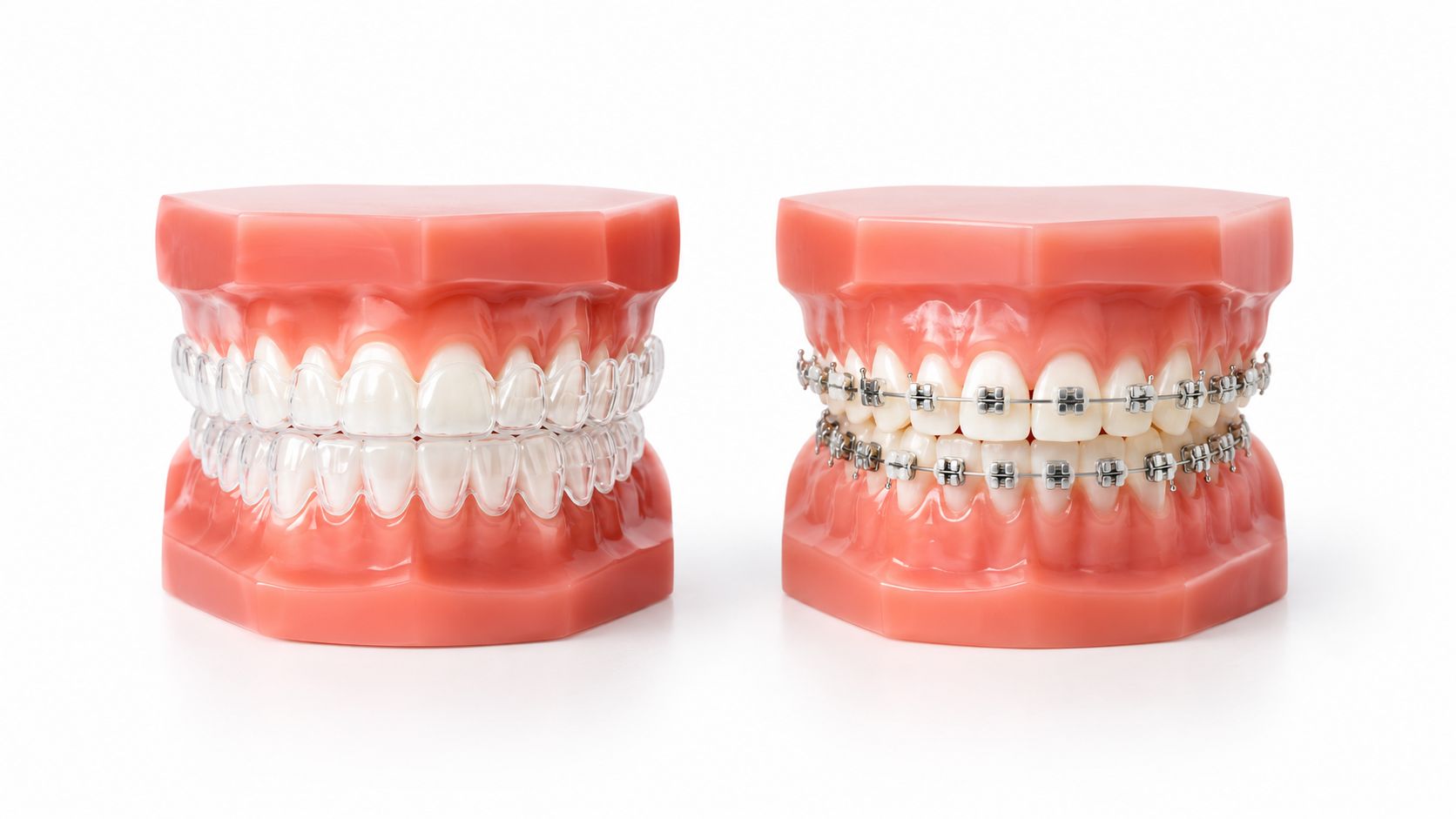
Braces use brackets bonded to your teeth and a wire that your dentist adjusts, usually every few weeks, to guide teeth into place. The American Dental Association says the brackets can be metal or tooth-colored, and sometimes they are placed behind the teeth. Invisalign uses a series of custom clear trays. You switch to a new tray every week or two, and each one moves your teeth a little further. Small tooth-colored bumps called attachments may be bonded to some teeth to help the trays grip.
A review that pooled several studies found that both approaches were effective at treating bite problems. It also found clear aligners were less effective than braces at some jobs, such as creating good contact between the upper and lower teeth, controlling the tilt of the tooth roots and widening the arch. Aligners performed better at moving some teeth in segments, and they shortened treatment time. That is why a case with severe rotations or a big bite problem is often handled with braces.
Invisalign vs braces cost for adults
Price is the question most adults ask first. Typical US prices without insurance are shown below, but your quote depends on how much movement you need and how long treatment takes.
Many dental plans that cover orthodontics pay a lifetime maximum, often up to about $3,000, toward braces or aligners. Coverage is more common for children than for adults, and some plans do not cover orthodontics at all, so check your benefits before you start. If you want to spread payments out, read about our dental payment plans.
When you compare quotes, the monthly payment is not the whole story. Use these questions to compare like with like.
| Ask your dentist | Why it matters |
|---|---|
| What is the total fee to finish treatment? | Some quotes leave out refinements, retainers or replacement aligners. |
| What happens if my teeth need extra movement? | Refinement trays or extra months can change the price and the timeline. |
| Who will treat me and how often are the visits? | The skill of the provider matters more than the appliance. |
| What retainers are included and how long do I wear them? | Every patient needs retainers after treatment. |
| What does my insurance pay toward orthodontics? | Many plans pay a lifetime maximum, and coverage is more common for patients under 18. |
Practical rule: Compare the total cost to finish treatment and get your retainers, not just the monthly payment.
How long does Invisalign take compared with braces?
Invisalign often takes 12 to 18 months and braces often take one to three years, and the ADA says most people with braces are in treatment for one to three years. Neither comes with a guaranteed timeline. Aligners can only keep their schedule if you wear them 20 to 22 hours a day, taking them out to eat, drink anything besides water, and brush. Braces work all day whether you remember them or not.
Comfort, eating and daily life
Expect some soreness with both. It is usually strongest in the first few days and after each new tray or adjustment. Braces can also irritate your cheeks and lips until you get used to them. With aligners you can eat what you like, but you must brush your teeth before putting the trays back in so food does not get trapped against your teeth.
Cleaning and food rules for Invisalign and braces
Both options need a good brushing and flossing routine, because plaque builds up where teeth are hard to reach. The ADA warns that sugary foods can cause plaque buildup around brackets that can permanently stain or damage teeth, and it lists popcorn, corn on the cob, chewing gum, whole apples and other sticky foods as foods to avoid with braces. The AAO adds that aligner wearers should clean their teeth before putting aligners back in and avoid drinking soft drinks, flavored waters or sports drinks while the aligners are in.

Which is better for adults? Five questions to decide
Use these questions as a starting point for your consultation.
When braces are usually the better choice
Dentists often recommend braces for severe crowding or spacing, teeth that need to rotate a lot, large overbites or underbites, and cases where precise control of tooth roots matters. Braces are also a good fit if you know you would struggle to wear trays all day. Some adults choose ceramic braces, which use tooth-colored brackets, to make braces less noticeable, though they tend to cost more than metal.
Who should treat you: a dentist or an orthodontist?
The ADA says braces can be provided by a general dentist or by an orthodontist, a dentist who specializes in diagnosing and treating dental and facial irregularities. The right choice depends on the dentist's orthodontic experience and how complex your case is. The AAO also stresses that an evaluation with x-rays, photos and models comes first, and that the skill of the provider matters more than the type of appliance.
Why does it matter to fix a bad bite at all? According to the ADA, untreated bite problems can lead to tooth decay, gum disease, tooth loss, speech or chewing problems, abnormal enamel wear and jaw problems. Straightening is about health as well as looks.
Retainers: what happens after treatment
The finish line is not the end. The AAO says all patients need to wear retainers after treatment, whether they had braces or aligners, and the ADA says treatment is followed by a retainer to hold the teeth in their new positions.
What to do before you start
Your teeth and gums need to be healthy before they move. A dental exam and X-rays should come first, and any cavities or gum disease should be treated. Ask your dentist to explain the diagnosis, the likely time frame, the full cost and what happens after treatment. If you also have crowns or missing teeth, ask how they affect the plan, and ask about how well Invisalign works for your type of case. Parents comparing options for a child can read about Invisalign for teens.
When to call your dentist
Most discomfort is part of normal treatment, but some problems should not wait. Our emergency dentist page explains when to go now.
Frequently asked questions
1Is Invisalign better than braces for adults?
2How much does Invisalign cost compared with braces?
3How long does Invisalign take compared with braces?
4Can adults get braces?
5Does insurance cover Invisalign and braces?
6Which hurts more, Invisalign or braces?
7Can Invisalign fix an overbite as well as braces?
8Do I need a retainer after Invisalign or braces?
Still comparing? Call Aspiring Smiles at (702) 508-6699 or request an appointment online to talk through your options.
Next steps in Las Vegas
The right choice depends on your teeth, so start with an exam. Call Aspiring Smiles Dental and Braces at (702) 508-6699 or request an appointment online. We are at 3211 N Tenaya Wy #122, Las Vegas, NV 89129, open Monday to Saturday, 9:00 a.m. to 5:00 p.m. Learn more about Invisalign in Las Vegas and our Invisalign or braces guide.
This article is general information and does not replace advice from your dentist or orthodontist. Costs are typical ranges and vary by case and office. Written by the Aspiring Smiles Dental Team. Last updated November 18, 2026.
Sources: American Association of Orthodontists: braces vs clear aligners; American Dental Association (MouthHealthy): braces; Ke et al., BMC Oral Health 2019: clear aligner vs fixed appliance effectiveness (PubMed); NewMouth: Invisalign vs braces cost (citing the ADA Survey of Dental Fees); Invisalign: comparing the cost of Invisalign vs braces.