All on 4 Dental Implants Financing
If you're searching for all on 4 dental implants financing in Las Vegas, the most popular advice is often the least useful: focus on the lowest monthly payment. A small payment can make treatment appear affordable while interest, long repayment terms, excluded procedures, and future prosthetic work increase what you ultimately pay.
At Aspiring Smiles Dental and Braces, patients considering dental implants near me, a dentist in Las Vegas, NV, or full-arch restoration deserve a clearer calculation. All-on-4 combines four strategically positioned implants with a fixed, full-arch prosthesis, so the financial decision involves surgery, temporary teeth, the definitive restoration, maintenance, and the credit agreement. A careful consultation should protect both your smile and your household budget.
Understanding the True Cost of Full Arch Restoration
A full-arch treatment estimate should never be reduced to four implant fixtures. All-on-4 commonly uses tilted posterior implants to make better use of available bone and may reduce the need for grafting, but your final plan still depends on anatomy, periodontal health, smoking, systemic conditions, bone volume, prosthetic design, and maintenance needs. The All-on-4 treatment cost guide can help you begin the conversation, but only an examination and individualized estimate can define your actual balance.
A 2021 CareCredit guide reported an average U.S. All-on-4 treatment cost of $15,176, while emphasizing that this isn't a universal price. Diagnostic imaging, extractions, bone grafting, sedation, temporary teeth, the final prosthesis, laboratory fees, geographic market, and whether one or both arches are treated can all change the charge. Some dental insurance plans classify implants as elective and may exclude the implant portion, although a plan may contribute toward a crown or related restorative component. CareCredit's All-on-4 cost and financing guide explains why the advertised treatment price and the amount financed aren't always the same.
Separate the clinical estimate from the credit agreement
Ask for two documents. The first should describe the care itself, including:
- Diagnostics: Imaging, examinations, and treatment planning.
- Surgical care: Extractions, implant placement, grafting, and sedation.
- Provisional teeth: The temporary fixed prosthesis and adjustment visits.
- Definitive restoration: The final bridge, abutments, laboratory charges, and delivery.
- Aftercare: Follow-up appointments, repairs, maintenance, and warranty terms.
The second document should describe the financing. It should show the deposit, insurance contribution, financed balance, annual percentage rate, origination or account fees, promotional expiration date, monthly payment, repayment period, and total repayment amount.
Practical rule: Compare the total amount you'll repay, not just the payment shown beside the application button.
The clinical history also matters. Nobel Biocare reports that Paulo Malo developed the protocol with Bo Rangert, treated the first patient included in the initial scientific study in 1998, published the first retrospective clinical study with colleagues in 2003, and launched the concept commercially in 2004. The related study followed 44 patients and 176 implants for two years, reporting a cumulative implant-survival rate of 96.7% in that specific group. Longer-term evidence summarized by Nobel Biocare reports survival rates up to 17 years of 97.5% in the maxilla and 96.9% in the mandible among a 173-patient cohort treated between 2004 and 2009. These figures describe clinical outcomes in defined studies, not a financial guarantee or promise for every patient. Nobel Biocare's All-on-4 clinical history provides that context.
Implant survival also doesn't mean the attached teeth are maintenance-free. A systematic review reports approximately 99.0% mean cumulative implant survival at 36 months, while noting limitations in long-term evidence and study quality. The NCBI evidence summary supports separating the initial surgical and prosthetic phases from foreseeable repair or replacement costs.
Navigating Dental Insurance and Coverage Limits
Insurance usually enters the process before financing, but many patients reverse that order. They see a plan promising a percentage toward major dental care, assume the same percentage applies to the entire All-on-4 episode, and only later discover that the annual maximum, waiting period, or exclusions limit the actual payment.
The phrase “50% covered” doesn't mean the insurer will pay half of your complete treatment. An annual maximum can cap the benefit, and surgical placement, abutments, prosthetic teeth, extractions, grafting, imaging, sedation, and maintenance may be billed as separate components. Some plans may cover a crown or restorative portion while excluding the implant itself. This dental insurance overview explains why patients should analyze eligible components rather than rely on a headline percentage.
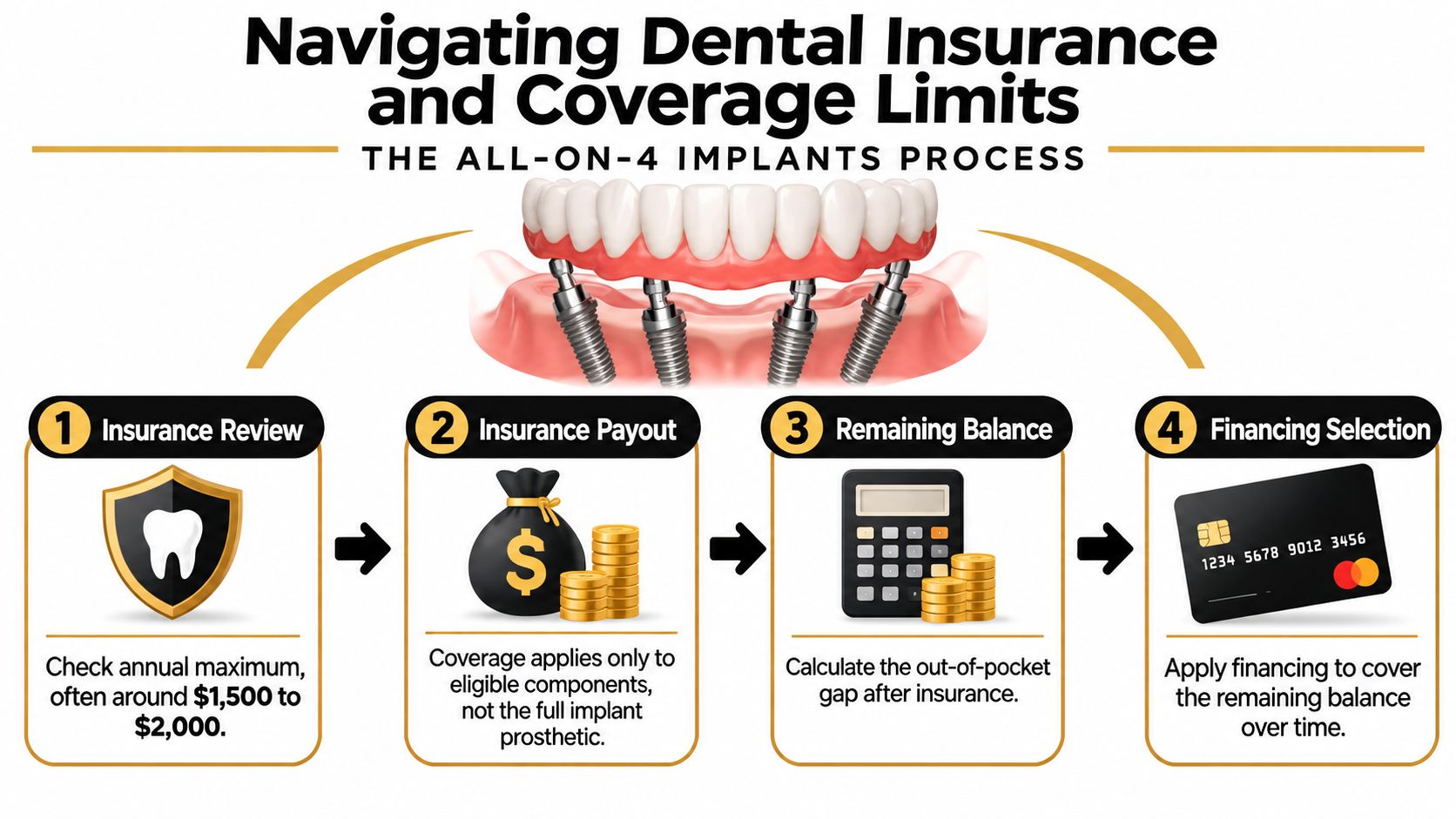
Use a procedure-by-procedure worksheet
Request a written predetermination and ask the insurance coordinator to map each part of treatment:
- Insurance review: Confirm the annual maximum, deductible, waiting periods, exclusions, and benefit-year dates.
- Eligible components: Identify whether the plan contributes toward extractions, grafting, temporary teeth, the final prosthesis, or another restorative service.
- Expected payment: Record the negotiated fee, covered amount, and remaining balance for every procedure.
- Financing balance: Apply savings, HSA or FSA funds, and confirmed insurance benefits before choosing a loan amount.
Dental insurance, medical insurance, HSA or FSA funds, discount plans, and promotional credit aren't interchangeable. Ask which account can legally or practically be used for each charge, and confirm whether reimbursement arrives before your payment is due.
Buying implant insurance immediately before treatment may not improve affordability. A waiting period can postpone benefits, while the annual maximum may prevent meaningful first-year assistance even after eligibility begins. Patients near our Desert Shores and Sun City Summerlin service areas should compare the cost of starting care now with the cost of waiting for benefits to renew, based on clinical urgency and the written insurance response.
For a visual explanation of how insurance and financing interact, review the video below.
Comparing Third Party Loans and In Office Payment Plans
Once insurance is applied, patients generally compare a third-party medical or dental loan, promotional credit, or an in-office arrangement. Each option can work, but none should be judged by monthly payment alone. The agreement's annual percentage rate, fees, repayment length, promotional rules, and consequences of missed payments determine the actual overall cost.
A third-party loan may provide a clear fixed schedule and a longer repayment period. That can help a patient manage a large balance, but a longer term usually means more interest over time. Promotional credit may offer a temporary low-interest or deferred-interest period, but the balance-due date matters. If the promotional rules aren't satisfied, interest can affect the balance under the credit agreement. An in-office plan may offer a direct relationship with the practice, but availability, down payment requirements, treatment staging, and missed-payment policies vary.
| Financing Type | Interest Structure | Best For |
|---|---|---|
| Third-party medical or dental loan | Fixed or variable terms, with possible interest and fees | Patients who want a defined lender schedule |
| Promotional credit | Promotional terms that may change after expiration or under deferred-interest rules | Patients who can meet the balance deadline |
| In-office payment plan | Practice-specific terms, deposits, and payment schedule | Patients seeking a direct office arrangement |
| Savings combined with smaller financing | No interest on the savings portion, lender terms on the remainder | Patients who want to reduce the amount borrowed |
A published patient example involved approximately $27,000 for treatment involving both arches, financed at about $490 per month over eight years. Multiplying that payment by 96 months produces approximately $47,040 before any deposit, fees, or changes in the quoted balance. This dental financing example shows why the monthly figure can conceal a substantially higher repayment total.
Read the promotional language before accepting
Look for the exact promotional expiration date, the amount due by that date, the annual percentage rate after the promotion, origination or account fees, late-payment consequences, and prepayment policy. Ask whether a missed payment changes the interest terms and whether the lender finances only the initial procedure or also medically necessary revisions.
Patients researching payment structures for elective procedures can also review this payment plans for facelift and mommy makeover resource to see how financing discussions commonly separate treatment cost, repayment terms, and approval requirements. The clinical services differ, but the budgeting principle is similar.
For local patients comparing options, Aspiring Smiles Dental and Braces provides information about dental payment plans so you can discuss available arrangements alongside the clinical estimate, rather than treating financing as an afterthought.
Calculating Monthly Costs and Qualifying for Approval
The monthly payment is not the number that protects you. The numbers that matter are the amount you need to finance, the full repayment over time, and what happens if insurance pays less than expected or pays later than expected.
Start with the full treatment estimate. Then subtract only confirmed insurance benefits, your deposit, and any savings you are comfortable using without emptying your emergency cushion. If your plan has an annual maximum, a waiting period, or missing implant benefits, treat anything uncertain as your responsibility until the insurer confirms it. A practical formula is Amount to finance = complete treatment estimate minus confirmed benefits, deposit, and available savings.
That financed amount should reflect more than the surgery date. Include known surgical and prosthetic charges, and leave room in your budget for maintenance visits, professional implant cleanings, bite adjustments, and possible prosthetic repairs. All-on-4 treatment can perform well over time, but follow-up needs still carry real costs. A systematic review reported pooled implant survival of 98.14% at five years or longer, with mechanical complications around 5.91% and biological complications around 6.54%. The PubMed review helps explain why good clinical outcomes and careful financial planning need to go together.
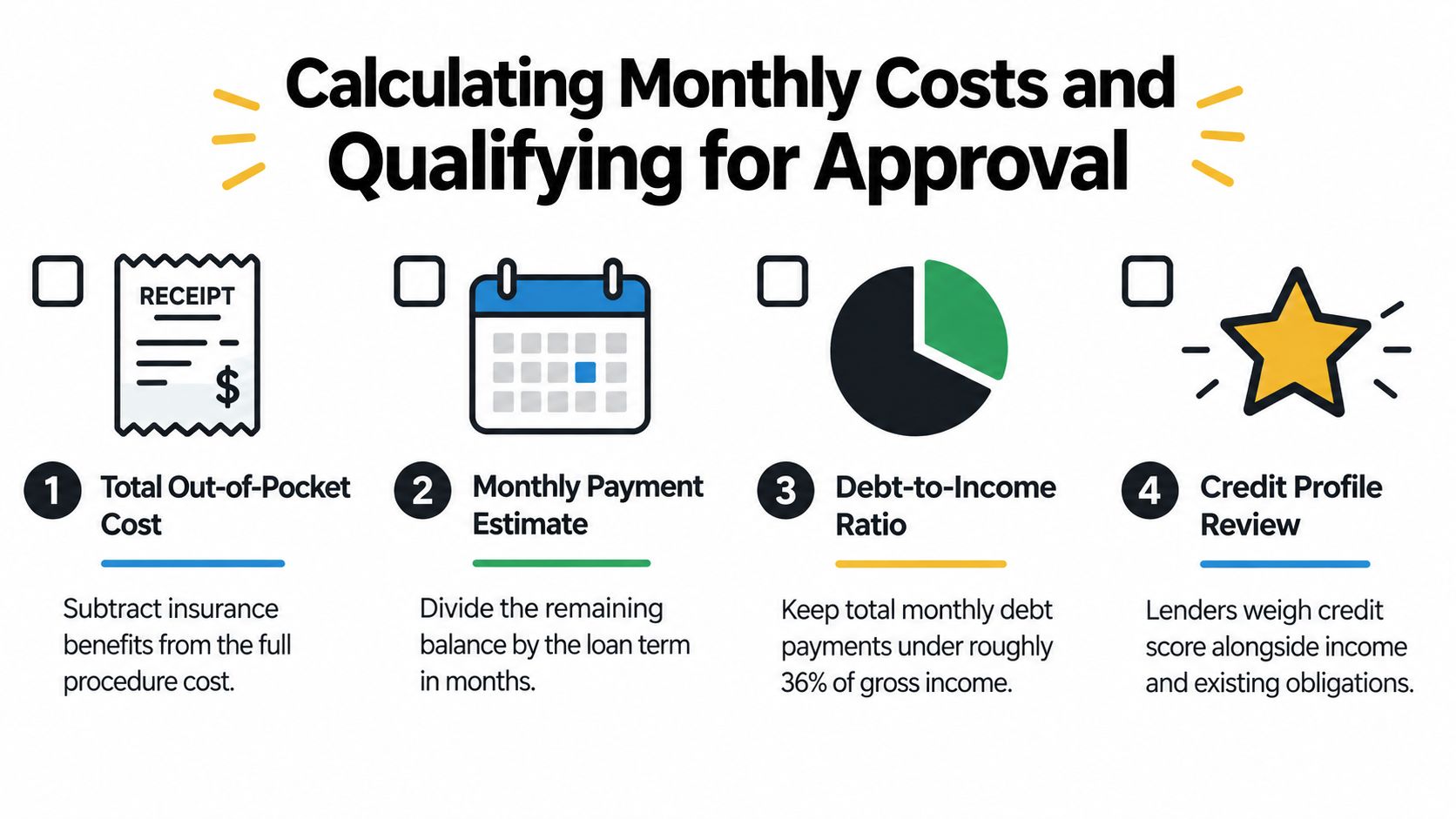
Build a payment that remains manageable
Before you apply, gather proof of income, list your fixed monthly obligations, and check your credit reports for errors. Lenders look at approval. You need to look at durability. A payment can fit on paper and still become a problem if a temporary set needs repair, your insurance benefit resets slower than expected, or another household expense shows up at the wrong time.
Medical and dental debt are already straining many households. 41% of U.S. adults reported some form of health care debt related to medical or dental bills, and 26% reported bills that were past due or they could not pay, according to KFF's medical debt polling. Approval does not equal affordability.
If you do not qualify for the full amount, ask whether treatment can be staged safely. For some patients, that may mean one arch first, a smaller loan combined with savings, or implant-supported dentures. The sequence has to be clinically sound first.
For help comparing repayment paths after you know the total financed amount, review the Toya AI debt payoff strategy guide. Use it to compare payoff scenarios, then confirm the actual payment, interest, fees, and contract terms in writing before you sign.
Your Local Partner for Comprehensive Implant Care
A financing plan is only as reliable as the treatment estimate underneath it. At Aspiring Smiles Dental and Braces, Dr. Patel's consultation process begins with an examination of your teeth, gums, bite, medical history, and goals. When appropriate, advanced 3D imaging helps the team assess bone anatomy and plan implant placement before discussing a fixed full-arch restoration.

What the consultation should answer
A patient should leave knowing what happens first, what happens later, and what each stage costs. The conversation may include:
- Clinical eligibility: Bone volume, gum health, remaining teeth, bite forces, smoking status, diabetes control, and hygiene access.
- Treatment sequence: Extractions, implant placement, temporary teeth, healing, and final prosthesis delivery.
- Material choices: Whether the proposed restoration uses acrylic, composite, ceramic, or another design, and how that choice affects maintenance.
- Financial coordination: Insurance predetermination, confirmed benefits, deposits, financing options, and the amount that remains your responsibility.
A full-arch restoration also requires continuing care. The team can explain cleaning around the prosthesis, professional maintenance, bite checks, and what to do if you notice looseness, persistent discomfort, swelling, bleeding, or a change in your bite.
The Las Vegas office serves patients seeking a dentist near me, a cosmetic dentist near me, restorative dentistry, tooth extraction, emergency dental care, dental x-rays, new patient exams, cleaning and exams, teeth whitening, Invisalign, and dental implants. Patients from Sunhampton, Monterrey, Mar-A-Lago, Painted Desert Estates, Desert Shores, and Sun City Summerlin can request appointments online and discuss ongoing care through available payment options and the practice membership program. Extended weekday and Saturday hours can make consultations and maintenance visits easier to schedule.
Common Questions About Implant Financing and Care
What if I can no longer make the payments?
Contact the lender and dental office promptly instead of waiting for missed payments to accumulate. Ask about hardship policies, balance-due dates, late fees, credit-reporting consequences, and whether the practice can safely pause or stage unfinished treatment. A lender's approval doesn't remove the obligation, and a dental office can't automatically change a separate credit agreement.
Can unused financed funds be refunded?
Ask before treatment begins. Some agreements finance a defined procedure amount, while others may release funds according to the provider's billing process. Confirm whether unused funds can be returned, who receives the refund, how it affects the loan balance, and whether a staged or clinically modified plan changes the contract.
Does implant survival mean I won't have future dental costs?
No. Implant survival measures the implant, not the condition of the attached prosthesis or surrounding tissues. A systematic-review summary reports approximately 99.0% mean cumulative implant survival at 36 months, but it also identifies limited long-term evidence and study-quality constraints. The clinical evidence summary should be read alongside a maintenance plan.
Mechanical and biological complications can occur even when implants remain integrated. Budget for professional cleaning around implants, examinations, occlusal adjustments, hygiene supplies, and eventual repair or replacement of prosthetic components. The material, bite forces, bruxism, hygiene, smoking, periodontal history, and general health all influence the maintenance conversation.
Can I choose a different treatment if All-on-4 isn't financially comfortable?
Ask about clinically appropriate alternatives, not just cheaper versions of the same plan. Depending on your examination, options may include an implant-supported denture, treating one arch first, phased care, or combining savings with a smaller loan. A removable or staged solution may involve different comfort, stability, maintenance, and future-cost trade-offs, so the decision should include both clinical and financial information.
A new patient exam can also identify urgent problems before they expand. If you have severe tooth pain, facial swelling, uncontrolled bleeding, trauma, or a loose restoration, contact an emergency dentist promptly. Tooth extraction, infection control, restorative dentistry, and implant planning may need to occur in a specific order.
What should I bring to my consultation?
Bring your insurance information, medication list, relevant medical history, income documentation if you plan to apply, and a written list of questions. Ask for the full treatment estimate, insurance predetermination, payment schedule, total repayment amount, warranty terms, and maintenance expectations in writing. That preparation lets you evaluate an investment in function and oral health without confusing a low monthly payment with a low total cost.
Aspiring Smiles Dental and Braces provides All-on-4 consultations, dental implants, restorative care, insurance coordination, and financing discussions for patients in Las Vegas, NV. Visit Aspiring Smiles Dental and Braces to request a consultation and review a complete clinical and financial plan with Dr. Patel's team.